


Is This What a Five-Star Safety Rating Looks Like?
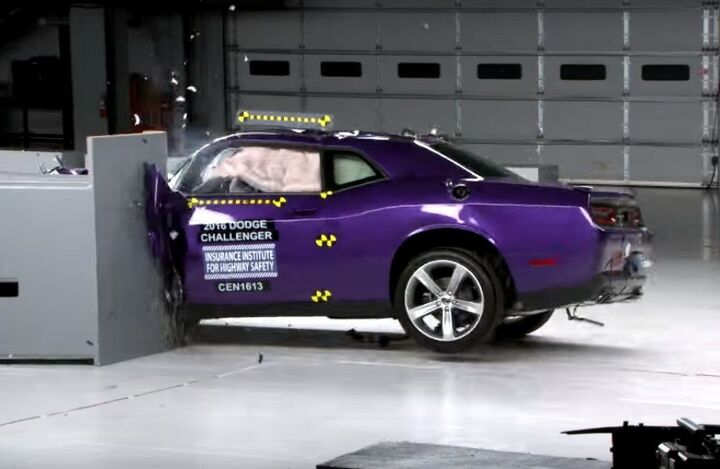
Once again, the National Highway Traffic Safety Administration has handed the Dodge Challenger a five-star safety rating in its annual crash tests.
Shelf space at Fiat Chrysler Automobiles headquarters must be at a premium thanks to all those awards, but does the NHTSA safety rating tell the whole story?
In short — no, it doesn’t.
The NHTSA assigns the 2017 Challenger the same ratings as last year for frontal and side impacts, as well as rollover protection. Not surprising, as the model hasn’t changed in any significant way.
For frontal impacts, the Challenger’s crash performance rates a four out of five, as does its rollover performance. Side impact testing returns a five out of five score. Couple those results with available safety technology and restraints, and the overall score would please any automaker — a boastworthy five out of five stars. You’d go and see a five-star movie, right?
Unfortunately for occupants, the Challenger’s perceived safety depends more on the test than the car. The NHTSA’s frontal test involves a vehicle running straight into a flat barrier at 35 miles per hour. The Insurance Institute for Highway Safety, on the other hand, goes a step further, and the results aren’t good for the Challenger or its front seat occupants.
Earlier this year, the IIHS showed just how bad the 2016 Challenger performed in its dreaded small overlap test. In this test, only 25 percent of a vehicle’s frontal area hits a rigid barrier at 40 mph. The result? A second-worst “marginal” rating, and certain hobbling for the driver or passenger in a real-world crash.
“During the crash, the Challenger’s front wheel was forced rearward into the occupant compartment, and the footwell intrusion trapped the dummy’s left foot and deformed its ankle,” IIHS president Adrian Lund said in a statement.
“Our technicians had to unbolt the dummy’s foot from its leg in order to free it. Entrapment is pretty rare. That’s only happened five other times in a small overlap test.”
The federal government’s side impact test involves both a pole and a ram that mimics another vehicle. Both that test and the independent IIHS test gave the Challenger’s side impact protection top marks. In its moderate overlap frontal test, the Challenger still came out on top. A roof strength test came back as “acceptable,” so not far off from the NHTSA’s four out of five stars.
While the Challenger performs decently in most respects, the NHTSA’s limited testing hides a serious safety issue. Until a small overlap test becomes standard, the five stars results will continue to roll in as IIHS shouts from the sidelines. The NHTSA last updated its ratings in 2010.
With the advent of the small overlap test, criticism of the government’s tests grew. Consumer Reports calls out the frontal test, claiming, “Some automotive experts have criticized NHTSA’s full-frontal, rigid-barrier test as unrealistic because such head-on crashes into a flat, solid wall are relatively rare.”

More by Steph Willems




Comments
Join the conversation
"Earlier this year, the IIHS showed just how bad the 2016 Challenger performed in its dreaded small overlap test." The letters L and Y are your friends, Steph. "Bad" is an adjective, not an adverb.
I drive my Challenger every day, not worrying at all about how it will do in a wreck. I've been in two serious wrecks since I began driving, and both vehicles protected me well, even though they weren't "the best" rated ones available at the time. The Challenger's basic design is over a decade old, so I don't really expect it to be at the top of current safety ratings. I'm planning on buying another one before the new platform is introduced a few years from now, without worrying at all about it's safety ratings.