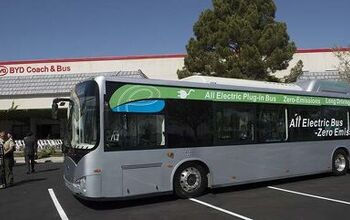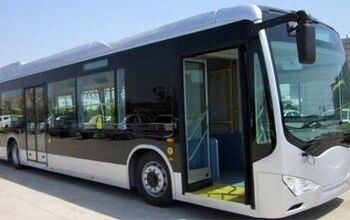
Chinese battery maker and aspiring automaker BYD earned $215m in the fourth quarter of 2009, bringing its net profit for last year to $555.2m, reports Automotive News [sub]. BYD’s performance outstripped analyst estimates, which projected fourth quarter profits of $130.5m, and full-year profits of $473.2m. Though the Chinese auto market grew 46 percent to 1.6m vehicles, 47 percent of BYD’s 2009 sales came from the firm’s cell phone battery business, which is expected to give back recent gains as the global economic crisis takes its toll. Not so with BYD’s auto business: the firm has raised its 2010 car sales projections 14 percent, with sales of 800k foreseen. And as China’s car market takes off, BYD, which has one of the nation’s best-selling cars in its F3 compact, is expected to keep growing. Says one JP Morgan analyst:
BYD is a company that can’t be underestimated. If the Chinese vehicle market expands 10 percent this year BYD’s sales will grow at least 40 percent — 50 or even 60 percent is also a possibility.

There’s plenty of room to question the practices that BYD is riding to success. After all, reliance on reverse-engineering and labor-intensive production will only take the firm so far before it has to join the industry in adopting modern production and development practices. In the meantime, the Chinese firm is building on its domestic-market success by prepping its F3DM hybrid and E6 EV for European and US sales. If those vehicles can make headway in mature markets starting next year in Europe, BYD will be well on its way to becoming a global force in the car business.
And those plans are moving forward rapidly. The LA Business Journal reports that BYD is shopping for North American headquarters in LA County, and could be looking for a production site as well. Portland, Oregon has also been in the running to host BYD’s US operations. With local governments eager to attract “green-collar” jobs, BYD can expect the red-carpet treatment (and hosts of local tax abatements) as they prepare to bring the fight to the US and European markets.
Backed by cash from Warren Buffett and technical cooperation with Daimler and VW, BYD remains the front-runner among Chinese firms who are anxious to back up their domestic-market success with a seat at the table with the global giants. But as with so much that emerges from China, their vehicles are under-tested, and if BYD is pushing for acceptance before its product is ready for prime-time, it could give new life to anti-Chinese-car prejudices. Needless to say, BYD is one of the firms we’ll be watching closely over the next several years.
About those new energy vehicles BYD is announcing: don’t hold your breath. The BYD F3DM was supposed to be the “world’s first mass produced PHEV” way back in December 2008 but few (if any) were ever delivered to customers. According to the Wallstreet Journal the problem is the batteries. Apparently BYD’s labour intensive production methods just don’t get the right quality for large automotive battery packs: http://www.tinyurl.com.au/2r2
theonewhogotaway - The problems with diesels in the US are: a. Generally uninformed and/or biased “average” consumers (and some of them remembere the...
mjz - It is absolutely maddening that Chevy doesn’t offer this new wagon or the hatchback Cruze here. They say that Americans won’t buy either bodystyle,...
hriehl1 - Attempts to avoid “cannabalizing sales” is a very dangerous game. Assume 10 shoppers come into the Chevy store for something like an HHR /...
theonewhogotaway - That’s why you have a retractable cover in a wagon/SUV that can cover your things from view. Most hatches already have that (the rear...
morbo - There is hope yet. My 2011 300C has a submenu in the digital speedometer screen (itself trapped between two oversized and overly useless analog...
darex - There are actually people who are attracted to and seriously considering the Sonic? Really? There’s so much better competition out there. What...
Pch101 - “Many foreign auto makers used inflated HP numbers through 2004 or 2005 IIRC until it was cracked down.” Not really, no. There is no single...
About those new energy vehicles BYD is announcing: don’t hold your breath. The BYD F3DM was supposed to be the “world’s first mass produced PHEV” way back in December 2008 but few (if any) were ever delivered to customers. According to the Wallstreet Journal the problem is the batteries. Apparently BYD’s labour intensive production methods just don’t get the right quality for large automotive battery packs: http://www.tinyurl.com.au/2r2
Gotta love the BMWesque BYD logo.
http://img89.imageshack.us/img89/2780/dashnl3.jpg
http://37signals.com/svn/archives2/chinese_logo_lookalikes_bmw_and_byd.php
It has been changed since.