


Inspector General Confirms EPA Broke Law, Failed to Study Environmental Impact of Ethanol

According to the U.S. Environmental Protection Agency’s inspector general, the Obama Administration has failed to live up to its legal obligation to study the environmental impact of blending ethanol with gasoline.
Those findings, the result of an inspector general audit, confirm what the Associated Press reported back in late 2013, prompting the audit.
In 2007, Congress passed the Energy Independence and Security Act, which was and signed into law by Pres. George W. Bush. Among other things, the 2007 legislation increased the Renewable Fuel Standard that mandated biofuel production, primarily ethanol, and the blending of at least some of that ethanol into the gasoline supply.
The law also stipulates that the U.S. EPA must conduct studies every three years and report to Congress on the air and water quality benefit, or lack thereof, by adding corn-based ethanol to gasoline. The purpose of that part of the law is to make sure solutions to the country’s energy needs don’t adversely affect the environment.

Kitman Begins His Literary Quest to Find the Truth About Ethanol

One struggles to count on more than one finger the number of fuels debated more than ethanol — in America, corn-based ethanol specifically. Many detractors claim ethanol’s disadvantages outweigh its benefits. Proponents for ethanol in our fuel supply contend the fuel’s geopolitical positives and other factors give ethyl alcohol much needed consideration. Unfortunately, both sides of the ethanol coin have a multitude of reasons for supporting or protesting the fuel beyond the immediately obvious.
Enter Automobile’s Jamie Kitman. The man is looking to separate the corn from the husk in a new multi-part series dubbed “ The War Against Ethanol.”

New Ethanol Mandate to Breach 10% 'Blend Wall' Satisfies Nobody - Except EPA
Serendipitously, Sajeev Mehta’s post about the possible damage to older cars from gasoline-ethanol blends went up just a few days after the U.S. Environmental Protection Agency proposed a new mandate to mix another 700 million gallons of biofuels — including 300 million gallons of corn-based ethanol — into the country’s fuel supply.
The objective of the new mandate: hit a 18.8 billion gallon 2017 target for biofuels.
The move has both critics and supporters of ethanol unhappy.
Piston Slap: Tolerate the Government's Ethanol Boondoggle?

David writes:
Hi Sajeev,
Is it worth the extra 40¢/gallon to go for 91 octane ethanol-free gasoline based on its durability merits?

TTAC News Round-up: Ford Soothes Investors, Dodge Gets Its DiCaprio Moment, and Kentucky Aims for Volkswagen's Center Mass

Ford is doing so well, you’d be a damn fool to ever think of not investing in Ford, says Ford.
That, hiring a crop of cranky old people paid off for Dodge, Kentucky joins the let’s-sue-Volkswagen party, Honda gets a Hoosier boost, and ethanol continues to suck … after the break!

Higher Octane Could Solve All of Our Problems
Speaking at a conference this week, EPA exec Christopher Grundler said automakers have asked for higher octane fuels for higher compression tolerance and more powerful engines, Automotive News is reporting.
Speaking at the CAR Management Briefing Seminar series, Grundler said the EPA has the authority to regulate fuel, but that the agency would investigate whether it would make sense to offer the higher-grade fuel. Grundler is the agency’s director of the Office of Transportation and Air Quality.
(Note to Grundler: You seem like a smart guy. Why can’t we all have race fuel all the time?)

Beer-based Ethanol is the Best/Worst Idea for Car Fuel
A New Zealand chemist has found a good use for spent yeast normally discarded after brewing beer, Popular Mechanics is reporting (via AutoFocus).
It’s not the first time beer-based ethanol has been used to power cars, but New Zealanders can fill up on 98-octane (!) booze-fuel for a limited time. The mix is 90 percent gas to 10 percent beer ethanol.
(Note: I covered parts of the 2008 Democratic National Convention in Denver and remember the Coors-powered cars in Denver and think it’s the best imaginable use of Coors Light)
Average Gas Engine Specific Output Isn't Quite 100 HP/L, Yet

It was nearly 15 years ago that Honda was touting their magic number — 118.5 hp/L. This was the specific output for the U.S.-spec Honda S2000 powered by a high-strung, 237-horsepower, 2-liter engine and it was a marvel of engineering, trumping the Viper and many other more expensive machines.
Fast forward to today and there are only a few naturally aspirated vehicles that top Honda’s claim to fame, but many that easily beat it with some form of forced induction. Yet, even with this plethora of new high-output, small-displacement engines, the average specific output of gasoline and flex fuel vehicles in the United States is still below the record set by Honda back in 1999.
Hillary Clinton Throws Support Behind Ethanol While In Iowa

During a campaign tour stop in Iowa, Democrat hopeful Hillary Clinton threw her support behind corn ethanol.

Gov. Scott Walker's Changing Ethanol Stance Sign Of Greater Issue For GOP Hopeful
Wisconsin Gov. Scott Walker’s flip-flop on the issue of ethanol may be just the tip of an iceberg that could affect his chances for the 2016 GOP hopeful.
Republican Presidential Hopefuls Discuss Ethanol In Iowa
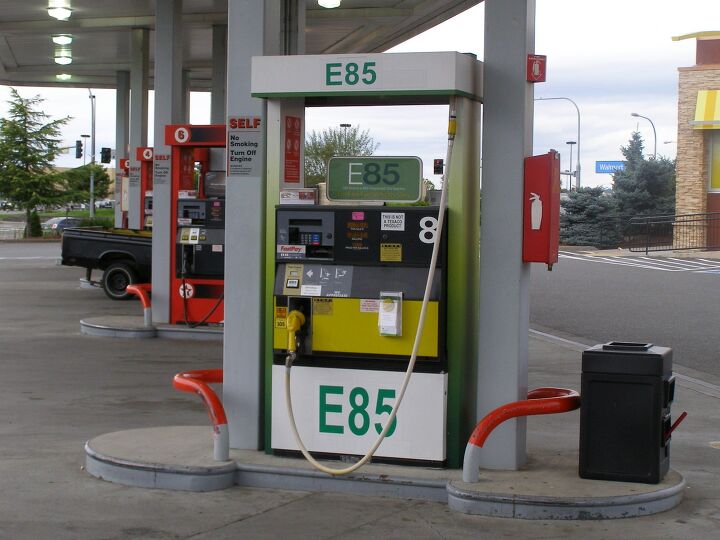
A handful of Republican presidential hopefuls converged upon Iowa last weekend to discuss the pros and cons of ethanol.
US Ethanol Exports Reach Near-Record Levels In 2014

Of the 14.3 billion gallons of ethanol produced in the United States in 2014, a near-record 836 gallons were exported.
Is This E85's Time To Shine?
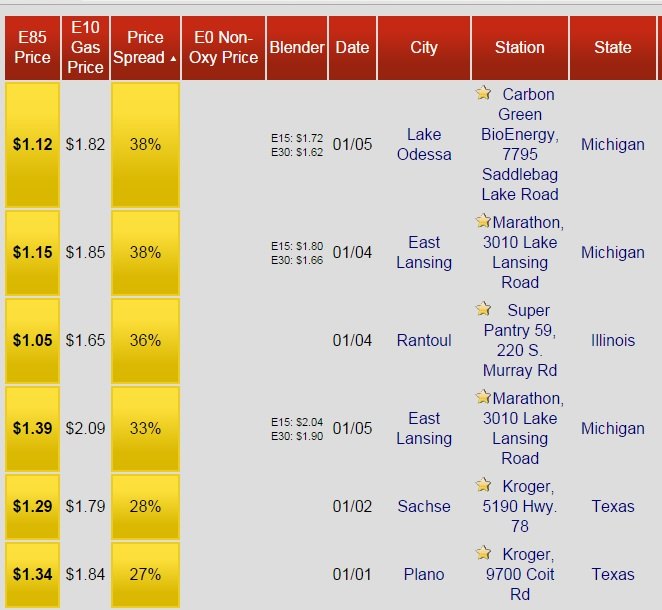
The recent fall in fuel prices isn’t just an opportunity for Americans to demonstrate their collective inability to remember the events of even the recent past; it’s also a decisive hammerblow to E85 plants and retailers across the country.
This has to be the case, right?

Fuel Prices Leave Efficient, Greener Offerings On The Lot

Falling fuel prices are helping to drive sales of SUVs and trucks as of late, but at the expense of more efficient, greener offerings.
Report: Global Fuel Consumption To Decline 4 Percent By 2035

Though peak oil usually refers to when production reaches the highest point it’ll ever see before coasting back down to the same level once experienced in the 1800s, a new report reveals a different oil peak will come in the next few years: the total product consumed worldwide.
US Energy Department Unveils Four-Year Strategy For Alternative Energy

The U.S. Department of Energy unveiled last week a four-year plan that would advance the goal of energy security by building upon as many alternative sources as possible, further reducing dependence on imported petroleum.
Gasoline Power To Dominate U.S. Highways Through 2040

The green warriors who hoped EVs and hybrids would be the dominate force on the highways of America may need to wait a bit longer: the United States Department of Energy predicts gasoline will be the fuel of a generation until at least 2040.

For First Time, E.P.A. Proposes Cutting Renewable Fuel Standards' 2014 Ethanol Requirement for Gasoline Blends

While ethanol producers have been lobbying to increase the blend of that alcohol in standard gasoline to 15%, many in the auto industry have opposed that increase, saying that it could damage cars. Now the U.S. Environmental Protection Agency has, for the first time, proposed reducing the ethanol requirement in the nation’s fuel supply. Actually, what they are proposing is a smaller increase in the overall use of ethanol, which means that the national standard may not be raised to E15.
AAA: No More Alcohol For Cars!

The AAA asked the U.S. government to prohibit the sale of E15. Only about 5 percent of the 240 million light duty vehicles on U.S. roads today are approved by manufacturers to run on the gasoline that contains 15 percent alcohol, and the other 95 percent could be ruined by the wicked fuel, says the AAA. The industry agrees.

U.S. Government Ignores Obama's EV Plans, Cuts EV Purchases In Half

Last year, President Barack Obama declared that one of the “Apollo projects of our times” is the goal for the United States to be “the first country to have a million electric vehicles on the road by 2015.” Companies that made and people that bought those electric vehicles received generous government money. One holdout in the rush for EVs: The U.S. government. It did not do as its President said, and ended up with a drastic cut in purchases of electric and hybrid vehicles after the speech was delivered.
House Science Committee Approves Bill Blocking E15

The House Science Committee approved a bill that bars the EPA from approving E15 gasoline without a further study into its effects. The bill passed 19-7 as members voted along party lines. The bill was sponsored by Rep. James Sensenbrenner (R-WI).

U.S. Congress Stops Ethanol Subsidies & Tariff on Brazilian Imports

After spending thirty years and $45 billion dollars encouraging the use of ethanol the United States Congress has adjourned for the year without extending tax subsidies to the to ethanol industry. The subsidy currently costs taxpayers $6 billion a year. A related import tariff on Brazilian ethanol was also allowed to expire. With a wide group of critics, cutting across political and ideological lines, the tax break had become unpopular in Washington. Business interests in the food and cattle industry as well as environmentalists opposed the law which paid 45 cents per gallon to fuel blenders to subsidize their costs for producing E10 gasoline/ethanol blend. The subsidy resulting in corn being diverted from feedlots and food processors to ethanol production, raising the cost of many foodstuffs. The environmental movement now opposes corn ethanol as a fuel it because it considers the fuel and its production to be “dirty”, in the words of Friends of the Earth.
Study Says: EV Drivers Coddled, Flex Fuel Cars Discriminated Against
So what is all this talk about flex fuel being shoved down our the throats of our cars, and EVs driving up Xanax sales due to rampant range anxiety? Bloomberg brings us astounding news:
“Public charging stations for electric autos outnumber outlets for alternative motor fuels by almost two to one, even though there are hundreds of times more flex- fuel vehicles than plug-in cars on U.S. roads. “
Kanpai! Toyota Turns Wood Into Booze

One of the biggest complaints about biofuel is that food is turned into fuel while people go hungry. Price hikes for staples have been blamed on ethanol production, especially subsidized ethanol production. Ethanol is usually made from sugarcane, corn, and beets. Grapes find their way into fuel tanks instead of wine glasses, rice is often driven instead of eaten. Woodscraps and agricultural residue would be less of a moral and financial hazard if converted into fuel. However, it proved resistant against yeasts. Today, Toyota took reporters to a lab in Aichi and showed off a yeast that wood-scraps, dead leaves, straw etc find highly irresistible.
Brazilian Cars High on American Alcohol
Around two thirds of the oil used in the United States is imported. Now, something is done to offset this energy trade imbalance ever so slightly: Ethanol, the stuff that is supposed to save the U.S. from foreign oil dependency is shipped out of the country.
Who buys it? Brazil, the land where cars drink alcohol to drive.
Wonders Loom: The Greening Of NASCAR

The rot-gut whiskey powered good ol’ boys who turned their fleet flite from revenooers into stock car racing must be flipping their ‘40 Fords in their graves. Nah, on second thought, they’d be so proud that their Prohibition-defying race car culture has swept the nation they’d be bemused by the news. Nascar is going effete… uh, green.

Where Are Our Green Car Priorities?
As a relatively pragmatic person who generally chooses the imperfect-yet-achievable path rather than agonizing over the perfect-but-unattainable goal, this chart [from a fascinating Boston Consulting report, in PDF here] frustrates me. I understand why Americans choose hybrid-electric cars as their most favored “green car” technology, but from their it gets fairly crazy. EVs are fantastic on paper, but in the real world they’re still far too expensive, their batteries degrade, they have limited range, oh and did I mention that they’re freaking expensive? Biofuels, America’s third-favorite “green” transportation technology can be fantastic in certain limited applications, but the ongoing ethanol boondoggle proves that it will never be a true “gasoline alternative.” Finally, at the bottom of the list, Americans grudgingly accept only relatively slight interest in the two most promising short-term technologies: diesel and CNG. Neither of these choices is radically more expensive than, say, a hybrid drivetrain and both are considerably less expensive and compromised than EVs at this point. So why are we so dismissive of them?

United Nations: This Is Your Car On Ethanol

A chicken could become as unreachable as caviar in many poor countries, warns a study of the OECD and the United Nations. Chicken is projected to rise in price by 30 percent in the next ten years – inflation adjusted. Other staple foods such as corn, sugar or cooking oil are seen rising in price by twenty percent. Why? On one side of the ledger is higher demand, mainly from China and India. On the other side: „Increasingly, the crop doesn’t end up in the pot, but as fuel in the tanks of cars,“ says the German magazine Der Spiegel.
Senate Votes To Repeal Ethanol Tax Credits
Cracks continued to in the ethanol industry’s once-impregnable political vanguard, as the San Francisco Chronicle reports that the Senate has voted to roll back the Volumetric Ethanol Excise Tax Credit (VEETC) as well as import tariffs on foreign-produced ethanol. This rollback of multi-billion-dollar ethanol credits failed earlier in the week, when the Detroit News reports automakers came out in opposition of a bill that would have required that 95% of all cars built in the US be capable of running 85% ethanol by 2017. The Senate did fail to pass a repeal of a government ethanol blending mandate that underpins the VEETC, however, and funding is moving forward for ethanol blending pumps. Still, the Senate’s repeal of VEETC alone means taxpayers could save over $5b per year on subsidies, and as one expert puts it
“Looks like we’re going to be relying on the biofuels mandates to make sure blenders use biofuels, rather than bribing them to use it with $6 billion,” [Bruce Babcock, professor of economics and the director of the Center for Agricultural and Rural Development at Iowa State University] said.
In fact, Babcock thinks killing the subsidy could help ethanol because it would come out from the stigma of being a subsidized industry. And removing the subsidy may strengthen support for the mandate, and the tariff on imports.
Over to you, House of Representatives…
Quote Of The Day: The Beginning Of The End Of Ethanol Edition
Over the course of TTAC’s coverage of US ethanol subsidies, I’ve often wondered why nobody made a political issue out of slaying an ever-growing waste of tax dollars ($6b this year on the “blender’s credit” alone). And with the political rhetoric about America’s debt prices rising, I’ve been wondering with more and more regularity when someone will finally take the ethanol fight to the American people, who are already voting against ethanol with their pocketbooks. But just last December, Al Gore explained why not even he, an environmentalist standard-bearer, could oppose the corn juice he knew was bad policy, saying
It is not a good policy to have these massive subsidies for first generation ethanol. First generation ethanol I think was a mistake. The energy conversion ratios are at best very small… One of the reasons I made that mistake is that I paid particular attention to the farmers in my home state of Tennessee, and I had a certain fondness for the farmers in the state of Iowa because I was about to run for president.
The Iowa primary is a key early contest in the Presidential election, and because Iowans grow and refine a huge amount of corn ethanol, campaigning against ethanol subsidies in Iowa is a non-starter. At least that’s what the conventional wisdom was before today, when, with nearly nine months to go before the primary, the impossible just happened.
Bipartisan Bill Seeks To End Cornerstone Ethanol Subsidy
Yesterday evening I directed some ire at President Obama’s continued reliance on ethanol as a major plank of his do-nothing transportation/energy agenda, noting
That extra money for 10,000 E15-capable pumps? That’s because no gas station owner will pay to install a pump for a kind of fuel that only cars built since 2001 can use… and which the auto industry has tried to ban. And why E15 in the first place? Because blenders can’t sell enough E10 to blend the government-mandated amount of ethanol and collect their $6b this year in “blender’s credits” to do so. A subsidy to support a subsidy which in turn props up yet another subsidy (I may have missed a subsidy in there somewhere). You can’t make this stuff up.
The “cornerstone” subsidy that all other ethanol subsidies support is the Volumetric Ethanol Excise Tax Credit, or VEETC, or “blender’s credit,” a $6b per year subsidy that directs 45 cents to refiners for every gallon of ethanol they blend with gasoline. The VEETC nearly died in December’s lame duck session, only to be revived as a way to buy votes for the President’s tax policy. Now, however, The State Column reports that a bipartisan Senate bill has been introduced that would eliminate both the VEETC and import tariffs on foreign-made ethanol. And with a rash of bad news coming out about ethanol, this could just be the opportunity to kill this wasteful government subsidy with fire.
What's Wrong With This Picture: Fixing Transportation Edition
President Obama devoted his weekly address to energy and transportation policy this week, speaking to the nation from an Allison hybrid bus transmission plant in Indiana. A White House blog post accompanying video of the President’s speech included a large infographic on “The Obama Energy Agenda And Gas Prices,” the transportation-oriented section I’ve excerpted above. This one section is actually a fairly good representation of Obama’s auto-related energy policy preferences, and illustrates why I often find myself criticizing the president here at TTAC.
GAO: Government Ethanol Rules Actually Increase Gasoline Use
A massive study by the Government Accountability Office into “Opportunities to Reduce Potential Duplication in Government Programs, Save Tax Dollars, and Enhance Revenue” has turned up an interesting finding. It seems that the government’s desire to buy more “alternative fuel vehicles” (AFVs) may actually increase the amount of gasoline used by government fleets. Why? Because agencies largely buy E85 ethanol-powered vehicles to fulfill their AFV requirements, and there aren’t enough E85 pumps to actually fuel the fleet, forcing agencies to obtain waivers to buy regular gasoline. Hit the jump for the report’s full findings on this, the latest unintended consequence of America’s ongoing ethanol-subsidy boondoggle.
New Ethanol Bill Faces Automaker Resistance
How things change in a few years! Just a few short orbits of the sun ago, automakers like GM were some of the biggest boosters of ethanol subsidies. Now, the Detroit News reports
The Alliance of Automobile Manufacturers – the trade association representing General Motors Co., Ford Motor Co., Chrysler Group LLC, Toyota Motor Corp. and eight others – opposes a bill sponsored by Sen. Tom Harkin, D-Iowa, that would require 90 percent of all vehicles to run on E85 – a blend of 85 percent ethanol – by the 2016 model year.
Shane Karr, vice president for government affairs, said the mandate “would cost consumers more than $2 billion per year” for flex fuel vehicles if automakers passed on the full cost “even though consumers will have little or no access to alternative fuels. Therefore, such a mandate is essentially a tax with little consumer benefit.”
In the face of this new opposition, the Renewable Fuels Association has even taken to employing the rhetoric of market economics to justify market-manipulating ethanol subsidies. And it doesn’t seem to be convincing anyone. If anything, Harkin’s bill may just hasten the death of existing subsidies, which are under pressure as both Democrats and Republicans seek to trim the federal budget.
Ethanol "Blender Credit" Under Attack Again
At the end of last year, the Volumetric Ethanol Excise Tax Credit (aka “Blender’s Credit) very nearly expired before congress passed a one-year, $6b extension to the subsidy. The near-collapse of the largest “renewable energy” subsidy on the federal books came as the backlash built against the EPA’s approval of E15 (15% ethanol) blends for certain vehicles, with a huge coalition of industries, environmentalists and budget hawks coalescing around the idea of ending government support for corn-based ethanol. That coalition lost some momentum as the VEETC was extended in order to drum up support for the controversial tax bill that was passed during December’s lame duck session. But now, SolveClimate [via Reuters] reports that the brewing deficit battles have put the Blender’s Credit back on the chopping block, as a new bill seeks to cut the wasteful, inefficient and unpopular (outside of farm states) subsidy.
Study: Ethanol Industry Must Go Back To E85 To Beat "Blend Wall"
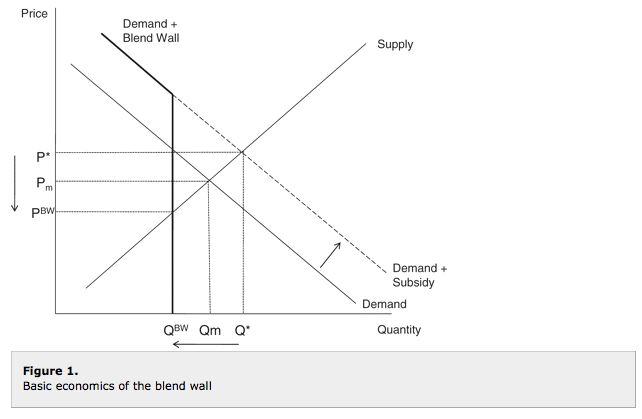
Recently the ethanol industry has “suffered” from a problem that epitomizes the problematic nature of government subsidies. Known as the “blend wall” this obstacle was created not by negligence on the part of the industry, but by the fact that its lobbying efforts have been far more effective than its marketing efforts. The problem, in a nutshell, is that the 2007 Renewable Fuel Standard mandates a steady increase in the amount of ethanol blended into the national fuel supply, from 9 billion gallons per year (BGY) in 2008 to 36 BGY in 2022… but with gasoline consumption falling and with standard pump gasoline capped at a maximum of ten percent ethanol ( recently raised to 15% for vehicles built after 2007), the industry that’s supposed to get America off gas needs more gas to blend its ethanol into. As a study in the American Journal of Agricultural Economics puts it
Total national consumption of gasoline in the United States has been about 140 billion gallons in 2010 and is expected to fall over time due to increasing fuel economy standards. Thus, at present, if every drop of gasoline were blended as E10, the maximum ethanol that could be absorbed would be 14 billion gallons. In reality, 10% cannot be blended in all regions and seasons. Most experts consider an average blend of 9% to be the effective maximum, which amounts to about 12.6 billion gallons. U.S. ethanol production capacity already exceeds this level. Thus, our ability to consume ethanol has reached a limit called the blend wall.
The solution: well, the EPA’s ruling allowing 15% ethanol blends was supposed to fix the problem, but according to this report, that “fix” would only buy some four years before the industry is back to bumping against the blend wall. The solution?
With ethanol as the primary biofuel and either blend limit (E10 or E15), a substantial increase in E85 would be required to fulfill the mandate.
Bio-Fuel Boondoggle Hits Europe, Kills Cars
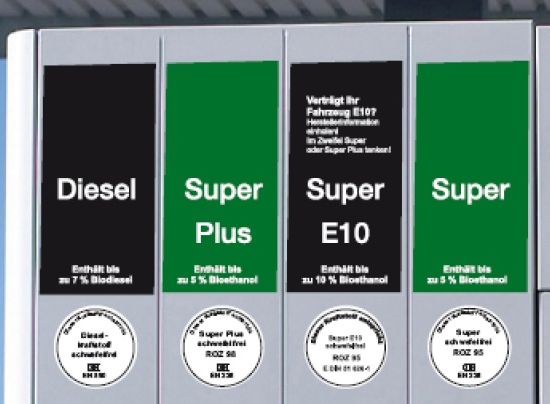
EU car owners will get a new kind of gasoline – whether they want it, or not. Most don’t want it. They get it anyway. While US-automakers sue to stop ethanol blends, an edict handed down from Brussels demands that Super has to contain 10 percent of ethanol. An alliance from Germany’s ADAC autoclub to Greenpeace says the new gasoline is a work of the devil, it is liable to ruin cars, and the environment.
Ethanol Subsidy Extension Headed To White House

Both the Senate and the House have passed a one-year extension of the Volumetric Ethanol Excise Tax Credit (aka “blender’s credit”), the Sm…
Read more
Quote Of The Day: Al Gore's Ethanol Regrets Edition

It is not a good policy to have these massive subsidies for first generation ethanol. First generation ethanol I think was a mistake. The energy conversion r…
Read more
Corn Ethanol Advocates Trash Dems

At least one of the institutions financing ads damning Democratic candidates this election season wants to put ethanol in your gas tank. The American Future Fund was founded by one Bruce Rastetter, the CEO of Hawkeye Energy Holdings, one of the larger ethanol companies in the US, according to an article in the New York Times. The fund is financing ads aimed at Democrats in key positions to influence booze fuel… so is the problem their “liberal” policies, or the fact that they’re insufficiently supportive of the farm lobby’s beloved corn juice?
What's Wrong With This Picture: The Very Model Of A Modern Mainstream Automobile Edition

The Automotive X-Prize is over, and the Edison2 Team has won the “Mainstream” class with its Very Light Car. It may not look like any mainstream…
Read more
E15 Ethanol Opposition Calls For Congressional Hearings

Opposition to the Ethanol industry’s push to allow gasoline blends with up to 15 percent ethanol is coming together this week, as a massive coalition of interest groups calls for congressional hearings on the EPA’s pending E15 decision [via PRNewswire]. The Alliance of Automobile Manufacturers and Association of International Automobile Manufacturers joined 37 other groups, ranging from the National Resources Defense Council to the Outdoor Power Equipment and Engine Service Association, in calling on congressional energy committees to take up the issue.
China Decides: We'll Eat The Corn, We Won't Drive It

Chinese motorists are spared the joy of ethanol. In China, corn will continue to be eaten, not driven. China’s state news agency Xinhua reports that agricultural experts decided that it is “too early for China to adopt corn-based ethanol fuel to feed automobiles, given the expensive production costs and the country’s large population.” The short version is: “Ethanol? Bu yao!” (No want.)
E85 Boondoggle Of The Day: EPA Lets Corn-Free Ethanol Goal Slide

Since corn-based ethanol began coming under attack for a wide variety of negative environmental and social impacts, the renewable fuels industry has sought to cover the sins of its corn juice gravy train with a coat of “advanced biofuel” greenwash. Accordingly, the ethanol blending mandate (from the 2007 Energy Independence and Security Act (EISA)) has included requirements for cellulosic and non-corn-derived biofuels which the industry says will replace corn… eventually. Unfortunately it seems that “eventually” is going to take longer than was expected, as the EPA has already slashed the 2010 mandate for advanced biofuel blending from 100m gallons to 6.5m gallons. And today the EPA announced rules for the 2011 advanced biofuel blending goal, and once again the non-corn fuels are getting the short end of the stick.
EPA Resists Cheap BP Spill Symbolism, Delays Ethanol Blend Hike
America’s ethanol producers were some of the few Americans optimistic or cynical enough to find a bright side to the BP Gulf spill. Ethanol’s lobbyists-in-chief, GrowthEnergy, decided it would be real cute to run ads highlighting all the bad things ethanol hadn’t done. One of which is not “ Ethanol has never harmed the Gulf of Mexico,” by the way. As the ad parody above points out though, even if the ethanol was creating a dead zone in the Gulf of Mexico for years before the BP spill, there are quite a few other things ethanol hasn’t done. Like this, just in from the AP [via Google]: convince the EPA to buy into its shameful, manipulative PR line and rush a decision on increasing blending limits.
Will The BP Oil Spill Lead To More Ethanol Subsidies?

Slate‘s Robert Bryce reckons so. With ethanol producers and blenders bouncing off the ethanol “blend wall” and into bankruptcy court, Bryce figures
Now the industry is counting on a president beleaguered by the made-for-TV crisis in the Gulf of Mexico to help it out. And he appears ready to do just that. On April 28, six days after the Deepwater Horizon rig sank, President Obama visited an ethanol plant in Missouri and declared that “there shouldn’t be any doubt that renewable, homegrown fuels are a key part of our strategy for a clean-energy future.” Obama also said, “I didn’t just discover the merits of biofuels like ethanol when I first hopped on the campaign bus.”
The strongest indication that an ethanol bailout is imminent came last Friday when Agriculture Secretary Tom Vilsack (former governor of Iowa, the nation’s biggest ethanol-producing state) said, “I’m very confident that we’re going to see an increase in the blend rate.”
Meanwhile, Back At The Farm: Ford Promises Flex-Fuel Bumper Crop

As TTAC readers well know: There is a huge E85 flex-fuel loophole in the new federal fuel economy CAFE standards. Ford will drive right through that barn door-sized hole.
By the end of this year, Ford wants to deliver 370,000 flex fuel vehicles, a number which they can trade against fuel oinkers. Let’s review: A flex-fuel vehicle is one that is capable of running on E-85. But it doesn’t have to. It can also run on straight gas. Or on any mixture of the two fuels. As long as it’s E85 capable, it counts at least for a Peppermint White Chocolate Mocha at the DC CAFE.
GM Bets Nearly $900m On Next-Gen V8s, Thanks To E85 Loophole

CAFE got you down? Worried that it’s only a matter of time before the feds come for your V8? You can relax a little, as General Motors is announcing th…
Read more
CAFE For Free

On April 1, new federal fuel economy CAFE standards went into effect. By 2016, new cars should get 35 mpg or thereabouts. The true number remains an exercise in abstract algebra. Says Consumer Reports: “The new standards require different fuel economy averages for each manufacturer and for each type of vehicle (such as small, midsized, and large sedans or SUVs).” There are plenty of loopholes and offsets. Extra credit for cars that take E85 Ethanol, for instance. And here is another huge loophole:
E85 Boondoggle Of The Day: GM Still Tilting At Biofuels
GM is spending about $100 million a year adding flex-fuel capability to our vehicles. We can’t afford to leave this capital stranded… I think it would be very helpful if we could get government assistance. But I really want the oil industry, I want the people who are at this conference, I want the government and I want us to just work together to make ethanol a reality,
This was the message the GM’s Tom Stephens took to the Renewable Fuels Association’s National Ethanol Conference in Orlando. And though Stephens’ exhortation of the ethanol industry makes for a pleasant addition to GM’s typical ethanol message (i.e. the first sentence of the quote), it’s little more than filler. GM’s push to align itself with the ethanol industry continues unabated, as Stephens reveals that half of all GM vehicles will be flex-fuel capable by 2012. The problem is that GM reckons the country needs another 10k E85 pumps (up from the current 2k), and since the ethanol industry would effectively collapse without government support, nobody from the industry is jumping in to take responsibility for this self-serving infrastructure project.
E85 Boondoggle Of The Day: Obama's Corny Ethanol Science
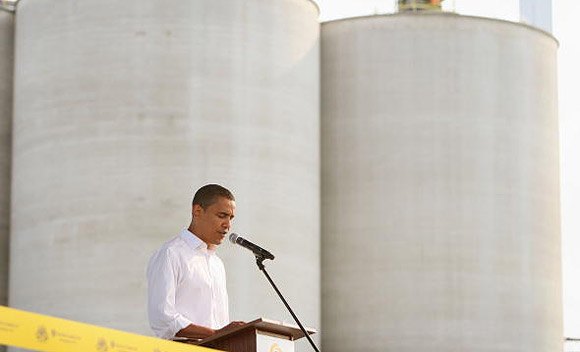
First President Obama said the Senate may forego passing cap-and-trade, by far the most critical piece of the energy legislation that’s brewing on Capitol Hill. And now, the Environmental Protection Agency is suddenly pushing snake-oil, uh, corn-based ethanol in the latest iteration of the renewable fuel standard [ proposed rule PDF], claiming that its substitution for gasoline will reduce greenhouse gas emissions. This contradicts an earlier renewable fuel standard iteration, and most studies of the matter, including a 2008 study in Science, which found that “corn-based ethanol, instead of producing a 20% savings [as per typical life-cycle studies], nearly doubles greenhouse emissions over 30 years and increases greenhouse gases for 167 years.” [Ed: for more on the corn ethanol sham check out TTAC’s E85BOTD archives]
EPA Won't Rule On E15 Based On Two Cars Worth Of Data
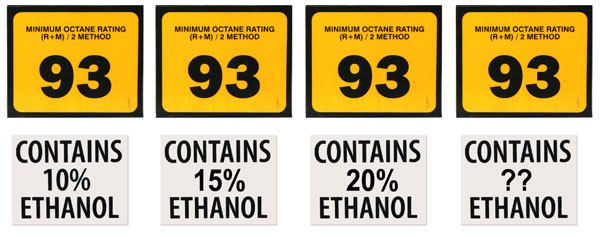
Well, the good news is that the EPA has thus far refused to allow gasoline blends of more than ten percent ethanol. The bad news is that the Agency has yet to take a firm stand against the idea of eventually allowing E15 into the nation’s gas pumps. In fact, as the EPA’s response to the ethanol lobbying group Growth Energy’s request to allow E15 [ full document in PDF form here] opens:
It is vitally important that the country increase the use of renewable fuels. To meet that goal EPA is working to implement the long-term renewable fuels mandate of 36 billion gallons by 2022. To achieve the renewable fuel requirements in future years, it is clear that ethanol will need to be blended into gasoline at levels greater than the current limit of 10 percent.
E85 Boondoggle Of The Week: Blend Cap Decision Coming This Week
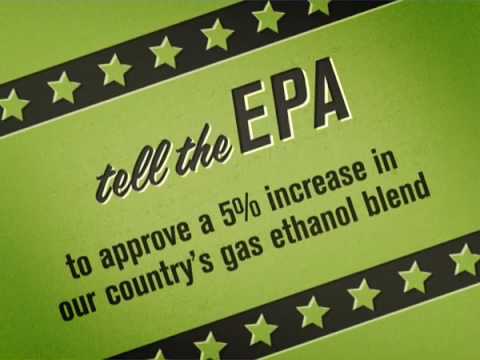
The EPA is set to rule as soon as tomorrow on the so-called “blend cap,” which forbids the sale of gasoline with more than ten percent ethanol. The petition to raise the blend cap came from a relatively new pro-ethanol lobbying group, Growth Energy, which requested the cap be moved to fifteen percent ethanol. Growth Energy’s request cites foreign oil dependence, “green-collar jobs” and the future of cellulosic ethanol as reasons to bump the blend cap, but as the New York Times reports, the real problem is that the ten percent limit is bumping up against a congressional mandate to blend 15b gallons of biofuels with gasoline by 2012. What the Times fails to mention is the financial incentive for raising the blend cap: the 51 cent-per-gallon of ethanol blended tax credit. In 2007, when gas consumption was at an all-time high and ethanol blending mandates required a mere 4.7b gallons (with 7b actually blended), that credit cost taxpayers nearly $3b. In 2012, when the mandate hits 15b gallons, the taxpayer tab will be closer to $7.65b.
Department of Energy in Hot Water Over Electric Vehicle Love

Let us begin with the money shot, courtesy BiofuelsDigest. “If it were up to me, I would put every cent into electric cars.” That would be the US…
Read more

Canadian Memo: E85 No Greener Than E10

Our friendly neighbors to the north are starting to cope with a difficult and embarrassing reality. Canada.com reports on a briefing note prepared for Canadian Natural Resources Minister Lisa Raitt warning that hundreds of millions of dollars spent subsidizing e85 Flex Fuel technology have been a colossal failure. Not the least of which is the fact that a complete lack of convenient fueling infrastructure has resulted in people using “dirty” gasoline. According to the memo, obtained under public information laws:
Given that E85 (fuel) is not sold in significant quantities, these credits (to manufacturers) are not tied to actual GHG emission reductions because Canada’s FFVs are fuelled almost exclusively with gasoline

E85 Boondoggle Of The Day: Corn Ethanol Justified By POETic License
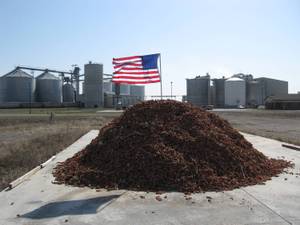
The EPA’s goal of encouraging production of 100m gallons per year (gpy) of cellulosic (i.e. non-corn-based) took a bit of a hit recently, when it was found that the firm responsible for producing 70m gpy was actually showing investors petroleum-based fuels and lying about its production capacity. Whoops! But instead of drawing the conclusion that ethanol is the modern equivalent of snake oil, attracting hucksters and scams like mainstream car blogs to a special-edition Mustang, the government is keeping the sector well-stocked with taxpayer cash. Green Car Congress reports that the Department of Energy has awarded ethanol firm POET a $6.85m increase over its already-delivered $76m grant, with another $13.15m on the way. The funds were awarded through Project LIBERTY (Launch of an Integrated Bio-refinery with Eco-sustainable and Renewable Technologies in Y2009), which seeks to move ethanol past the tortilla riot-era bad press while keeping it chained to big agribusiness. The method? Ethanol from corn cobs!
E85 Boondoggle of the Day: Automakers Kinda Heart E20
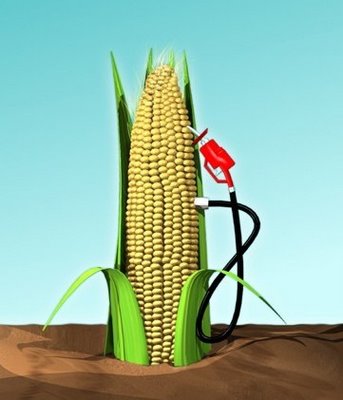
More than a year ago, the ethanol industry hit the “blend wall”: the difference between what they could produce and what the market wanted to use. This despite billions in tax credits: direct and indirect federal and state subsidies. All enabled by a federal mandate mandating that the ethanol boys brew nine billion gallons of renewable fuels in 2008, rising to 36 billion by 2022. And then the gas price bubble burst and environmental impact studies arrived, revealing corn-for-fuel as a carbon positive endeavor. The ethanol industry pretty much curled-up into the fetal position. The small players went belly-up. The big boys—including Archer Daniel Midlands (whose corporate jet ferried candidate Obama around the Midwest)—put their hopes into E20.
E85 Boondoggle of the Day: Meloncholy, Baby
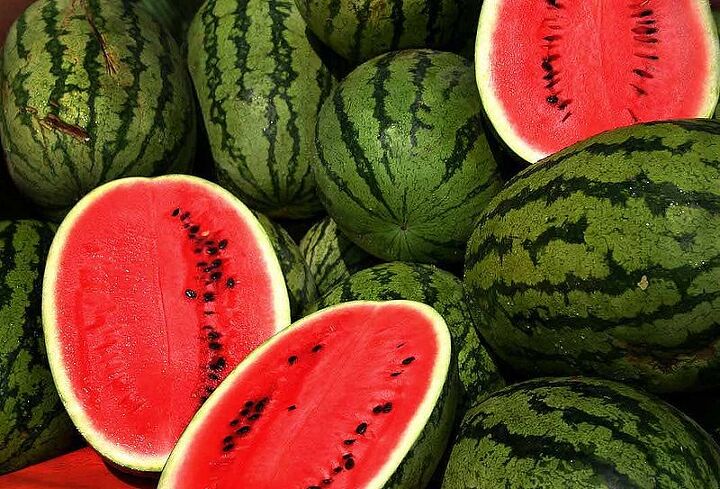
Move over corn. There’s a new sheriff in Ethanol City and his name is Watermelon. Every year, famers leave about 800 million pounds of watermelons to r…
Read more

E85 Boondoggle of the Day: E85's Future Still Up in the Air

The E85 industry has a problem. Well, a bunch of problems: corn prices, water supplies, environmental impact, flagging political support for subsidies, limited access to the marketplace and profitability. Yes, there is that. Or, more precisely, there isn’t that. If only the feds could find a way to force the country to use the corn juice . . . I’ll see your mandatory E10 and raise however hell as much as I can get away with. The thing of it is: when there’s a choice, people aren’t buying E85. What’s left of the ethanol industry post-gas price drop has convinced itself that it suffers from a near-lethal perception gap. (Remember: no one ever died defending a corn field.) As we recently reported, the Department of Energy is spending $2 million of federal funds to help you discover that E85 isn’t really cheaper when you factor-in the mpg drop. Anyway, Evolution Fuels has announced that it wants some of that taxpayer loot.
E85 Boondoggle of the Day: $5.5 Million DOE Grants for the SOS

Now that the Department of Energy (DOE) has doled out some $25 billion to help automakers retool taxpayers—I mean, retrofit factories to build incrementally more fuel efficient vehicles than the ones built at the same locations previously—the agency is continuing its cash for anything environmental program. Our old friend E85 is the beneficiary of a $5.5 million handout as part of the American Recovery and Reinvestment Act. The money goes towards two noble goals sure to get the American economy on its feed—I mean feet. First up: “outreach.” Which is Fed-speak for pro-industry propaganda, presumably . . .












Recent Comments