


Question Of The Day: What Does Japan Know About Fuel Cells That We Don't?
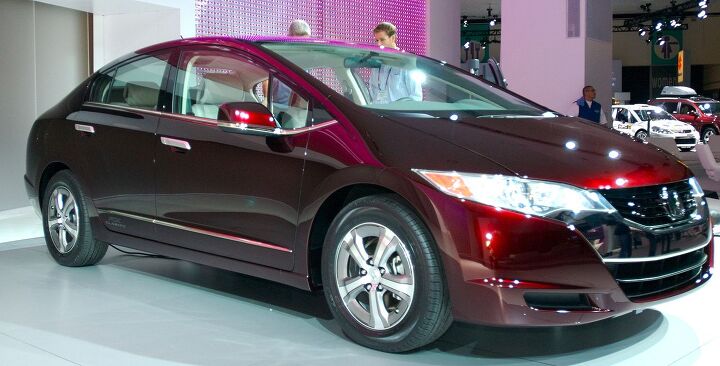
A new report from Reuters highlight’s the Japanese auto industry’s increasing focus on hydrogen fuel cells, a technology that has long been written off as dead by many industry observers and battery electric vehicle advocates.
Reuters reports
Japan’s government and top carmakers, including Toyota Motor Corp, are joining forces to bet big that they can speed up the arrival of the fuel cell era: a still costly and complex technology that uses hydrogen as fuel and could virtually end the problem of automotive pollution…With two of Japan’s three biggest automakers going all in on fuel cells, the country’s long-term future as an automotive powerhouse could now hinge largely on the success of what they hope will be a key technology of the next few decades.
While Nissan is a notable holdout (pursuing battery EVs like their signature Nissan Leaf), Toyota and Honda are pursuing hydrogen as the alternative fuel of the future, and they have the backing of the Japanese government.
Prime Minister Shinzo Abe’s growth strategy… also included a call for subsidies and tax breaks for buyers of fuel-cell vehicles, relaxed curbs on hydrogen fuel stations and other steps under a road map to promote hydrogen energy.
While Honda has been promoting fuel cell technology since the 1990’s, Toyota recently abandoned their EV program in favor of focusing on hydrogen. Despite all of the criticism of hydrogen fuel cells, their cost and the lack of infrastructure, the technology is still alive in this corner of the automotive world – one that is arguably the leader in hybrid cars and alternative powertrains overall.
Industry scuttlebutt has it that Japanese OEMs are convinced that the cost of developing a hydrogen fuel station network is going to be cheaper than developing a 500 mile EV battery, but I’m still curious: what are we the public – and the hydrogen skeptics – missing out on that’s driving Japan to persist with fuel cell technology?

More by Derek Kreindler





Comments
Join the conversation
Dead-end technology... Hmm... I know this is boring ancient history to some, but early pioneers of flight (Wright Bros etc) were widely and incessantly ridiculed for being fools and idiots.
"What does Japan know ... ?" Dumb question. What does the US know about corn-based ethanol that everyone else doesn't know? (Nothing, it's just a matter of money, votes, power, etc.). I don't know their money trail, and I don't really care. If Toyota continues down the path they seem to be, it will fail similar to how E85 is a failure. Hydrogen has a couple advantages over batteries, and batteries have certain advantages over hydrogen. Given those two technologies, batteries will win. For everyone wondering where the promised breakthroughs for batteries is, the same can be asked about the breakthroughs for producing hydrogen. I am also not yet convinced that water-vapor-as-exhaust will forever be considered "no pollution." When I was in school, CO2 was still not a pollutant. Being all-to-familiar with the effects of humidity and clouds on weather, I just can't buy casual claims that "It's natural" (like CO2) and "It constantly removed from the atmosphere" (like plants do with CO2). If it turns out that it's a complete non-issue, great! But if it turns out that water-vapor-as-exhaust also causes some form of climate change, will the scientific community ever be able to clean the egg off its face?