

By Bertel Schmitt on July 12, 2009

One of my jobs was to create marketing programs for Volkswagen that drive their customers to Volkswagen dealers at regular intervals for scheduled service. It was in the late 80s. I presented a daring idea:

“How about we give the customer a free roadside assistance program if they come to the shop once a year?”

“Interesting. Run the numbers, come back and tell us more.”

Why would a car company care about how much service business is done at their dealers? If they don’t care, the car companies will go out of business. As anybody who really knows the car business knows: You don’t make money selling cars. The real money is made fixing them.

If a car dealer turns a profit, new car profit contribution is in the single digits. The real money is made back in the shop, on the used car lot, in financing (those were the days.) The same is true with a car maker. Believe it or not, when car makers still made profits, their fattest profits were made with their captive finance organizations and through parts sales.

If a car company is smart, it sees to it that their customer happily visits his dealer for scheduled service at regular intervals. The customer should leave with a smile, because a happy customer will return, create lots of fat profits, and eventually buy a new car. A pissed-off customer will desert to AutoZone, tell all his friends (or the world on TTAC) that he has been had, and take revenge by buying another brand at another dealer next time. The trouble is, neither the previous automaker nor the previous dealer will notice that the customer has left.

We ran the numbers. The numbers of actual breakdowns were pretty low. (Why do you think does AAA make fat profits on your $59?) Our customers drove mostly new cars which rarely broke down. Whatever broke down could usually be fixed on the spot. The really serious cases were few and far between, and we could splurge on them and treat them like royalty.

We came back with a juicy offer:

“Free roadside assistance!” (If you do your scheduled service as proscribed.)

“For the life of your car!” (They usually sell the new one after a few years.)

“Free loaner car!” (If we can’t fix the car the same day.)

“Free hotel room!” (If we can’t fix the car the same day and you won’t take the loaner.)

We didn’t hire a service organization or buy thousands of wreckers. At the time. we had 3500 dealers in Germany alone; one every five miles (on average). Properly organized, this would cost next to nothing. Actually, the true cost of the program came to less than $10 per car and year, most of it for the advertising campaign. It was charged to the dealer for every scheduled service, and the dealer hid the cost under “service parts and lubricants.”

The operative word was “properly organized.”

Trouble was, Volkswagen didn’t want to spend the money for a call center where you call in when you break down. This was the 80s. Call centers weren’t as prevalent as they are today. Most of all, a call center would have blown the less than $10/car per year budget.

“We don’t need a call center. They just call the next VW dealer and he will take care of them.”

“And at night? On weekends?”

“One of the dealers in the area will have standby duty.”

“Gentlemen, you need a call center. How’s the customer going to know who’s on standby?”

“We’ll give them answering machines! They will direct the customer to the dealer who’s on duty.”

“This will never work.”

“Bertel, you worry about the advertising. Leave the details to the grown-ups.”

And so, someone sold 3500 answering machines, and Volkswagen entered history as the first car company definitely in Europe, maybe even in the world, which provided free roadside assistance. Before, roadside assistance was the monopoly of the auto clubs. Again, we are talking 20 years ago. Today, free roadside assistance is standard with purchase, even in China.

We called it “Mobilitätsgarantie.” It rhymes with “Abwrackprämie” and translates to “Mobility Warranty”. We announced it with great fanfare. Stupid me didn’t recommend that we trademark “Mobilitätsgarantie”. It became a household word in Germany, and every new car from every manufacturer has one. Google shows more than 250000 entries. If I only had a penny for each car sold with a Mobilitätsgarantie , I wouldn’t be typing this.

Immediately, there were strong protests by the ADAC, Germany’s version of the AAA autoclub. They thought we wanted to put them out of business. Added PR for us.

Half a year into the program, great news: “It’s working unbelievably well! We have much fewer cases than we thought! We are way under budget!”

I liked to hear that, because we took the extra money and spent it on extra advertising. They had been a bit cautious in the beginning, worried they might drown in calls if they advertise it too much. With the new data, they opened the spigots and went all-out.

Top management also loved to hear the good news, because it proved again the unmatched reliability of a Volkswagen. They just won’t break down.

Funnily, our numbers were much lower than the breakdown numbers reported by the ADAC.

“Ah, they just get the old clunkers which are not serviced by our dealers. We have the new ones. Regular scheduled service. Proves our point. And who knows, they may fudge the numbers because they hate us.”

I suspected the truth: people couldn’t get through. No call received. No wrecker sent out in the middle of the night. No money spent. Trouble was, I couldn’t prove it. Volkswagen spent money on countless studies. They measured the satisfaction of people who received roadside assistance (high). But somehow, there never was a budget to study whether people could get through. I was alone with my suspicions.

For several years, I ended every presentation of a large campaign with a chart that said “We need a central emergency number.”

This always elicited smiles and applause all around the meeting room. Not because they wanted the central emergency number. Oh, no. Thumbs down on that. They clapped because they had learned that this was my last chart, and we could all go and have lunch.

So one day, my last chart did read: “We need a central emergency number, because:”

I had someone make an emergency call and tape it. I pushed the Start button of the tape machine. The voice began to tell the drama:

“It is 10 at night. I am dialing the first number of a Volkswagen dealer in the phone book.”

Ring. Ring. Ring. Ring. No answer.

“I am dialing the next number in the phone book.”

Ring. Ring. Ring. Ring. No answer.

“I am dialing the next number in the phone book.”

Ring. Ring. Ring. Ring. “This is your friendly Volkswagen Partner Fritz Müller. Our business hours are 9 to 5. If you need Mobilitätsgarantie roadside assistance, please call the on duty Volkswagen partner Hans Mayer at 123-4567.”

“I am calling 123-4567.”

Ring. Ring. Ring. Ring. “This is your friendly Volkswagen Partner Hans Mayer. Our business hours are 9 to 5. If you need Mobilitätsgarantie roadside assistance, please call the on duty Volkswagen partner Fritz Müller at 901-2345.”

As the tape ran, faces around the table turned from their natural pink to crimson.

“I am calling 901-2345.”

Ring. Ring. Ring. Ring. “This is your friendly Volkswagen Partner Fritz Müller. Our business hours are 9 to 5. If you need Mobilitätsgarantie roadside assistance, please call the on duty Volkswagen partner Hans Mayer at 123-4567.”

I was lucky that the chief of Volkswagen’s Customer Service Dept liked me, otherwise I would not have left the room alive.

“Stop it! We’ve heard enough!”

“Gentlemen: Give Bertel his damned central number.”

“And Bertel, please give me the damned tape.”

I handed it over.

“Any copies existing?”

“No, Sir.”

“Let’s hope none turn up. And now, let‘s have lunch!”

Finally,  my central number was approved. The prefix for a toll free number in Germany was 0130 at the time. I got them a catchy, easy to remember number: 0130-9900. A call center was hired that had the home phones of the on duty mechanics. All was well.

I was happy and went back to my core business of creating masses of ads, posters, stickers, imprints in the car manual, all with the same number: 0130-9900.

A few months later, I was back at Volkswagen. Someone of their service department proudly gave me a stack of credit card sized cards. The card had 0130-9900 on it, and two real 10 Pfennig coins in it. This was before the Euro.

“Who made that for you?” I inquired.

“Merchandising company. Great deal. Only 25 Pfennig apiece.

“What do we need it for?”

“To publish your damned number! People put it in their glove compartment.”

“But why the coins?”

“For the payphone.”

“It’s a toll-free number.”

“You need the coins to place a call.”

“No, you don’t.”

“Yes, you do. They come back out at the end.”

“Down in the foyer is a payphone. Let’s go and check.”

With the guy in trail, I went down to the foyer. I picked up the receiver of the payphone. I did not insert any coins. I dialed 0130-9900.

“Volkswagen Mobilitätsgarantie. How can we be of assistance?”

My guy went pale.

“Please, can we keep this amongst us?”

“Sure, but I wouldn’t print any more cards.”

“Are you out of your mind? This is one of our most successful promotion pieces. We’ve sent out millions! Dealers order them by the thousands. At the rate we are going, soon each of the 15 million VWs on Germany’s roads will have two of those. 0130-9900 will be better known than directory assistance!”

“How many years do you have until retirement?”

“Two, why do you ask?”

“I wouldn’t print any more cards.”

All promotion material sent to dealers was free. They received an initial quantity and then could re-order whatever they needed. Careful statistics were kept on the re-order rate. The higher the rate, the more successful the promotion. Or so they thought.

We printed new cards without the coins.

They sent them out. The re-orders stopped dead.

You guessed it: The dealers had taken the coins out of the cards. Talk about free cashflow. There were stories of apprentices sitting around a table, popping coins out of the cards all day long under the watchful eye of the chief accountant.

I promised not to tell anybody. The matter was swept under the carpet.

The statue of limitation for coins in cards is covered with patina. My man has long retired. You’ve heard it here first. At thetruthaboutcars.

PS: A few years later, Germany received 800 toll-free service with vanity numbers. I immediately secured 0800VOLKSWAGEN for the VW Service Department. Higher-ups found out that the Service Dept. had that number, wanted it for themselves. “Can’t we use one simple number,” I pleaded. “If someone wants a catalog, send him a catalog. If someone needs help, send help.” Too simple. The Mobilitätsgarantie got its own number 0800VWSERVICE.

By Bertel Schmitt on July 5, 2009

Flashback: Last time, Bernd Schäfers, Herr S. of Volkswagen and his gang, and yours truly were on a mountain top at the southern tip of Spain, out of luck and out of film. Pulling a daredevil stunt, Bernd had somehow saved me from being slaughtered and fired.

What now?

As the sun kept rising, we collected our equipment and our thoughts. We drove down the mountain to our base in Sotogrande. In the back seat, Herr S. lectured his Spanish-speaking assistant again why we had to abort the movie making: “That light, despite looking beautiful to the untrained eye, would have ruined the whole shot.”

We had lied to him. I yearned for Maalox or something stronger.

Down behind the secured gates of the Sotogrande golf course, Bernd and I went into a private crisis meeting:

“We need film,” I stated the obvious.

“What we need is a helicopter shot,” Bernd declared.

Bernd showed no outward signs of dementia. His pupils were normal. His hands didn’t shake. No signs of unusual perspiration. His calm demeanor made me even more furious.

“We need what? We need fricken film!”

“Ah, maybe 30,000 to 40,000 more. And we would have great shots. Not to forget something to shoot with.”

“We need to talk the client into a helicopter shot. That long shot down the mountain gets boring after 10 seconds. If we intercut it with the hel . . . ”

“Bernd! We need F-I-L-M!!!!”

“Hear me out. This helicopter shot can only be done by one guy. He lives in Hamburg. He’s not just a helicopter pilot. He’s a flying camera! He thinks and flies camera!”

“Bernd. Film. We need film.”

“If I call him now, he could be here tomorrow. And before he leaves, he could throw some cans of film in the chopper.”

“What’s this going to cost us?”

I threw up my hands in despair and told Bernd to go and sell the mad idea to Herr S.

We walked over to the villa of Herr S.

Bernd gave Herrn S. his best “You need that shot!” spiel.

It was easier than I thought. The idea of a chopper appealed to Herr S. He placed a call to Wolfsburg to have the expenses approved. While still on the phone to headquarters, Herr S. raised his thumb.

Two hours later, Bernd’s pilot who thought he was a camera was in the air for a 3000km or so ride from Hamburg to Malaga.

In the meantime, Bernd regaled me with stories about the pilot’s accomplishments.

“You won’t believe how many times this guy nearly lost his pilot license.”

“Once, they did a documentary about the castles of the Rhine River.”

“He buzzed all Rhine castles so close that most of Germany’s gentry took down his number and filed suit against him.”

I was impressed.

“He was the first helicopter pilot to cross the Mediterranean from Turkey to Egypt.”

“Completely out of fuel, he landed on a military airbase near Port Said.”

“They arrested him because they thought he was an Israeli spy. Nobody believed he could have crossed the Mediterranean in a chopper.”

Not only did he think he was a flying camera. He also thought he was the Jack Baruth of the skies.

(Read More…)

By Bertel Schmitt on June 28, 2009

You know what I loved most about car advertising? There was never a shortage of money to play with. I’m no longer tracking these things, but in 2007, GM spent $3 billion on what we call “measured media” alone. Measured media is defined as television, print and outdoor advertising. The unmeasured expenses, what’s called “below the line,” in the vernacular, are usually just as huge, maybe bigger. Above and below the line, GM must have spent the GDP of Mongolia on advertising.

Volkswagen’s budget resembled the GDP of a much smaller country, but I thoroughly enjoyed helping them to put it to good use.

One of these big ticket “below the line” activities are launch events. A new car gets launched. All dealers must come to see a grand presentation. In the 70s, Volkswagen had more than 10,000 dealers all over Europe. They usually showed up with three or more people. Can’t put them all in a soccer stadium. So we produced events for about 500 people each, and the event ran for about a month. Sometimes two events a day.

Sixty events in a row. A monstrous logistical undertaking. Chartered flights. Masses to be wined, dined, bedded, entertained. There must be test drives. Programs for the ladies. Discrete programs with ladies. Whole hotels booked for a month. The guy who was in charge of booking the hotels never had to pay himself for the presidential suite at any of the large chains. Even long after his retirement. Until the hotels found out that he had left.

A lot of money was also spent on the launch movie to be shown at the event. It was designed to get the hearts of the dealers pumping and to make them order the car by the lotful. The budgets for these launch movies often exceeded the budget for a consumer commercial. After all, a consumer buys only one car. A dealer buys thousands.

It was in early 1978, and my job was to produce the launch movie for the Gen 2 model of the Audi 80, internally called “B2″ or “Typ81.” Some of you may know the car as the “Audi 4000.” These movies were similar to pornography, inasmuch they never had much of a script and were geared to get the testosterone going. Lots of moneyshots, little dialog, if any at all. The heavy breathing was supposed to be delivered by the audience.

My script was the usual simplicity: A Jack Baruth lookalike sits alone in a mountainous wilderness. He’s awaiting a super-secret Audi 80, to be delivered for a test drive. A truck brings it under wraps. Tarp removed, Jack admires the car. Sits in it. Then drives it like bent out of hell along the switchbacks of the mountainous roads to the music of the London Symphony. Think “Tail of the Dragon”—but without the cops.

As money was no object, I always had the best producers. I worked with Bernd Schäfers, producer of epics like “Das Boot,” “The NeverEnding Story,” or “The Name of the Rose.” Bernd and I were friends. I lost track of him when he became a fugitive of the law after a large investment deal for the MediaPark in Cologne went sour in the late 90s. If anyone knows his whereabouts, tell Bernd Bertel misses him. Codeword “Bald Eagle.”

To shoot the Audi 80 dealer flick, we took up residence at the Sotogrande Golf Course in Spain, between Gibraltar and Malaga. This was the late 70s, the ghosts of Generalissimo Franco were still haunting the country. The Gibraltar part was a matter of high suspense, a story to be told in the next installment of the Autobiography of BS ©. It was March, golfing season hadn’t started yet, and we rented the whole golf club. It was a gated community with lots of security. Secret cars could be photographed there without a risk of detection. We had used the place a lot before. We called it “Photo Grande.”

As we had rented the whole complex, each of the team members could choose any available villa. The clubhouse served as production headquarters. The only drawback was that, save some guards, the club was deserted of all help. No cooks, no maids. We were on our own. We lived on bocadillas, or sandwiches, and instant coffee, while we slowly converted our individual villas into pigsties: Because there was no cleaning staff, we simply moved from one room to the next when it got too dirty. Once a villa was thoroughly trashed, we changed villas. There were enough to go around.

The team VW had brought in was bigger than our film crew. There were people responsible for the well-being of the two prototypes we had. There was one guy who had spent time in Argentina and could speak Spanish. He was our designated liaison with the natives, which were not there. There was security. And then there was Herr S., second in command of the Promotion Department of Volkswagen, who knew everything about making movies. Or so he said. He always stressed that he knew the difference between an A and a B roll. He probably owned a Super 8 at home.

After two weeks of bocadillas, switching rooms and the occasional villa, we had most of our film “in the can” as the saying went, except for the opening scene. It was a very long shot, taken from the peak of a mountain. The truck with the car under the tarp would come up the mountain pass, out of the rising sun. Sound simple? It wasn’t.

First of all, it amounted to getting up at 3 a.m. We needed to get our stuff together, truck up to the mountain peak, set up the camera with the help of a compass, because it was pitch dark and the GPS hadn’t yet been invented. Miles downrange, the truck had to get in position, and then we had to get ready for the sunrise. Only one sunrise per day. If something goes wrong, you can’t simply say “Sunrise, the fifth!” Next chance next day.

The best thing that could happen was that at 3 a.m. it was raining. Back to bed. If it wasn’t raining, we had to head for the hills. In total darkness, there was no finding out whether there were clouds or not. Up on the frigid mountain we waited for dawn. When dawn broke to a cloudy sky, we packed it in. We did that many times.

Then, there were the little dramas.

There were days with just one little lammie-bah of a tiny cloud in an otherwise beautiful sky. Roll camera. Roll truck. Then, that little sumbitch of a cloud inevitably moves right between the sun and the camera. We wasted a lot of expensive 35mm film on those cute little clouds.

Finally, a day without clouds. Everybody sprang into action. Two miles downrange the truck started its engine. Radios crackled. “What’s that yellow car down there doing?” High powered binoculars focused on a van. We had removed a street sign that had ruined the beautiful scenery and tossed it into the ditch. The little yellow car was a road crew. They recovered the street sign, put it back into its intended place and drove off. In the meantime, the sun had risen. Another day down the drain.

Three weeks and several villas were wasted and we still had no opening scene.

The alarm went off on yet another morning at 3 a.m. No merciful rain was heard on the roof. We had to saddle up and go to the hills. For the umpteenth time, the truck got ready miles down the road. The camera was brought in position on the mountain peak. The street sign was tossed into the ditch. Dawn broke, and Paul Simon would have loved it: Not a cloud was in the sky, not a negative word was heard from the people passing by. Or, in the words of his other hit song: Kodachrome.

The place buzzed with activity.

I said to Bernd: “This is it, we’re finally gonna do it!”

Herr S. nodded furiously.

Bernd took me to the side and mumbled:

“We are out of film.”

“Bernd, this is an old joke. Let’s get going.”

“No joke. We are out of film.”

“Really?”

“I kid you not.”

“But how are we going to explain it to the client? Everything is perfect!”

“Leave it to me,” Bernd said. “I’ll fix it.”

Before sunrise, I needed a drink very badly.

Radios crackled. First rays of the sun probed the cloudless sky.

“Start truck.”

“Started.”

The sky turned purple.

“10. 9. 8. 7. 6.”

“Roll camera!”

“Rolling.”

“4, 3, 2, 1.”

“Action!”

The sun rose over the mountains. Two miles down, the truck came rumbling up the pass.

Suddenly, Bernd jumped in front of the camera waving his skinny arms.

“Cut! Cut! Everybody cut!”

“What’s up Bernd?” I asked.

“The light! The light is awful!”

I looked at Herr S., scared to death.

Herr S. took in the deep blue sky and the crimson fireball burning through the morning haze over the green mountains in southern Spain. Then, with deep conviction, bolstered by his knowledge of A & B rolls, he announced:

“He’s right. The light sucks.”

I still couldn’t get a word out.

Herr S. said: “Bertel, any idiot would think the light is perfect. But if you know something about camera work—as I happen to—you know that this light just won’t do.”

(Did Bernd and Bertel get the film done? Did Herr S. ever find out? Stay tuned for the next episode of the Autobiography of BS ©—and watch the whole crew in a face-off with the feared Guardia Civil.)

By Bertel Schmitt on June 21, 2009

Did you ever hold a 70s vintage Volkswagen car catalog in your hands? You know, the ones without a picture of a car on the cover? Just “The Rabbit,” “Der Käfer,” “Le Golf?” One distinct color per model, that’s it? Yes, those were the handiwork of yours truly.

My cartalogs were even exhibited at the Smithsonian in Washington, D.C. In a “mass production” exhibit. A shockwave assaulted my artistic pride. After it had abated, I had to concede that the museum was right: We cranked the catalogs out in assembly line fashion.

At the time, I had advanced from lowly copywriter to the lofty title of Creative Director of our advertising agency in Düsseldorf, Germany. I was in charge of a horde of 20 creative types. Rumor had it that when it came to hiring, my decision making was guided by physical factors alone: Copywriters had to be big bruisers, engage in body building, martial arts, and motocross biking. Art Directors had to be thin, sicklish, and at least had to look effeminate.

The most important part in the creation of a new catalog was the decision where to shoot the pictures. The location discussion took longer and was taken more seriously than producing the catalog. Except for brand new models. Those had to be photographed in utter secrecy, which led to the great Ehra-Lessien duck kill, chronicled in an earlier chapter of the Autobiography of BS.

Facelifts or new variants could be photographed in broad daylight. Daylight played the most important role in the discussions of where to shoot the cars. Everybody was seriously convinced that we needed that special light, only available in certain locations. The weather should be bright and sunny, otherwise the photography would get interrupted and delayed by rain. Sun was very important. It just so happened that the best suited locations were always close to a beach, in an area with touristic appeal, served by fancy hotels. Photographers, Art Directors, and the many suits of VW who had to accompany the photo shoot for supervisory, security, and whatever other reasons, all were in total agreement when it came to the requirements of a photo location.

The day’s work of a photo shoot was usually very short: Cars were shot at sunrise and at sunset. Again, “because of the light.” In between, there was time to hit the beaches, explore bars, and to familiarize oneself with the models that had been carefully cast before.

I once had suggested photographing the cars north of the Polar Circle, in Finland, during midsummer. While the sun would set at midnight, we would shoot some pictures. Then we would turn the car around and wait for the sunrise which would occur minutes later. 23 hours of uninterrupted free time! That suggestion never received traction. No beaches or fancy hotels beyond the Polar Circle.

I believe it was the launch of the Scirocco GTI, 1976. At the time, I was living in Düsseldorf with my American girlfriend, a short five feet tall, her mother was a Manhattan slumlord who lived in a co-op at 64th and 2nd. If you are my age and you lived in NYC at the time, you probably know who I’m talking about. She was a bit promiscuous. Now you remember her. Yeah, the good old times.

The Scirocco GTI was the perfect car to photograph in the wild. The difference was the 110 hp engine underhood. Outside, not much that couldn’t be added with careful retouching.

Again, the big location discussion ensued.

Nice? Sardinia? Majorca?

My guys had worked hard and I wanted to reward them with something special: “This is an exceptional car. It deserves an extraordinary location,” I declared.

“Where?”

“Los Angeles. The light is wonderful in Los Angeles.”

Neither my guys at the agency, nor the suits at Volkswagen, nor the photographer and crew had ever been to Los Angeles. Within minutes, they were deeply convinced that there was no better light and no better location for that car than Los Angeles. I was thanked for the artistically adroit inspiration.

Weeks later, three Scirocco GTIs (with the “GTI” removed from the rear to disguise the car’s true nature) were loaded on a 747, headed for LAX. My main Art Director didn’t want to go. In tune with my personnel selection process, he was a frail diabetic and was worried about the strain of the trip.

Art Director second-in-line gladly accepted the assignment. He joined a huge crew, consisting of the photographer, his assistants, models and anybody at the Volkswagen advertising department that was remotely connected with catalogs. All piled into another 747 and off they went.

I didn’t go on photo shoots anymore. I sent my people. I stayed behind in Düsseldorf and focused on more pressing matters. Such as hard partying.

A few days later, a loud, headache-inducing rrrrrriiiiing awoke me from a short sleep. I had a massive hangover. I decided to ignore the rrrrrrriiiiiiiing. Thankfully, it stopped. I settled back into my sorely needed sleep. The phone rang again. Angrier. Louder. Downright demandingly. I shook my head to clear the cobwebs, a move I immediately regretted. Serious headaches punished me for doing it. I clambered over Ms. Five Feet.

I picked up the phone.

“Hallo?” I said with a hoarse and annoyed voice.

“Bertel?” said a voice from far away, with the transatlantic echo of those times.

“Yeah, who’s that?”

It was Herr P., the trusted Master Sergeant of the Volkswagen Advertising Department, who had led the Wolfsburg contingent to Hollywood.

“Bertel, are you sitting down?”

“Sitting down? I’m in bed! With a splitting headache and a roaring hangover.”

“Well, you may need another drink. Your Art Director is dead.”

“He’s what?”

“Dead.”

“Herr P! It’s 9 in the morning. As I said, I have a splitting headache and a roaring hangover, and I am in no mood for distasteful jokes.”

“No joke. He’s dead.”

“You are shitting me, right?”

“I wish I were. He didn’t show up for the evening shoot. We called him, no answer. Hotel security opened his door. He was in bed. Dead.”

I slowly started to believe that he wasn’t pulling my chain.

“He’s dead? Seriously?”

“I don’t joke about these things.”

“What did he die of?”

“We have no idea. It just happened.”

Ever the copywriter, a banner headline formed in my tortured head:

“Death In Hollywood: Ad Man Overdoses In Hotel Suite.”

Someone had told me that the photographer was a friend of illicit substances, and that he shared his goodies sometimes.

I hit the shower and set off for the office. As the man in charge, I had to inform the parents who lived in Switzerland and whom I had never met. Then, as gently as possible, I had to tell my Art Director’s girlfriend, with whom he had shacked up with, that her “fiancé” would not come back due to the fact that he had died of so far unknown causes.

She cried a lot. She sobbed that because they were not married, she would not receive any benefits, that she didn’t have a job, and that she was penniless. Moved by her tears, and not wanting another headache, I told her that the finance dept of the agency could possibly “overlook” that he had died, they would continue paying three monthly salaries until they detect the error, which hopefully would give her time to re-arrange her life.

That done, I instructed Art Director One to forget his diabetes, to pack his stuff and get his skinny rear end on a plane to L.A.

The next day, Herr P. was on the phone again. The coroner’s report was in. Thankfully, there was no overdose. Unbeknownst to me, but not surprisingly, Art Director Two had suffered from epilepsy, had an attack while in bed, and had choked on his arm. After Herr P. had finished relaying the report, he said: “And where is my new Art Director? The photo shoot must go on!!!”

“Herr P! The Art Director is at the pharmacy to buy a two week supply of needles, insulin and whatever else diabetics need. Then he will be on a plane. Or would you rather have a second corpse on your hands?”

“Watch your mouth, Bertel. And get on with it.”

“Yessir.”

Fast forward eight years. I had moved to the U.S. and was asked to come back to manage the whole agency. On my return, I saw that the fiancé of deceased Art Director Two had shacked up with diabetic Art Director One. She must have had an attraction to skinny boys. Whatever.

One morning, the phone rang. It was her. She was in tears and distraught.

“Could you come to the apartment, please?”

“Why?”

“He’s dead.”

Not again!

Like Art Director Two, he had died in his sleep. Diabetic coma. The girlfriend’s situation was the same as 8 years ago. Not married. No benefits.

I gave her the same three-month solution. With one caveat:

“If you ever get close to one of my Art Directors again, there will be another death. And it will be you.”

By Bertel Schmitt on June 14, 2009

It was November 1989. After a long into-the-evening meeting with Volkswagen execs in Wolfsburg, after the usual after-meeting festivities and after a very short night, I sat groggily behind the wheel of my Audi V8 (as it was called at the time) and headed back to Düsseldorf. Little did I know that what happened that night would gain me the company of sixty near-naked women. Others would gain even more . . .

I planned to hit the Königslutter exit of the Hannover-Berlin Autobahn with the usual élan. That road was not well travelled. Königslutter was the last exit in the free West. Next stop: The Iron Curtain. The death strip. Built to keep East Germans in East Germany.

I intended to make a high speed right turn and go west. Next stop: Düsseldorf. Two hours and forty-five minutes on an empty Autobahn. (These days, six hours is not uncommon.)

I executed the turn. Then, I faced the unbelievable.

The ABS engaged, sending loud shockwaves through the car. All 32 valves clattered with trepidation.

I saw myself surrounded by hundreds, thousands of little Trabant cars, and the occasional Wartburgs. East German cars. All with East German plates. All heading west. What were they doing here? How did they get through the border without being shot?

Suddenly, I was very afraid. “This must be war,” I thought. Thousands of Trabants pressed westward, leaving blue clouds of exhaust in their wake.

I pictured myself in a convoy of refugees, chased by Russian tanks, which were undoubtedly rolling across the border, right at this very minute, 12 klicks behind me. Soon, I would die in the crossfire of German Leopards and British Chieftain tanks, rumbling out of Celle.

I turned on the radio, expecting instructions to seek underground shelter.

It was all over the news: While we had been partying until unconsciousness, the wall had come down. East Germany celebrated their new found freedom with a little road trip.

What followed was one of the strangest years in the many strange years of Germany. The wall hadn’t really come down yet, it had opened. East Germany was still there. The borders and the guards were still there, but were underemployed. Citizens from both sides could come and go. Nobody gave a damn anymore.

Egon Krenz, who succeeded East Germany’s Erich Honnecker as man-in charge, asked the working masses at a big rally: “What do you want?”

“We want VCRs!” the masses shouted back.

And they wanted cars. Western cars.

Volkswagen had always kept neighborly relationships with East Germany. In 1977, VW had sent 10,000 Golfs to East Germany, a barter deal. In exchange, VW received rolled steel that made the car rust while it was still in the catalog. Even that didn’t succeed in bringing evil capitalism to its knees.

After the wall had come down, VW used their good relationships and quickly bought the Trabant factory. Not for the factory. The factory was hastily closed, with as much environmental responsibility as behooving a plant that made cars out of a mixture of Russian cotton and East German phenol. The car burned easily. East German officials were proud that, by volume, a Trabant had “a higher heating value than a coal briquette.” Too bad the material turned into cyanide fumes when burning. VW bought Trabant for their dealer network. In addition, they recruited hundreds of freshly baked East German entrepreneurs with enough guts to open a dealership.

With the wall, a hungry market had opened, access to more than twenty million people that before had to wait fifteen years for a car. We decided to change that as quickly as we could. Promptly, we had a network of 450 dealers in East Germany.

And it was time to get them all together for a big dealership congress.

Who was elected to organize the historic event? You guessed it, they picked yours truly.

East Germany was not united yet with West Germany. It was a country of its own as far as they and VW were concerned, and as such, East Germany was the responsibility of the Export Department.

The dealer congress was to be held in Berlin. The Export Dept. insisted on meeting in East Berlin.

I didn’t like that at all.

“Come on, let’s show them the good life of West Berlin. There is that great congress center. For starters.”

The Export Dept. didn’t agree. In West Berlin, they would have stepped on the toes of their domestic sales people. As far as VW was concerned, the iron curtain was still in effect. It had to be East Berlin.

I tried logistical logic. You could make the most outlandish statements at VW, as long as they were based on what resembled logic.

450 dealers, with wives and other personnel meant 1200 people.

“There is no hotel in East Berlin that can house 1200 people.”

“No problem, we’ll send them home in the afternoon,” was the response.

I was quickly running out of excuses.

“There is no hall that seats 1200 people in East Berlin.”

“Oh yes, there is: Der Palast der Republik.”

My stomach churned.

The Palast der Republik was an abomination of East German architecture. Opened in 1976, it housed East Germany’s alleged parliament. It was also the venue for the annual congress of East Germany’s communist party. It was a marvel of technology. Huge sections of seats could be hydraulically moved out of sight. The rumor was, it was a precaution against pseudo parliamentarians registering the wrong vote. At the push of a button, the people would vanish. Problem solved.

The architectural abomination sported a bowling alley, a disco, and an art gallery showing huge paintings glorifying the heroic acts of the working masses.

“Come on guys, we can do better than herding them into a symbol of an oppressive government which they just have disposed.”

“Shut your loose mouth, Bertel.”

“Yessir.”

The carpet at the Palast der Republik was a bit threadbare, so we purchased what looked like a square kilometer of wall-to-wall carpeting, Volkswagen blue (Pantone 293), at the cost of the GDP of one of the lesser Soviet satellite states.

Two weeks before the event, fate intervened in a gruesome way.

It became apparent that 5000 metric tons of asbestos had been used during construction of the abomination. Keeping up with Western standards, East Germany condemned (in more ways than one) its own house of parliament. It was closed. Betreten Verboten.

Crisis session in Wolfsburg. What now?

Cancelling the event was no option. Can’t possibly show defeat while the West was winning. No way. But we had only 2 weeks to go. Impossible? Sure looked that way.

In my head gelled a secret plan.

“Gentlemen, I think I can make it happen.” I said, turning to the head of the Export Dept.

“All I need is two things: I need your executive assistant 24/7 for the next two weeks. Approvals on the spot. And I need a guy from Finance the night before the event. Bring fifty thousand in cash. No receipts.”

“What’s your plan?”

“No idea yet. I’ll make it up as we go. See you at the conference. Wish us luck”

They had no other choice.

There was a solution I had in mind. But they would have never agreed if I would have told them. East Berlin sported the Friedrichstadt Palast, the communist version of the Paris Moulin Rouge, the Radio City Hall Rockettes, and Bob Fosse’s Cabaret, all rolled into one socialistic experience. They had sixty dancing girls with the longest legs east of the former iron curtain. I knew this was my last chance to put them on the same stage as the latest models of Volkswagen. If I would have proposed that in the first place, they would have locked me away.

Once, I had suggested bringing the real Rockettes to a West German dealer convention. Then, it was shot down in the name of frugality. Now, we were in the first stages of the “Höherpositionierung,” the up-positioning of the Volkswagen brand, and dancing girls were considered gauche, for official events at least. This was my last chance, and I took it.

The Friedrichstadt Palast was down and out at the time. They gladly agreed to hand over their place and their show to us, in exchange for new hard Deutschmarks. For two weeks, we rented the whole Gästehaus der Republik, the East German guest house for visiting dignitaries, conveniently located across the street from the theater. That was our base of operation. There were workers busy ripping out cables. They didn’t bother us. We didn’t get much sleep anyway. The workers showed us the room where all the cables went: Audio and video feeds from every guest room terminated in a monitoring station with big tape machines. They were sorry they couldn’t show us the tapes with the visiting dignitaries and the long legged showgirls from across the street. “The tapes were always collected the next morning.”

We threw together a ballet of our cars and their showgirls. They had a lift that could bring a huge swimming pool on stage. We didn’t know who to throw into the pool. Instead, we lifted a design study of the Golf III on stage, obscured by lots of artificial smoke. We did all that on paper, in script form. There was no time to rehearse.

The night before the event, several semis arrived with Volkswagen’s complete lineup of new cars. Three trucks with West Berlin plates disgorged a group of long haired, burly roadies, better at home at an AC/DC concert than in a communist cabaret. They unloaded trusses, stage lighting, audio and video equipment, and commenced to assemble it on stage.

The director of the Friedrichstadt Palast, an effeminate guy with a ponytail, loved the cars. He was appalled by the equipment that was brought into his place.

“We have the latest in stage technology! Get out of my theater!”

To underscore his point, he switched on a laser that painted a VW logo into thin air. The logo morphed into a bird, and flew away. We kindly asked him to never ever switch the laser on again.

“Communist crap,” said the Über-roadie.

The director fainted, his artistic senses deeply insulted. When he came to, he said that he and his ensemble would not submit themselves to insults and intrusions, and they would walk.

It was time for the guy from Finance and his attache case. I didn’t want to know who got how much, but after the latch of the case slapped close again, everybody was very happy and said Ja to everything.

We had one quick dry-run at 5 a.m. It was a disaster—a good omen in show business.

The main show went off without a hitch. For the last time in history (and maybe the first), one could look up the crotches of 60 long legged dancing girls at a Volkswagen dealer convention. Staying on context, Sales Chief W.P. Schmidt took the stage and said the memorable words: “You must love your customer. You must love the customer more than you love your wife. You must love the customer like you love your girlfriend.” 450 East German dealers had arrived in depraved capitalism, just like they had seen it on Western TV.

The dealers loved it. They felt welcomed like visiting dignitaries . . . excluding the undignifying part in the Gästehaus. A few weeks later, West Germany and East Germany were re-united. To unite the East German and West German dealer organizations took a bit longer; corporate politics proved tougher than the iron curtain. But, hey, it took the Russian army until 1994 to leave East Germany, so there was ample precedent. W.P. Schmidt’s sexy admonitions were taken to heart also. Consistently, (formerly) East German dealers beat out their (formerly) West German counterparts in customer satisfaction. Love for their new girlfriends? Lower expectations of former Trabant drivers? We’ll never know.

By Bertel Schmitt on June 7, 2009

This one has less hilarity. But it is German, I mean germane to The Truth About Cars.

1973, at the tender age of 24, I defected to the enemy. BS, the former muckraking journalist, became a copywriter in a hotshot advertising agency. As the saying went, I didn’t sell out, I cashed in: As a junior copywriter, I was paid twice as much of what I had made before as the editor in chief of a muckraking journal.

Raking muck had paid shit. Advertising was paradise. Work was easy, no more nerve-racking and downright dangerous undercover research, just sit and write. Powered by pilsener. Soon, my salary multiplied. Times were good.

They put me on the Volkswagen account. I didn’t have the vaguest idea about cars. I didn’t even have a driver’s license. This qualified me as an utterly unbiased and unbelievably gullible tool of automotive propaganda.

One of my first jobs was to launch a new Volkswagen with a funny name: “Golf.”

Everybody at Volkswagen hated that car. It had the wrong shape. At the time, a true Volkswagen was round. This thing was boxy with harsh corners. It had the wrong engine. A true Volkswagen was air-cooled, this one was cooled with—ughh—water. The engine was in the wrong spot. A true Volkswagen hat the engine in the rear, this one had it up front. It was designed by the wrong people. A true Volkswagen was designed by Volkswagen engineers. This one was engineered by people from Audi, that strange little Bavarian company Volkswagen had acquired from Mercedes a few years before.

Not that all that mattered to me. Frankly, I didn’t know the difference between air-cooled and water-cooled. Or between double wishbone and a chicken breast. But it had been impressed on me to listen to the client. And the client thought that water-cooled was an act against nature. The mere thought that this contraption would de-bug Volkswagen was regarded as insanity.

Everybody at Volkswagen was deeply convinced that the Golf would be an utter disaster. But they had no other choice. Attempts of their own engineers to make something else than the Bug, with the proper shape and the proper engine, had ended in even bigger disasters, again and again. Anybody remember the VW 411 or VW 412? Nobody? See?

The cupboard was bare, so they had to sell the ugly water-cooled duckling.

In late 1973, the first oil crisis hit. This didn’t instill additional confidence in my first client. The price of a barrel of oil jumped from $3 to the obscene level of $12. Everybody at VW was convinced that this would be the end of the car as we knew it, and that we would all be taking the (steam powered) train, or the bicycle. I began to wonder whether my career choice was sound. I began to suspect that I was put on the Volkswagen account because nobody else wanted it. My colleagues, who pushed cigarettes, hair coloring and Jägermeister, confirmed that suspicion.

There was a positive aspect to all of this: Nobody really cared, and everybody was convinced that the Volkswagenwerk Aktiengesellschaft (as VeeDub was named at the time) would soon be gone, along with all other car companies on the planet. This gave us free range, and we could do whatever came to our warped and alcohol-affected minds.

(Later, whenever oil spiked, the notion that cars and car companies would soon be dead returned with regularity. With the same regularity, the auto industry kept puttering along, reminding us of Mark Twain. The news of my demise, and all that . . . )

The campaign we created in late 1973 for the Golf showed the car on a spot of green. We placed a little flag next to it. The headline went: “The new popular sport: Golf.” (“Der neue Volkssport: Golf.”) At the time, golf was something for the super-rich in Germany. We thought it was uproarious. Nobody complained that the Golf wasn’t a sport scar. “Positioning” was something you did on the soccer field, or in corporate politics. It wasn’t part of the marketing arsenal, at least not at Volkswagen. Nobody admonished us that times were dire, and that word games with snooty sports were just wrong. Political correctness was invented later, long after the PC. Frankly, nobody gave a damn.

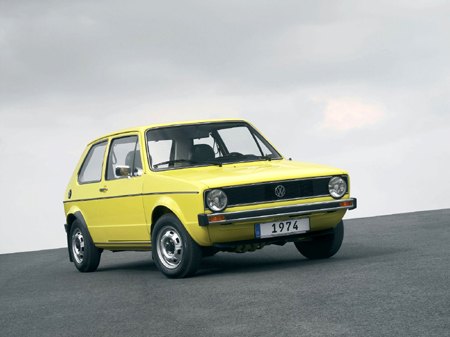
In March 1974, the first official Golf rolled past Zählpunkt 8 at the VW factory in Wolfsburg, and into the showrooms of doubtful dealers. Yet again, all predictions went out of the window: The Golf became a runaway hit.

Quickly, the Golf outsold all cars in all of Europe, a title which it defended well into the new millennium. In 2002, the Golf dethroned the Volkswagen Bug as the world’s best selling car. It was later ousted by the Ford F series truck, and the Corolla. The F truck’s success is widely repressed from consciousness, as it doesn’t jibe with current politics. The title of the Corolla is disputed as Japanese trickery.

A few years after the launch—a million was still a million—the Golf had turned a loss of 807 million Deutschmarks into a gain of 667 million. At the same time, the head of the ZAF, or the Zentrale Absatzförderung, as the Volkswagen Advertising Dept. was called, and I sat in the dining car of the train from Wolfsburg to Düsseldorf.

He wiped the König’s Pilsener froth off his mustache and announced:

“The Akademie Bad Harzburg asked me to present a case study of the success of the Golf.”

I was in awe. Die Akademie für Führungskräfte der Wirtschaft in Bad Harzburg was at the time THE breeding ground for future leading executives. Asked to give a presentation in Bad Harzburg was a high honor. It was the management equivalent to giving a seminar about rocket science at the Jet Propulsion Lab at Caltech. My guy had never been at an institution of higher learning. He had sold carpets, and then went to Ford, then to Volkswagen.

He was nervous.

“Can you help me write the darned thing?”

“Sure,” I said.

“So what are we going to say?”

Time for a beer for me.

“How about something unusual,” I offered.

“Such as?”

“The truth.”

“The TRUTH????”

“That’s right: Truth. We know, but they don’t: Nobody wanted the car. The car was wrong. Everybody hated it. To everybody’s surprise, it became a success.”

My man grunted admission. Then he went into deep thought.

He lit another cigarette and had another drink. One of the many of both he consumed every day.

“That’s a good idea. They really could learn something new,” he announced after thoughts, drink and cigarette were finished.

“A really good idea.”

In my mind, I already started writing. He lit and poured another one, then scratched an itch on his balding head.

“They would learn the most important ingredient of success: Luck, effing luck.”

I nodded furiously.

“But if I do that, I’ll get fired.”

The typewriter in my head made a last cling, and went silent.

And so it happened that, once more, students and faculty at the Akademie für Führungskräfte der Wirtschaft in Bad Harzburg were blatantly lied to.

They were told that after careful analysis of the market, after a study of the changing habits of the target group, with premonition of the rising oil prices, which everybody at VW had long seen coming, and with an enthusiastic cadre of engineers, the right car was made at the right time for the right price.

Due to the combined wisdom of everybody at Volkswagen, and the heroic effort of the Volkswagen workers, the Golf became a success, all according to plan.

For decades, the (official) version of the launch of the Golf was regarded as the textbook case of how to design, build, and market a car. The world was yet again deprived of an essential piece of wisdom:

Most big successes just happen to happen.

I was very sorry he lied, but I was very glad he kept his job. A decade and a half later, he became my partner in my own advertising agency. We continued doing the same old shtick: Advertising for Volkswagen. We made a lot of money.

The world really wasn’t ready for the truth.

By Bertel Schmitt on May 31, 2009

For more than ten years, every word a certain top executive of Volkswagen uttered in public was pure BS. I wrote his speeches. I wrote articles under his name. I even ghostwrote a book for him. I studied his mannerisms, his way of thinking and talking. He slowly but surely slipped into the role for which I wrote the script. He’s retired now but still a sought-after speaker on the conference circuit.

He liked to live and work on the edge, and I gladly walked him there. We had a strange symbiotic relationship. His trust in me bordered on the obscene. Even before major strategy announcements, his brief for the speech usually amounted to: “You know what to write.” He rarely did read the speech before giving it. He always delivered it with great aplomb and usually to thundering applause. I could put practically any word into his mouth. Power that had to be used wisely.

Twice a year, there was an international conference during which the top brass of VW’s many outposts throughout the world congregated in a European city. My job: write the keynote speech that opened the event. Then write the wrap-up speech for the finish.

The keynote speech could be written at leisure. The wrap-up speech was always written under great duress: I had to make summations of remarks by other executives that they had yet to make. The other execs played their speeches close to their chests and wouldn’t surrender their manuscripts. I finally struck a secret deal with the simultaneous translators: They would trade the classified manuscripts for the supposedly off-the-cuff closing remarks of my guy.

And again, a conference came to an end. I was slap-happy from a lack of sleep. It was his time to give the closing remarks, for which I had pulled an all-nighter, as usual.

He headed for the podium, then stopped and gave me that “come hither” wave.

“We’ve got to change the speech.”

“We’ve got to what?”

“Change the speech. Something came up.”

“Are you nuts? You are going to be up there in 30 seconds. How am I to re-write a speech which you will give in — 25 seconds?”

“Change the speech. Something happened. Something about China.”

“What happened?”

“Gotta run. Showtime. You know what to write.”

And off he went into the varilights.

As usual, I had no idea what he was talking about. I asked around. My spies rolled their eyes. It turned out that during the conference, a silly speaker had used the phrase “You in China.”

This had bothered the two Chinese delegations to no end.

To this day, Volkswagen’s business in China is run by twins who don’t get along.

Volkswagen’s joint venture partner FAW in the North is the bitter enemy of Volkswagen’s joint venture partner SAIC and the SVW venture in the South. There is no “You in China” in the eyes of the Chinese. At least not as far as VW is concerned.

Slipping a changed speech on the fly to my guy was easier than I had thought in my first shock. There was a video segment towards the end, during which a revised manuscript could be swapped with the old one.

I, however, was in a foul mood and wanted revenge.

I sat down and typed away. The printer purred. We were up to 18 point Courier—his eyesight had weakened and he was too vain to wear glasses on stage. The video came. The manuscript was swapped. I even kept my deal with the simultaneous translators and gave them the revised version to be translated into many languages.

End video. Spot on speaker:

“Ladies and Gentlemen, we nearly had a diplomatic incident at the conference,” he intoned with his usual gravitas.

“Apparently, someone carelessly referred to China as China.”

That got the interest of the two Chinese delegations. Their ears perked up.

“Ladies and Gentlemen, we are fully aware of the importance of the One China Principle.”

The Chinese delegations developed a distinct “WTF?” expression on their faces.

“We know, the One China Principle is dear to the heart of our Chinese friends. But . . . ”

Panicked looks from both Chinese factions.

“But this is Volkswagen, and as far as Volkswagen is concerned, the One China Principle does not exist!”

The Chinese delegations, at the time with short cropped hair and with a certain military bearing, because that’s where they had worked before (or were still) suddenly sat ramrod straight in their seats.

“Get it in your heads, there is no ‘One China’ at Volkswagen!”

Some Chinese went pale and gasped. Mouths dropped.

The rest of the audience—not as much in tune with Chinese politics as they were with corporate politics—was mostly oblivious.

“The One China Principle doesn’t exist at Volkswagen. There is FAW-VW in the North, there is SVW in the South. Keep that in mind and keep it apart.”

The Chinese delegations exhaled, looked at each other. One Chinese tried on a sheepish grin and it was returned by the other Chinese. Then they laughed, and finally broke into a roaring applause. The rest of the audience, still oblivious, but polite, joined in.

When the speech was over, both Chinese delegations rushed to the podium, slapped him on the shoulder, pumped his hand, a chorus of “xie xie!” and “heng hao!” ensued, one ebullient and short-cropped Chinese even hugged him.

He took the adulations in stride.

Then he waved me over and whispered:

“What did I say?”

By Bertel Schmitt on May 24, 2009

From 1973 through 2005, my job was to create excitement for Volkswagens in the hope that people would buy them. The job had its ups and downs. We loved facelifts and hated totally new cars. With a facelift, we could travel to attractive and warm places for the photo shoot. “Because of the sun.” Not to mention the beach. And the nice amenities of the Hotel Negresco in Nice. With a facelift, we could tool around in broad daylight, and nobody would bat an eye or even think of snapping a picture. Which magazine would publish the spy shot of a re-designed bumper? Totally new cars were top secret. Not allowed to travel outside the confines of the VW factory. Even there, constantly under tarps. The only places we could photograph them were at the in-house photo studio or at the VW proving grounds in Ehra-Lessien.

Ehra-Lessien (”Ehra” for short) was—still is—in a godforsaken place north of Wolfsburg. Surrounded by woods, barbed wire and an army of guards, Ehra is Europe’s largest test track. According to Wikipedia, “they had originally built it here during the Cold War, because it was a no-fly zone on the East German border, safe from prying eyes seeing secret prototypes.”

We said they built it there because they saved barbed wire on the one side abutting the death strip of the border. It was a lie. Everybody who knew Volkswagen—but not the environs of Ehra, Boitzenhagen and Küstorf—believed our version. Ehra houses 100 km of roads of all stripes, from mudholes to banked corners which can be taken at top speed while your car is glued to a wall. You may have seen it on Top Gear, when James May hit 407 km/h in a Bugatti Veyron.

Sound exciting? Compared to Nice, it’s boring as hell. We hated Ehra. It was a bad assignment. “Ehra wem Ehra gebührt,” we said; a bad pun that requires knowledge of German to understand. The weather was usually rotten, especially in the months before the inevitable spring launch. Most of the time was spent waiting for the sun to come out. We spent weeks in Ehra in the rain.

I learned to drive in Ehra. I did Volkswagen advertising and didn’t have a driver’s license. I was in good company; VW of America’s advertising director in the 60s didn’t have a license. Helmut Schmitz had hired DDB, the agency that did the classic “Lemon” or “Think small” ads. (He ran that agency later.) Werner Butter, President of DDB Düsseldorf, didn’t have a license. He had lost an eye when he was young and didn’t qualify. Asked how he could sell a product he couldn’t use, Werner inevitably answered: “I also do ads for tampons.”

Not having a license made us unprepossessed: we would sell anything VW came up with. Engine in the back? Great. Front? Super. Aircooled? The best. Watercooled? State of the art. 4, 5, 6, 8 cylinders, gas or diesel, we loved it all. Also, we consumed inordinate amounts of alcohol during, after, and before work. A driver’s license would have been a waste of time and money better spent in bars.

But what do you do when you are bored and surrounded by cars and 100 km of non-public roads? You sit in a car. You turn the key. What did they say, push the gear, shift into clutch—or was it the other way round? I quickly found out. After some stints in Ehra, I could drive (illegally).

Again, it was time to launch a super-secret new car the world hadn’t seen before and wasn’t supposed to see before the designated date. So there we were sitting in a hut next to the Dynamikfläche in Ehra, and it was pouring rain. Outside were a bunch of highly classified handmade prototypes, some with only one side finished. Why waste the money on the other side if it doesn’t get photographed?

The photographer and his crew loved it as they were paid by the day. We played cards with the guards. They loved it, too, because watching us advertising yo-yos was better duty than standing in the rain. Their job: keep us from doing something entirely stupid like driving a hand-made prototype (that cost a million dollars to make) at 200 km/h through aforementioned banked corners. It happened. Once.

The Dynamikfläche is a huge skid pad, half a kilometer in diameter, flat as my Japanese wife’s chest. It’s surrounded by dense woods. With the rain coming down, it glistened like a lake. I mean, the Dynamikfläche did.

There was a faint “quack-quaak” in the distance.

One of the guards said: “Here comes dinner.”

The other guard dropped his cards and grabbed a canvas bag. The guards went outside. We followed. The rain had subsided to a drizzle, rays of sun on the horizon.

The “quack-quaak” turned louder. In the air, five ducks in perfect V-formation.

“Quack-quaak!”

The ducks were on final approach, headed for a landing on the glistening lake surrounded by the dense woods.

With a last “quaak,” they flared. Made contact with the concrete. Tumbled over each other in a big ball of duck feathers. Broke their necks and were dead before they stopped skidding.

The guards went out and collected them in the canvas bag that had obviously seen ducks that had met a similar fate on what must have been the world’s most expensive and most elaborate duck trap.

We declined the offer of a dead duck.

Next day, the sun was out and we could get on with our business of creating anticipation and desire for a new Volkswagen. At lunch, we shared some cold duck sandwiches. Guaranteed lead-free.

By Bertel Schmitt on May 17, 2009

In the late 70s, after Volkswagen had launched their new worldwide dealer network under the mysterious V.A.G. moniker. The V.A.G. dealers received a strong voice, their own national advertising campaign and a renewed focus on the importance of service. No wonder. Then as now, after-sales is the VW dealer’s number one profit center. The profit contribution of parts alone was often 30 percent or more. In 1979, for the first time, VW invited the service guys to the IAA auto show in Frankfurt. The suits asked me to come up with a spectacular concept for their debut. My first idea: fix cars live, Formula 1 pitstop style. Everybody liked it—until someone found out that the maximum height of the booth was 2.5 meters, way below the heights of the lift. Scratch that idea. Then I had an odd thought: Why not do it virtually?
This was 1979. “Virtual” wasn’t part of the vocabulary yet. I, however, was a closet nerd. Four years before, I had bought a copy of Popular Electronics at the magazine shop of the Düsseldorf Airport. I saw an ad for something called “Altair.” Supposedly the first computer. I sent $400 to a company called MITS in Albuquerque. For months, nothing happened. I wrote the money off. Then I received a postcard that required my presence at the Düsseldorf customs office.

In front of a suspicious customs official, I opened a strange package. It contained unpopulated circuit boards, hundreds of resistors, bags of chips and a manual. I was supposed to explain what it was. I couldn’t. It was the world’s first personal computer, unassembled. There was no customs tariff for an unassembled personal computer. We decided that it was ”training material”—no duty. The customs official rightly assumed I was crazy, and he didn’t want to make my life any harder than it already was.

A year later, after a lot of soldering, I had a working Altair. I was also a member of the Homebrew Computer Club—most likely the only member from Germany. I even had an occasional article in Dr. Dobb’s Journal of Computer Calisthenics – Running Light without Overbyte. I bought a roll of punched tape from a hippie who was long on hair and short on personal hygiene. Bill Gates’ BASIC required a Teletype, hard to get in Germany, where the 5 bit Baudot Fernschreiber ruled. I got a used Teletype, olive color. It carried a plaque reading  ”U.S. Army.”

Time had moved on, In 1979, a geek could buy an Apple II with GRAPHICS! So I sold Volkswagen on the strange idea that we show how a car is serviced . . . via interactive video. Which didn’t exist. At the IAA, the customer was supposed to input in the computer car model, color, and type of trouble. And voilà, a video would appear.

You put in “Golf,” “Yellow,” “Brakes,” and a video would show a yellow Golf that had its brakes fixed. Breathtaking.

We spent half a million Deutschmarks to video about 500 short segments (green Golf enters workshop, red Golf enters workshop, blue Golf enters workshop, black Golf enters workshop, green Golf goes on lift . . .  You get the picture). In the meantime, an engineering firm in Hannover custom engineered a box that interfaced a Sony U-Matic 3/4″ videotape machine to the Apple II. The U-Matic didn’t even have timecode. So they put a 50Hz signal on one audio track, and the box counted the ups and downs of the frequency. My friend “Spermy Hermy” Hettche (he fathered a lot of children) wrote the software.

A day before the car show, the stuff actually worked. We put in “Golf,” “Yellow,” “Brakes.” U-Matic seeks. Yellow Golf appears. U-Matic seeks. Mechanic looks at yellow Golf. U-Matic seeks. Yellow Golf goes up lift. U-Matic seeks. Mechanic looks at brakes. And so on. Ad nauseam.

On the opening day of the IAA, we provided 10 video stations. A few people approached. After the third seek of the tape machine, they usually gave up and walked away. How exciting can it be to watch someone fix your brakes? Especially when interrupted by 30-second seeks of a tape machine? In contrast. . .

Another booth. A desk. A person. A telephone. The customer would tell the person how badly the dealer had treated him. The person called the dealer. “Here is Volkswagen. Herr Maier has a complaint. He’ll be there on Monday, and you will take good care of him.” That was the hit of the show.

The interactive video idea was swept under the carpet and forgotten.

Ten years later, I ran into Nicholas “Nic” Negroponte at a joint event. He had created the MIT Media Lab. As Wikipedia puts it, they developed “into the pre-eminent computer science laboratory for new media and a high-tech playground for investigating the human-computer interface.”

I told him about the Apple II and the U-Matics. “When was that?” he asked. “1979. It was a disaster. I’m still embarrassed.” “Don’t. Be proud. You most likely did the world’s first interactive video.” Yes, well, interactive video never really caught on. I’m not surprised.

Recent Comments


Auto Insurance GPS Navigation
Car Loans Auto Parts
Car Warranty Wheels
Automotive Tires Car Care