

By Robert Farago
January 5, 2005
Bristol is one of Britain's most venerated carmakers. For over thirty-five years, Brits "in the know" have considered the obscure automaker's products to be the embodiment of English hand built quality and understated exclusivity. Unfortunately, motoring journalists need not apply. In fact, Bristol actively discourages any sort of publicity for its current cars. A test drive is "out of the question".
A few weeks before the end of my English adventure, I gave Bristol one last try. I immediately recognised the cut-glass accent on the other end of the phone: Tony Crook, former RAF pilot, racing driver and the undisputed Emperor of Bristol Motor Cars. Luckily, the octogenarian and self-professed "living legend" didn't recognise my voice. Mr. Crook agreed to a "five-minute chat".
Discretion being the better part of valour, when my turn to speak finally arrived, I tried to establish a few simple facts. How many cars does Bristol make? "We don't quote production figures," Mr. Crook replied. "We always build fewer cars than people want." How many craftsmen does Bristol employ to build this indeterminate number of cars? "Not stated." How much does a new Blenheim 3 cost? "One hundred and thirty nine thousand pounds." (Approximately $250,000) How much for the more "sporting" Blenheim 3S? "Considerably more." What sort of improvements does that include? "Bigger camshafts. That sort of thing."
And there you have it. A test drive was still impossible. Thank you and goodbye.
I would love to tell you how I got my hands on a Blenheim. It's a story that involves some truly Dickensian characters: quick-witted, long-suffering mechanics labouring in dark garages; a short-tempered multi-millionaire who believes that anyone who can't afford a Bristol is in no position to judge it; a motoring journalist whose florid prose poems to the marque are proof positive that love is blind. Suffice it to say, everyone I contacted in my quest for some Blenheim wheel time either refused to speak to me or laughed (guffawed?) at my request to drive their car.
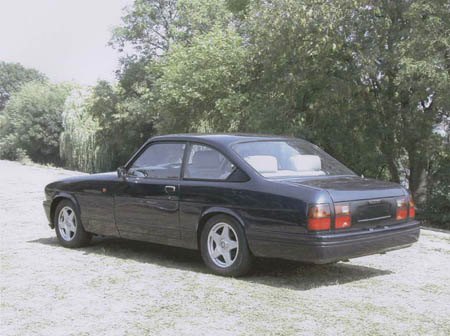
Luckily, one brave Blenheim owner decided to step out from Tony Crook's long shadow. I eventually encountered a Bristol Blenheim in front of a sturdy brick manse in northern England, bathed in afternoon sun. Suffice it to say, the car's design did not complement it salubrious surrounds. It's angular aesthetics were a far cry from the organic, streamlined forms of Bristol's earlier models. As for the way the Blenheim was put together…
"What are the two things that can be seen from outer space?" the owner asked rhetorically. "The Great Wall of China and the panel gaps of a Bristol." True enough, despite the fact that this particular Blenheim had recently enjoyed a body-off restoration– to eliminate rot. Which was discovered after the car's paint had cracked (necessitating a total re-spray). Whereupon the owner's mechanics addressed a veritable laundry list of mechanical ailments: inoperative air conditioning, "inappropriate" shock absorbers, a failed exhaust system, two blown window motors, axle whine, insufficient engine cooling and more.
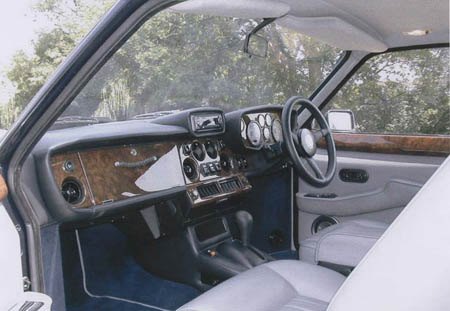
This tragic tale of mechanical malfeasance was easily eclipsed by the horror lurking inside the Blenheim's cabin. To call the combination of wood, cheap rocker switches, tiny mirror controls, gigantic air conditioner, fiddly Japanese stereo and seemingly random assortment of switches, buttons and knobs "unattractive" would be like calling a drag racer "quick off the mark". The Blenheim's interior is such a hideous concoction of styles and textures the snooty millionaire mentioned above felt compelled to redesign and rewire the entire dash.
Once underway, the much-repaired Blenheim handled better than you'd expect– for a car whose chassis dates back to 1946. At the time, it must have been a revelation. By today's standards, Group A rental cars offer better ride and road-holding. As for power, the 5.9-liter V8 felt decidedly reluctant. When I asked if the odd sound under throttle indicated some kind of problem, the owner told me to drop the subject.
All in all, as my father would say, "another myth exploded". The Bristol Blenheim offered insufferable build quality, questionable reliability and appalling aesthetics. Yet it cost twice as much as a top-of-the-line Mercedes, BMW or Porsche. Tony Crook will disagree to the point of apoplexy, but the only possible justification for buying a Blenheim lies in its rarity and its connection with Bristol's famous heritage. For some wealthy owners, a handful, it is enough.
But is it enough to keep the Bristol Car Company going? Probably not. Which is why, under new co-ownership, Bristol has produced a new car built around a Chrysler V10 engine. As test drives are still strictly verboten, one can only hope that the Bristol Fighter signals a return to the company's glory days of meticulous build and innovative engineering. If not, no amount of badge snobbery can sustain this manufacturer of overpriced, under-engineered automobiles.
6 Comments on “ Bristol Blenheim Review ”

Leave a Reply
Back to Top
You must be logged in to post a comment.
Subscribe to New Content Alerts
More Reviews

BlinkList
Digg
del.icio.us
Facebook
Furl
Google
Live
NewsVine
Reddit
StumbleUpon
Technorati
YahooMyWeb
POWERED
July 16th, 2007 at 2:05 am
After looking at the photos of this car, I am in literal shock and awe that it exists, and that it is indeed being created to this very day. The vehicle looks, at least on the exterior, as if its last model year should have been circa 1984, while the interior looks as if its last model year should have been…well…the very moment it was put into production. What a disgrace that Bristol Motor Cars and Tony Crook himself should be producing this monstrosity, this poor excuse for badge snobbery and money making. Pathetic.
November 25th, 2007 at 7:38 pm
I respectfully disagree with the review.
For a start, to get price on the 3S going to the Bristol Car web site http://www.bristolcars.co.uk/Blenheim3S.htm will show the published price of Basic £134,750.00 VAT £23,581.25 Total £158,331.25. The reviewer is converting into US dollars, so Value Added Tax may not apply. The company web site will also explain in detail what extras the buyer gets.
To look at a Bristol, one need not skulk around North England associating with Dickinsonian characters, although it does make for writing in the “it was a dark and stormy night” genre. Presuming the reviewer went to England, the first stop would be a few miles down from Heathrow Airport where new Bristols are on display in the showroom. If you don’t like Mr. Crook, speak to Mr. Silverton, who owns the company (since 2001). By the way, as of this writing, Mr. Crook has retired at the merry old age of 87.
To look at used Bristols, go to http://www.boc.net the home page of the Bristol Owners Club, and learn about the club meetings or what car shows they will be visiting with displays. At those meets and meetings, you will find drivers and enthusiasts from the full range of Bristols… 1946 through current models. If you are friendly, owners may kindly volunteer a test drive – but be aware you may be driving a decade-old car or older.
The reviewer then goes on to evaluate a Bristol that is reputed to have undergone a body-off restoration due to rot. How old? The model began production in 1994 and could be 13 years old by now. We must assume the reviewer is suggesting (but does not state) that the restoration was done by the factory, and we must assume the owner instructed the factory that cost was no object in bringing the car back to factory new. We need to know if these two assumptions are correct or not.
A car that is so badly rotted as to require the body be removed is, with few exceptions, a candidate for the crusher. That a Bristol is even worth such rescue sets it apart from other cars.
But then, if it is so rescued, one has to ask who did the work, and what budget and time frame was provided? One also has to ask under what conditions the car was driven and for how many years to require such a restoration?
Bristol has a remarkably high survival rate, with the club registry showing cars on the road from every single production model starting with the 1946 ones. Some suffered from mid-life neglect when they were bought by posers who wanted the ego boost, but could not afford proper maintenance. Some are driven in salt without protection and cleaning, parked outdoors for years on end, and when something failed, parked in a field for more years. If it were a Ford, it would have been hauled away and crushed. But in the case of a Bristol, some bold enthusiast would recover and restore it.
A few of those cars get proper restorations, but the price of restoration exceeds market value, so this is the domain of the passionate and rich. Many get brought back to running status, but with details neglected. It will drive like a car, but not drive like a Bristol.
Bristols are not cars for the masses, thus to judge the car by mass production applies the wrong test. If one wants a top of the line mass-produced Mercedes, BMW or Porsche, one goes to one of hundreds of such dealers, plunks down the dosh and drives away.
Bristols are hand made, and hands are never so precise as computer driven machines and lasers. Even the relationship of buying is personal. The salesman owns the company… for 45 years it was Tony Crook, now it’s Toby Silverton. Send a car made in 1970 back to the factory, and the fellow who built it will remember it. Order a part not in stock for a 30-year-old car, and be told to come back on Tuesday. The factory made it on Monday; Tony Crook flew out from Heathrow to Bristol aerodrome and brought it back. You need a part for a 45-year-old car? They may still have it in stock, ex 1962 or even ex 1952 since they only change designs when engineering demands it.
“Another myth exploded” writes the reviewer. What myth? Bristol does not truck in myths. They make few claims. They mostly build to order, so the customer is already sold before they place their order. Customers for new cars are a different breed than the reviewer. They are rich. Seriously rich. Rich enough that they don’t really concern themselves with the fact that it is double the price of Germany’s finest. They also dress down. Sure they could afford a Rolls, but that calls too much attention. They want a Bristol, and they want it for reasons completely different than the standards the reviewer sets.
The reviewer contends the car performs badly based on a test drive in one that is not in factory condition, but an old rotted one brought back to life and owned by an unhappy owner. The reviewer criticises the engine performance. The engine is a Chrysler. If the performance of the test unit is weak, then maybe the engine has a problem. But the Chrysler V8 engine as a brand is as proven as one can ask.
As for handling, check the rubber bushes. After a decade or more of use and aging, the handling can begin to feel sloppy or worse. Tony Crook was a race driver, it took him a long time to even agree to provide power steering (midway through the 409 series) and when he did, drivers agree the ZF unit gave excellent road feel.
Interior aesthetics? No, it’s not a plastic fantastic where even the wood veneer looks as if it is coated in epoxy, like the Mercedes. It’s old school British. Flat panels of wood, real (and fine) leather and a grudging concession to safety that required Bristol give up the rocker switches and go to plastic flat ones. You do need to remember however, that with production in the dozens or hundreds per year, one does not place a bulk order for custom switches. One buys what the market supplies, and Tony Crook was never one for poofery. If it worked, if it switched on the lights, that was good enough for him. No Moet Hennessy Louis Vuitton edition for him. And since it was his company, what was good enough for him is what he offered for sale… and when Aston Martin, Jensen, Rolls Royce and all those other marques got into trouble, he kept selling just enough cars to keep him enjoying his passion.
What Mr. Crook does not have any interest in is what the motoring press says. To the contrary, he wants to be left alone. Bristol shows little interest in the motoring press in part because unlike almost all other marques, it does not need them. The press writes for an audience unlikely to find themselves in 368 - 370, Kensington High Street, or if they did, unlikely willing to part with the admission price because they bring a different value set.
If one were to summarise Bristol, it is about authenticity in a world of mass production and franchises. A few human beings appreciate authenticity, and value the work of a man’s hand over the price-performance of the era of automation. Bristol has two audiences. For new cars, the buyers are rich yet have some discernment in what they buy.
For used (older) cars, the buyers tend to love engineering over image, and they get a bargain because the cars are not well known so underpriced relative to comparable British classic marques. Andrew Blow, who brokers many of the used Bristols lists them typically for £8000 for a decent one up to £25,000 for an excellent or properly restored one. See http://www.racecar.co.uk/andrewblow/contents.html He is most conversant with the lemons out there as well… the ones badly restored or tarted up.
It’s a small circle. One owner thought he was smart stuff by having his car repaired and then driving off without paying. Word gets around. He took it to another one of the repair shops, and when he went to pick it up, he was told to pay the other shop first. How many Mercedes or Porsche dealers would do that for one of their competitors?
I write this reply for the one in million drivers who would otherwise be misled by the above review. Driving and owning a Bristol is a path few take. It takes weeks of driving to begin to appreciate its qualities. There is something quiet and peaceful about it; it’s an absence that takes time to recognise. It’s like living in a city and walking out at three in the morning to notice something different… heavy snow fell and it stopped the traffic. The air is cleaner, quieter and something is missing… that buzz that is so familiar as to be accepted as normal.
Bristols have a different feeling to them, a feeling no Mercedes, BMW or Porsche can match. But it is a feeling that requires the car be ship-shape, not tired or abused, and it is a feeling that takes weeks to sense and a broader vocabulary than mine to articulate.
Disclosure: The author of this critique has no connections or affiliation with Bristol Cars or any other Bristol business. This author has owned five used Bristols over the years and currently owns one Bristol as well as a Mercedes and a Toyota. Over the years he has bought new Mercedes, and various BMWs including one H&B set up for racing. He is qualified to compare the difference.
November 26th, 2007 at 4:17 pm
The thing about Bristol Cars is that you either get them or you don’t. My business partner hates mine and can’t understand why people come up and start enthusing over it every time you pull up at the lights or park up. My kids love it, as do their friends, especially sitting on the sofa like seats, which they reckon are the most comfortable ever made.
I drive mine daily and I absolutely love driving it. It is luxurious, smooth, powerful, hugely maneuverable and I can go anywhere in it without offending anyone’s sensibilities. These are the qualities that only a Bristol embodies.
They depreciate very slowly and fortunately for enthusiasts, they last a very long time. By the time they hit classic car age they are eminently affordable as they don’t have a badge premium unlike some marques which were the pin ups for previous generations. Like the Forth Bridge they go on and on and Owners Club members regularly put 15k miles a year up their cars, even when the cars are older than they are. How many other makers can say that of their cars.
Each car is unique, I have met the men who built my car and have maintained it ever since. It is handmade which does mean that it has quirks and like most things made from scratch by a man it has imperfections, it is built using hand tools not computers. If you should be so fortunate as to be able to afford to have one built for you, then that is what you get, a car built for you. Personally. Just like bespoke shoes or a hand made suit it will fulfill it’s purpose perfectly, speak quietly and last a lifetime. For that last reason it won’t conform with fashion, it is not a style statement or a display of wealth. just the quiet enjoyment of the best that life can offer. Bristol’s walk quietly and carry a big stick, as my own dad often advises this is the best way to approach life.
Part of the fun of being a Bristol owner has been the joy of dealing with Tony Crook. Unfortunately he has recently retired at 87 and that chapter of the history has closed to open up a new era. A test drive with Mr Crook has been one of the more memorable hours of my life. Hopefully someone will write a biography of this very english eccentric. As a very private man he certainly never would himself. Neither would the factory director, who is 88 and has now worked for the company for an incredible 62 years. He knows every single car the company has ever built, and has driven each of them.
It is really unfortunate that the car driven for the review was obviously old and unloved. A worn out car is not a fair reflection of the marque.
If you are on a return trip to the UK there are many owners who would be more than happy to share their car with you for an hour, perhaps you might even get a run in a Fighter. It is unlikely that the Company will supply a test drive in a brand new car, it will after all have been made especially for a customer, and like Lobbs of St James they wouldn’t let you try on another man’s shoes.
Like the previous post, I have owned Porsche, BMW and Merc cars and driven Aston’s Morgans, Maseraiti and Bentley Company and friends cars and enjoyed them for a while, but none has made me feel special in the way that my Bristol does. (I am not connected with the Company in any way either)
If you are at a place in life where you appreciate the real value of something and don’t want to wear a Logo then a Bristol is pretty much the only choice of car to buy. They transcend money, whether you have money or not anyone can enjoy a Bristol.
November 26th, 2007 at 7:17 pm
Message for ‘Enthusiast’. You say your Bristol attracts a lot of interest, which Bristol model is it?
April 1st, 2008 at 6:24 pm
While it is blatantly apparent that there are three sides to every coin, there is little genuine reason to behold the Blenheim which remains visually inside retentive esoteric domains to the absolute. Proportionately so in my opinion, that it is what it is and if folk wish to spend thier hard earned on one it is a choice.
Someones junk is another one others gold and rightly vice versa of course. As long as we all are capable of dialogue there will always be a disparity of opinion and due regard for Bristol design. It is a given, and as far as Bristol Cars are concerned it is clearly intended by now. Whether or not that is a wise choice remains to be seen, although I personally doubt this. A couple of things do bother me however and have done so for decades. One would be the continued non admission of any sort by Bristol Cars. The other would be the irritatingly singular and galvanised viewpoint of particular Bristol users.
It is a little sad, but it is at the same time a legacy.
June 16th, 2009 at 3:46 pm
[...] Crook, who was personally responsible for the design, sales and service of each car and famously refused test drives to the motoring press. He retired a few years back at the age of 87, but most of the designs he supervised remain in [...]