


America's Best-Selling Vehicles in 2016, State by State - What Are Your Neighbors Buying?


The Toyota Camry, America’s best-selling passenger car in 2016 for a 15th consecutive year, was not the best-selling overall vehicle in any one state last year.
According to registration figures tabulated by Kelley Blue Book and highlighted by USA Today, the Honda Accord, Honda Civic, and Toyota Corolla were the only cars to claim any state-wide auto sales victories.
In 15 other states, utility vehicles of one variety or another (Ford Escape, Honda CR-V, Subaru Outback, and Toyota RAV4) were tops in overall vehicle sales. Hawaii’s sales crown stayed in the hands of the Toyota Tacoma. GM’s full-size truck twins ruled the roost in eight states, largely east of the Mississippi.
That leaves the Ford F-Series’ F-150 variant, the top-selling vehicle in America, to take top honors in 22 states, including its biggest market of Texas.
It’s worth noting that automakers release sales figures for full-size trucks such as the F-150, Silverado, and Sierra in a manner that encompasses the entire light-duty and heavy-duty lineups. KBB’s registration figures highlight the respective half-ton variants.
The most significant local anomalies relative to national status are the victories scored in Washington, Oregon, and Colorado by the Subaru Outback. The Outback was America’s 27th-best-selling vehicle overall in 2016, generating only half as much volume as the Honda Civic.
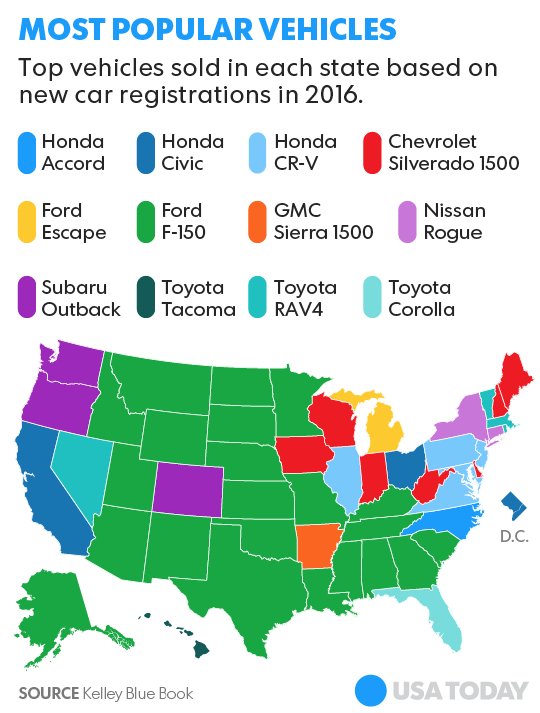
All but one of the passenger car victories were scored in coastal states. The Corolla was 2016’s top seller in Florida, the Honda Accord was North Carolina’s most popular vehicle, and the Honda Civic outsold every other vehicle in California, D.C., and Ohio, home to more than half of Honda’s U.S. production in 2016.
Meanwhile, in 10 of America’s 11 least-densely populated states, the Ford F-150 was the most popular vehicle. In 22 of the 25 least-densely populated states, pickup trucks – F-150, Silverado, Sierra — were the sales leaders.
[Images: Ford, Kelley Blue Book via Twitter]
Timothy Cain is a contributing analyst at The Truth About Cars and Autofocus.ca and the founder and former editor of GoodCarBadCar.net. Follow on Twitter @timcaincars.
More by Timothy Cain


Comments
Join the conversation
So.......the least dense you are, the more likely you will buy a full sized pickup. Aluminum and turbo V6 was such a failure for Ford ;)
When Texas was admitted, it could break itself up into five states if it wanted to. You should have done that, since it's likely that southeast, northeast, Rio Grande, central, and west Texas all have somewhat different tastes. You could do the same for California, since bay area preferences aren't shared with northern california, the central valley, the L.A. basin, the high desert, or San Diego areas. I suspect you could divide Florida into three or four zones of different preferences too, along with east-west Pennsylvania, upper NY vs. NYC metro, and downstate Illinois vs. Chicago metro. Those top six states by population (and sometimes area) have multiple urban areas that can skew the overall choice. Politicians already know those states have to be addressed by regional concerns.