


Mercedes' Inline-Six Makes the Rest of Its Impressive New Motors Look Like Mechanical Plebs

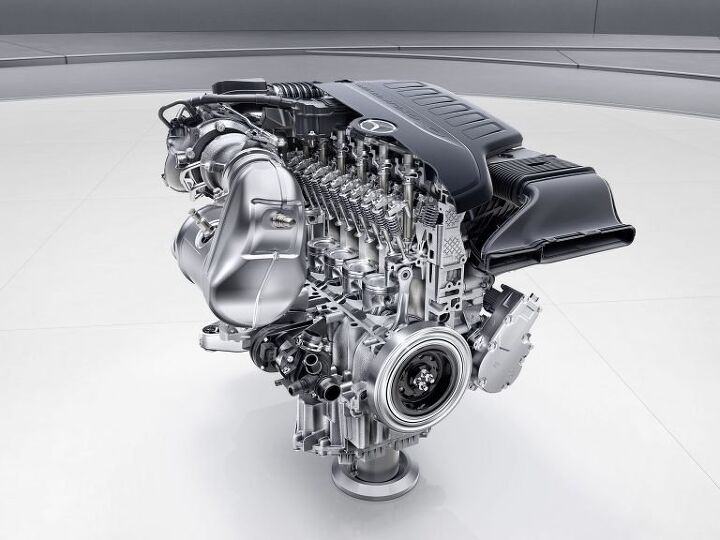
Mercedes-Benz is introducing a host of new engines with clever shared modular components, including a standard 500cc cylinder displacement.
These new engines include a new AMG-developed twin-turbocharged V8 for the S-Class and one of the most encouraging mechanical additions to the automotive landscape seen in a while — a high-tech inline-six specifically designed to compete with, and outclass, larger motors.
While Mercedes wants to keep you interested with claims of vastly improved economy across platforms, enhanced efficiency is definitely not the most impressive bit of engineering on offer. For example, the aforementioned inline six-cylinder features 48-volt systematic electrification, so there’s no belt drive for ancillary components at the front of the engine. This reduces the overall length of what would normally be a fairly long motor and frees it up for packaging in areas that may have not worked otherwise.
Those 48 volts also work with the engine’s electric turbocharger. Mercedes claims that it only takes the e-turbo 0.3 second to reach 70,000 rpm, followed by the larger twin-scroll exhaust-driven turbo. The intended result is seamless linear power delivery without any turbo lag. The new inline-six is rated by the company to “at least” 408 horsepower and 369 lb-ft of torque and Mercedes says it’ll come in silky smooth with 15 percent better CO2 emissions than the current V6 being offered.
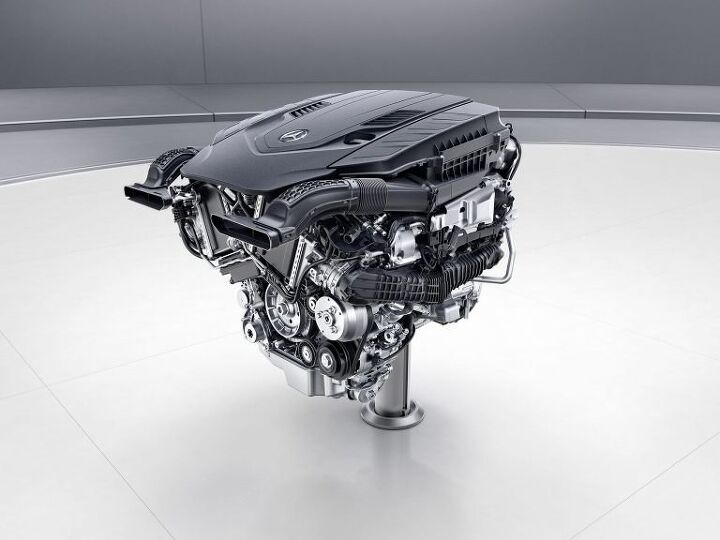
The other spec sheet darling is the slightly lower tech M176 twin-turbo 4.0-liter V8. Although, on paper, this engine looks very similar to the 4.0 biturbo that Mercedes-Benz is already producing, right down to the matching 17 pounds per square inch of boost pressure.
Mercedes says this V8 will output over 476 hp and 516 lb-ft in the upcoming 2017 S-Class with a 10 percent improvement in economy — partly due to cylinder deactivation. However, cylinder shutoff is only active in an engine-speed range of 900 to 3,250 rpm and only when the vehicle operator has selected one of two conservative driving modes. Otherwise, it’s a full-time V8.
In addition to two diesel engines that are somewhat less likely to show up in North America, Benz is also offering a practical 2.0-liter turbo four for next year’s more economic models. The package includes twin-scroll turbochargers that merge the exhaust gas ducts of cylinder pairs into a “flow-optimized” manifold. Mercedes says this setup aids in the production of low-rpm torque. The engine also has a belt-driven 48-volt starter-alternator that is responsible for for fuel-saving hybrid functions such as energy recovery, imperceptible on/off at stops, and boosting the engine-speed range up to 2,500 rpm.
[Images: Mercedes-Benz]
Consumer advocate tracking industry trends and regulations. Before joining TTAC, Matt spent a decade working for marketing and research firms based in NYC. Clients included several of the world’s largest automakers, global tire brands, and aftermarket part suppliers. Dissatisfied, he pivoted to writing about cars. Since then, he has become an ardent supporter of the right-to-repair movement, been interviewed about the automotive sector by national broadcasts, participated in a few amateur rallying events, and driven more rental cars than anyone ever should. Handy with a wrench, Matt grew up surrounded by Detroit auto workers and learned to drive by twelve. A contrarian, Matt claims to prefer understeer and motorcycles.
More by Matt Posky




Comments
Join the conversation
Hopefully Japan will follow Germany's lead, and this will convince Toyota and Nissan to make inline sixes again. I want a successor to the JZ, dammit!
It's just a shame Mercedes lag behind with their own gearboxes while everybody else uses ZF or Aisin. 48v will soon be the norm. Another manufacturer was saying it was becoming a necessity.