


2019 Toyota Sienna: Bringing All-wheel Drive to More of the Masses
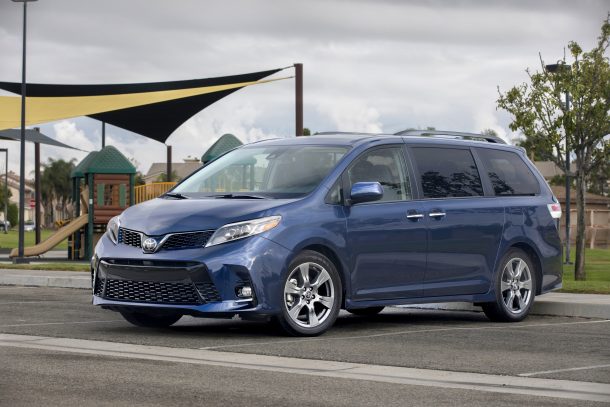
As the Ford Aerostar and Toyota Previa fade from our collective memory, one could be forgiven for thinking minivans were always a front-drive proposition. As for winter-beating all-wheel drive, a laundry list of crossovers and SUV fill that buying space, poaching sales from the once-hot minivan segment.
Still, one model continues offering four-wheel traction for buyers who aren’t scared of being seen in a traditionally uncool minivan. That model, the Toyota Sienna, enters 2019 with more AWD availability. As an underdog in the segment, it seems Toyota wants to sell its offering as the more family-friendly SUV alternative.
First noticed on order guides by CarsDirect but now live on Toyota’s consumer website, the 2019 Sienna isn’t relegating the AWD option solely to the top-spec XLE trim level. Now, buyers of mid-range SE and SE Premium models can fling snow from their rear rubber, too.
While the base LE ($32,160 after destination) remains front-drive-only, the trickle-down AWD option means getting into a grippier Sienna is significantly cheaper than last year. An AWD SE stickers for $39,815 after destination, compared to $38,310 for a front-drive model. Moving up to an SE Premium AWD means forking over $45,910.
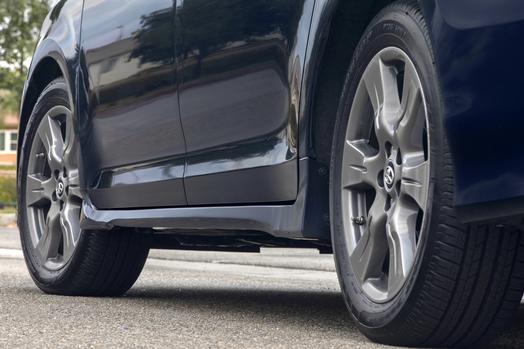
Choosing AWD means swapping the front-drive model’s 19-inch wheels for 18-inch hoops, providing more rim protection during those inescapable off-road minivan excursions. You’ll also forgo the eight-passenger interior for a seven-person layout, though backseat passengers might find the perforated leather captain’s chairs more to their liking, anyway. Standard goodies include an Entune 3.0 Audio Plus system with Apple CarPlay and Amazon Alexa, navigation, and Toyota’s app suite.
With Chrysler’s Pacifica and Honda’s Odyssey offering fresher sheetmetal, the Sienna’s sales year hasn’t been a good one. July sales sank 39.1 percent in the U.S., with volume over the first seven months of 2018 dropping 21.6 percent. With 52,761 units sold by the end of July, the Sienna’s volume is 44.2 percent lower than at the end of July, 2006 — the Sienna’s best sales year.
As for the Sienna’s rivals, Odyssey sales rose 3.8 percent, year to date, with Pacifica volume up 6 percent. The minivan segment’s perpetual best-seller, Dodge’s ancient Grand Caravan, saw its pool of buyers increase 8 percent this year.
[Images: Toyota]

More by Steph Willems






Comments
Join the conversation
"top-spec XLE trim level" - what happened to the Limited? Limiteds are practically Lexus-like, with gathered leather, wood (okay, it's fake) trim, and items like a memory seat.
My family had a Sienna. The reason we had a Sienna and not an Odyssey was because Honda didn't provide an AWD option. My wife who made the ultimate decision on which minivan to buy liked the Honda better. But AWD won out, given snow/ice is a daily occurence for us 3-4 months a year. It has always baffled me how Honda ceded that entire market to Toyota. We kept that Sienna for just under 100K miles with absolutely no issues. And talk about holding its value!! MSRP was $37K, we sold it private party 6 years later for $16,500. That was impressive. The one downside were the run flat tires. They lasted 20-25K miles and cost a fortune to replace. I hate those things - run flats - with the passion of 1000 burning suns.