


The 2016 Honda HR-V Is Honda's Worst Current Product

Every week, I’m driving something different. Just yesterday, I shuffled out of a Fiat 500X Trekking AWD into a Mercedes-Benz GLC300 4Matic for a true back-to-back nine-speed automatic transmission comparo. (Mercedes-Benz wins.)
But in the real world with real money, our family vehicle is a 2015 Honda Odyssey. It’s not our first Honda; it likely won’t be our last. I consider the Accord to be the best midsize sedan on the market. I managed to enjoy a week with the new Honda Pilot despite a troupe of electronic gremlins. I believe the Integra GS-R is the ultimate expression of all that was right with the auto industry. Yet I am not remotely close to succumbing to the notion that Honda can do no wrong.
Crosstour? It’s ghastly and expensive. CR-Z? Sadly, it’s boring and not terribly efficient. Second-gen Insight? A lackluster response to the all-conquering Prius.
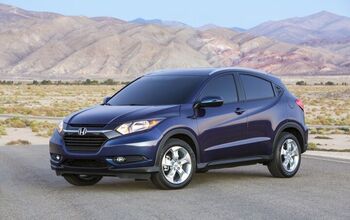
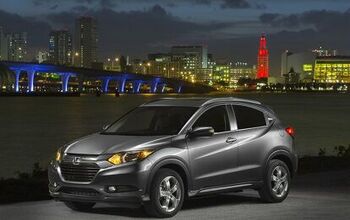
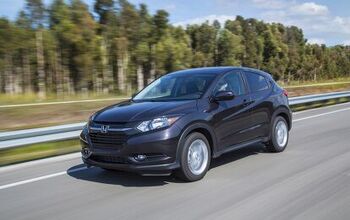
HR-V? Quite successful, but also loud, uncomfortable, slow, overpriced, and frustrating.
Priced (in the United States) at $26,890, the 2016 Honda HR-V EX-L Navi AWD is incomplete and unfinished. There are reviews aplenty for those who wish to read about the HR-V’s positives: we published on GCBC last week; Alex Dykes’ thorough video review went live in April.
Yet besides the very concept of the Fit-based HR-V — and the little Honda’s subcompact crossover rivals — and a handful of niggling issues, there are five chief issues, which on their own could be deal breakers for a large number of buyers.
Sure, the HR-V is popular, and sales have decreased during its tenure only because availability is scarce. Yes, subcompact crossover sales are taking off, essentially doubling month after month. But it’s worth noting that traditional compact SUVs/CUVs such as Honda’s own CR-V, a perennial best seller, attract many thousands more buyers.
That won’t always be the case. After all, the nascent subcompact crossover segment is hurrying to make headway. But the HR-V serves to highlight the reasons a typical buyer’s search for an affordable, practical, flexible, efficient vehicle does not presently end with a subcompact crossover purchase.
DRIVER COMFORT
This is a problem in the Fit, and Honda actually lists less front legroom in the HR-V. (Automaker-supplied measurements don’t always make much sense, particularly when it comes to legroom.) Regardless, as someone who rarely slides the seat back to its most distant location, I couldn’t get far enough away from the HR-V’s pedals. Deal breaker.
ROAD & WIND NOISE
And it’s really, really loud. https://t.co/FMRQnjsbA9
— Mark Stevenson (@MarkTTAC) January 31, 2016
I’ll accept the fact that in Car and Driver testing of the quiet CR-V Touring and loud HR-V EX-L, sound levels were basically identical. Tolerating the real world impact of the HR-V’s decibels, however, is downright challenging. I can’t blame the Michelin Primacy MXV4 tires, as the same tires on our Odyssey don’t produce the same resulting steady roar. Nor did this 1.8-litre inline-four create such cacophony when it was positioned under the hood of the last-gen Civic.
Noise is fatiguing on the highway. Conversations are held at bay. Other minor irritants become major aggravations because you’re already tensed by the intrusion of the outside world. The HR-V’s noise levels made me wish I was in a Buick Encore, a thought I ne’er had done thunk aforetime.
In an entry-level subcompact car, maybe such a moaning engine and so much inward-directed outside roar would be assumed. But a top-spec HR-V costs 60 percent more than a basic Fit LX. At $27,000, perhaps even $21,000, this is simply not up to the standards of 2016 NVH.
SLOW
Want to get up to highway speed quickly? Aside from a Nismo-badged Juke or a Mini Countryman JCW, no subcompact crossover will do the deed, but the HR-V is less effective than most.
LIMITED SAVINGS
So we assume that the HR-V and like-minded utilities won’t be direct competitors for their donor vehicles. They’ll line up more directly with compact cars and then, when optioned to the hilt, with their own compact siblings. Honda builds two different all-wheel-drive CR-Vs, the LX and SE, which cost less than this HR-V. The CR-V EX AWD is only $1,305 more than the all-wheel-drive HR-V EX-L Navi.
The CR-V offers 60 percent more cargo volume behind the rear seats; 21 percent more with the seats folded.
Fuel economy? It’s a wash. In our week-long tests, a CR-V Touring AWD on winter tires achieved 23.8 miles per gallon on the U.S. scale during a cold week at the end of January 2015. Almost exactly one year later, the HR-V EX-L Navi AWD did 23.5 mpg on all-season tires. Official EPA ratings are in the HR-V’s favour, but not by much. AWD HR-Vs are rated at 27 mpg city; 32 highway. AWD CR-Vs are rated at 25 in the city; 31 on the highway.
American Honda sold 46,146 HR-Vs during the model’s first nine months on the market. During the same period, Honda also sold 262,276 CR-Vs. Availability accounts for much of the gap. There aren’t fewer than 7,000 HR-Vs in Cars.com’s inventory and nearly 50,000 CR-Vs. But even if Honda had been able to continue the torrid sales pace of the HR-V’s first two months, we’d still be looking at a vehicle that sold once for every four CR-Vs. Money is a factor.
ANCHORS
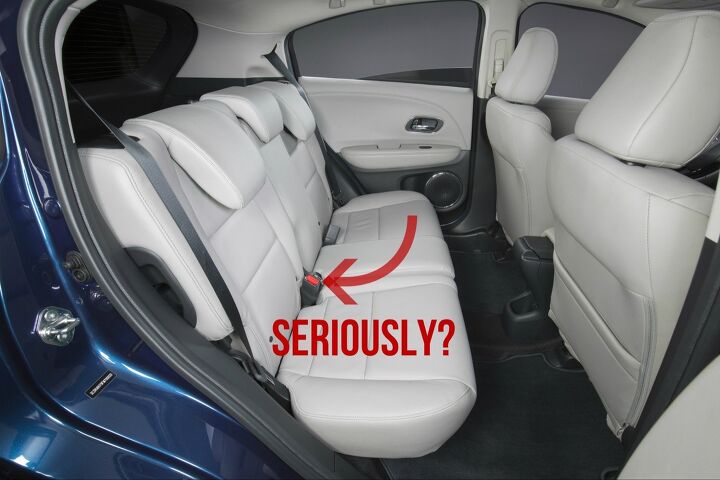
Stiff, dual vertical flaps protect the HR-V’s anchors from the very items looking to access those anchors. Making the situation even worse are buckles placed directly in front of the inboard flaps, which are directly in front of the anchors.
Do what you’ve got to do to young fathers. Make the HR-V slow, make the HR-V expensive, make the HR-V noisy if you must. Honda can even make me uncomfortable if the company feels ordained to do so. But don’t make the installation of child seats any worse than it already is.
[Images: Timothy Cain/ The Truth About Cars | Image Source: Honda]
Timothy Cain is the founder of GoodCarBadCar.net, which obsesses over the free and frequent publication of U.S. and Canadian auto sales figures. Follow on Twitter @goodcarbadcar and on Facebook.
More by Timothy Cain









Comments
Join the conversation
It's a Honduh. That means buyers don't care it is ugly, expensive, noisy, or fuel thirsty. Honduh buyers have an image of their company that hasn't existed in twenty years or more - dependable, well designed, and unique products. Today's Honduhs are expensive, bloated eyesores that aren't well made or the best at anything. I laugh at those who recommend the Accord. Considering that the Accord was like a lanky 165 pound youngster that has now grown into a 250 pound overweight lunkhead, I can't see how you can recommend the disaster. The Civic is the latest bloatware from Honduh - now bigger than the original Accord, we have a company that has lost its way. But Honduh knows its customers are idiots - they thought so little of the Honditwits that they decontented the Civic only to throw back some goodies and then to hide the disaster they brought out king kong civic - the biggest disaster on the eyes since Pontiac's Aztek (or anything made by Toyoduh). Why should the HRV be any good? Honduh knows these will sell to their seagull customers.
I'm late to this conversation, so here are some comments after more than 9 years of ownership and more than 100,000 miles.
I agree with the author about performance and noise. The HR-V is better than our 2009 Fit, and noisier (but no faster) than a 2018 Buick Encore. For me, the angle of the HRV's driver's cushion was too flat, and was not adjustable. Early on in my ownership, I removed the front bolts for the seat mounts, and slid a 6mm stack of flat washers between the seat mount the and frame. Problem solved.
Long-term overall gas mileage (FWD) is 33.0 mpg, ~38 mpg on highways below 65 mph, lower for stop-and-go driving in traffic and sustained speeds over 70 mph. It doesn't use a measurable amount of oil between 5000-mile oil changes.
For warranty purposes, except for oil & filter changes, service for the first 100,000 miles was through a dealership. The ignition switch was replaced and transmission software reflashed under warranty recalls. Other than 2 flat tires, no mechanical failures. In 9 years, it's on its 3rd battery. At the 100,000 mile dealer service, they said to check the disc pad thicknesses. I ordered a set, and when I pulled a wheel to measure, the pads were at 50% of new. Rotor thicknesses are within spec. I live in a mountainous area, so this exceeded expectations.
Around 90,000 miles the starter motor became erratic. At 102,500 miles, the rear hatch actuator switch died without warning. I had the starter replaced by an independent shop at 103,100 miles. At 103,200 miles I replaced the rear hatch switch myself with one purchased from Amazon for $30. At 103,350 miles, the right CV axle boot leaked. 100,000 miles is about the norm for CV axle boots, so I wasn't surprised, and I replaced both CV axles. Cost for parts & labor for all these repairs was $1300.
Overall, I consider this to be good reliability. Not completely trouble free, but no major repairs. Everything works.
In January 2023, I was looking for a replacement for the HR-V, and after a test drive, I immediately ruled out the redesigned HR-V. Honda made the car bigger and heavier, with worse gas mileage and less cargo space, but no improvement in performance. They also got rid of the paddle shifters and the magic seats. After test drives in a Mazda MX-30, a Subaru Crosstrek, we bought a Niro HEV, which is about 5" longer, is quieter, and has slightly better performance than the Honda while returning ~53 mpg over its first 24,000 miles. We decided to keep the HR-V, which is primarily our hardware store hauler.
There has been a lot of automotive evolution since 2016, and the HR-V feels very basic compared to the Niro.