By Robert Farago on September 24, 2008

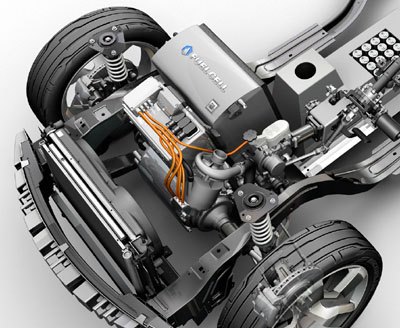
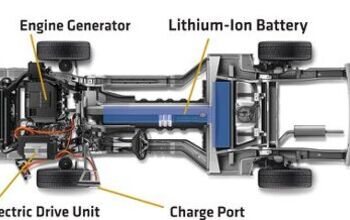
Edmunds Inside Line reveals that GM has changed their propulsion plans for the plug-in electric – gas hybrid electric Volt. We were laboring under the impression– created by GM’s itself– that the Volt would complete its [theoretical] 40-mile all-electric range and then use its internal combustion engine to recharge the batteries on the fly. Nope. “A release from the day of the production prototype’s reveal reads, ‘a gasoline/E85-powered engine generator seamlessly provides electricity to power the Volt’s electric drive unit while simultaneously sustaining the charge of the battery.’ And by ’sustaining’ GM says that it means only that no additional power is drained from the batteries.” Get it? If not… “Once a driver uses up his 40 or so miles of electric power, the 1.4-liter gas engine generates electricity to power the electric drive motor, but does not recharge the batteries. After the 40 or so miles, the battery becomes 400 pounds of uselessness, at least until the owner can plug the car into the electrical grid for a recharge. This means that regardless of how far one drives the Volt, the driver will only ever get up to 40 miles of electric-only range.”

91 Comments on “Volt Birth Watch 101: Gas Engine Does NOT Recharge Batteries...”


  • guyincognito
    guyincognito

    So, what is the point of using the gas engine to generate electricity to power an electric motor?

  • Aegea
    Aegea

    Given the expected duty cycle of the vehicle (i.e., relatively short-range commuting and similar trips) it makes a certain amount of sense. This thing isn’t designed for extended road trips, that’s for sure.

  • barberoux
    barberoux

    WTF seems apropos. If the expected use is just for local trips then a golf cart could do the job. A Prius can drive all day on a combination of electric and gas. I think a diesel/electric combination with a hook up similar to the Prius is the way to go.

  • dwford
    dwford

    I think the idea is that most people drive less than 40 miles per day in their commute, and would rarely be using the gas engine. Personally that would work for me. I drive a 22 mile round trip to work , and even with some errands could get through the day on electric only. Of course, the Volt is so ugly I could never buy it….

  • starlightmica
    starlightmica (Richard Chen)

    Looks like Li-ion battery technology hasn’t progressed far after all – I”m guessing this is done to prevent unnecessary charge/discharge cycles that would shorten battery life. Those batteries aren’t cheap and the battery warranty target is supposedly 10y/150k miles.

    Just like Chrysler’s lifetime warranty, it’s long as good as there’s a company around to honor it.

  • virages
    virages

    Ok, I might understand not having the engine charge the batteries, because of the inefficiencies of the engine, plus the inefficiencies of charging. You might as well use the engine to directly drive the wheels. But, I would hope that the regenerative braking –this car does have it no?– would charge the batteries.

    In anycase, this will then be a obligatory plug-in car as opposed to optional plug-in.

  • John R
    John R

    1st chink in the armor.

    So far, looks like the Volt is shaping up to be the automotive equivalent of the Mona Lisa. Good from Far / Far from good.

  • RayH
    RayH

    WTF seems apropos.

    WTF indeed. When/if the car comes out, maybe an aftermarket will emerge to where one could, oh, CHARGE THEIR BATTERY with the onboard engine. Novel idea.

  • NulloModo
    NulloModo

    Virages – I am also hoping that it at least has regenerative braking. GMs only hope for this car is to make it better than a Prius in every way, and slowly but surely, they are moving it the opposite direction…

    First strike for me was the price going up $10,000, then we find that the production vehicle looks nothing like the stunning concept (that alone killed it for me, I would have bought it if it looked like the concept just on looks), and now it might not even be able to charge unless plugged into a wall? GM is once again letting the bean counters cost-cut away what could have been an incredible vehicle into another middle of the road also-ran.

  • scrubnick
    scrubnick

    If the electric motor is capable of providing 150 horsepower and must run solely on the generator after the battery is 70% drained, that means the generator must supply all of that 150 horsepower. Given that generator is not 100% efficient and the electric motor is not 100% efficient, this means the gas engine must supply much more than 150 horsepower. Better crank the boost up on that 1.4L!

  • Strippo
    Strippo

    So, what is the point of using the gas engine to generate electricity to power an electric motor?

    To limp home, obviously.

    I pity GM – the GM exclusive of upper management, that is. I get this particular decision from a practical standpoint; using a gasoline engine to maintain those persnickety batteries regardless of driving habits would be haphazard at best. It’s the Volt itself that doesn’t make any business sense.

  • ericthejet
    ericthejet

    Some laptops have a power connection that is held in place with a small magnet to avoid pulling it off a desk.

    I see GM selling a lot of replacement plugs when people trip over the wire.

  • QuasiMondo
    quasimondo

    They need to fix that problem before this car hits the market. Even a trickle charge is better than no charge.

  • Alex Kambas

    The real question is how does it manage the two power sources. When you travel 100 miles, does it start in electric for the first 40 and then switches to gas? Because that would be a terrible waste of resources.

    Is it smart enough to decide in a 100 miles trip when it’s better to use either power source and thus minimize the requirements (and hence consumption and emissions?)?

  • Strippo
    Strippo

    If the electric motor is capable of providing 150 horsepower and must run solely on the generator after the battery is 70% drained, that means the generator must supply all of that 150 horsepower.

    More likely it means that you’ll have a 150 hp car only for the first 40 miles or so after a recharge.

  • Rday
    Rday

    How long will it take to recharge a drained battery if the gas engine is the only power source available? This is starting to sound like another ‘not well thought out’ GM product. And how long will it take to charge a completely drained battery once you make it to a ‘plug’? Surely there must be some life cycle limit on how many ‘recharges the batteries can take’?

    GM should have taken their time on this project. The more I hear, the less i like.

  • 210delray
    210delray

    This is bad. $40,000 for what amounts to a special-purpose (commuter) car? Now if it cost $5,000 or even $10,000, I could see the logic.

    So after that first 40 miles, you’re lugging around 400 pounds of dead weight. The Prius battery pack, IIRC, weighs about 100 lbs, and you get to use electric or gasoline power as needed, no matter how far you drive the car. And its base price is $22,000.

    Way to go, GM!

  • crackers
    crackers

    Currently, the buying public is used to being able to use a vehicle for any application, whether it is long distance traveling, short commutes or hauling as much stuff as can be loaded into the vehicle. Even the SMART can go on long road trips. It won’t be comfortable, but it will do it. For GM to try and sell the Volt with this kind of limitation, they are going to have to get the public to change their perception of what a vehicle can be used for. This is not going to work unless there is a tremendous life cycle cost advantage.

    Edit:

    Another thought – when the Volt fails, is GM going to blame it on the consumer for not being willing to pay for an “advanced technology” green product?

  • bunkie
    bunkie

    “If the electric motor is capable of providing 150 horsepower and must run solely on the generator after the battery is 70% drained, that means the generator must supply all of that 150 horsepower.”

    No car requires full power all the time. That’s why highway mileage is always better than city mileage (unless you have energy recapture as with most hybrids). At cruising speed on level ground, you shouldn’t need more than 20-25% of the engine’s peak power.

    Ultimately, most cars will be built this way. electric motors (with energy recapture) excel in city driving cycles. Steady-state cruising requires only a small ICE engine. Combine the two for passing and you have an optimal combination. Of course, the problems of battery weight and cost have to be solved first, but when they are, we won’t miss ICE-only cars.

  • karan1003
    karan1003

    It might not be that bad. Most power loss occurs at the transmission for cars – by taking it out they may actually be removing one of the largest inefficiencies of cars.

  • tsofting
    tsofting

    Seems The General is drawing on his experience from decades of building locomotives. All diesel locomotives are actually (as far as I know) diesel-electric, where the diesel engine runs a generator that in turn churns out juice to run the electric motors. Yeah, and there is no battery in the locomotives, either! Maybe the Volt will appear with an optional articulated arm that can hook up to overhead power lines?

  • Michael Karesh

    Regerative braking will still recharge the batteries, which will then be able to help with acceleration.

  • Mike66Chryslers
    Mike66Chryslers

    GM is really going to limit the market for the Volt if it’s not an option for people to purchase and use as their only car. Even people that typically commute 40 miles round-trip to work will occasionally need/want to go on a longer trip. They won’t want to be relegated to the slow lane for most of the journey, find a place to plug-in the car at the destination, and hang around for 8 hours for the battery to charge before returning home.

    Even though it is the least efficient method, allowing the driver to use the genset (ICE+generator) to recharge the battery needs to be possible, or the Volt won’t even be a viable Prius competitor.

    In the simplest case, there could be an “extended trip mode” button on the dash. When engaged, the genset would kick-in to supplement the battery when the battery charge drops below a threshold, then continue to run after the car is parked to recharge the battery. This mode could be cancelled automatically if the car is plugged in to charge.

  • charly
    charly

    That articulated arm joke isn’t that far of the mark. When you drive long distance than it is probably on the highway so electrifing only that part of the roads would be enough for making 99% of the trips electric.

    The battery is still 30% full when it is “empty” and the engine kicks in. It assist the gas engine when you need peek power. The gasengine does recharge the battery but it is more efficient to run the engine to only provide the needed energy than to also charge the battery and then cut the engine and run on battery power. It does have generative braking.

    ps. the engine could recharge the battery in about 15 minutes when it is on maximum power (Theoretical, without considering losses etc and the fact that the battery would probably blow up) When the mains provide the electricity it takes 3 hours on 240V

  • charly
    charly

    Mike:

    Why would you run the ICE to recharge the battery. Charging a battery will loose 20% of the energy so running on the ICE is simply more efficient/cheaper

  • SkiD666
    SkiD666

    Mountain out of a molehill.

    Does it really matter whether or not the battery is recharged by the ICE?

    40 Miles on battery then 50 MPG afterwards, isn’t that better than any other car currently available or likely to be available in the foreseeable future?

  • psarhjinian
    psarhjinian

    The Volt’s electric motor must be just a motor, not a motor/generator pairing as in the Prius. The only way I could see it “sustaining” the charge is if there’s a conventional alternator on the accessory belt.

    Or it could be a case of sustaining zero charge.

    Anyway, this seems to be a design decision in GM’s implementation of a series hybrid, and it makes some sense because there would be power conversion loss if the engine drove a generator, which then charged batteries, when then drove another motor. It also means that it’s not really a series hybrid, but a very basic parallel one. It’s probably quite simple a system: a battery and motor, the engine, and a gearset that switches between them.

    Toyota’s parallel system physically can’t work this way, and is more complex, mechanically, as a result. But it can go as far as it has gas for, and it can choose the most efficient/effective combination of power sources on the fly, where GM’s seems to be either/or.

    Actually, does anyone know if the Volt can use the engine and electric motor together at any point in it’s operation?

  • William C Montgomery
    William C Montgomery

    RF: We were laboring under the impression– created by GM’s itself– that the Volt would complete its [theoretical] 40-mile all-electric range and then use its internal combustion engine to recharge the batteries on the fly.

    This was more than an impression. GM explicitly touted Volt’s ability to recharge it’s batteries. From GM’s press release when Volt debuted at the 2007 NAIAS:

    When the battery is depleted, a 1-liter, three-cylinder turbocharged engine spins at a constant speed, or revolutions per minute (rpm), to create electricity and replenish the battery.

  • Ed S.
    Ed S.

    “The battery is still 30% full when it is “empty” and the engine kicks in. It assist the gas engine when you need peek power.” -charly

    I’m not sure this is correct since 30% is probably the minimum charge the system will allow. Below that damage and/or reduction in charge/discharge cycles may occur. I believe that once the 30% level is reached no more power will be delivered from the battery unless recharged by regen braking.

    “The gasengine [sic] does recharge the battery but it is more efficient to run the engine to only provide the needed energy than to also charge the battery and then cut the engine and run on battery power.” -charly

    I don’t see how this can be the case since the engine will be running only at a single RPM (i.e. max efficiency) all the time Unless the car needs all that power to move it all the time (physical impossibility) then it is not most efficient to only use the engine to move the vehicle. That’s beauty of a more sophisticated system, that you can run the engine at full bore to motivate the car and, when there is excess, to charge the battery. Also, Li-ion batteries prefer trickle charging and partial discharges, IIRC. This would seem to favor the Prius implementation of engine power to charge the battery at a slow but steady rate.

  • Stingray
    Stingray

    Even when the idea doens’t makes sense… it actually does.

    I agree with one commentator above, they’re digging in their locomotive experience. Locomotives deosn’t have batteries. I also bet that some EV-1 experience is going in this project.

    The magic here is that, the engine stays working mostly at a constant speed, and power supply is controlled by the computer (not directly by the driver as a normal car). And this may make it more efficient.

    The engine has to run at a constant speed… I guess they’re using an AC generator. You can even tune it to be über efficient at 3600 RPM or some multiple of that speed.

    They should allow some energy to recharge the battery, when ICE power is not fully demanded… effectively extending the range.

    Electric motor has a better response characteristics than the ICE.

    This car is getting interesting to me. Maybe this guys are not THAT crazy after all.

    This is not the same technology as the Prius. And it SHOULDN’T.

    Why every hybrid has to be like the Prius?

  • yankinwaoz
    yankinwaoz

    Alex Kambas :

    Is it smart enough to decide in a 100 miles trip when it’s better to use either power source and thus minimize the requirements (and hence consumption and emissions?)?

    I’ve said the same thing before. With input from a GPS system, and navigation systems, a car could be told where it is going and let it figure out the best mix of tech to get there.

    I envision a nav system where you can program your favorite destinations, such as home, work, gym, church, etc. You can also indicate which favorites you can and will plug in to charge. Then when you get in, tell the nav system where you are going, and it can feed the details to a power system that will decide the best power mix for the trip.

    Also, if a nav system has a wireless internet component, it can also use real time traffic information to compute an optimum route for you.

  • sitting@home
    sitting@home

    If the electric motor is capable of providing 150 horsepower and must run solely on the generator after the battery is 70% drained, that means the generator must supply all of that 150 horsepower. Given that generator is not 100% efficient and the electric motor is not 100% efficient, this means the gas engine must supply much more than 150 horsepower. Better crank the boost up on that 1.4L!

    The peak HP of my car comes at about 5000 rpm (hp=torque*revs/5252) but I can guarantee you I don’t drive at 5000rpm all the time, most of the time is around 2000-3000 so I’m only generating 1/2 peak horsepower (assuming relatively flat torque curve). The Volt ICE will only run at one (or a small range of) speed and that will be optimized for maximum output and efficiency.

    What is the point of charging the batteries with the ICE when it is more efficient to run the electric motor directly from the generator ? There’s no magic here that somehow charging the battery with the ICE gives you more range to “limp home”, you’d be better off burning the gas only when you need it.

    Regenerative braking aside, the batteries only really exist to give GM a PR flag to wave in the “plug-in” battle with the Prius. All it has really done is muddied the water and detracted from the fact that the Volt is a fully Electric Vehicle with an onboard generator, something that is completely different from the Prius.

  • RetardedSparks
    RetardedSparks

    Pure GM. Build it crappy and compromise it out the wazoo and then blame consumers for not buying it. There’s a funny mantra at GM – the customer is always wrong. Either the customers “demand” SUV’s and are then wrong for changing their mind with insufficient notice, or customers are wrong for not buying whatever POS GM decides to push on them. It’s somehow always the customer’s fault. GM’s attitude is, appallingly, that the car-buying public exists to serve THEM, not the other way around.
    They will be back in 2 years asking for ANOTHER $10B to develop the next bad idea.

  • KixStart
    KixStart

    I believe what GM really means is that the engine does not FULLY recharge the battery.

    And why don’t we FULLY recharge the battery? When you return home (or arrive at a destination equipped with an outlet), you recharge the battery with cheap electricity made from coal, sunlight, falling water, fissioning atoms, what-have-you… rather than recharging it using expensive gasoline in the ICE via the generator.

    The engine should run to add enough juice from time to time to keep the battery between 30% and 40% charged. You use those little bits of juice in extended-range operation.

    And you really need that battery. The engine is a conventional 1.4L engine and the vehicle’s about the size of a Cobalt but with an extra 400lbs of battery. Heavy. Accelerating on juice supplied by the engine alone will yield appreciably worse acceleration than a Cobalt. Accelerating uphill on juice supplied by the engine along would be… interesting.

    So, they will do like the Prius, except they’ll mix power electrically, rather than electromechanically. Battery plus engine under peak demand conditions.

    I still think the Volt is a dumb idea, or, being charitable, an idea whose time has not yet come (and never may), but I have some little faith that GM’s not going to screw it up as badly as humanly possible.

    We’ll leave that to Chrysler. Hybrid Wrangler? That’s a good start. Rebadged Tesla? Yessirree… they are on the way.

  • KixStart
    KixStart

    Sitting@home, Your way requires varying the engine speed to match demand on the vehicle. The Volt way allows GM to optimize engine operation for efficiency at a certain RPM/load range and always use that RPM/load.

    I take that back… GM could do it at a fixed RPM by varying the load at the generator. However, I don’t think that would be optimal, either, as operating wide open when necessary and optimizing for that. And remember, the engine’s too small to do the job alone.

  • Jerome10
    Jerome10

    I really dont’ see any problem with this. Not sure why everyone here is freakin out.

    To me, this car is designed to be an all-electric, while not having the limitation that you can’t take it on long trips like every other EV out there.

    So you run the 40 miles all electric, then you have an engine providing just enough power/electricity to keep running the car. Use minimal gasoline. You want to run the car AND charge the batteries? That would require a larger motor using more gasoline. I would suspect that even if you could charge the batteries then switch back to electric, and go through that cycle that the overall fuel use would be higher than the 40miles+ just enough power to keep you rolling.

    I’m no battery expert, but I’d guess that constant charging, draining, charging, draining cycle is hard on batteries, reduces their useful life. If that is the case, I can understand why you’d want to do it in full chunks of charge time, not a fill and drain cycle.

    I could see regenerative braking being beneficial, might as well get the free electricity. But I don’t see it then allowing you to pull out that electricity….maybe just cut down on plug-in time.

    I don’t know, I’m trying to keep an open mind because overall, I like the ideas behind this car. If regenerative braking and/or other tweaks are possible, I fully expect GM and other automakers to continue making those adjustments as these types of vehicles mature and become more popular.

    I really don’t have any problem with this as is.

  • Wulv
    Wulv

    Ever since first reading about the Volt I have been trying to get my head around their plan. $40k for a commuter car? Which leads one to believe that GM would like you to have a second car for trips, like what a Malibu? Right now people are selling off their “extra” cars due to lack of cash onhand. With the economy in the tank people are not going to be opting for a $40k second car to go to work in.
    When I look at it, greenwashing something in this way seems insane. “You can have this GREEN Car for your daily needs, but to go anywhere else, you should have a secondary vehicle handy” because having 2 cars is MUCH better for the environment than having only one. Who cares what effect on the environment manufacturing all the parts cost, IT’S ELECTRIC!

  • joeaverage
    joeaverage

    I think the comment above about the different batteries offers a clue about why the Volt doesn’t charge while underway.

    The Prius uses a NiMH battery. The Chevy Volt uses a Lithium-Ion battery. I’d recommend that you visit Wikipedia and read the articles on the two different kinds of batteries. The NiMH battery appears to be the better battery but Chevron won’t let anybody use them in an EV so the Lithium battery is a runner up. The Lithium batteries have very specific requirements. Can’t charge all the way up, can’t discharge all the way down. They loose charge over a certain temp. They age quickly over a certain temp. They age by time as well as by charge/discharge cycles.

    I wouldn’t be surprised if the Volt didn’t reach the market in 2010 with a NiMH b/c the patent will run out on Chevron’s battery at that time. GM prob needs to LOOK like they are testing a battery to make their Volt look credible to customers and investors. At the last minute they could switch to the NiMH and have a much superior and long lasting product.

    I’d be okay with the Li-Ion battery if replacements were cheap enough b/c if I owned one I’d not buy gas for our second car commute ever. Well, maybe just once a year to burn what was in the tank and give the engine a little run so it didn’t lock up from disuse.

    Better yet, leave out the engine and spend the savings on a larger (better) battery.

  • 1996MEdition
    1996MEdition

    The next GM press release on the Volt:

    “The battery will be used to supply power to a small electric motor mated to the engine flywheel. After assisting the starting of the ICE, the batteries will be recharged using the generator attached to the ICE which will also generate enough extra electricity to power vehicle accessories.”

  • oboylepr
    oboylepr

    The General is drawing on his experience from decades of building locomotives. All diesel locomotives are actually (as far as I know) diesel-electric, where the diesel engine runs a generator that in turn churns out juice to run the electric motors

    It’s done this way in locomotives because of the massive zero RPM torque required to move the thousands of tons of a typical freight train. Electric motors are far better at this than the the diesel engine would be if directly coupled to the wheels. I am not sure that the advantages of such a system applied to a car, would compensate for the energy losses.

  • Mike66Chryslers
    Mike66Chryslers

    @charly: As KixStart just stated above, the genset in the Volt will not provide enough power, by itself, to keep-up with traffic in some circumstances. eg: long hills, accelerating to pass. You need some reserve battery power to supplement the power from the genset in those conditions, or vehicle performance will be reduced.

  • Jonny Lieberman
    Jonny Lieberman

    Two words: Hydrogen Fuel Cells

  • Syn-Ack
    Syn-Ack

    I’m sure some genius will find a way around this with a big DC/AC inverter.

    Are lithium polymer batteries not an option here?

  • JoeEgo
    JoeEgo

    Two different things being said, and GM’s original ambiguous marketing did not help:

    *Recharging the batteries from the gas engine to 100% or anywhere above the minimum charge range: NOT happening, not even desirable. Why charge your batteries with a personal gas generator when even daytime, peak rate electricity is cheaper?

    Yes, the batteries are mostly dead weight after the first 40 miles. Yes, people are going to have to adjust to a vehicle like this rather than the other way around. Yes, contrary to some of the whiners here, this is the most efficient way to power the car.

    *Recharging the batteries a small amount with regenerative braking and the gas engine: YES this is happening. Diesel locomotives do not have regenerative braking or a huge battery so it is safe to assume some small amount of charging can take place.

    No, we don’t know how much charging is done. No, we do not know how the Volt performs after the 40 EV miles.

    There are many questions still to be answered. The Volt is a fundamentally different car. We should be looking for those answers instead of extrapolating from golf carts and Priuses (Prii?) to decide it is stupid because it will not give you a 400 mile trip and end with a fully charged battery. The least we can expect from TTAC and the B&B is an honest attempt to understand the vehicle. I share the interest of a few here who want to understand how this works so we can figure out how much it might cost us to run the vehicle so we can finally figure out what MSRP is actually appropriate or competitive.

  • fisher72
    fisher72

    So if the battery is drained and the engine has switched on, what does it do sitting in traffic?

    Think Los Angeles.

  • JoeEgo
    JoeEgo

    Jonny Lieberman :
    Two words: Hydrogen Fuel Cells

    One word: infrastructure.

    Aside from actually getting your hands on hydrogen, all it does is replace the gas motor with something cleaner. So you still have the 40 EV miles and a fuel cell engine cycling on & off to maintain a minimum charge level and keep the vehicle powered.

    Can’t say they were too ambiguous about it, but GM has always said the Volt architecture allows for different “range extenders” such as a diesel engine, CNG, or hydrogen fuel cell.

    re: fisher72
    Being that the gas motor will only run if the battery hits the minimum, the Volt could run its gas motor while sitting still. In Los Angeles traffic you’ll still have your air conditioning, radio, and lights needing juice.

  • blindfaith
    blindfaith

    why doen’t GM just sell the car now without the batteries. that makes sense to me. It would reduce the cost by $20,000 and weight by 500lbs.

    Why not?

  • psarhjinian
    psarhjinian

    Two words: Hydrogen Fuel Cells

    I can sum up the problem in one: Net Energy

    Is there a net-energy-positive way to get hydrogen in commercially viable quantities?

  • Robert Schwartz
    Robert Schwartz

    What we have here is a PR driven clusterf&^%$.

    GM could build a perfectly nice and reasonable compact with a conventional 1.4L motor, maybe even with some lightweight Honda style hybrid components. GM could sell it for less than $20K and sell a lot of them. It might hit the 35 mpg CAFE target pretty easily.

    Or you could build a genuine electric car and put more batteries in to replace the motor and generator. It would be expensive, have a limited range, and not be useful in northern climates. But it would make Ed Begley happy and that is what counts.

    Instead what we have here is the worst of both worlds, except that the range won’t be as limited. A more practical approach might be to sell an electric car, a gas car, and a tow hitch as a package.

    Note: Charge times: The fundamental equation is Amps x Volts = Watts. I don’t know what GM is planning, but the cord in the picture looks like a 15 Amp, 120 Volt cord, which carries 1800 Watts (1.8 kW). Of course chargers are not 100% efficient. I think you could not expect more than about 1.5 kW/h. I have seen figures like 12 and 16 kWh for total battery capacity (probably including the 30% reserve), which would point to recharging times of 8 to 10 hours.

  • T2
    T2

    obligatory plug-in car as opposed to optional plug-in

    The whole point of a PHEV is off-oil.

    Therefore you need to return to your garage with an exhausted battery in order to get that experience.

    As others have posted, aside from braking regeneration, deliberately recharging by the onboard genset is inefficient despite the reduced losses of churning energy that I am told you can get with Li-ion technology.

    Plus the fact, unlike other fuels, gasoline carries a road tax that you may like to avoid by grid charging at home.

    PHEVS further highlight the issue of cabin heating. We may not have given it much thought before but we use copious amounts of heat on those winter commutes. Are you going to use road taxed gasoline heaters like the VW bugs of yore, or be forced to run the engine for this privilege, or worse still, waste your expensive Li-ion power on electrical heaters ?

    Bearing in mind that it is illegal to use untaxed liquid fuels for transportation on public roads, shouldn’t that be reversed if onboard fuel is being used solely for human comfort and survival ?

    To finish my answer to the poster that complained about no recharging on the run.There is no reason that a dashboard switch, or somesuch, couldn’t change that scenario to allow recharging out on the hiway to allow electric-only operation in the city at the end of the trip. In other words you move your noise and pollution out of town. Could make it a candidate to avoid inner city congestion charges.

    Finally someone else has pointed out another disadvantage of these batteries that when the battery is depleted it becomes 300kg of dead weight. For the Prius it was computed that after 45 minutes at 50mph the benefits of recapturing a 50mph regen to stop cycle are completely dissipated by the extra rolling resistance that the battery mass incurs.

    From all this you might think I am against EVs.
    Nope, I would have purchased an EV1 had they been available back in 1999 and still be using it today. Its 90/70 mile hiway/city range would suit me just fine.

    PHEVs I am against. When I look closely they seem nothing more than exotic ’boutique’ energy systems being foisted on a scientifically-challenged public. As energy containment systems they hold about the same amount of energy as the $10 plastic container I use for my lawn mower.
    Sure I can’t fill it from a 110v outlet but nor can you the gas tank of a PHEV.

    As I have written before the popular Prius is all about the advantage of an electrical transmission. They currently have a 1.5L able to perform as if it were a 2.4L in a mid size vehicle. That’s with their HSD and make no mistake the fully decoupled Chevy Volt could be even better.
    The Prius is not about being an electric car and Toyota understands that. That’s why I believe they have been foot dragging on PHEVs.

    All this distracts some people away from the real problem with automobile powertrains. The problem used to be with the transmisson but Toyota’s HSD and the fully decoupled Chevrolet VOLT system are fixing that. These will become the transmissions of the future.
    The new problem, as I see it, is with the gasoline engine itself.

    What’s holding hybrid development back right now is the reliance on gensets that are based on old school automobile engines. Fiat has a new two cylinder capable of 65Hp as opposed to the four cylinders of Prius(76Hp) and VOLT (53Kw?). Where is the small displacement high rpm engine that will be needed if fuel economy is to be taken to the next level ?
    T2


Back to TopLeave a Reply

You must be logged in to post a comment.

You can also login using Facebook Connect. Connect with Facebook

Subscribe without commenting

Recent Comments


Auto Insurance GPS Navigation
Car Loans Auto Parts
Car Warranty Wheels
Automotive Tires Car Care