

By Paul Niedermeyer on April 10, 2008

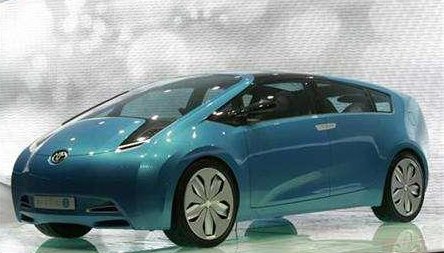
toyota-hybrid-x.jpgThe great hybrid showdown is coming. GM Car Czar Bob Lutz has thrown down the gauntlet: “We are headed for the OK Corral.” In fact, GM has staked its reputation on the Volt, intending to “leapfrog the Prius” and evoking America’s Apollo moon-shot program. Meanwhile, Toyota continues its domination of the alt power mindspace, finalizing their third generation Prius. While we prepare for the clash of the hybrids, let’s take a closer look at the contenders…

In the serial-hybrid corner: the Chevrolet Volt. Actually, GM prefers to call its gas -electric plug-in an “extended-range electric vehicle” or E-REV.

The Volt will feature a rechargeable 16kw lithium-ion battery pack. Its 120kw/160hp electric motor provides the motive power. A 53kw generator driven by an efficiency-optimized (non-E85) three-cylinder gasoline engine kicks-in when the batteries are depleted to a 30 percent state of charge (SOC). The Volt’s generator will then cycle as needed to keep the batteries within a targeted SOC range. Fuel economy– after initial charge depletion– is a projected 50mpg.

The Volt’s target price started at $30k. More recently, GM’s Car Czar declared that the Volt would sell for about $48k. The winner of TTAC’s annual Bob Lutz award reckons $40k might be possible “without making any profit.” For comparison purposes, we’ll assume an MSRP $44k.

GM has confirmed that the Volt’s first year production run will be limited to 10k units. After de-bugging, the number will rise to 100k and possibly beyond– depending on demand, how large a financial loss GM is willing to accept and for how long.

Even if the Volt’s batteries perform to specifications, GM’s initial promise of a forty-mile EV range has evaporated. GM now says continuous highway-speed driving will deplete the E-REV’s battery in “closer to 32 miles.” And that’s probably at the low end of typical highway speeds (as per the EPA highway cycle). A brisker freeway run, elevation gains, extreme temperatures and the use of heater, A/C and other electrical peripherals will all take their toll on the Volt’s range. It could easily descend into the twenties or… less.

Toyota will introduce their gen3 2010 Prius in January 2009. It will use a refined version of Toyota’s parallel Hybrid-Synergy drive (HSD), whereby electric and mechanically-transferred gasoline-engine propulsion are used individually as well as in various blended forms for propulsion.

Toyota has clearly stated goals for the gen3 Prius: reduced HSD-specific costs, weight reductions and most importantly, a targeted gain in efficiency of 15-20 percent. This should result in combined EPA mileage numbers of 53 – 55mpg (2008: 46mpg). Since average user mileage for gen2 Prius runs 42-44mpg, gen3 Prius should deliver real world mileage of 50+mpg.

The new Prius will have a more powerful electric motor and increased battery capacity, extending its limited EV-only range. Other refinements: improved aerodynamics, further efficiency gains in the Atkinson-cycle gas engine; and improved regenerative braking and hybrid system control.

For the first two years of production, Toyota will stick with the tried-and-proven NiMH batteries. In 2010, li-ion cells will go into volume production at Toyota’s battery supplier Panasonic. With the higher energy density of the li-ion pack, it’s safe to assume that the EV-only range of the base Prius will increase, perhaps double. This should further increase fuel efficiency, possibly to about 55mpg.

Additionally, there will be a plug-in Prius. Fleet tests start in 2010. If all goes well, volume production will begin the following year. Early versions will have a NiMH pack that will provide an EV range of about seven miles and an EV top speed of 62mph. When the definitive li-ion plug-in Prius arrives, its EV range could be some twenty miles.

Toyota has announced a 60 percent production increase for the gen3 Prius– from 280k units in 2007 to 450k in 2009 (worldwide). The car’s average transaction price should stay level, or possibly contract further. We’ll assume $22k for our comparisons. An educated guess at the price for the plug-in version: $30k.

Our comparison will encompass three primary criteria: owner economics, environmental benefits and “green cachet” (to both owner and manufacturer).

Hypothetical economic scenario one: six weekly round trips of 35 miles each. In this example, the Volt would never need a drop of gasoline (except for the occasional auto-programmed runs to cycle fuel and oil). If we inflation-adjust today’s electric rates, a recharge will average about one dollar. Annual “fuel” cost: $312.

A Prius would take 220 gallons of gas @ 50mpg to cover the same 11k miles. Assuming $4/gallon in 2011, annual fuel cost is $880. The Volt’s $22k purchase premium over the Prius would take 39 years to amortize. A $40k “subsidized” Volt would take a mere 32 years. These calculations don’t include interest, either on the higher purchase price of the Volt, or on the money saved (opportunity cost). 

Even if we slash electric rates in half, to 50 cents a charge, it would still take over thirty years to amortize the Volt’s higher purchase price. Comparing the Volt to the plug-in Prius is even less favorable to the Chevy: it would take 58 years to recoup the Volt’s $14k price differential.

Scenario Two: a short daily commute of twelve miles round trip (3744 miles annually) and an additional 3744 miles on long-distance trips @ 50mpg. The Volt’s total annual combined “fuel” cost is $400. The regular Prius’ annual fuel cost is $600. It would take 110 years to amortize the Volt. And the plug-in Prius, which can make the short commute all-electrically, trumps the Volt altogether, with fuel costs of $372. And it costs $14k less.

Scenario three: a long-distance commute with a daily round trip of seventy miles, plus 6k of long-distance miles (23.5k annual total). The Volt’s fuel costs run $1465 annually. The Prius’ are $1880, resulting in a 53 year payback for the Volt. And the plug-in Prius accomplishes the task with a $1488 fuel bill, only $23 more than the Volt (609 year payback!).

Scenario two and three point out the Volt’s two biggest weaknesses: its expensive and heavy battery pack becomes increasingly less cost-effective when its maximum range is not fully utilized (Scenario 2). And its serial hybrid drive is no more efficient (if anything, somewhat less so) at continuous highway speed than Toyota’s HSD (Scenario 3). The Volt’s efficiency losses of generation, conversion, battery storage, re-conversion to AC, and electric drive-motor losses equal or exceed the minimal efficiency loss of the Prius’ mechanical transmission.

All of the above scenarios point out the glaring economic disadvantage of the Volt due to its high cost. Its price would have to come down to $28k to justify a (barely) reasonable ten-year payback in the Volt-optimal Scenario One, and substantially less for the others.

Plug-ins clearly are not about the economics, because even the plug-in Prius (@$30k) has a payback of between 24 and 35 years versus the regular $22k Prius in the above three scenarios.

A comparison and analysis of the environmental-social benefits of hybrids versus plug-ins quickly becomes complicated, due to the variable sources of electricity (high or low carbon content). But the over-arching issue of total (cumulative) gas savings offers some simpler answers.

Aggregate gas savings are much more readily and cost-effectively accomplished through large numbers of conventional hybrids (Prius) than small numbers of somewhat more efficient but much more costly plug-ins. Toyota’s 2009 production of about 500k Priora (@ 50mpg) will save 120 million gallons of gasoline compared to a like number of 25mpg conventional mid-sized sedans, at little or no incremental cost.

But 100k Volts produced per year at an adjusted/equivalent 100mpg save only 36m gallons over the 25mpg car, and a mere 120k gallons over a like number of Priora; in both cases at an incremental cost of some $22 million. Smaller gains in economy spread over a large number of vehicles always delivers a much greater cumulative savings than a small number of super-high efficiency cars.

Even if plug-in hybrids are driven on cycles that maximize their EV range, greenhouse gas (GHG) reductions are surprisingly modest, and highly dependent on the carbon-intensity of the electric source. A new study by Carnegie Mellon shows that unless plug-ins are matched to low-carbon electric sources, GHG emission gains (compared to conventional hybrids) are minimal, and negative in some circumstances.

These and a number of other objective criteria clearly suggest that finite public (and private) resources are best spent in the expansion of existing high-efficiency hybrids, like the Prius and the upcoming new lower-cost Honda hybrid sedan, rather than exotic and expensive limited-production vehicles like the Volt– at least until li-ion battery prices drop dramatically. Meanwhile, GM does not have a Prius-like hybrid to sell, or in the planning stages.

Objective criteria are not the main reason for the GM’s “moon shot” investment in the Volt. When it comes to “green bragging rights,” the Volt may well out-score the Prius– at least for GM and its eager cadre of early adopters. If the final styling is both distinctive and has “it” (like the concept), if the Hollywood crowd adopts it as their newest green baby, if the words “plug-in” or “E-REV” supersede plain-old “hybrid” in green-speak, the Volt could become THE car of the green-tinged moment.

But let’s be clear: both eco-consciousness and the Toyota Prius have moved beyond fads, into fully blown trends. (Federal legislation sealed the deal.) The Chevy Volt and the Toyota Prius must ultimately compete in the automotive mainstream, where the Volt is at a supreme price disadvantage. Unless GM is willing to heavily subsidize the Volt for many years, no matter how good it is, the Prius will kick its ass.

94 Comments on “The Great Hybrid Showdown: Chevrolet Volt vs. Toyota Prius...”


  • Bunter1
    Bunter1

    Now that is a interesting analysis Paul.
    This ought to stir up some thought.

    Thoroughly enjoyed it.

    Of course this “supposes” that there is a Volt sometime in ‘10.

    I predict a Vue with a bigger battery pack and a cord. Electric only range maybe 5 miles.
    Real “Volt” in 2013-15.

    Bunter

  • jolo
    jolo

    “The Chevy Volt and the Toyota Prius must ultimately compete in the automotive mainstream, where the Volt is at a supreme price disadvantage.”

    Not only in price, but reputation as well. If you compare the Volt to the plug in Prius or even just the regular Prius, which car company has more experience with the technology required to make sure you get a reliable, quality, and durable hybrid machine?

    Most people looking for this kind of vehicle don’t care about speed and performance, they care about saving (gas, the environment, their own money, etc). Toyota made the initial Prius a plain-Jane and then jazzed it up a bit when it took off. They made sure that people wanted the vehicle before they changed its appearance. GM wants to give you a “sharp” looking vehicle and is hoping that its looks will overcome any potential technology issues that will arrive with Volt1.0.

    Never buy a first generation vehicle from a company that keeps making first generation vehicles.

  • Cammy Corrigan
    Cammy Corrigan

    “GM has staked its reputation on the Volt”

    This actually means very little. If anyone remembers, Maximum Bob staked GM’s repuation late 2007 on bringing the Volt by Easter 2008. Toyota officials said “It couldn’t be done without corners being cut” (paraphrasing). Bob said “Someone will have egg on their face and I, personally, don’t like that”*.

    Well, Easter 2008 has been and gone and nothing! So for GM to “stake their reputation” means nothing as they’ve already lost their “reputation” in a bet regarding whether they’d bring the Volt to market by Easter 2008.

    Also, another factor which wasn’t really addressed in the editorial was what customers will make of each beast.

    With GM’s line up against Toyota’s line up, customers are buying Toyota’s cars citing “quality and reliability” as a major factor (Toyota’s core brand values). Well, logically, if GM can’t sell a product which has been on the market for, at least, 100 years without it being reliable or of good quality (in the eyes of customers), how can they sell a technologically advanced car supposed to supplant Toyota, who are the gold standard in terms of reliable cars?

    Looks-wise both cars are equally bad. The Volt is just plain hideous and the Prius (if the picture is anything to go by) is just plain odd. The front look eerily similar to Peugeot 307CC** and the back looks squashed. Also, is there ANY need for the alloys to look that stupid?

    Another thing which I am not aware of (and maybe someone can help me here), is anyone ACTUALLY looking forward to the Chevy Volt coming to market? So far, the only people I’ve seen excited about the VOLT are GM themeselves and a few Chevy enthusiasts. Whereas, there seems to be more anticipation for the Prius. I suppose because there are so many happy Prius owners, they, naturally, are looking forward to the next generation of their current car. In line with Toyota’s philosphy, have a happy customer, they won’t leave you. So Chevrolet do have a distinct disadvantage here; they have to get customers interested in a car against a car which is tried, tested and loved by the customers who they are trying to woo. A difficult job.

    So let’s look at the facts:

    GM’s Volt is more expensive WITHOUT generating a profit for them and doesn’t actually bear better fruit than the Prius. Also, there doesn’t seem to be much anticipation for it, plus, it’s ugly.

    Whereas the Prius will sell for pretty much the same price, bear a decent profit for Toyota and has an established market base.

    It looks like a walkover for Toyota.

    * = http://www.autobloggreen.com/2008/01/14/bob-lutz-has-egg-on-his-face-drivable-volt-in-june/

    ** = http://www.in.gr/auto/dokimes/pr_dokimes_ae/foto_big/Peugeot_307CC_Paris_01.jpg

  • Rday
    Rday

    I think it is great that we have this great competition going on. I own an 04 Prius and love it. The tech is simply amazing. The car is a joy to drive and almost maintenance free.
    The Volt will have its’ work cut out for it. Not only do I think it is just another GM’s PR program, but I wonder just when/if it will actually be available. Sorry, but I have seen GM make so much about their future product that I don’t take them very seriously when it comes to new technology. And who would want to buy a Volt in the first model year anyway? Betcha Bob Lutz will never drive one.

  • Mud
    Mud

    +1 Rday.
    IF I was considering a hybrid of any sort, I would be crazy to even contemplate the Volt. Why in the world would you take a chance with the first (and expensive) production run out of GM? They are not known for getting it right the first time. Or second, or ….

  • Donal

    I think plug-in cars appeal to those who would rather not:

    A – depend on fossil-fuels (even though the electricity will probably come from coal), or

    B – depend on a steady supply of fossil-fuel, or

    C – spew greenhouse gases in their own wake (even though GHGs probably will be spewed somewhere).

    One point in favor of the Volt – it will allow you to both look like an eco-warrior and buy American.

  • AGR
    AGR

    Great that GM and Toyota go “head to head” with series hybrid(GM) and parallel hybrid (Toyota).

  • menno
    menno

    Hi Katie, I suspect that the show car Prius (photo above) is just a show car, and that the real deal which is said to be coming in January 2009, will be toned-down.

    Go look at any show-car and then the following production model from virtually all manufacturers, and this is the case (except for the very low production, original Dodge Viper).

    I notice a trend in upcoming and new car bodies – less glass, more metal. So, my current 2008 Prius is looking more modern all the time!

    I think the reasons are several; glass is way heavier than steel and there is a general desire to keep weight down and efficiency up. Higher body sides pass the side-crash tests better. And, good or bad, car stylists act like schools of fish.

    For example, for awhile the Bangle-Butt was popular on a lot of cars. Now, the greenhouse is shrinking and cars are getting aerodynamic without being seen as weird-mobiles.

  • BerettaGTZ
    BerettaGTZ

    Recall that similar cost-benefit analysis was run on the Prius vs. gasoline-powered economy cars when it was first introduced to the market, and the conclusions were similar. The business case didn’t make sense for the consumer, as the fuel saving would take decades to overcome the cost premium. But Toyota steadily improved it and brought the cost of the car down as they refined the manufacturing economics.

    The point is that any new technology is going to be expensive, a bit clumsy, and not make economic sense at first, whether it is flat-screen TV’s, DVD players, or plug-in hybrids. Somebody’s going to lead, to innovate, and take the lumps for doing so. Toyota decided to lead with the 1st gen hybrid cars. Now it’s GM’s turn. It’s always easier to sit back and throw darts at the front runner than have the courage to be the pioneer. That is, as the Cadillac ad used to say, “the penalty of leadership.”

  • Sid Vicious
    Sid Vicious

    Interesting article. I think this is a classic case of just letting the free market work. In other words at the end of the day show me the money. The Volt or the Tesla “may” be great gadgets, but do they make environmental AND economic sense. Prius owners get to save money and, if they’re so inclined, bragging rights (greed cred, whatever.)

    It might be great to have a plug in charging overnight off of my windmill, but it just doesn’t make economic sense. Better to have the windmill running the heat pump on my geothermal system, and just buy a little gasoline.

  • menno
    menno

    BTW, Paul? REALLY good article, thanks. And I’m not just saying that because I’m on my 2nd Prius.

    I’ve said for some while that the NIH (“not invented here”) syndrome was going to get a lot of car companies into the dumpster, because they aren’t adapting HDS (Toyota’s Hybrid Synergy Drive).

    There’s an interesting parallel from post-war America.

    General Motors, then the preeminent automaker of the world (as Toyota clearly is now) stole the idea from Reo’s Shelf Shifter transmission* / supposedly invented the Hydramatic automatic transmission just before the war and popularized it after the war.

    Hydramatic was optional (later standard on) all Cadillacs, Pontiacs and started out on Oldsmobiles before the war.

    GM sold Hydramatic to Ford’s Lincoln Division in the early/mid 1950’s, to Kaiser, Frazer, Nash (also for use in their Rambler as an option), and Hudson.

    Today, only Nissan (reluctantly) is purchasing the HSD from Toyota (unless you count the Ford system which is virtually identical and which uses Aisan as the drivetrain components supplier – Aisan supplied the original 1997-2003 Prius drivetrain components but now Toyota manufacture them).

    I guess that’s a long winded way of saying, the automakers of the world might be wise to get on the HSD boat instead of their own leaky rafts.

    It certainly seems to be the best means of stretching ever reducing crude oil at this time.

  • mykeliam
    mykeliam

    I’m confused! Doesn’t take much, I know. Didn’t GM make an electric car some years ago?? Didn’t people really like them? Didn’t GM refuse to sell that car and insist on destroying them instead? Why can’t they (GM) just dust off the plans for those, use the new technologies and make the freaking car already?
    Instead, they have to reinvent the wheel and start from scratch? Um Ricky, Lutzie – any comments??

  • davey49
    davey49

    What you’re really saying is; GM needs extra money to help subsidize the Volt so go right now and buy a Silverado Crew Cab, an Acadia and a Malibu to help them out.

  • Robert Farago

    menno :

    I’ve said for some while that the NIH (”not invented here”) syndrome was going to get a lot of car companies into the dumpster, because they aren’t adapting HDS (Toyota’s Hybrid Synergy Drive).

    I remain convinced that GM almost bought HSD from Toyota in May ‘05. (Check out General Motors Death Watch 8). If they had, the world’s largest automaker would be in an entirely different situation.

    As John Prine says, humidity built the snowman; sunshine brought him down. Or something like that.

  • ttac2000
    ttac2000

    mykeliam

    GM’s EV1 was a small batch prototype. Yes it technically worked but it was a massive money loser. They were leased as no one would be willing to pay anywhere near what the car actually cost. It existed solely to meet the CARB zero emissions reqs (which were later pushed back or cancelled or substantially changed).

    I hate the endless vaporware from GM re: the Volt, but I’m glad they’re at least throwing R&D $$ at something.

    10 years ago who would’ve thought that the Prius would be in th position its in today?

  • Cammy Corrigan
    Cammy Corrigan

    Mr Farago,

    If you’re convinced that GM was trying to get a licence to the Hybrid Synergy Drive (HSD), then what went wrong?

    Toyota have stated quite clearly that they’ll license the HSD to anyone who wants it. Nissan wanted it, Ford wanted it, they hammered out a licence and they made their own hybrid cars.

    So, what was special about GM? What was the factor that caused them to abandon that idea?

    It can’t be the “wasn’t invented here” attitude, because GM quite happily put that aside and flew to Tokyo!

    In fact something went viciously wrong, because GM came back, made their own hybrid system which was ridiculously expensive and bore not much better mpg. A “lose all around” situation.

    Could it be that Toyota purposely gave GM a really unworkable licence (i.e high royalties to Toyota) that GM would sod off and build their own system out of spite. Thus, causing GM to commit more money they didn’t have on a system which would be years behind Toyota’s established powertrain? The fact it was expensive and not much better than an ICE’s mpg, was a bonus? If this is the case, then Toyota are more calculated, that I gave them credit for!

    Cynical, I know, but plausible…..

  • starlightmica
    starlightmica (Richard Chen)

    RF:

    Even if GM were to have licensed Toyota’s HSD, would there be enough battery/planetary CVT/etc. capacity to make a difference? Ford complained that there production constraints on the components to make hybrid Escapes/Mariners – Toyota getting the lion’s share, and Nissan isn’t selling many hybrid Altimas although that’s probably on purpose.

  • Robert Farago

    KatiePuckrik :

    Could it be that Toyota purposely gave GM a really unworkable licence (i.e high royalties to Toyota) that GM would sod off and build their own system out of spite. Thus, causing GM to commit more money they didn’t have on a system which would be years behind Toyota’s established powertrain? The fact it was expensive and not much better than an ICE’s mpg, was a bonus?

    No. If you recall, at the time, Toyota was talking about raising their prices to help GM. ToMoCo was/is extremely sensitive to the possibility of a backlash if/when one of the domestics went/goes belly-up. Hence their decision to spread their factories throughout the South (and California)– a practice that they would never contemplate in their home turf.

    My guess is that GM was too arrogant to admit that they’d been out-flanked by the competition. That’s the company’s proven M.O.

  • SherbornSean
    SherbornSean

    Excellent analysis, Paul.

    To succeed, GM is going to need to take it on the chin the first few years and offer the Volt for less than $30K. And not with some gimmick where you pay $30K and then ‘lease’ the battery for another $200/month, but a true price in the 20’s.

    To make CAFE and achieve technology parity with the leaders, GM needs to view the Volt as its future sedan. It’s not an adunct to the current product portfolio, its not a halo to get people into dealerships and then sell them Impalas or Lucerns. No, it is the first iteration of their future sedan, period.

    In the mean time, Honda and Daimler Benz appear to be Toyota’s only real challengers.

  • Cammy Corrigan
    Cammy Corrigan

    Mr Farago,

    My theory (and remember, it’s just a theory!) still holds, in fact it holds better and, if true, is a masterstroke on Toyota’s part (whilst being extremely underhanded).

    Since Toyota are doing their best to “help” GM in public. The details of that meeting between GM and Toyota probably won’t ever be made public (since GM don’t want to accept that they needed help), so Toyota still could give GM an unworkable licence, thus, hurting GM and GM can’t make the details public.

    Things like raising prices and putting plants around the United States is just spin (i.e raising prices could be due to rising raw material costs, but their public reason was to “help” GM)

    As for GM too arrogant to admit that they’d been out-flanked, doesn’t hold for me, because they put their pride aside and made it public that they’d to fly out to see Toyota, what they DIDN’T make public was what they wanted……

  • Robert Farago

    KatiePuckrik:

    As for GM too arrogant to admit that they’d been out-flanked, doesn’t hold for me, because they put their pride aside and made it public that they’d to fly out to see Toyota, what they DIDN’T make public was what they wanted……

    As I recall, the meeting was supposed to be a secret. In fact, at first, GM denied that Wagoner was meeting with ToMoCo.

  • Cammy Corrigan
    Cammy Corrigan

    Mr Farago,

    Yeah, but GM were NEVER to going to keep the fact that they flew to Tokyo a secret for long. They must be stupid, if they thought otherwise.

    It’s just the contents of that meeting which is really interesting.

    I agree that it was about the HSD, but I think Toyota gave them an unworkable licence. Which is bad form for a company like Toyota….

  • tulsa_97sr5
    tulsa_97sr5

    Great article Paul, how hard would it be to run the same scenarios for a couple other cars, maybe a camcord/civic/yaris?

  • pch101
    Pch101

    In my opinion, here are the problems with the Volt:

    -It doesn’t exist
    -It isn’t going to exist when it’s supposed to exist
    -By the time that some version of it kinda sorta exists, it will be too late and no one will care

    Frankly, I seriously question whether even GM particularly cares whether the Volt exists. It’s just a PR gimmick and a source of free advertising.

    The main value of the Volt is that it gives publications such as the Wall Street Journal and Business Week something to say about GM that doesn’t highlight all of the problems that have caused the company to lose 80% of its stock value in eight years, to the point that General Motors is now worth less than Starbucks on a bad day.

    GM’s primary product error is not its failure to create leading edge technologies, but in its seeming inability to build basic transportation that regular people want. If they have trouble bringing basic gasoline-powered vehicles to market, imagine what problems they are going to have with the Volt.

    This ain’t much of a showdown — Toyota is aiming a cannon at GM’s skull, while GM showed up with a toy sword and a sketch of a laser beam.

  • Cammy Corrigan
    Cammy Corrigan

    Pch101

    “This ain’t much of a showdown — Toyota is aiming a cannon at GM’s skull, while GM showed up with a toy sword and a sketch of a laser beam.”

    I REALLY wish you hadn’t said that. Now I feel sorry for GM. That analogy makes GM sound (for want of a more politically correct term) mentally retarded…..

  • ScottGSO
    ScottGSO

    “But 100k Volts produced per year at an adjusted/equivalent 100mpg save only 360k gallons over the 25mpg car, and a mere 120k gallons over a like number of Priora; in both cases at an incremental cost of some $22 million. Smaller gains in economy spread over a large number of vehicles always delivers a much greater cumulative savings than a small number of super-high efficiency cars.”

    I believe you have a math error there, 100K Volts would save 36 MILLION gallons, not 360,000 and 12,000,000 over the prius, not 120,000. But hey, what’s a factor of 100 between frineds?

  • KixStart
    KixStart

    Once you factor in an opportunity cost or an interest rate, there will be no payback at all for the Volt, compared to the Prius or an economy car. The money you save can be invested to more than pay for all the Prius’ fuel over the life of the car.

    Some comparisons, especially those comparing the Prius to something like a Corolla, did suggest that a Prius had a long payback period. But never this long. Allowing for interest rates or opportunity cost, a Prius pays for itself over a Camry CE in a couple years and over a Corolla in perhaps ten. More sophisticated comparisons, which looked at lengthened oil change intervals, practically infinite brake life (OK, I exaggerate) and other factors, suggested that the Prius could be fairly well cost effective.

    And at the time of the initial release, the Prius was entirely unique. I think, in the minds of the public, the Volt, by virtue of having a gas tank, will be considered to be just about equivalent to the standard Prius. Comparisons will be made to the Prius and the Volt is going to have a rough time of it.

    On the highway, on trips, the winner will almost certainly be the car with the least aerodynamic drag. After finding, late last year, that the Volt was more aerodynamic backwards (Lutz – probably just hyperbole but certainly not good aero), they redesigned it and it “matches” the Prius. However, a) that quote didn’t say “matches” to what tolerance and b) matching the current Prius is certain to mean “loses to the Prius 3″ and c) this is probably the pure shape in the wind tunnel, in advance of crapping up the exterior with antennas, badges, door handles and whatnot.

    GM’s already hinting that long-range fuel economy won’t be stellar; they’ve implied that the battery range on the highway will be significantly less than 40 miles. This does not bode well.

    I think when we see the real deal, we’re going to find that the Volt comes nowhere near living up to its GM-puffed reputation.

    What if Toyota brings out a Lexus version of a compact HSD vehicle? It would likely sell for less than the Volt (the RX400h sells for less than a Tahoe two-mode hybrid… which does not sell at all). For less, I can have a Lexus instead?! Sign me up!

  • Steven Lang
    Steven Lang

    Toyota garnered enormous losses on the Prius during it’s first several years. The technology had to be improved (the U.S. never saw the Japanese 1st generation), and the economies of scale had to be reached so that the Prius would become a viable product.

    GM will have to do much the same thing. GM will probably price it for less than what Lutz is saying at this point in order to build up scale and improve the viability of their technology.

    Although I love the Prius, I can’t really give Toyota as much credit with it as most folks here. The popularity of the Prius has largely come through the economics of our time and no automotive company is ‘wise’ enough to predict what’s going to happen in the market five or ten years into the future.

    GM and Honda have both provided fuel efficient vehicles that are notable as well. But I will say that Toyota has been leading the pack with the Prius and the Corolla. I’m surprised that no one at TTAC has commented that Toyota is really designing the Corolla as a ‘midsized alternative’ in the marketplace. The dimensions of the vehicle and the powertrain are very comparable to what the Toyota Camry was like in the 1990’s.

    The real question in the next several years, at least in my mind, is whether a given automaker will be successful in downsizing their offerings. Toyota and Honda have orientated towards simply upping the size of their models and, in Honda’s case, slotting in a new subcompact to fit that mold.

    We’ll see what happens…

  • Ingvar
    Ingvar

    “Could it be that Toyota purposely gave GM a really unworkable licence (i.e high royalties to Toyota) that GM would sod off and build their own system out of spite.”

    Think occams razor here. What is more plausible:

    1. Toyota, in some evil scheme, stacked the cards in their favour, buttfucking GM once and for all.

    2. Toyota offered GM a license agreement, like they gave Nissan and Ford, but GM declined, due to bad and arrogant leadership.

    To test the logic, one can ponder:

    A: Did Nissan and Ford license technology from Toyota? The answer is yes, and therefore, one can conclude, it is quite possible that GM could have licensed the same technology on equal terms.

    B: Does GM have a history of bad and arrogant leadership? Yes?

    Well, then… Case is closed.

  • menno
    menno

    Steven, nobody but Toyota and Honda (not forgetting Honda) dared to think outside the box and develop the first generation hybrids, because they were far too busy doing what they’d already been doing. Raking in the dough on super-cheap to produce SUVs based on el-cheapo, mass produced pickup trucks, and charging an arm and a leg.

    Toyota and Honda have a true global perspective. I recall reading (when I was contemplating the order of my first 2004 or 2005 Prius and then waiting almost a year for my first Prius) about how Toyota’s then-CEO declared that he wanted a compact car with double the MPG of a Corolla. So, being Japanese, the engineers looked at all of the possible engineering solutions and as a group decision, designed the Prius system, then just kept plugging at it. (Note that the current Prius is classed – and is in reality – a midsized car, due to it’s incredibly large interior, while the car is only as physically long as the compact Civic hybrid/non-hybrid sedan).

    Forethought. Consensus. Persistence.

    Prius.

    No forethought. Mental laziness. Arrogance.

    Detroit 2.801

  • jthorner
    jthorner

    Toyota will be on it’s 3.0 generation Prius by the time the Volt 1.0 comes out and will be well on it’s way to 3.1 (lithium-ion batteries) and 3.5 (plug-in option). My money is on Toyota to continue winning this race against GM.

    However, the real dark horse is Honda. What is it’s next hybrid going to be? Honda was first to market a hybrid in the US, but has taken a back seat to the Prius in recent years and never replaced the Insight. Honda is expected to bring it’s direct Prius competitor, the Honda Global Hybrid, to market for 2010. Unlike GM, don’t expect to see an advertising campaign from Honda until you can actually buy the car &*@$^%!

  • Paul Niedermeyer
    Paul Niedermeyer
    ScottGSO: You’re right, the Volt saves 360 million. But I messed up twice; 500k Priuses save 1.2 billion, not 120 million gallons. Same proportions, more zeros. We’ll amend text.

  • Paul Niedermeyer

    Paul Niedermeyer

    jthorner: What we know about Honda’s coming hybrid sounds interesting: Fit based, it will be a compact sedan, and cheaper than the Prius (high $ teens). Honda is still stuck with their “less-than-full” hybrid IMA, which is an engine assist hybrid. But it works well enough. It will probably generate Prius 3-like EPA numbers, at less cost, but less interior room. Good move on their part.

  • LUNDQIK
    LUNDQIK

    I rarely post… but I do feel I have some valid input not addressed in this article.

    First off – this is a well written and very analytical piece!

    The comparison between cost and fuel economy is spot on and the Volt certainly does have its work cut out for it. If the purchase of a new car was completely driven by rational thought I’d say the Volt is dead in the water before it even arrives. Thankfully cars appeal to emotion, as much, if not more, than logic.

    I would argue that the Prius is bought on just as much emotion as it is logic. Sure great gas mileage in a family friendly package is a major selling point, but so is the associated look at me! “Green” club you get to join – where you can drive your political views, save the earth, and announce the latter with bumper stickers. My personal spotted favorite is “How many deaths per mile does your SUV get?”

    Ok – I am laying into the Prius a bit more than it deserves. My point is that it’s this cachet that just as much turns people on to it as it turns them off. The grownup in me loves the idea of saving gas and the environment, but the kid in me hates the pedestrian looks and the associated stigmas.

    The Volt’s “ace in the hole” will not be based in rational thought. It’ll come as an anti-Prius – a dead sexy, American alternative, which gets better gas mileage (albeit no where near to justify the price difference) AND saves the environment. IF the production Volt is close to as beautiful as the concept and IF it gets the estimated mileage and IF its premium is semi-justifiable with electricity sucking luxury items – it could very well be popular. Then again, those are a lot of “IFs” and 44k is a lot of money. I still believe the idea of the Volt is a valid venture and should be done. I’m hoping against hope that GM executes it correctly.

    The argument has been made before – when Hybrids first became available. “It’ll take X dozens of years to recoup the thousands of dollars in premium a Hybrid commands.” Yet people are buying them.

    Perception is reality.

  • Paul Niedermeyer
    Paul Niedermeyer

    LUNDQIK: I think you have some valid points. As Heinein said: Humans are not rational animals; they are rationalizing animals. And a number of them may well rationalize the Volt.

    If the sneek pictures of the aerodynamically-refined final Volt are any indication, it won’t be as sexy as the concept, but it’s hard to tell.

    So if your IF’s are right, the Volt may sell – up to a point (maybe 100k units per year). The Prius is now selling well beyond the “look at me” crowd; but I doubt the Volt will be able (at best) to break out of that limited field.

  • ttacgreg
    ttacgreg

    GM is so much like Microsoft, all promises/vaporware, top heavy giants with visionless leadership, playing catch up and “me too” constantly. Leaner, more long term focused competitors are steadily taking both apart. Both are too big to die, but both are too arrogant, and self centered to produce any sort of cutting edge products of any quality. Both “compete” producing second or third rate catch up products.

    Another point, Would anybody care to guess how reliable, as well as what the level of the build quality of the Volt will be? I’m absolutely, cynically convinced, like much of GM’s stuff, it will be superlatively unreliable.

    The foremost thing GM could do to impress me would be to produce a Corolla type vehicle that scores higher reliability and quality than a Corolla.

    I have my fireman’s suit and respirator on , and am bracing for my flaming now! :)

  • LUNDQIK
    LUNDQIK

    Paul: Yes – you are correct. With the type of numbers the Prius is putting up it definitely is selling to customers outside the “Look at me” crowd. I’d also agree that based on what we know about the Volt and comparing that to the Prius – the Prius is the clear cost winner.

    However, I believe there is still a large untapped consumer base that want ultra-efficiency but don’t want a Prius. The average Volt buyer probably isn’t even a Prius buyer. I am of course speaking from my own biases. I do consider myself a potential Volt buyer but I would never look at a Prius. Now – let me caveat that. I am a potential customer of the “Idea” of the Volt: an upscale, great looking, fuel efficient car, with decent power. Give me a 1-Series like Volt and I’d be all over it. Rational thinking be damned!

    My hope is that the Volt will fill this void. Though, admittedly, it’s looking more and more grim with each update on the car’s progress.

    I guess until that day comes; the diesel A5 will be my rebound.

  • Cammy Corrigan
    Cammy Corrigan

    Ingvar,

    Slight problem with the theory.

    Yes, GM does have arrogant leadership, but why would they put their pride aside to fly out to Tokyo , but their pride back into the equation when it comes to hammering out details?

    Why would a company fly out to the headquarters of their main competitor to decline a meeting which THEY set up?

    It doesn’t make sense….

  • Bancho
    Bancho

    I agree with others about Honda. I’m really interested to see what they show up with in their small hybrid.

    The deck is stacked heavily against GM and the Volt, but I hope they can stick with it and develop it into a viable, and affordable car.

  • Cammy Corrigan
    Cammy Corrigan

    Bancho,

    “The deck is stacked heavily against GM and the Volt, but I hope they can stick with it and develop it into a viable, and affordable car.”

    Unfortunately, I doubt it. GM are hardly a bastion for nuturing organic growth, are they….?

  • Ingvar
    Ingvar

    “Why would a company fly out to the headquarters of their main competitor to decline a meeting which THEY set up?”

    I think you put to much emphasis on the fact that they had a meeting. Business meetingsa are made every hour of every day of every week. And the ties that knots the auto industry together could not even Alexander The Great unravel without severe bloodshed.

    Ok, so they had a meeting. Perhaps GM wanted to see what Toyota had to offer, to decide later upon what to do? Perhaps politics made them decline? there are a gazillion reasons why, that we know nothing about. The only facts we have, is that Toyota made GM an offer, as they made several other auto makers, and that GM declined, and that several other auto makers did not. The only interesting thing is the consequence of that business meeting, and that is a Chevrolet Volt vaporware for $48K and rising.

  • Engineer
    Engineer

    The Volt will feature a rechargeable 16kwh lithium-ion battery pack. Its 120kw/160hp electric motor provides the motive power. A 53kwh generator driven by an efficiency-optimized (non-E85) three-cylinder gasoline engine kicks-in when the batteries are depleted to a 30 percent state of charge (SOC).
    Paul,
    This part confused me. First off, a generator should be rated in units of power (kW) not energy (kWh). If you meant a 53 kW generator, I see a problem: how well is a 53 kW generator going to drive a 120 kW motor (before even allowing for all the intermittent losses)?

    Maybe that’s how the Volt gets 50 mpg after running down the battery: the generator will limit the top speed to 40 mph! Assuming 53 kW could propel all that battery weight as fast as 40 mph.

    Please advise.

  • Paul Niedermeyer

    Paul Niedermeyer

    Engineer: The “h” in “kwh” needs to be deleted, and will. An aerodynamic vehicle like the Volt and Prius can cruise at freeway speed on about 25-30hp. Even conventional cars need modest amounts of their full available power. The 71hp/53kw generator is more than what most normal driving requires, and will cycle on-off as needed. The battery in the Volt acts as a buffer, for reserve power. If you went up a very long grade, you might run the batteries down, and end up at low speed. That’s a reality with hybrids.

  • Engineer
    Engineer

    Paul,
    That explains it. At 30 hp for moving the vehicle, there would still be 30 kW available for charging the battery. But for a while, with the SOC around 30% you will have limited power available. I guess we will have to wait and see how this plays out in the real world.

    The “h” in “kwh” needs to be deleted, and will.
    Won’t you capitalize the “w” while you’re at it? It’s the same for all SI units based on a persons name: Newton, Pascal, Joule and yes, Watt.

  • Alexdi
    Alexdi

    “GM is so much like Microsoft, all promises/vaporware, top heavy giants with visionless leadership, playing catch up and “me too” constantly.”

    Nothing like some good, old-fashioned, GM hatin’, eh?

  • ScottGSO
    ScottGSO

    I’m still not getting your math here.

    500,000 prius driven 12,000 miles per years = 6,000,000,000 miles per year.

    6,000,000,000 miles @ 50 mpg = 120,000,000 gallons.

    6,000,000,000 miles @ 25 mpg = 240,000,000 per year so savings is 120 million, not 1.2 billion.

    100,000 volts @ 12,000 miles per year = 1,200,000,000 miles per year.

    1,200,000,000 miles @ 100 mpg = 12,000,000 gallons per year.

    1,200,000,000 miles @ 25 mpg = 48,000,000 gallons per year, savings of 36,000,000.

    That’s what I get unless you are stretching it out 10 years, which doesn’t make sense to me if the Volt will be built in greater numbers as time goes by.

  • Paul Niedermeyer
    Paul Niedermeyer

    ScottGSO: Yes, the original 120 million (for Prius) was right. And 100k Volt save 36 million. Text will be amended. Is the math test over, I hope, ’cause I’m getting embarrased here.

  • cretinx

    what’s the f’ing hype?

    Sentras in the 80s and Civics in the 90s could routinely return 40-50 mpg with no problems, no extra technology – none of the bullcrap.

    It was simple aerodynamics, light weight (including super light weight wheels) and efficient engines.

    Hell, a mid-90s Civic will accelerate faster than a Prius and get better gas mileage because it weighs 2100 lbs.

  • Paul Niedermeyer
    Paul Niedermeyer

    cretinx: safety requirements, larger interiors, and substantially refined comfort; new compact cars are much quiter, safer and refined than the econoboxes of yore. You have to compare the Prius with something like the Taurus of the eighties.

  • tankd0g
    tankd0g

    It should be noted that GM has achieved exactly NONE of it’s stated performance goals with the Volt. They just recently announced the pefected an algorithm to take battery testing down to 2 years instead of 10. Shouldn’t they be just about done testing by now??? By the time this thing comes out the gen4 Prius might be due out, with a solar panel body and passive air conditioning…


Back to TopLeave a Reply

You must be logged in to post a comment.

You can also login using Facebook Connect. Connect with Facebook

Subscribe without commenting

Recent Comments


Auto Insurance GPS Navigation
Car Loans Auto Parts
Car Warranty Wheels
Automotive Tires Car Care