Hyundai’s on a roll. It wasn’t too long ago that the only things its cars generated were pollution and repair bills. Today, however, Hyundai cars are generating awards, increased sales, and most importantly, opinions. Read the comments section of any post on anything Hyundai, and people will have something to say. Many have good things to say, some do not. In either case, Hyundai has changed something: people care enough about its cars to have an opinion.
Take the new [2011 model year in the US market] Sonata. Much has been said about it already. Most of it has been positive. Some of it has been negative. But all of it has been good for Hyundai. As Madonna has proven time and time again, there is no such thing as bad publicity.
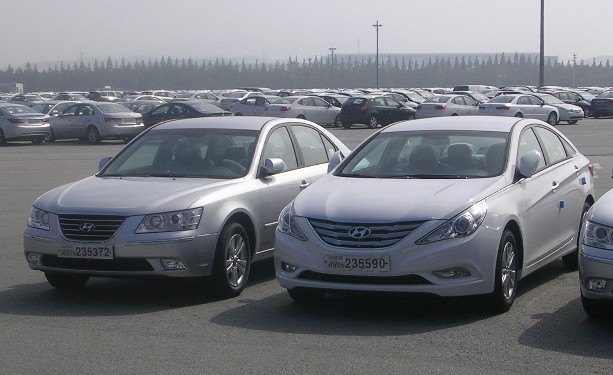
I spent a couple of hours with a production model of the 2010 Y20 Sonata in Korea recently and I too came away with a strong opinion. Namely, that Hyundai should be proud.
The next-generation Sonata is better than the outgoing model in every objective measure. It’s bigger, lighter, quieter, safer, roomier, more powerful, more fuel efficient, and emits less CO2, if you’re into that kind of thing. On these points, the numbers don’t lie.
When it comes to subjective measures however, the picture becomes less clear. We all know that beauty is in the eye of the beholder. Having said that however, some things are universally good-looking; Liz Hurley, Keira Knightley, and the 1956 Mercedes-Benz 300SL fall into this category. The Sonata is no Liz Hurley. But then, it’s not a Pontiac Aztek, either.
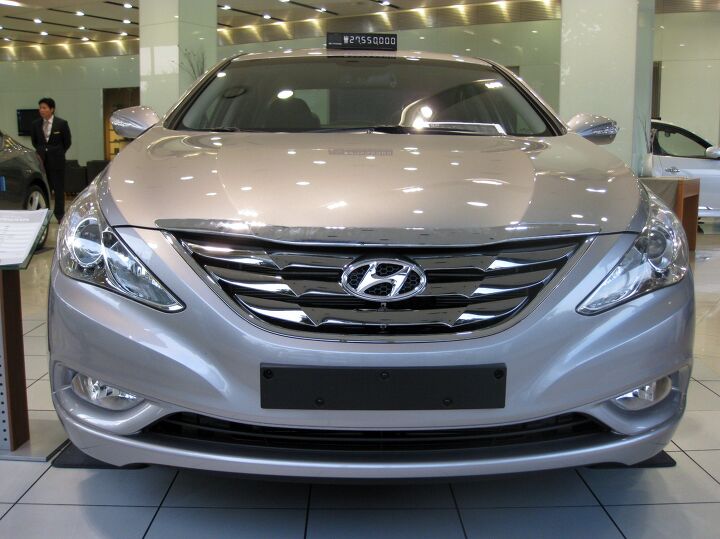
The grill is an especialy polarizing point. There are those who like it, those who don’t, and those who have reserved judgment until seeing it in the flesh, so to speak. Having seen the new Sonata in the flesh, the subjective eye of this beholder was surprised by its beauty.
Face-to-face, the Sonata’s snout manages to be bold without crossing into garishness. Above all else, it lends the Sonata something it’s always lacked: a personality. In comparison, the grill on the Genesis Coupe looks stifled and the Genesis Sedan’s grill feels stodgy. In short, Hyundai got it just about right.
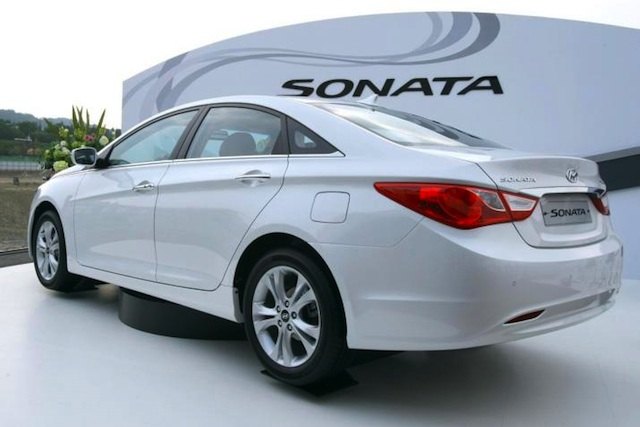
Another thing a lot of people have been talking about is the Sonata’s derivative styling. For those people, I offer the following:
One of these burgers is a Quarter Pounder, the other is a Whopper. Although they both have a top bun with sesame seeds, a plain bottom bun, and a meat patty in between, they have enough individual character, both in appearance and flavor, to set them apart from one another. The new Sonata is the same way. Yes, it looks similar to other cars on the road today, but it finally has a character and a flavor all its own that sets it apart.
The car I drove was a Y20 Top Super Deluxe model which retails for 27.85 million Korean won (about $23,000 US). As you might imagine, this model comes with a long list of features. That list is so long in fact that instead of putting it here, I have translated the entire price guide and options list [doc format] from Korean into English.
The dealership I visited for a test drive is near a highway onramp, so it was a right turn off the lot and another one onto the highway. The car I drove was equipped with Hyundai’s 2.0 liter four cylinder Theta engine. In fact, it’s the only power plant currently available in the Korean market Sonata. It’s rated at 165 horsepower (up from 163 last year) and 30 miles per gallon combined (up from 27 mpg last year).
Throttle tip-in seemed overly sensitive, but that was probably more my fault than the car’s. The car I drove had Hyundai’s newest six-speed automatic and apart from a 1979 Lincoln Continental I used to have when I was in college, I’ve never owned an automatic. My preference would be for the six-speed manual, but sadly it’s only available in the base model in Korea. With the automatic, the engine was turning just 1,500 rpm at 50 mph in sixth gear and the cabin was as quiet as Marcel Marceau in a bank vault. At higher speeds however, around 70 or 80 mph, I did notice some wind noise, particularly from around the A pillars.
Independent research done for Hyundai during the Sonata’s development found its wind noise levels to be 63.1 decibels. Unfortunately, that research didn’t say at what speed that level was recorded. For reference, that same independent research measured the wind levels of the Toyota Camry and the Honda Accord at 63.5 and 64.5 decibels, respectively. On paper at least, the new Sonata is quieter than both the Camry and the Accord. In the real world, I can attest to the cabin being nearly silent at speeds up to 60 or 65 mph, but over that, I was surprised at the amount of wind noise. This is something that other reviewers in Korea have noticed as well. Unfortunately, there isn’t a Honda dealership where I live and the Camry won’t be available in Korea until the end of October, so I couldn’t make a back-to-back real-world comparison. The table below shows how the new Sonata stacks up against its competition and against the outgoing model, at least on paper.
Previous Sonata Current Sonata Accord Camry
Wind Noise (dBA) 63.5 63.1 64.5 63.5
Road Noise (dBA) 70.0 69.5 73.5 68.0
In terms of performance, putting the pedal, which is the same ‘organ-style’ pedal as in the Genesis sedan, to the metal provided a smooth and prompt kick-down. The acceleration was good, but nothing to write home about and the engine sounded slightly overworked. The 201 horsepower 2.4 GDI engine will be available starting in January and I suspect it will remedy both these shortcomings. On top of being more powerful than the two-liter engine I drove, at 31 mpg combined, it gets better gas mileage, too.
A six-cylinder model is not available in Korea, but I’m sure the 3.3 liter 249 hp engine currently available in U.S. models will carry over and be tweaked for more power and better fuel economy when the car debuts in the States next year. That same engine in the Korean domestic Genesis sedan already makes 262 hp, so it should be an easy enough matter to pop it into the new Sonata. Having said that however, as I write this, there have been Internet mumblings and rumblings saying that because only 15% of previous generation Sonatas sold in the U.S. were equipped with the V6, Hyundai is considering dropping it as an engine option. I hope this is NOT the case. I don’t know if Hyundai can afford to turn its back on the 15% of people who did opt for the V6 in the old, rather humdrum Sonata. With the flash and dash exterior of the new car, people might be expecting a little more get-up-and-go and be disappointed, like I was, by the performance, and sound, of the four cylinder. Does anyone remember the Pontiac Fiero? It was all flash and no dash when it first came out. Besides, even if I buy a four cylinder, I like knowing that the company that makes my car has enough engineering prowess (spelt b-a-l-l-s) to build and offer a V6, even if it is superfluous in a car this size. Maybe Hyundai has something else up its sleeve. Wait and see, I guess.
During my test drive, I had the good fortune to pull alongside another new Sonata. It was a lower trim level that had the standard 16-inch alloy wheels (my test-drive car had optional 17-inch alloys with 215/55 R17 rubber). I must say that with the 16-inch wheels, the wheel wells look as empty as the L.A. Clipper’s clubhouse at playoff time. The wheels themselves look nice enough; it’s just that since the Sports model comes with 18-inch wheels, the designers had to make the wheel wells big enough to accommodate 18 inches and that leaves way too much room when equipped with the 16-inch wheels.
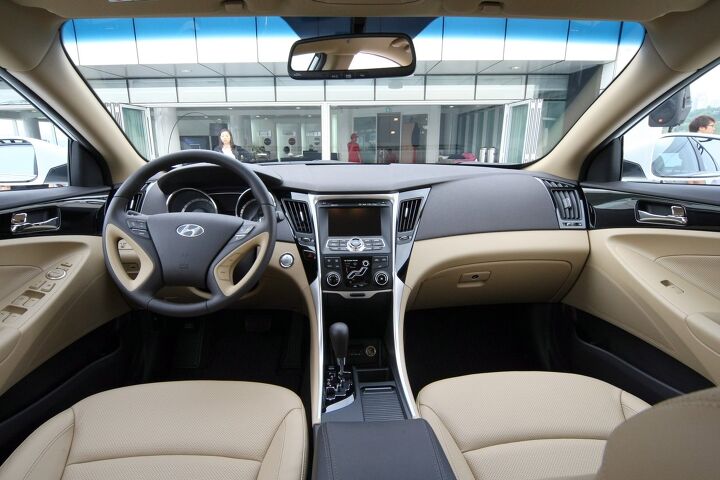
The interior of the new Sonata is not as revolutionary as the exterior. Instead, it is a nice evolution of the previous interior which now looks a little pudgy in comparison. The new model comes with a foot-operated electronic parking brake which has allowed Hyundai to position the shift lever closer to the driver. This move frees up a bit more room on the center console and makes it easier to access the storage bin, power outlet, and USB jack below the HVAC controls.
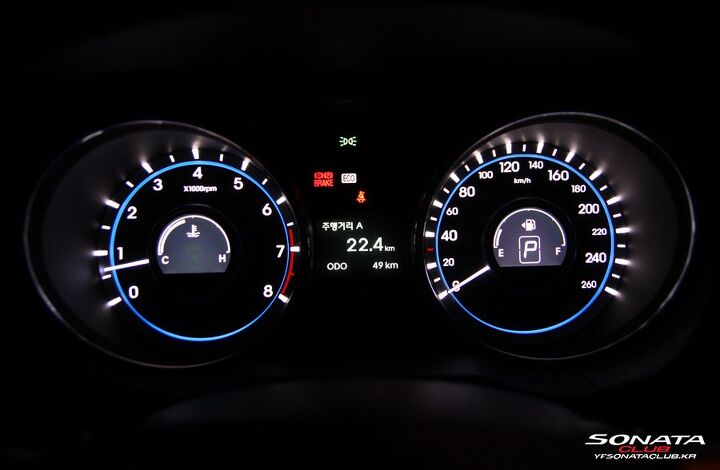
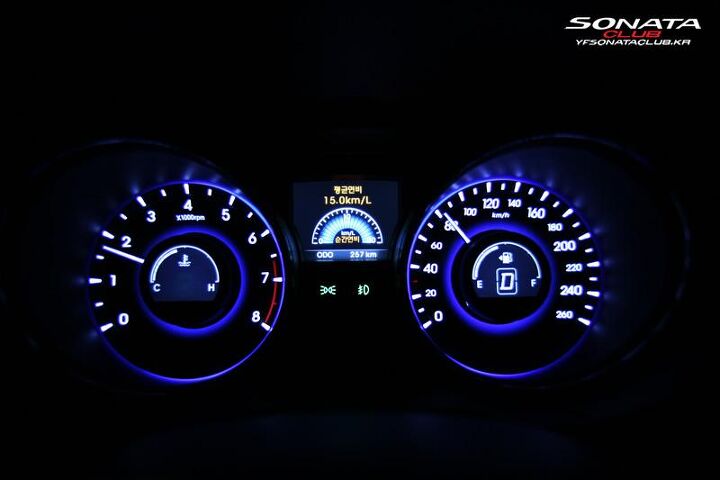
Perhaps the biggest change in the new interior is the gauges. The new gauges are, for lack of a better word, more engaging than those in the previous generation car. The car I drove was equipped with the Supervision Cluster which offers a higher contrast display and upgraded driver information center over the standard cluster. Both clusters come with ‘floating’ digital temperature and fuel gauges positioned in the center of the tachometer and speedometer. This not only looks good, but it’s also a good use of space.
The driver information center in both of these sets of guages displays instant and average fuel economy, distance to empty, average speed, and so on, but the Supervision Cluster offers the information in a larger, clearer, and more interactive format. This is due to the Supervision Cluster’s 3.5-inch TFT screen located between the tachometer and the speedometer. It does a wonderful job of displaying useful information, clearly, quickly, and dare I say it, in a intruiging way. The display graphics are so well done that I often found myself paying more attention to them than to the road. Just don’t tell Ray LaHood.
The interior plastics range from good to high quality. Some are a little hard and ‘plasticy’ for my liking, but fortunately nothing looks like it has come from the Tic Tac factory. This interior is far and away the best available in Korea in its class, and leaps and bounds better than the outgoing Sonata. If the last model seemed like a good start, the new Sonata seals the deal.
Hyundai has said that it hopes to do with this generation Sonata what Ford did with the first-generation Taurus, namely turn the entire automobile industry on its ear. The first-generation Taurus was unlike anything else on the road, a game changer for the entire car industry. Though the Y20 Sonata probably won’t change the entire industry the way the Taurus did, it also doesn’t need to. The road from Hyundai’s modest roots to this car was one of steady, incremental progress. This Sonata is merely an improvement on the last one, but it’s also the culmination of years of experience and development. In short, the perfect symbol of Hyundai’s transformation.

84 Comments on “Test Drive: 2011 Hyundai Sonata Y20 [Korean-Spec]...”
Back to TopLeave a Reply
You must be logged in to post a comment.
You can also login using Facebook Connect.


Based on the photos, I’m more a fan of the new interior than the new exterior. But I’ll grant that the latter will make the car much less anonymous than the current Sonata.
Nothing on handling? I gather there were no curves to speak of on the test loop.
The current Sonata has required few repairs according to TrueDelta’s Car Reliability Survey. If the 2011 proves to be a popular car–and Hyundai sales have been relatively strong lately–we could have a quick initial reliability stat for it.
http://www.truedelta.com/car-reliability.php
People who make negative comments about Hyundai mostly have questioned there current LONG TERM (Hyundai’s at 60,000+ miles have not done well) reliability which is still in question.
This “review” just like the mediocre Kia Forte one a few months back, seems to offer a lot of commercial like praise and strangely does not mention handling in the write up.
The new Sonata does look better than the old one at least. Even with that front end.
I too would be curious to hear more about handling. The looks of the car are great. Sure, it’s derivative styling, but it looks good! Also, since it borrows from a number of other cars, it’s not quite as vanilla as it might have been. A back handed compliment I suppose, but a compliment nonetheless.
I suspect that high on the design brief was the goal: Make it look more expensive than it is. If so, Hyundai is taking a page from the Honda design manual. Smart move.
People who make negative comments about Hyundai mostly have questioned there current LONG TERM (Hyundai’s at 60,000+ miles have not done well) reliability which is still in question.
One point of note: Phil Edmonston, who writes the Canada-centric Lemon Aid series bought (in 2003) and still recommends the Hyundai Elantra**. Lemon Aid is far harsher on a car’s reliability than Consumer Reports would ever hope to be, taking note of things like NHTSA complaint patterns and such that CR does not consider.
I think that, if someone like Edmonston can get behind Hyundai, that the long-term reliability issue is more in the minds of people who either haven’t kept up, or have something to prove.
** Over the Civic and Corolla, I might add. Edmonston is no import apologist, not by a long shot. He’s not a Hyundai apologist, either, having taken them to task for their horsepower misstatements of a few years back.
The front looks a little awkward but the rest looks fine. But then again, I guess that is subjective as I also don’t share your aesthetic appreciation of Ms Knightly or Ms Hurley.
does anyone really care about handling? in these cars? seriously?
it’s a fwd sedan… it’s not gonna carve up the nurburgring in 7′28″…
just not that interested if it weighs 3,500lb and only has a 2.4 four…
What is surprising in this “Family Car” segment that includes the 400,000 Accords and 450,000 Camrys sold every year,
is that SEDANS are so popular, while Family needs would be far better satisfied in a WAGON!
@ Rockit
Like the throttle tip-in on the new Sonata, I might be overly sensitive b/c this is my first review, but I don’t think it was full of “commercial-like praise.”
I called it out for not offering a manual in anything but the base model (in Korea), for being underpowered (with the 2.0), for not offering a V6 (in Korea and maybe also in the States), and for being noisy (over 65 mph).
As to the handling (or rather the lack of it in my review), perhaps that WAS an oversight on my part… again, this is my first kick at the cat. But I do like what @TonyJZX said, “does anyone really care about handling? in these cars? seriously? it’s a fwd sedan… it’s not gonna carve up the nurburgring in 7′28″”
Let me go back to my notes and see what I can come up with on the new car’s handling, and maybe it can be added to my post as an update or made into a new post.
Finally, about Hyundai’s at 60,000+ miles… In Korea, the average person puts on only 7,500 miles per year (small country with exceptional public transportation and high fuel costs). The average age of a car on the road in Korea today is between 6 and 7 years. That means that, in Korea at least, a car only has to last about 52,000 miles. Obviously, Hyundai needs to tailor their cars to the market they want to sell in, and I think take steps toward that with their increased quality and 10-year warranty in the States.
Ask Daniel J. Stern if you want to know why blue instrumentation lights suck.
@ carguy…
Ok, so you’re not into Liz Hurley or Keira Knightly, but you’ve got to agree with me on the ‘56 M/B Gullwing, right?
@Martin Schwoerer…
I always thought Daniel J. Stern just had it in for blue HEADLIGHTS? Does he also talk about blue IP lights, too?
The crease down the side reminds me of my 3-series, or a TSX. The interior reminds me of a Lexus RX. Other than the droopy front bumper, good looking car. Hopefully they didn’t have to sacrifice too much under the skin to pull this off at this price point (like VW often does)
@TonyJZX…
The new Sonata is rated at 3,240 pounds with the 2.0 liter engine and the 6-speed auto. The manual is rated about 25 pounds lighter.
I have no idea the weight of the 2.4 engine.
Also, does anyone know anything about published car weights? Specifically, how are they done? I presume they are ‘wet’ weights, but how wet? Full tank? Also, certain options are bound to add weight, like the 3-piece glass sunroof and power seats, no?
TonyJZX (and Walter):
Even in this segment, handling (in comparison to others in the segment) is still important to people. Sure, it’ll be blown out by a Vette or 300ZX in handling, but does a Corolla or Civic have more steering feel? Better braking? Mushy suspension?
Regardless of segment, compromises must be made with respect to seat of the pants and steering feel, so I think it’d be important to at least show some comparison; whether anecdotal or numerically supported.
Autosavant :
What is surprising in this “Family Car” segment that includes the 400,000 Accords and 450,000 Camrys sold every year,
is that SEDANS are so popular, while Family needs would be far better satisfied in a WAGON!
All car fans want to see more wagons, it’s just that most of us don’t actually buy them. AS for the public…
Subaru manages to sell wagons in good numbers, but when other manufacturers tinker, they don’t sell so well.
Just ask Mazda how Mazda6 wagon sales went a few years ago. Total disaster. People that bought them love them. All 8 of them.
Same goes for Ford’s attempts with the Flex/Taurus X/Freestyle, really. Too wagon, not enough SUV for American consumers. That, and the Freestyle/Taurus X were boring as sin and the Flex is too expensive.
Raised wagon/crossovers seem to be the only wagons that are palatable to families. And Hyundai cranks out plenty of those (Hyundai Santa Fe, Hyundai Tuscon, Hyundai Veracruz, Kia Sportage, Kia Sorrento, Kia Borrego).
I’m trying to say something sarcastic about how this looks like a camry solara and VW CC’s love child, but it isn’t happening.
Interior does indeed look nice.
“Justin Berkowitz :
October 5th, 2009 at 1:17 pm
Autosavant :
What is surprising in this “Family Car” segment that includes the 400,000 Accords and 450,000 Camrys sold every year,
is that SEDANS are so popular, while Family needs would be far better satisfied in a WAGON!
All car fans want to see more wagons, it’s just that most of us don’t actually buy them. AS for the public…”
Most buyers of Camrys are NOT car fans. Those of us that do not have families beyond a spouse and a child, can do just as well with less $ to buy and even less to operate the vehicle with a compact CIVIC or COrolla or Jetta Diesel.
“Subaru manages to sell wagons in good numbers, but when other manufacturers tinker, they don’t sell so well.”
True, maybe because its sedans are even uglier than its wagons.
“Just ask Mazda how Mazda6 wagon sales went a few years ago. Total disaster. People that bought them love them. All 8 of them.”
NO mazda was ever successful, and Mazdas are largely rebadged Fords anyway. the Accord and Camry did offer wagons, but the minivans, and now the obese and fuel-thirsty crossovers (which are nothing but tall, obese, AWD wagons) have killed them.
“Same goes for Ford’s attempts with the Flex/Taurus X/Freestyle, really. Too wagon, not enough SUV for American consumers. That, and the Freestyle/Taurus X were boring as sin and the Flex is too expensive.”
None of this explains WHY. I was aware of the fact that Families buy Accords and Camrys SEDANS and not wagons, I was curious WHY.
“Raised wagon/crossovers seem to be the only wagons that are palatable to families. And Hyundai cranks out plenty of those (Hyundai Santa Fe, Hyundai Tuscon, Hyundai Veracruz, Kia Sportage, Kia Sorrento, Kia Borrego).”
$4.50 gas in summer 2008 turned the best seller table (top 10 and top 20) on its head, and had the F-150, after of 2o full years of being no 1, plummet to no. 5 in May 08, below all of the big 4 (Camry, Accord, Civic and Corolla).
$4.50 gas will do it again, and this time rid us of the stupid crossovers, the same way it rid us of the StupidUglyVehicles and the 100,000s of pickups bought by those who never needed one.
BMW and Audi had beautiful wagons offered in the 3 and 5 series as well in the 4 and 6. Now they prefer to make more money offering obese crossovers and “activity” (LOL) vehicles. Again, give me $5 gas and these beautiful wagons will reappear in no time.
Perhaps Honda and TOyota could hire an Audi or BMW designer to design a BEAUTIFUL Wagon version of the Camry or the Accord and not some POS like the god-awful VENZA, and then they would sell a ton of them.
@speedbump47…
Very valid points. I’ll check my notes and/or drive the car again and come up with something on handling.
I won’t be able to compare it to the Toyota products as they are not available in Korea yet, nor can I compare it to the Honda products, as there is not a Honda dealership where I live.
I’ve driven a few different Hyundais and they all had a terrible, soft, bouncy suspension that made anything over 65mph very sketchy. I am curious if they are changing this at all as they seem to improve everything else year after year.
BMW and Audi had beautiful wagons offered in the 3 and 5 series as well in the 4 and 6.
They still do.
“NO mazda was ever successful, and Mazdas are largely rebadged Fords anyway.”
Wrong. Ever hear of the Miata? Also, they may share platforms and some components with Ford and vice versa, but no Mazda (excepting the Tribute and B-series truck) was ever a badge job.
Good and unbiased write-up. Thanks for that. I’m impressed.
I’ve seriously been considering one of these for the future – but I am also considering a Subaru Forester since Michigan (and much of the rest of the USA) has had 15 degrees colder temperatures than normal pretty much all year (after 5 months of snow on the ground last winter) – and I suspect that, due to the solar minima (i.e. lack of solar flares / COLD SUN = COLD EARTH), I may be wanting all wheel drive for northwestern Michigan winters after all…. despite “managing” my whole life without all wheel drive.
The ‘08 Prius will be gone soon enough, I suspect within a year. We’ll be keeping our ‘09 Sonata. I like it.
is that SEDANS are so popular, while Family needs would be far better satisfied in a WAGON!
No, because anyone with a family can instantly see the benefits of the higher roofline of a minivan, crossover or whatever-the-hell-the-Kia-Rondo-is. With a high-roofer you get much more space for a smaller exterior footprint, far easier ingress/egress and easier sightlines.
Minivans, not crossovers, killed the full-size station wagon because they’re better in every way that matters to the people who would buy station wagons in quantity. Hell, the low-roof wagon only exists because we went through a protracted “Long, Low and Sleek” period starting about the mid-1950s.
You’ll note that, even in Europe, low-roof wagons and hatchbacks are disappearing in favour of “space wagons” like the aforementioned Rondo.
Minivans were subsequently displaced by SUVs because people are insecure and marketers played to that insecurity since there was real money in doing so: it’s a lot cheaper to build a truck-based SUV than a unibody minivan or wagon. Crossovers happened when people realized that body-on-frame, rear-drive trucks really do suck to drive.
I don’t think you’ll see the low-roof wagon around much longer, except in subcompacts (which need the space) and premium marques (who can make up for the lack of volume with margin and their market’s more eclectic tastes). Much like the manual transmission, actually.
Regardless of how the styling and especially the grill look in the flesh (the grill I think is an extremely smart design) , this Hyundai is (and most probablt will be) able to compete in the segment succesfully worldwide.
In Europe, if they offer in (late) 2010 the new 1.6 liter engines, Opel, VW, Skoda, Seat, Peugeot, Renault, Mazda, Nissan, Honda should worry. As for handling, I cannot imagine that it is high on the agenda of interested customers.
Excellent first impressions review.
“Throttle tip-in seemed overly sensitive, but that was probably more my fault than the car’s.”
To me, sensitive tip-in is extremely frustrating and its presence or absence is my #1 consideration when deciding how much I like an automatic transmission. Please don’t gloss it over.
Kudos for lightening the car and being aggressive with the styling. Does it compromise interior comfort, especially in the back?
I drive a Madza6 wagon.
You would never have know they made them since Mazda didn’t advertise them much and rare was it that a dealer had it on the showroom floor.
Same goes for Malibu Maxx we also checked out.
Had to walk to the back of the lot (only after convincing the salesperson that we DID NOT want a SUV)
Millions are spent on telling people how SUV….er I mean CUV….oops I mean Crossovers are the PERFECT family vehicle and that decades worth of drivers were wrong in picking station wagons.
If you have a family, wagons work. If you need more space….go for the minivan.
and guess what…regular old sedans work as family cars as well.
who’d a thought
“PartsUnknown :
October 5th, 2009 at 1:49 pm
BMW and Audi had beautiful wagons offered in the 3 and 5 series as well in the 4 and 6.
They still do.”
I was talking about the USA market, of course. I am aware they still do overseas, even my yougner cousin has a 320 Wagon and they like it a lot (wife and Kids 1 and 3 years old)
“NO mazda was ever successful, and Mazdas are largely rebadged Fords anyway.”
“Wrong. Ever hear of the Miata? ”
How much % of All mazda sales is this Chick car I can barely fit in (and I am only 6 1″)? 10%? Not even that. So, even assuming the Miata was a huge hit, you at best can say that what I wrote was “10% wrong”.
And in fact, right after I posted it, I bet somebody would bring up the stupid Miata.
I would never bother looking at that supposedly reliable copy of 60s english roadsters. All yours.
“Also, they may share platforms and some components with Ford and vice versa, but no Mazda (excepting the Tribute and B-series truck) was ever a badge job.”
They have a ton of common components. Even just sharing a platform is bad enough in my book.
“psarhjinian :
October 5th, 2009 at 1:58 pm
is that SEDANS are so popular, while Family needs would be far better satisfied in a WAGON!
No, because anyone with a family can instantly see the benefits of the higher roofline of a minivan, crossover or whatever-the-hell-the-Kia-Rondo-is. With a high-roofer you get much more space for a smaller exterior footprint, far easier ingress/egress and easier sightlines.”
Duh, you are 20 years out of date. Minvians WERE popular then, but after a decade or so, Soccer moms decided they clashed with their wardrobe, and went to the STUPID SUVs and Crossovers.
I was referring to tall wagons anyway, but not obese AWD crossovers. You can do a tall wagon and actually it will weigh LESS than a longer, wider and not tall wagon.
Most cars today are much taller than they used to be anyway.
Height is the cheapest dimension, as any efficiency expert will immediately recognize from geometry etc considerations. BUT USEFUL Height, not SUV height that is 100% eclipsed by the higher ground clearance.
Most older people also prefer the higher seating position that you do not have to SINK into, but “parallel park” their aching skeletons on the seat.
All of this still does not even begin to answer my original question, WHY do most people still buy the STUPID SEDANS, when they are looking for a FAMILY Vehicle such as the Accord or the Camry, and they do not demand an EFFICIENT (Tall if you like) WAGON that is NOT a 4,600 lb giant Odyssey or Sienna Minivan and NOT a STUPID SUV or Crossover?
Again, $4.50 gas will make people rational once again, just as it did in May 08, and may waken the automakers to produce FIT, tall wagons that can take all the stuff of a family of 4 in COMFORT, with no gypsy-like piles of stuff on the roof or towed.
Honda used to offer an outstanding little, lightweight tall wagon CIvic in the 80s, with a rare for the times efficvient 6 speed manual. That was NOT the civic hatch but a 5 door wagon with a far higher roofline than the civic hatch, which until the 92s (and even beyond) was quite short, more stylish perhaps but not very good for a family’s worth of stuff.
Honda may want to take another look at that efficient design and have something similar next time gas goes to $4. Today’s Fit is the closest to that design.
Why the hate-rant against sedans, autosavant?
Sedans made up a huge portion of the auto market since 1923 when Hudson introduced the (finally affordable) closed Essex 2 door “coach”. Most cars were open touring cars before that.
Four door sedans became popular (except for car tests in “enthusiast” magazine) because – duh – it is a lot easier for rear passengers to get in and out.
When Ford started making Fordors in Model T’s, it didn’t take long for the 4 door sedan market to “take over”.
Prior to WWII, station wagons were solely for the wealthy, since they were low-production, wood based, etc.
But back to the present; some folks don’t NEED nor do they WANT tall vehicles because the taller the vehicle, the more frontal area and the worse the mileage. At least, that is my thinking.
Which is also why I’m vaguely considering the Subaru Outback or whatever that “lower” Subie station wagon is, as well as the Forester. Along with this new Sonata (which hasn’t AWD, alas – it’d be no contest if it did).
I have virtually no interest, personally, in SUV’s or crossovers per se. The Subaru Forester seems to have attributes that I like, including the low-ish center of gravity enhanced by the opposed engine design. (It may not make a lot of difference in the real world, I don’t know, but it does prove they had their thinking caps on when at design table – though the earliest opposed four Subies from the 1960’s were pretty much a copy of Borgward’s Lloyd technological lay-out).
I really don’t know what it is about your blog software and my achy ol browser, but being confronted with a 1.5-monitor-wide cheeseburger on the front page is fairly terrifying and makes me doubt my sanity.
Re: the wind noise? I have to wonder if it’s because the car is so quiet that once the speed increases, and the wind noise intrudes, it’s only noticeable because the car is so quiet at lower (sub-65mph) speeds?
In other words, it’d be less noticeable if the car were LOUDER below 65mph even if over 65mph, it was exactly as loud.
Needless to say, the 2012 Sonata will need reshaped mirrors (or how about little cameras and in-door LCD’s replacing the stupid mirrors?).
Of course, since mirrors are possibly going to be different on the Montgomery built cars, it may not be the case for cars sold in the states.
(I say that because the Montgomery plant doesn’t build cars with fold-down side mirrors – they are fixed, since these cars are shipped on wide US trucks, not crammed into close quarters on ships from South Korea to a US port).
Edit: In fact, look at the top photo again. Both the 2010 Korean spec Sonata (on the left) and the 2011 car (on the right) have mirrors placed into the “fold away” (or “fold up” in the case of the 2011 car) position.
Once again; my wife has a 2009 (identical to short-term only 2010) Sonata but it is built in Montgomery Alabama. The mirrors are different and externally do not move/fold/fold up. Alas, if you bump something (like get to close while backing into the garage) and catch it – it breaks off and you end up ordering parts from the dealer! (There are supposed advantages to the swing-away type though I did bash the 2002 Sonata which did have swing-aways by accidentally bumping the side of the garage door opening and it broke anyway)
autosavant: there is no post counter here. Please consider combining your thoughts into fewer posts. And please consider if it is REALLY necessary to emphasize your posts with such liberal helpings of all caps. It is easy to italicize words that you wish to emphasize.
Regarding your earlier statement: The 3 has also been a very successful car for Mazda. I’m not sure how well it fares in the US, but in Canada it is one of the best-selling cars overall.
I do agree with you that a wagon would be a suitable vehicle for more people, but there are numerous reasons why they don’t sell. Others have done a great job spelling them out.
Edit: the Sonata looks pretty good. I even like the exterior. I would seriously shop one of these if I was in the market for a mid-size sedan.
1. Writer said, he have not drove camry and accord.(he can’t compare with any other competiotrs. especially noise part)
2. Writer said, this a first car review. (he is a amteur. he is neither pro mag driver nor well experienced driver)
Hyundai’s current Sonata has very abrupt throttle response as well. My wife drives one, and I have a terrible time trying to drive it smoothly when I drive. I am sure that if I drove it all the time, I would get used to it and smooth out, but I don’t drive it very often. I read an article once where the writer (a former GM engineer) suggested that companies put in non-linear throttles to make their cars seem more responsive and powerful than they really are. I think that may be true.
TonyJZX :
October 5th, 2009 at 12:13 pm
does anyone really care about handling? in these cars? seriously?
I do. And I’d say anyone who buys an Accord does as well.
Styling is 100% subjective but I not only like the new Sonata I think it is by far the best styled entry in the segment. Far eclipes the Camry and anything far eclipses the ugly Accord.
How did this turn into a thread about station wagons anyway?
Styling is 100% subjective but I not only like the new Sonata I think it is by far the best styled entry in the segment. Far eclipes the Camry and anything far eclipses the ugly Accord.
How did this turn into a thread about station wagons?
Not to go off on too far of a tangent…but “supposedly” reliable copy of 60s English roadsters?” Really? I’d cordially ask that autosavant review reliability data for the Miata…ANY year Miata and see how it proves out when it comes to reliability. And if by copy you mean two doors, four wheels, an engine in front and the drive wheels in back…then sure, the Miata is a copy. Kind of how a Volvo 240 copies a brick, I suppose (and I truly like the 240).
And while Mazda certainly doesn’t enjoy Chevrolet-like numbers (now there is a guaranteed measure of success!), I’d contend that the Miata AND the Mazda3 have been successful.
Full confession…I own none of the vehicles mentioned above, but I will say that the Sonata has been on and off of our radar for a while as a family hauler. I’m sure if my wife sees the newly styled one, it’ll be on her list to look at when we are in a position to consider a car a few years down the road. Heck, for that matter, I think the Accent SE 3-door with the factory aluminum rims, sunroof and 5-speed look awesome for a commuter car, but then, I’m partial to simple and basic hatchback transportation. And I know I’m very much in the minority in this country when it comes to that.
Oh, and +3 on taking the time to thoughtfully combine points of discussion…
I was talking about the USA market, of course. I am aware they still do overseas
So was I. Think before you post. Wagons are offered in the 3- and 5-series and in A4 and A6 variants. In the US.
They have a ton of common components. Even just sharing a platform is bad enough in my book.
Right, but that’s not what you said. Again, think before you post. You do realize that the majority of manufacturers share components across brands and/or subsidiaries, correct? Condemning Mazda and Ford for that practice is a little weak. Most would recognize that Ford’s investment in Mazda has been beneficial to both automakers from an engineering and product development standpoint. It doesn’t make Mazda a sales king, but they do make interesting cars. (I don’t own a Mazda).
Wasn’t it reported that Hyundai was dropping the V6 from the Sonata and sticking with 4’s (T and N\A)?
Having been a complete cynic for a very long time, I have to admit being interested in Hyundai’s lineup. However one thing is starting to worry me. Hyundai have always been considered the ‘budget price’ brands compared to the likes of Ford/Honda/Toyota who were the ‘middle price’ brands.
Now when you look at the quoted prices of the new Sonata, it’ll put the vehicle in the same price bracket as a mid range Fusion or Camry. I think that Hyundai better start proving that their products can run rings around the likes of Ford and Toyota otherwise they’ll have a tough sell on their hands.
Where is Mr. s55 today? We need him to tell us again how much better his s55 is compared to these penalty boxes, which he would never consider, since you know, he drives an s55 and all that.
There are so many people predicting a return to $4 gas and $150/barrel oil, the contrarian in me (especially since it meshes with my belief that the global economy is weakening, credit is becoming more scarce, joblessness rates are rising) puts a fiver on the table that we see sub $2 gasoline and sub $55/barrel oil for quite some time.
I, too, am interested in the suspension characteristics (note, I did not use the term handling) of the Y20. The US-market NF seemed very, very crashy and floaty. Before the ‘09 update, the steering wheel would regularly twitch in your hands from bumps and, in the V6, torque steer. I always thought the NF was a 95% finished car, and the guys in charge of the US suspension partied right before their work was due and rushed to finish it. I’m not even talking about enthusiast-style driving (whatever that is). These were all rental cars, mostly 4 cylinder models, driven on surface streets and highways in the normal manner.
I suppose Hyundai figures people will go for the Azera if they really want a V6 in their sedans. Speaking of which, where is the Azera in all this? Did the Genesis take its place as the uplevel sedan above the Sonata or does the Azera still have a place in the lineup?
The exterior is gorgeous and is a stark break away from the norm in that old XJ – new XJ kind of way. That said, I think manufacturing this car without a V6 is a mistake. Even though it’s a shrinking market, I believe there are quite a few people who’d want a V6 in their sedans without opting for something bigger.
Autosavant : How much % of All mazda sales is this Chick car I can barely fit in (and I am only 6 1″)? 10%? Not even that. So, even assuming the Miata was a huge hit, you at best can say that what I wrote was “10% wrong”.
And in fact, right after I posted it, I bet somebody would bring up the stupid Miata.
I would never bother looking at that supposedly reliable copy of 60s english roadsters. All yours.
To summarize: the Miata was not successful because you’re not interested in it and because Mazda sells a lot of other vehicles. Very convincing argument.
Menno:
“though the earliest opposed four Subies from the 1960’s were pretty much a copy of Borgward’s Lloyd technological lay-out).”
I think you will find that the Subie’s layout came from Borgward’s mid sized line : the Goliath had an 1100cc flat four for a couple of years before it was used as a 900cc in the Lloyd Arabella – Which then became the Borgward Arabella. Most Lloyds were 300 and 600cc twins.
I know – Who cares? Just a bit of historical fluff.