


Rare Rides Icons: The Ford Taurus, Modernizing Family Transportation (Part IV)

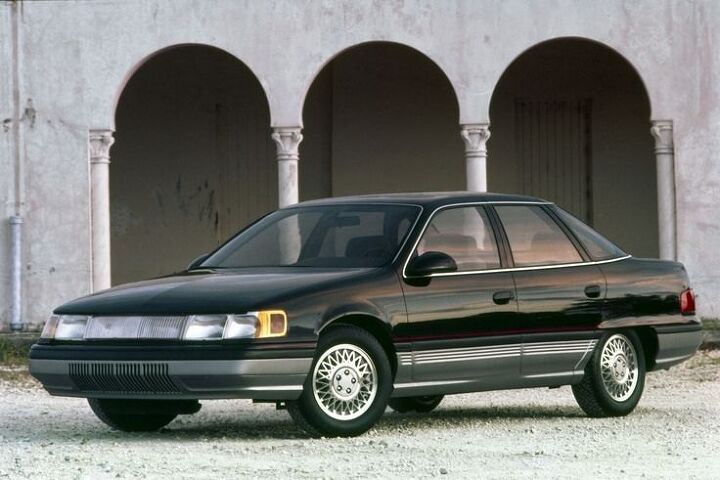
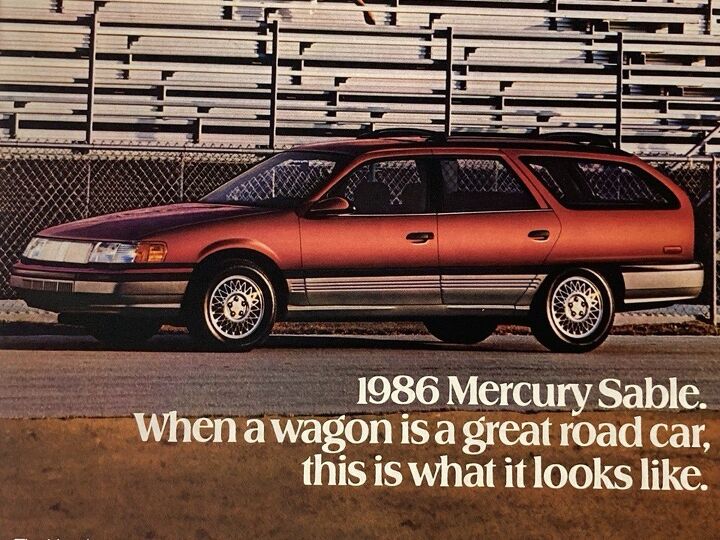
When the Taurus sedan and wagon launched in 1986, the space-themed event included an upscale sibling that arrived as Mercury’s flagship offering. More aerodynamic looking and with nicer trim, the Sable was intended to appeal to a slightly more daring customer with its design. Let’s take a little diversion into Sable styling.
Like the LTD at Ford, the Sable was a replacement for the near-identical Marquis, a name donated by the Panther-based sedan and wagon as they became Grand Marquis. Perhaps unexpectedly, the Sable sedan’s exterior shared only a roof and doors with the Taurus.
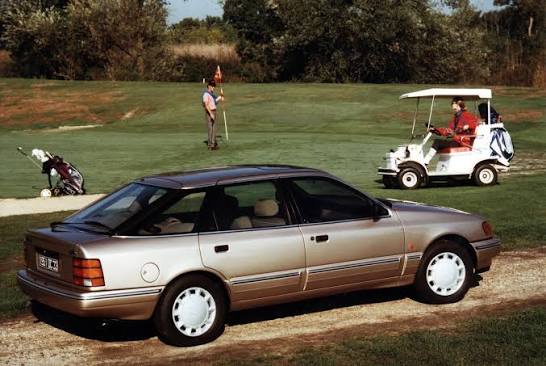
On approach to the Sable one could easily draw comparisons to the Ford Scorpio if they were aware of Ford’s European product. The ribbed lower trim and wrap-around rear side window carried many of the same design cues. Sable’s front end was decidedly different to the Taurus, with large headlamps and indicators that wrapped further into the fender. Unlike the Taurus, there was no cornering lamp set low in the bumper.
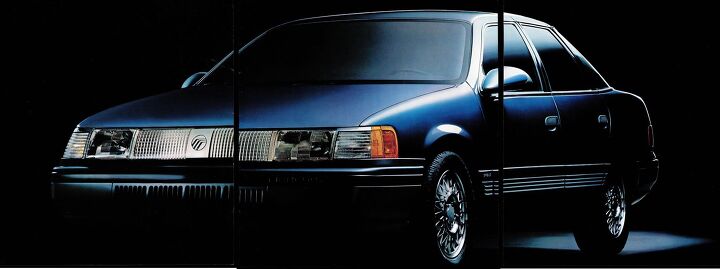
Lighting was the main thing at the front of the Sable, as the model introduced a unique light bar between the front lamps. In place of a traditional grille, the plastic panel was designed to give the Sable its own lighting signature. And it worked!
Keen onlookers would notice the composite lamps were slightly taller than the light bar, which led to a bit of a disjointed look across the fascia. The light bar effect would spread to all Mercury models in the coming years. Sometimes it was functional (Grand Marquis, Villager) and other times not (Tracer).
Even bolder were the vertical grille slats set front and center into the bumper. Four distinct sections of seven slats each were both unusual looking and more prominent than the traditional air inlets of the Taurus. Bumpers were either gray or body colored on Sable, and wore a metallic finish unlike base models of the Taurus.
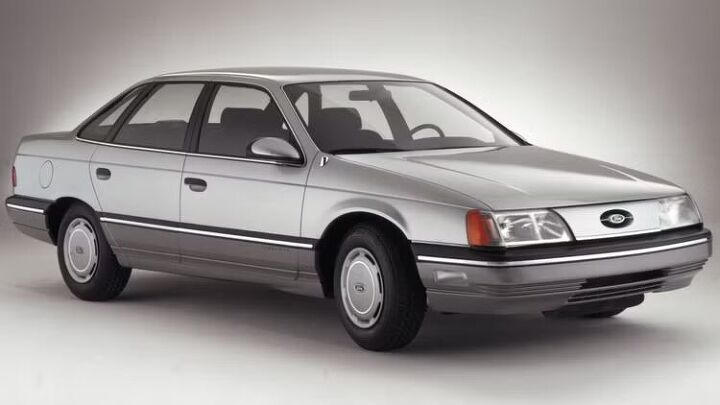
The Sable’s hood wore a single central hood crease and did not have a power bulge like the Taurus. Also absent was a body character line, as fenders flowed down across a smooth and rounded surface toward the lower cladding. Interestingly, though some Sables were photographed for press materials with a sporty looking red stripe at the top of the cladding, that feature (or perhaps trim) did not make production.
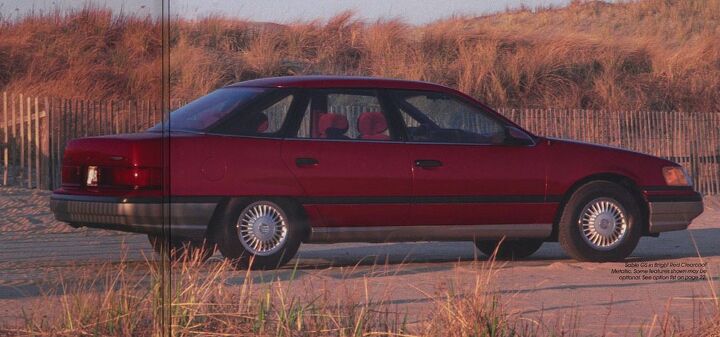
Sable wore less chrome than the Taurus, and emphasized lower cladding textures and shapes as its visual interest along the sides. There were three wheels available at Sable’s launch, which included a 15-inch lace alloy, a 14-inch cast wheel, and a 15-inch wheel cover. And that rear wheel was partially covered, in a daring fender line that went straight across!
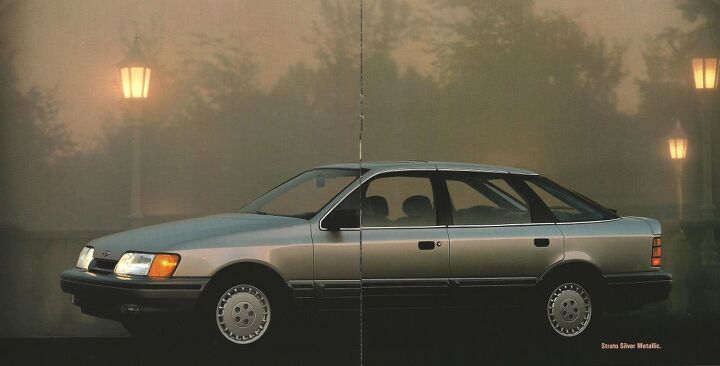
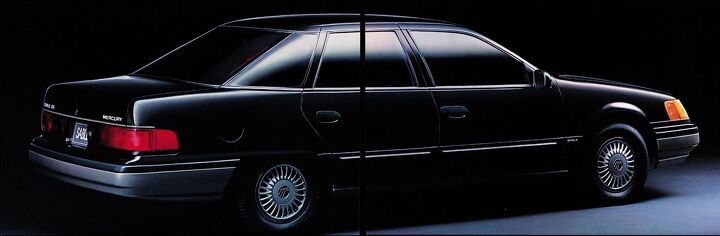
Much like the Audi 5000, the Sable had a lightly skirted rear fender that played up its aerodynamic mission. It was notably different to the traditional circular fender shape on the Taurus. Sable’s wheel arch flared outward, which continued unabated to the rear corner.
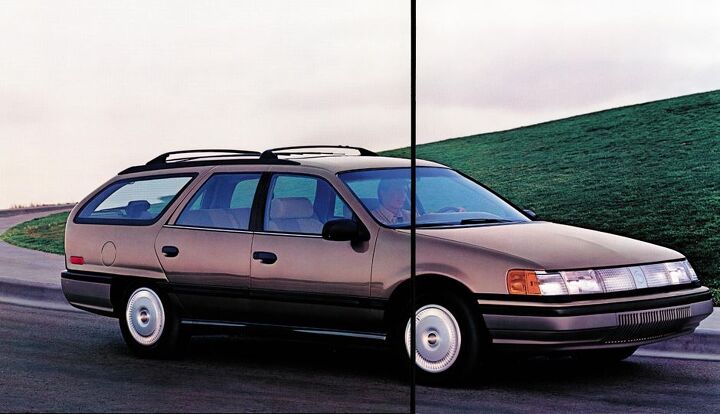
Above that straight edge rear wheel opening was another defining Sable sedan feature: a floating roof design. The rear side window of the Sable fully covered the C- and D-pillars, wrapping around to meet the rear windscreen. This created a floating effect (especially when windows were tinted).
The resulting view of the exterior made it look like the Sable had much more glass than the Taurus. In reality it had a slightly larger glass area that was much sleeker. The rear windscreen angle was slightly more relaxed as it flowed to the smooth rear end of the Sable.
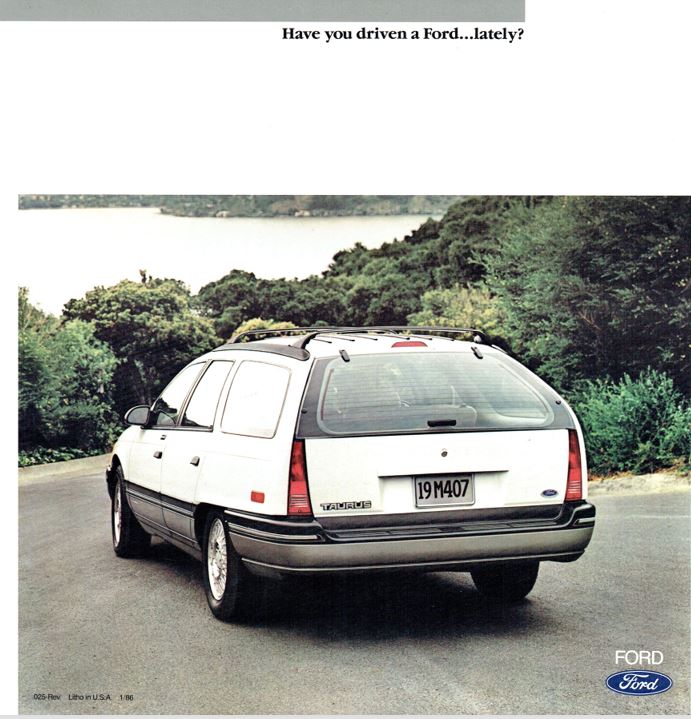
Like the front, rear lenses wrapped around onto the fender. Lenses were much longer than on the Taurus and finished in a red color that deepened to a smoke effect as it neared the reversing lamps. The lamp treatment would set a standard at Mercury, and the entire Mercury line (Villager excepted) would adopt the red-to-black rear lamp look in the coming years.
From a rear three-quarter view, the Sable was decidedly more European looking than its sibling. This would become a problem two years in the future, when Ford attempted to launch the similar looking Merkur Scorpio at Lincoln-Mercury dealerships. Though it looked similar, the Scorpio was made in Germany, rear-drive, and much more expensive than the larger Sable.
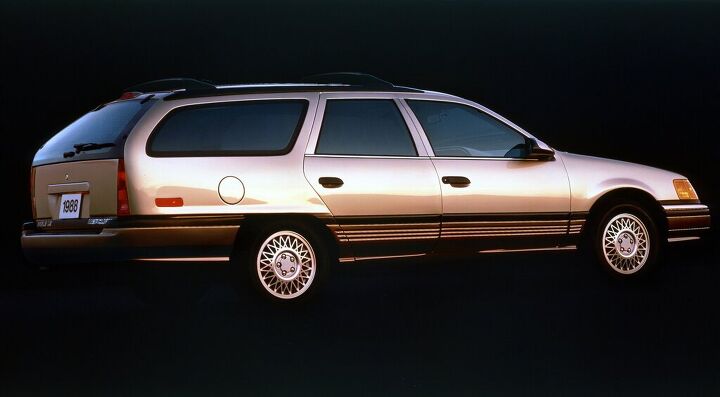
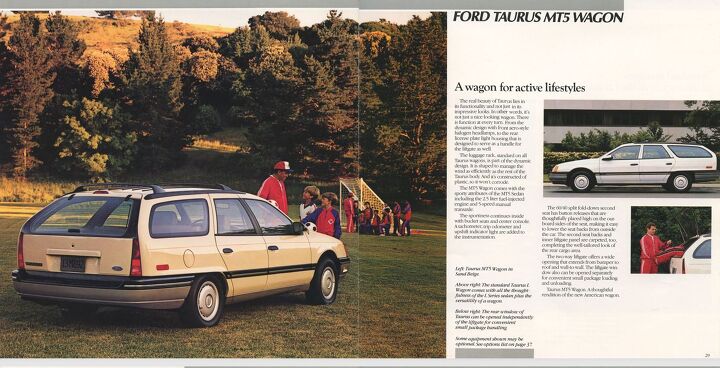
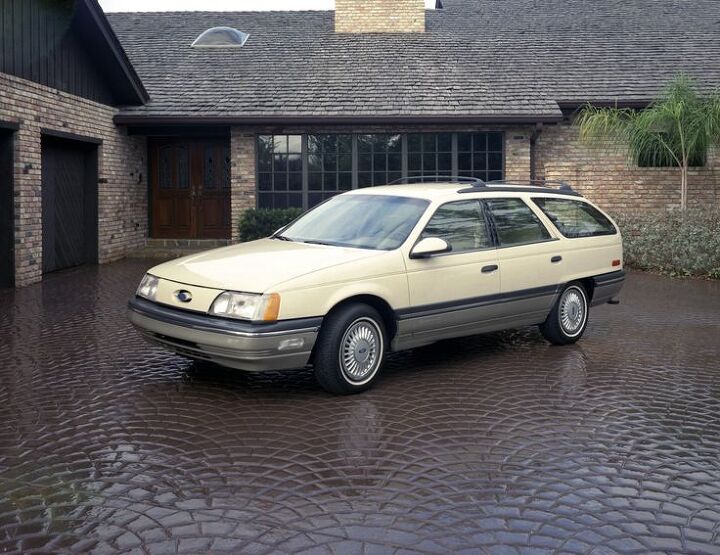
Because of its extended rear fender design the Sable was about two inches longer than the Taurus. Next to the Sable sedan on the showroom floor was the Sable wagon. The product people at Ford decided the Sable’s sleeker looks were more suitable when wagon-ing, and so the Sable wagon became the basis for the Taurus wagon. The Taurus wagon was differentiated with its own front clip sans light bar, and Taurus cladding and wheel designs.
Interestingly the Taurus wagon received the appropriate body character crease from the Taurus sedan, too. This is your author’s surprised face that Ford bothered. In light yellow and with aero wheel covers, the Taurus wagon looked decidedly like a German taxi.
Aside from badging, the Sable and Taurus wagons were identical at the rear. There was a separate opening glass hatch with an integrated wiper, and a pair of vertical tail lamps that were triangular in shape. A panel on the lower tailgate indicated the brand and model in large block lettering. Using the Sable as the foundation for the Taurus wagon became standard operating procedure at Ford, and held true for the remainder of the wagon’s four total generations.
But what wasn’t standard procedure was the differentiation between the first generation Taurus and Sable interiors. Would you believe the Sable was permitted a different dash design? We’ll take a look at their futuristic interior designs in our next installment and then revert to Taurus-only content. OnlyTaurus, if you will.
[Images: Ford]
Become a TTAC insider. Get the latest news, features, TTAC takes, and everything else that gets to the truth about cars first by subscribing to our newsletter.
Interested in lots of cars and their various historical contexts. Started writing articles for TTAC in late 2016, when my first posts were QOTDs. From there I started a few new series like Rare Rides, Buy/Drive/Burn, Abandoned History, and most recently Rare Rides Icons. Operating from a home base in Cincinnati, Ohio, a relative auto journalist dead zone. Many of my articles are prompted by something I'll see on social media that sparks my interest and causes me to research. Finding articles and information from the early days of the internet and beyond that covers the little details lost to time: trim packages, color and wheel choices, interior fabrics. Beyond those, I'm fascinated by automotive industry experiments, both failures and successes. Find me on Twitter, @CoreyLewis86.
More by Corey Lewis









Comments
Join the conversation
My parents bought a brand new 87 Buick Century wagon. I remember, as a young auto enthusiast, being surprised they chose the boxy Buick over the sleek and new Taurus wagon.
I owned a Mercury Sable 1989 and a 1991. Great and very comfortable cars. I still own a 1995 german Ford Scorpio Cosworth. This one is very comfortable and it´s behaviour is very similar to the one of the Sable. Due to its Cosworth engine, is also a very fast car. Excellent for the road.