Rare Rides Icons: The Cadillac Eldorado, Distinctly Luxurious (Part LXIII)

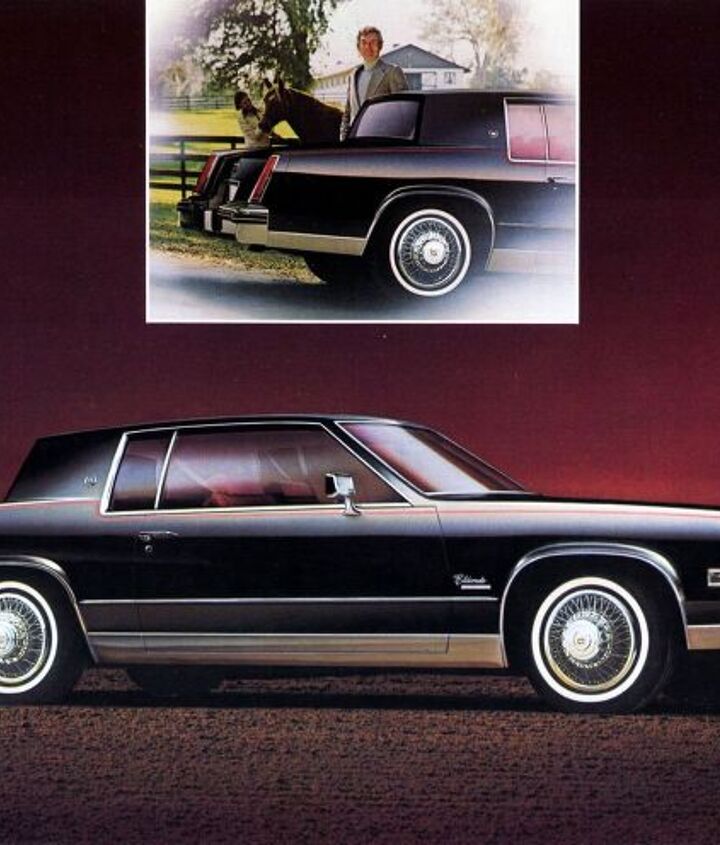
In 1979, Cadillac launched the tenth generation Eldorado into a changing car market. The Eldorado was Cadillac’s last model to downsize, after the rest of the brand bowed to the interests of fuel economy and cleaner styling in 1977. There was of course another big downsizing coming in just a few years, but nobody was focused on that yet. It was time to enjoy a thoroughly modernized, smaller, and more electronic Eldorado coupe.
As mentioned in our last installment, the Eldorado rode on the same E-body platform it used since introduction in 1967 with modernizations and downsizing. As before the platform was also used for the Oldsmobile Toronado and the Buick Riviera. Only the Riviera received its own special appearance via revised side windows and fender line; the Eldorado and Toronado were body twins for the first time.
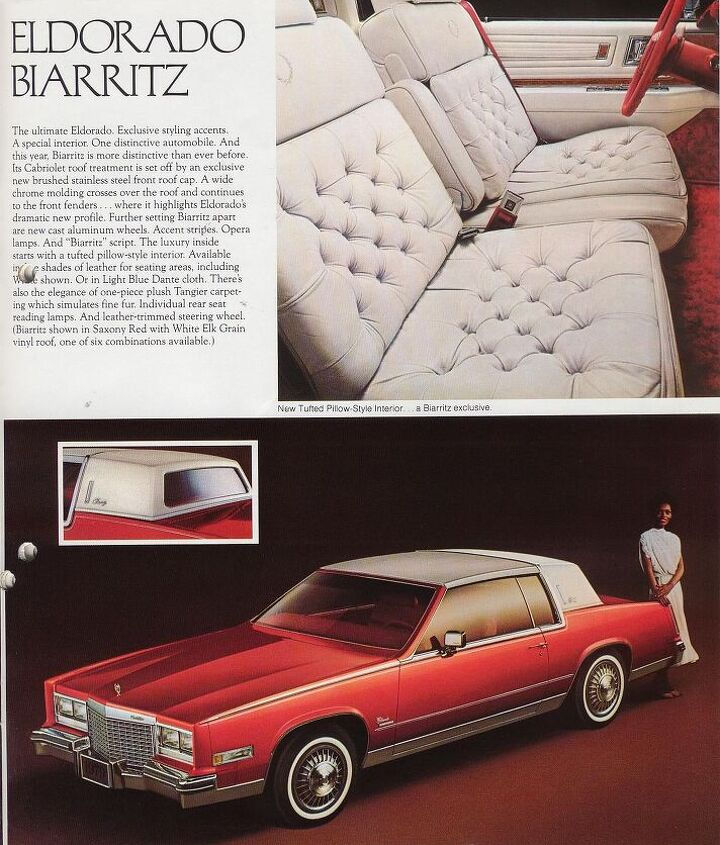
The Eldorado’s wheelbase shrunk from 126.3 inches in 1978 to just 114 inches in 1979, and matched its two cousins. Each of the triplets was within a couple inches of the others in measurements, given differing front and rear clip design and body panel shapes. Overall length for Eldorado was trimmed from 224 inches to 204 inches, while width decreased from 79.8 inches to 71.4”. Height remained the same as the prior version, at 54.2 inches. The changes meant a notable weight decrease of 900 pounds, down to roughly 3,792.
Unlike prior eras when the Cadillac option had to be the longest car from GM, the Eldorado was tied with the Toronado for overall length. Both were two inches shorter than the Buick Riviera. The Riviera was the longest via additional overhangs front and rear, and had a different rear side window arrangement. It also sported a more curved fender with a character line not present on the other two cars. Riviera would continually lean into the curved “boat look” appearance from 1979 through its discontinuation in 1999.

Headlining the shortened E-body platform was a new independent rear suspension. Though it was a nod to modernity, fully independent suspension was also a way for engineers to create more interior room in a car with much smaller exterior dimensions. Cadillac advertised that although it was smaller, the 1979 Eldorado had more interior room than the 1978.
Other advancements included a flush-mounted windshield, as the era of the thick chrome window surround was near its end. Wheel bearings were permanently sealed, so as to never need lubrication. The parking brake released itself automatically upon acceleration, no more burnt smell!

The engine was also smaller, as the big block era faded from view. Though the 425 V8 (7.0L) was in use in other Cadillac models for one final year in 1979, the Eldorado borrowed its introductory engine from the Seville. And for the first time, an Eldorado was powered by an engine not sourced from Cadillac: It was from Oldsmobile! The chosen mill was the 350 (5.7L) V8 used broadly across Oldsmobile models. It was deemed competent enough for Cadillac use in the Seville of 1976 to 1980, and for the new Eldorado’s introductory year in 1979.
The Oldsmobile Rocket 350 (as it was no longer called) entered production in 1968. In its various applications it produced between 160 and 325 horsepower. The era of manufacture could be determined by the paint color on the engine block: 1968 to 1974s were gold, 1975 and 1976 were metallic blue, and 1977 to 1980 examples were GM blue.

Those produced from 1977 to 1980 were known to be flimsier than earlier years. The engine was revised in ‘77 to use a lighter casting with a thinner block, and larger openings (windows) in the main bearing bulkheads. The cylinder head came from Pontiac in these years and was prone to cracking. The crankshaft was also lighter.
The flagship Seville debuted in 1976 with the 350, upgraded with electronic port fuel injection. It was the first American car with EFI as standard. Cadillac was eager to advertise the “on-board analog computer,” a phrase one simply would not hear today. The ‘79 Eldorado promised 14 city, 22 highway, and subtracted two miles per gallon for California residents.

Lower fuel economy for California was a result of tougher emissions regulation in that state only. It was a short era where car ads had to wear disclaimers. Vehicles were often termed as “49-state cars” when they did not comply with California’s rules. The California Eldorados and Sevilles used a revised ECU, an O2 sensor, and a different catalyst system.

Also borrowed from the 1978 Seville was a much worse diesel engine option. The Oldsmobile 350 diesel was available for all years of the tenth-gen Eldorado, and was a very unreliable engine. Abandoned History devoted an entire article to this disastrous decision.
GM attempted to save money by converting the gasoline 350 into diesel, but did not consider the compression differences between those two engine types (three times greater for diesel). It also decided to skip a water separator that engineers considered an unnecessary expense. Check the link above for a full overview of that 120-horsepower mess.

The Eldorado’s transmission was new for 1979, the short-lived THM325. Adapted from the heavier-duty THM425, the 325 was meant for the downsized E-body vehicles and was also used in the front-drive 1980-1981 Seville. This was the end of the line for the analog three-speed THM, and was replaced in 1982 by the four-speed THM325-4L with electronic overdrive.
Speaking of everything’s computer, the Eldorado featured the “Cadillac Trip Computer” for the first time in 1979. A feature that debuted on the 1978 Seville, the system was more than just a mileage computation. Twelve different buttons showed the status of various pieces of information during a journey.

Information included average speed, miles to empty, time duration of a journey, an instant RPM readout, number of miles to destination, and arrival time. For the most part these were all basic calculations done based upon a trip distance in miles set by the driver. In 1979 when almost nobody owned a computer and many had not used anything with a digital display beyond a microwave, boy howdy! Notably the trip computer was not available with the diesel engine option, as it only worked with the ECU of the gasoline engine.

These technological advancements combined with simplified and edgy new styling to take the Eldorado into the Eighties. And if you were stuck in the past and paid extra, Cadillac was still willing to layer on too much trim and vinyl padding. We’ll review the Eldorado’s exterior in our next installment.

[Images: General Motors]
Become a TTAC insider. the latest news, features, TTAC takes, and everything else that gets to the truth about cars first by subscribing to our newsletter.
Interested in lots of cars and their various historical contexts. Started writing articles for TTAC in late 2016, when my first posts were QOTDs. From there I started a few new series like Rare Rides, Buy/Drive/Burn, Abandoned History, and most recently Rare Rides Icons. Operating from a home base in Cincinnati, Ohio, a relative auto journalist dead zone. Many of my articles are prompted by something I'll see on social media that sparks my interest and causes me to research. Finding articles and information from the early days of the internet and beyond that covers the little details lost to time: trim packages, color and wheel choices, interior fabrics. Beyond those, I'm fascinated by automotive industry experiments, both failures and successes. Lately I've taken an interest in AI, and generating "what if" type images for car models long dead. Reincarnating a modern Toyota Paseo, Lincoln Mark IX, or Isuzu Trooper through a text prompt is fun. Fun to post them on Twitter too, and watch people overreact. To that end, the social media I use most is Twitter, @CoreyLewis86. I also contribute pieces for Forbes Wheels and Forbes Home.
More by Corey Lewis


Comments
Join the conversation
My boss did the opposite - in 1986 after decades of Cadillac ownership, he switched to the Lincoln Town Car and loved it.
I do like that black one on the cover image. Black with touches of chrome.