


Rare Rides: The Studebaker Avanti Story, Part II

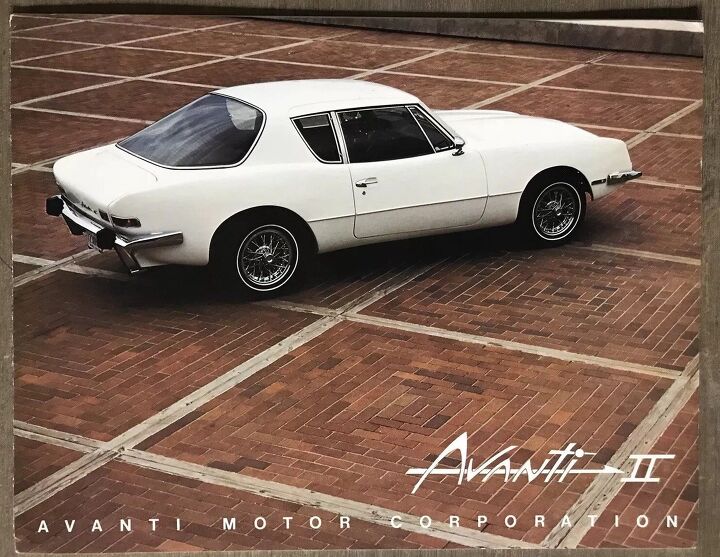
In Part I of the Avanti story (which received some great comments) we reviewed the coupe’s design and very short original production timeline at Studebaker. But the car was so unique and so modern that two enterprising Studebaker dealers knew they couldn’t let Avanti die after just two years.
Today we take a walk through the next couple of decades, as the Avanti strayed further and further from its true self, ravaged by the passage of time.
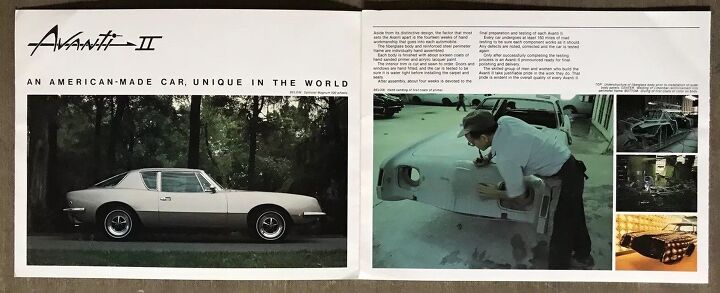
After Studebaker concluded its Avanti production at the end of 1963, the company was quickly approached by South Bend Studebaker dealers. Arnold and Nate Altman and Leo Newman were all about Avanti and felt it had a life ahead of it. Studebaker agreed to sell the Avanti’s name, production rights, tooling, extant parts, and the coupe’s space at the South Bend plant. Included in the deal were Studebakers truck production rights, as it ceased producing the Transtar and Champ pickups by 1964. In short order, Avanti was back in production!
Now built under the new AMC, that’s Avanti Motor Corporation, Avantis were built slowly and by hand. The company was profitable not because of the Avanti, but because AMC produced Studebaker truck parts. The company never built any new trucks, though it could have.
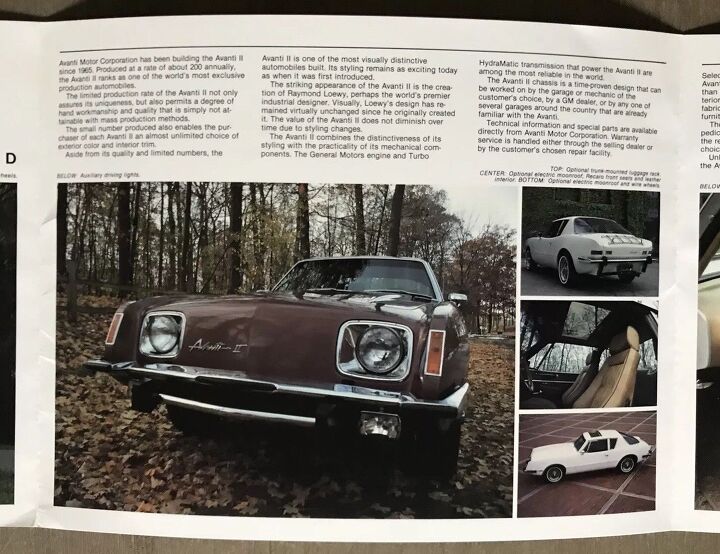
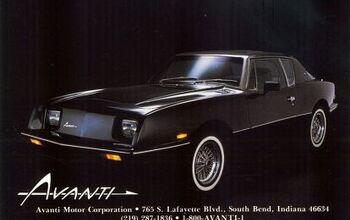
The NOS Avanti parts dried up in short order, and by 1965 AMC needed to get a little creative to continue production. Enter Avanti II. Introduced for the ’65 model year, the most notable change was a power swap: Gone was the 4.7 supercharged Studebaker engine, and in its place was a small block Chevrolet 327 (5.4L) V8 from the Corvette. Power was up to 300 horses, though the rest of the car (in ’65) remained largely the same as before.
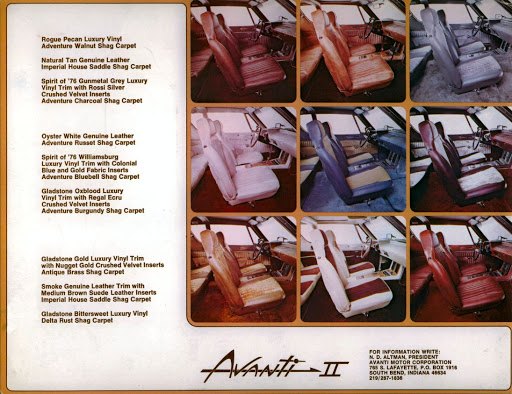
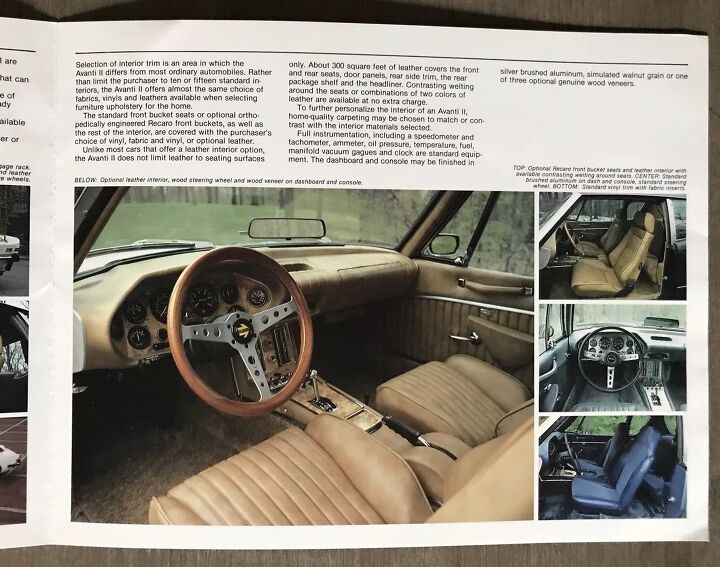
The Avanti II continued its life as a custom-order car, and Avanti Motors required 10 to 12 weeks lead time to build an Avanti dependent upon colors and trim chosen. Interior components drifted away from the Loewy-designed originals and more toward more current trim sourced from various places. Think lots of walnut, aftermarket gauges, and disco color themes.
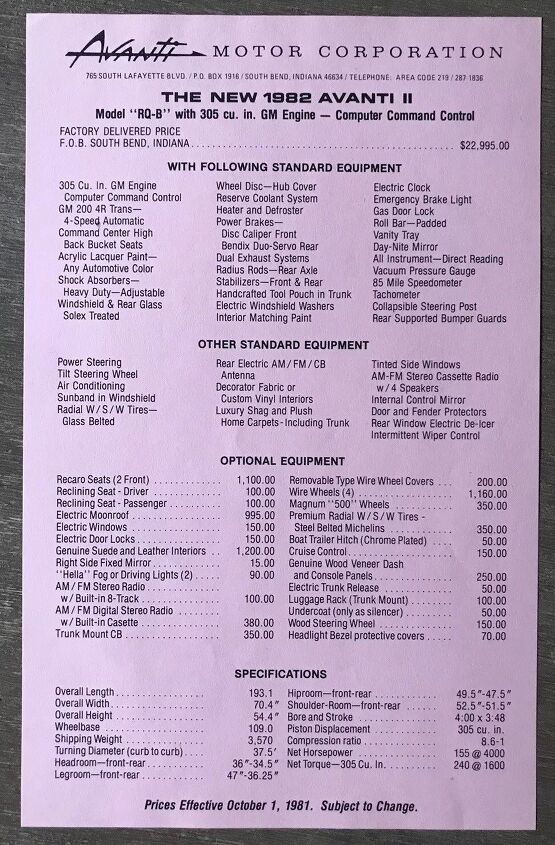
Over time the 327 was replaced by a 400, then a 350, and by 1981 was a Chevrolet 305. Tracking alongside the decline of the Corvette, the 305 brought with it malaisey electronic engine controls, a total of 155 raging horses, and a GM TH-350 three-speed automatic.
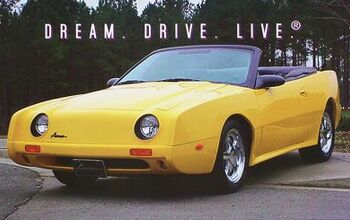
Much like the rest of the auto industry, the early Eighties were a dark time for the Avanti II. But the coupe still had a good 25 years of life left in it, and things got a whole lot darker. More to come in Part III.
[Images: Avanti Motor Corporation]
Interested in lots of cars and their various historical contexts. Started writing articles for TTAC in late 2016, when my first posts were QOTDs. From there I started a few new series like Rare Rides, Buy/Drive/Burn, Abandoned History, and most recently Rare Rides Icons. Operating from a home base in Cincinnati, Ohio, a relative auto journalist dead zone. Many of my articles are prompted by something I'll see on social media that sparks my interest and causes me to research. Finding articles and information from the early days of the internet and beyond that covers the little details lost to time: trim packages, color and wheel choices, interior fabrics. Beyond those, I'm fascinated by automotive industry experiments, both failures and successes. Lately I've taken an interest in AI, and generating "what if" type images for car models long dead. Reincarnating a modern Toyota Paseo, Lincoln Mark IX, or Isuzu Trooper through a text prompt is fun. Fun to post them on Twitter too, and watch people overreact. To that end, the social media I use most is Twitter, @CoreyLewis86. I also contribute pieces for Forbes Wheels and Forbes Home.
More by Corey Lewis









Comments
Join the conversation
Me thinks the one I remember had a small block 305 because it sounded exactly like a Camaro of the 70s. Off the cuff, I could see an electric startup buying the design/name.
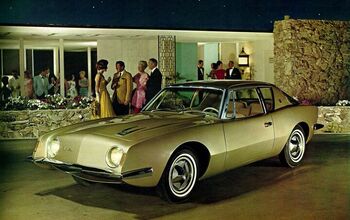
Unfortunately, the Avanti II lost the nose-down rake that made the original Studebaker version look aggressive. Compare the front wheel openings and you'll see. There is a noticeable difference in the front fenders. By jacking up the front end, the Avanti II lost part of the visual appeal of the original version's styling. I read that it was necessary to jack up the front end of the Avanti II to accommodate the Chevy engines, but I'm not sure that's true, given that the Sting Ray's hood was quite low.