


Refresh Awaits Hyundai's Kona; N Line Model to Arrive for 2021

The subcompact Hyundai Kona earned itself no shortage of attention on these digital pages after it landed in dealers in February of 2018. Some of that press was, ahem, not favorable to the little Hyundai, which impressed neither in interior volume or in off-roadability.
It’s a subcompact crossover, of course. Its utility will be limited. Still, the Kona proved a success for Hyundai, boosting sales volume for the suddenly-struggling brand and helping get it to where it is today. Despite the pandemic, July saw the model’s fourth-best monthly showing since its debut.
Committed to fielding the freshest lineup around, Hyundai already has changes in store for the Kona. If power was once a concern, a new variant should put that issue to rest.
Yes, there’s a Kona N on the way, but before that happens, there’ll be an N Line. Y’all know what that is, don’t you? The Elantra just received the treatment, and the Elantra GT just lost it (along with its life). A sportier ride, mild exterior flourishes, larger wheels, and a potent four-cylinder turbo denotes N Line.
In the Elantra version, it means a 1.6-liter turbo making 201 horsepower and 195 lb-ft, with a six-speed manual or seven-speed dual-clutch automatic doing the rowing. This mill will likely find its way into the Kona N Line. Hold out a little longer if “N” levels of power are the only thing capable of getting you out of your seat.
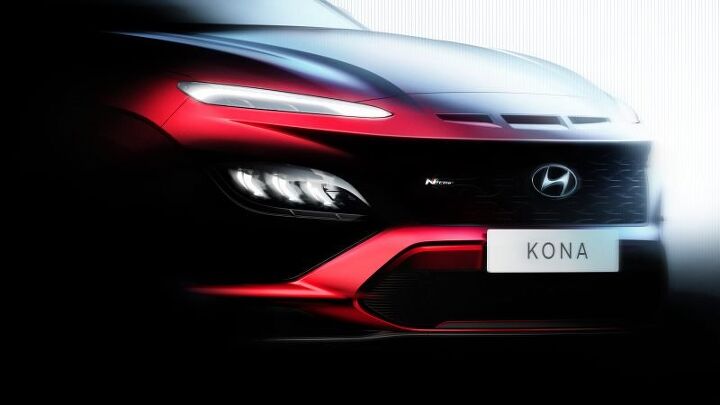
As for the upcoming refresh, Hyundai saw fit to maintain the stacked headlamp motif, but changes abound. For starters, the grille is now horizontally-oriented and not nearly as tall. The Hyundai badge migrates northward, between the still razor-thin upper headlamps, while the lower lamps become a trio of upright LEDs placed on a slight diagonal. The lower bumper also sees significant changes, with a wider and larger lower intake. In the dark, the refreshed Kona looks more than a little like the Ford Escape.
Going N Line means a meaner front fascia, however, with an N Line badge tucked into the corner of the grille mesh. Three slots in the upper fascia replace the long slit seen in the current iteration of the Kona. While they look like the N Line needs to gulp more air, it isn’t known whether they’re even functional.
Elsewhere, the N Line’s LED Trio seems more on the level, literally, while the Hyundai badge returns to the center of the grille mesh. It shouldn’t be hard to tell the two variants apart.
Hyundai claims that a new front skid plate and bumper lends the Kona an “armored appearance,” which is certainly a statement worthy of debate. The automaker also claims the model boasts a wider stance, without elaborating on it. More details should land in the coming weeks as the ’21 Kona heads closer to these shores.
[Images: Hyundai]

More by Steph Willems







Comments
Join the conversation
Not a single comment! Either the comment machine is out of order, or no one really cares about the Kona. I think it's the latter.