

#fcv
Hydrogen Fuel Station Blast Temporarily Halts Fuel Cell Vehicle Sales in Norway
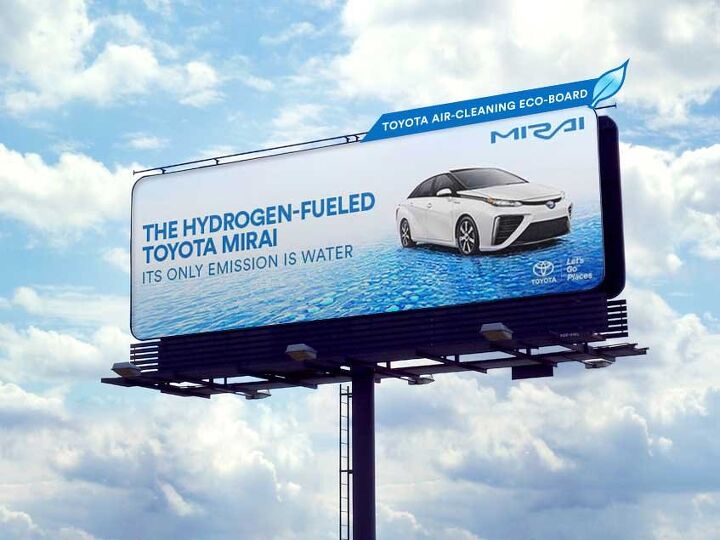
Toyota and Hyundai have reportedly suspended sales of the hydrogen fuel cell-powered Mirai and Nexo in Norway after one refueling station went up like the Hindenburg.
Local media reports that, on Monday evening, a Uno-X station in Sandvika suffered a “huge explosion” that injured two nearby drivers after the shock wave caused their vehicles’ airbags to deploy. It’s a black eye for a fuel that, despite the best efforts of a handful of determined automakers, can’t seem to make much headway in the marketplace.

Not Giving Up: Toyota Wants Mass-produced Mirai FCVs, Longer Range

Despite it being the most abundant element in the world — but one of the hardest fuels to source — automakers aren’t giving up on hydrogen. That group includes Toyota, which launched the world’s best-selling hydrogen fuel cell vehicle, the Mirai, in 2015.
Early this year, the 3,000th U.S. Mirai found its way to the driveway of a California customer. Cali remains the only American jurisdiction where FCV vehicles, and refueling infrastructure, are offered (though a hydrogen shortage last week saw SoCal stations dry up).
In the hopes of boosting the fuel’s prevalence and stimulating demand, Toyota plans to enter mass production with its second-generation Mirai, expected early in the coming decade.
Hyundai Plans New Fuel Cell Vehicle for CES, But What's This About Powering Your Home?

Despite the inherent challenges with using hydrogen as a fuel source, Hyundai is plowing ahead with a new generation of fuel cell vehicle as a follow up to the Tucson Fuel Cell it currently offers in limited markets.
Difference is, the current hydrogen-powered Tucson shares a lot of sheetmetal with the traditionally fuelled Tucson. The new, as yet unnamed, hydrogen crossover doesn’t look like anything in Hyundai’s portfolio … at least not yet.

Honda Has Another Hydrogen Car It Wants To Talk To You About

Honda took the wraps off its hydrogen-powered FCV sedan Wednesday. It that will pick up from where the FCX Clarity left off last year.
The FCV will be shown Oct. 28 at the Tokyo Motor Show this year, alongside the automaker’s NSX and Civic Type R. (Any bets on what goes on sale first?) However, it probably won’t be called the FCV when it goes on sale next March in Japan in sometime after in the U.S. Like the FCX Clarity, the FCV may not have much of a life outside California — that’s really the only state with a semblance of hydrogen fuel infrastructure.

Nissan, Toyota, Honda Team to Build Fuel-Cell Infrastructure in Japan
According to Toyota, three Japanese automakers — Honda, Toyota and Nissan — are working together to build hydrogen fuel stations around for future fuel-cell cars.
The program, which will subsidize fueling stations up to 11 million yen ($89,500) per year for each station, is meant to boost the nation’s infrastructure for hydrogen-powered cars.
Hydrogen Digest: July 1, 2014
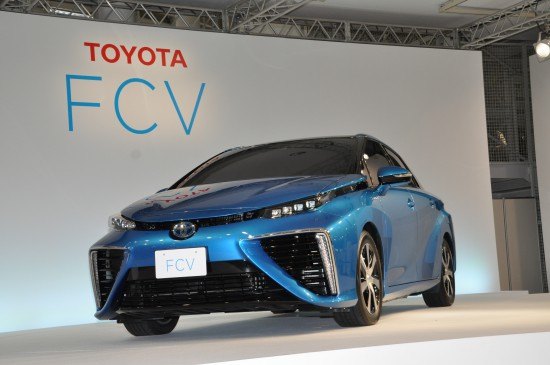
In today’s hydrogen digest: Toyota asks the National Highway Traffic Safety Administration for a two-year exemption on its FCV; the automaker banks on subsidies to help the FCV leave the showrooms at home and abroad; and ammonia may be the secret to hydrogen’s success as a fuel.

Toyota Aiming For Modest Annual Sales Of Fuel Cell Cars
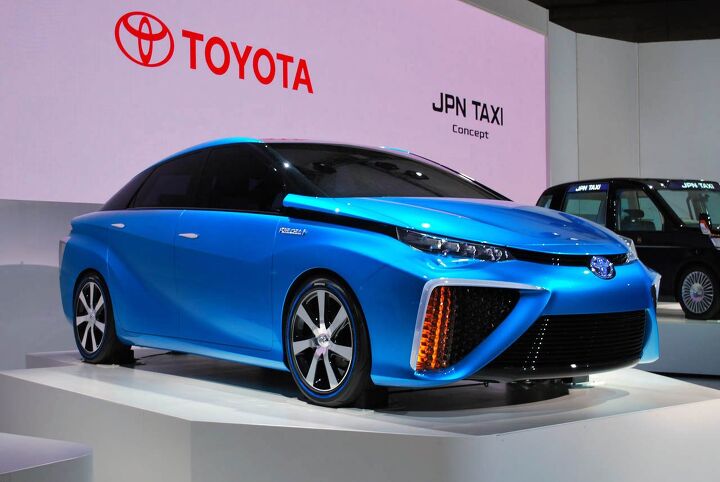
Toyota believes fuel cells are the future, becoming a competitive technology up against other zero-emission compliance tech by 2030 at the latest. In fact, the automaker plans to hedge their bets in the near future by setting an annual sales goal of 5,000 to 10,000 fuel-cell powered machines beginning in 2015.

Japanese And Korean Carmakers Jointly Promote Fuel Cell Vehicles
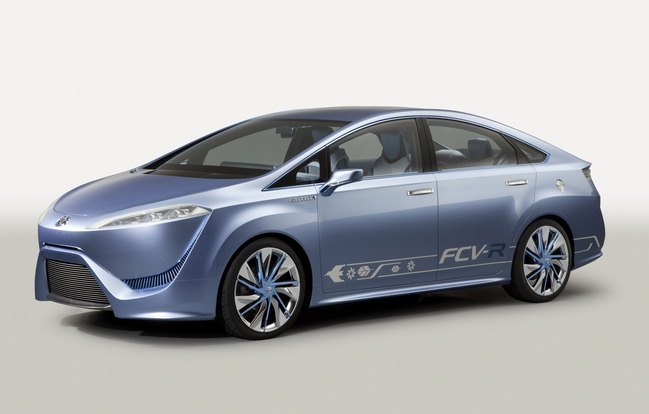
Pretty much most of the world’s large automakers plan a commercial launch of fuel cell vehicles in 2015, Hyundai even earlier. One of the hot spots could be Scandinavia. At the end of a month-long hydrogen-powered tour through Europe, Toyota, Nissan, Honda and Hyundai signed an agreement to jointly promote fuel cell vehicles in Norway, Sweden, Iceland and Denmark.

"Super Credits": The CAFE Loophole That Might Have Been (And Could Be Again)
The Michigan Congressional delegation’s letter, stating that the Detroit-based automakers are not technologically capable of serving the market while complying with a proposed 2025 CAFE standard seemed strange to me in light of the recent progress made by Ford and GM on fuel economy. Why, I wondered, would these firms boast of their fuel econmy efforts on the one hand while allowing their congressional representatives to portray them as unable to build a CAFE-compliant fleet on the other. Why, I wondered, don’t Ford and GM come out and angrily insist that they can build the most fuel efficient cars in the world? My guess: because they know that they can probably wheedle a loophole out of the feds if they keep pleading inability. Yes, everyone knows they can comply with CAFE… but even the UAW knows that when the government asks you to do something, you ask for something back. Which in turn made me wonder: what might the OEMs want? And, turning to the 2012-2016 CAFE Final Rule [go on, give it a read in PDF format here], I found a glaring loophole that all the manufacturers seemed to want, but which the feds turned down. I have no evidence that this is back on the table for 2017-2025, but I thought I’d put it out there to give a sense of what the OEMs may be pushing for by pleading inability to comply with the proposed 2025 standard.

Range Anxiety Strikes Mercedes Fuel-Cell Convoy, TTAC Alum
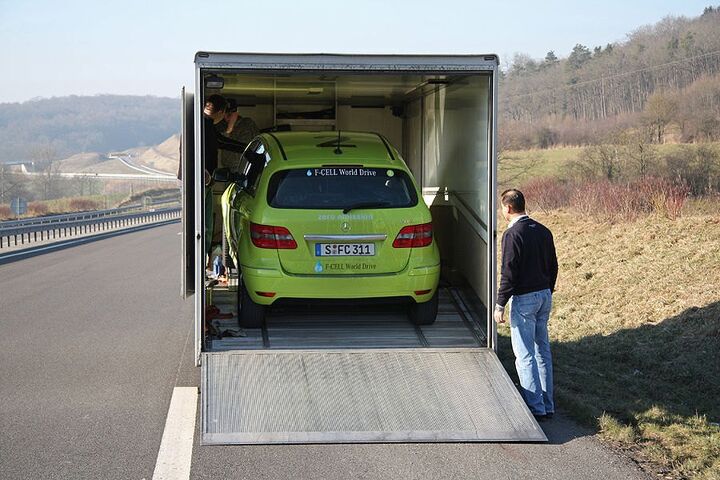
Hydrogen Fuel Cell vehicles (FCVs) are enjoying something of a comeback lately, as everyone from Hyundai and Honda to GM and Daimler are talking about forthcoming production versions of test-fleet FCVs. And with EVs poised to both dominate the short-term green-car game and inevitably disappoint consumers, it’s no surprise that the perennial “fuel of the future” is enjoying a fresh look from automakers. But if high cost and range anxiety are the flies in the EV ointment, the FCV-boosters are finding their hydrogen cars tend to suffer from the same problems. Daimler says
By 2015, we think a fuel cell car will not cost more than a four-cylinder diesel hybrid that meets the Euro 6 emissions standard.
but that by no means guarantees its Mercedes FCV will be truly “affordable” by any reasonable standard, as diesel-electrics are considered one of the most expensive applications of internal combustion power. And then there’s the whole range issue. Yes, FCVs refuel faster than EVs, but even the most ambitious of Hydrogen-boosters, Daimler, are only pushing vehicles with a 250-mile range. Which is why we puzzled a bit over The Globe And Mail‘s assesment that
Three Mercedes-Benz B-Class F-CELL models will make [a 125-day] global trek, which will seek to highlight the real-world benefits of fuel cells versus EVs – mainly their much further range
Flipping over to AutoMotorundSport, we find that the irony which completely escaped the G&M is threatening to overwhelm Daimler’s entire demonstration. And, as is only natural when things like this occur, there’s a bizarre TTAC connection…
Toyota: $50k Hydrogen Sedan By 2015
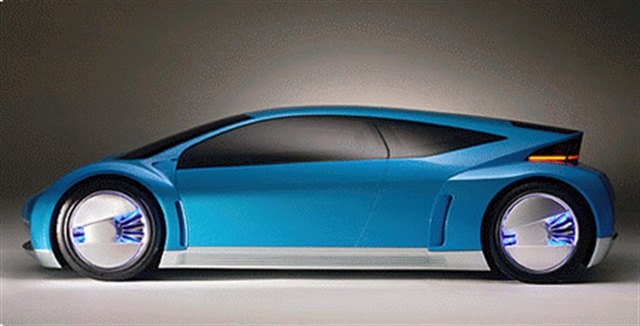
Lithium-ion batteries aren’t the only automotive cleantech that appears to be getting cheaper. Toyota’s head of advanced autos, Yoshihiko Masuda, tells Bloomberg that the Japanese automaker has cut the cost of hydrogen fuel cell vehicles (FCVs) by 90 percent in the last five years or so. Mid-decade, Toyota’s per-car estimates for FCVs ran near a million dollars per car. With costs now closer to the $100k mark, Toyota says it plans to cut that number in half by 2015. If they can make that happen, Masuda says, a $50k hydrogen FCV will be on like Donkey Kong.






Recent Comments