We’re told that the “pony car” era started when the 1964 1/2 Mustang was introduced at the New York World’s Fair on April 17, 1964. Actually, the Plymouth Barracuda beat the Mustang to the market by 16 days, but the Mustang made a huge impression, which is why they’re called pony cars and not fish cars. Ford has already started with their 50th anniversary celebrations, and of course you’ll be able to buy your choice of merchandise with the golden anniversary logo, which uses a version of the font used for the Mustang’s 5.0 liter engine logo. By April 17th of next year you may be sick of hearing about Lee Iacocca’s pride and joy, but in the meantime, please enjoy 49 years of Mustang advertising.
Posts By: Ronnie Schreiber
At the 2013 Shanghai Auto Show, Daimler used the occasion for their smart brand to introduce what they say will be “an extremely limited special edition” street legal production version of the smart fortwo by fashion designer Jeremy Scott known as the smart forjeremy, first shown as a concept at the Los Angeles show late last year. Also at this year’s Shanghai show, Buick introduced their latest Riviera concept, a product of GM’s Chinese design studio. 2013 is the 50th anniversary of the first Riviera, introduced on October 4, 1962 as a 1963 model.
It’s April, when automotive engineers from all over the world gather in Detroit for the SAE World Congress. Protean Electric, which has been promoting the electrification of cars with their in-wheel mounted direct drive motors for the past few years, used the occasion of the World Congress to introduce the production version of their motor, which will start being assembled in a Protean owned factory in China next year.
This is a post that I’d rather not write. As a Detroiter, in an ideal world I’d rather that the domestic auto manufactures made tons of money selling great cars. I’m willing to take an unvarnished look at them, after all, those of us who live here are more likely to have some kind of personal interaction with the auto industry than most folks who live elsewhere, but I don’t feel the need to gratuitously slam GM, Ford and Chrysler the way some people do. I just want to be fair. In addition, it grates on me when people accuse TTAC of having a bias against those three Detroit based car companies. Sure, we’re not cheerleaders, but the writers and editors at TTAC don’t have conference calls or Skype sessions where we choose which of the domestic automakers we’ll slam that day. So it’s with some reluctance that I have to note what I considered to be a couple of quality control issues with the all new Lincoln MKZ, now finally arriving in dealerships after a botched launch.

1998 Pontiac Rageous
All good things, even obscure and maybe even not so good, must come to an end. You can see previous installments of the Encyclopedia of Obscure Concept and Show Cars here, here, here, and here.
Oldsmobile, Packard, Plymouth. Another dead brand with obscure concept cars in this part of the alphabet is Pontiac. This is their Rageous concept from 1997, another proto-CUV, and what some have called “the Aztek that should have been”. Imagine a four door Trans Am (the rear doors are suicide style like on the RX-8 Mazda) with a hatchback and a flat load floor that will accommodate a 4X8 sheet of plywood. A ’90s vintage LT1 and a Corvette based rear suspension completed the package, which of course had Pontiac’s supernumerary nostrils from that era. Actually, the Rageous isn’t that obscure. Mattel’s Hot Wheels released their own version of it in 1999 and reissued it at least 8 times since then. Like the Jeep Jeepster concept, if you’re a Gen Y’er, or a baby boomer who collects Hot Wheels you may actually remember the Pontiac Rageous. (Read More…)

Mitsubishi HSR III from 1992
It started with a photo of a strange looking Pinto with a targa style roof and it metastasized into an encyclopedia of just about every concept car you never heard about. Part One, Acura to Chevrolet, is here. Part two, Chrysler to Ford, is here. Part three, Honda to Mercury, is here.
Mitsubishi likes three letter acronyms and alphanumerics. Behold, above, the HSR III from 1992, some kind of Eclipse concept, I think. (Read More…)
Continuing with our look at long forgotten (and some not so long forgotten, but forgotten just the same) concept and show cars from the major automobile manufacturers. Part One, Acura to Chevrolet, is here. Part two, Chrysler to Ford, is here.
Sure, once you see it, the Honda SSM (Sports Study Model), first shown at the Tokyo show in 1995 and styled by Pininfarina, was obviously the concept for what became the S2000 roadster. The question is do S2000 fans even remember the SSM? (Read More…)
Part One, Acura to Chevrolet, is here
Yesterday, we started are look through concept and show cars from major car companies that may have slipped your attention by being rather obscure. I delight in the obscure and the unusual, figuring that not everyone needs more pics of ’69 Camaros or ’58 Isettas. We continue with barely known Chrysler, Dodge and Ford concepts. (Read More…)
Is it a cliche to say that as a writer I try to avoid cliches? Anyway, I do try to avoid the word legendary (see Dash Parr on being special), but some concept and show cars are, well, legendary. Not in the sense, of course, that people tell grand tales about them but because they are remembered, ending up in books and blog posts. Some concept and show cars are, if not the stuff of legends, certainly the stuff of history. Other cars, not so much. For every memorable Cadillac Evoq, Sixteen and Converj, there’s been at least one La Espada or Aurora, cars that never really caught the public or auto enthusiasts’ imagination even if they may have influenced production cars. A concept car can cost an easy million dollars to build, but once that year’s auto show season is over, it’s often forgotten.
While researching the topic of the “blackout” cars of 1942, that had painted rather than plated trim due to wartime restrictions on strategic metals, I came across this promotional postcard for the 1942 DeSoto, the second American production car to feature hidden headlights, advertised as “airfoil lights” . “Boy,” I thought, “Now that’s a sleek, streamlined car, I’m surprised I don’t remember it,” well until I saw a photograph of an actual ’42 DeSoto. (Read More…)
If you ever do any research about the Tucker automobile, you’ll eventually come across references to the collection of David Cammack. Cammack, of Alexandria, Virginia, passed away last Sunday at the age of 84. At the time of his passing Cammack owned the largest collection of Tucker automobiles, three of them, number 1022, number 1026, the only Tucker with an automatic transmission, and the first production Tucker made, 1001.
You will find distinct improvements in the 1939 cars. The new cars are generally more functionally streamlined than ever before. Many wind-resisting gadgets have either been completely eliminated or made integral parts of the bodies. Headlights, in most models, have been set in the front fenders both to give wider light range and to reduce wind resistance. Trunk bulges have tended to disappear, but without loss of luggage space. Windshields are generally wider and higher, and corner posts are smaller to improve vision. Interiors are wider and seats designed for greater comfort. Upholstery is more luxurious. Door and window handles are improved to avoid catching clothes. Motors are generally more powerful without any sacrifice in economy. Hydraulic brakes have been improved, and frames and bodies strengthened for safety.
- Collier’s Magazine November 19, 1938
Discuss amongst yourselves.
Ronnie Schreiber edits Cars In Depth, a realistic perspective on cars & car culture and the original 3D car site. If you found this post worthwhile, you can get a parallax view at Cars In Depth. If the 3D thing freaks you out, don’t worry, all the photo and video players in use at the site have mono options. Thanks for reading – RJS
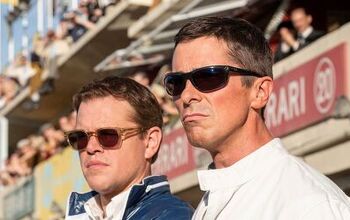
The people running the low key publicity campaign for director Ron Howard’s upcoming Formula One based film Rush have done their job well, at least as far as car enthusiasts are concerned. Howard’s an A-list and very bankable director with a string of critical and commercial successes so it will be interesting to see how general audiences, as opposed to racing fans, respond to the movie. Since plenty of folks who weren’t space buffs enjoyed Howard’s Apollo 13, I don’t think that will be a problem. If you’ve seen Apollo 13 then you know that Howard is a stickler for authenticity. Howard has made sure that car blogs and the like have been teased with tweeted cheesecake shots of umbrella girls and information about how realistic the racing footage will be in the movie, centered on the 1976 rivalry between playboy James Hunt and methodical Niki Lauda. The theatrical opening of Rush is scheduled for September but the film’s official trailer has now been released. You can’t tell a book by its cover nor a movie by its trailer but it does look promising. It also looks kind of familiar, there’s a sense of deja vu about it. (Read More…)
Public funding of stadiums, arenas and other privately promoted sports events is a financially dubious proposition for taxpayers, at least according to some critics of the phenomenon. I tend to agree. If an event isn’t sustainable on its own it’s not a good business deal. So I’m not that broken up about the fact that the mayor of Birmingham, Alabama has withdrawn his request for the city to cut a four year, $1.2 million deal with promoter Zoom Motorsports to at least partially underwrite the Honda Indy Grand Prix of Alabama races scheduled to be run at Birmingham’s Barber Motorsports Park. The mayor decided not to go forward with the deal after the Birmingham city council was deadlocked on the issue. A majority of the council was in favor of supporting the race with money and in-kind services, but the mayor and the council president have sparred over particulars of the deal, like the length of the proposed contract. In addition, Councilman Steven Hoyt, a backer of “diversity” initiatives, inflamed the debate with his comments about race from the council dais, implying that blacks have no interest in motorsports. (Read More…)
While Damon Lavrinc at Wired’s Autopia makes the observation that the revived Detroit Electric company seems to be following the Tesla playbook, launching their company with a car based on an electrified small Lotus, Detroit Electric CEO Albert Lam insists that his team is using a different business model than Tesla and that they have learned from other EV startups’ mistakes. Lam also said there was no comparison between Detroit Electric and Fisker, which appears to be headed to bankruptcy soon, having just furloughed all but 50 employees. Detroit Electric says they are following the model of Apple (on Lam’s CV along with a stints at Lotus and Sun Microsystems) focusing on design and engineering with much of everything else contracted out. Lam pointed out, at a press conference following the reveal of the SP:01 sports car, that buying and equipping a factory to build an original platform, as Tesla is doing, or even contracting out assembly of an original platform, as Fisker has tried to do, both require up front investments of hundreds of millions, perhaps a billion dollars or more, requiring quick success and substantial early sales just to break even. (Read More…)


Recent Comments
DeeDub - Yes, it’s the revenue number, and it’s considerably higher than “a few million” as you wrote.
David Dennis - They have delivered more than 10,000 cars and are on course to sell over 20,000 cars this year. 20,000 cars is sufficient for breakeven....
Athos Nobile - Sadly not yet. But I would be looking at the current diesel ones or the regular I6. It is highly praised by the local press and I see plenty of them around....
Kyree S. Williams - I believe one of the things to come out of that unholy second marriage was the Dodge Caliber, which we had one of, a white 2007 SXT.
Conslaw - ” this strategy has allowed companies like Ford to sell overpriced vehicles with reliability problems to middle...
bigtruckseriesreview @ Youtube - It’s not surprising. People’s only experience “charging” technology has come from smartphones and...
Hummer - An EV is a niche vehicle, I can pickup and go across country at a moments notice in either of those vehicles and be a hell of a lot more comfortable....
KixStart - I’d like to know how much of the deal Lutz is putting together is Lutz’ own money. It also occurs to me that this might...
nine11c2 - thats Revenue number – out of that they pay for the people, and the cost of goods that goes into the cars. what they have left to pay off the...
Land Ark - Can someone (who actually knows) tell me how much charge an EV loses by sitting? As in, If you were to drive exactly 1/2 of a full charge and need...