


French Government Claims Stellantis CEO's Pay Is Suspect

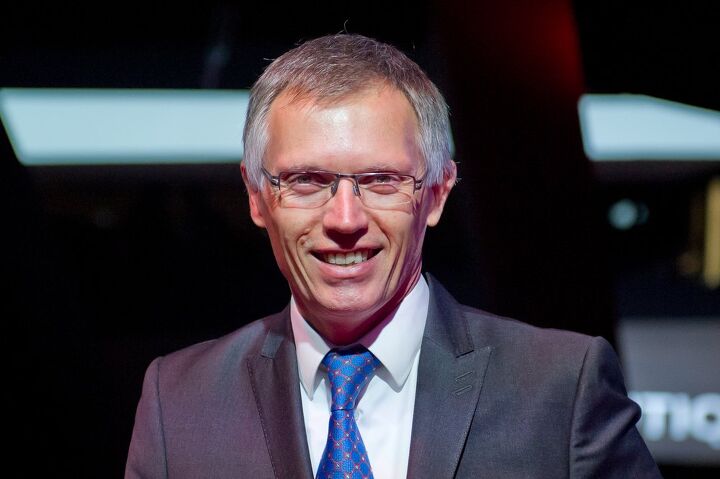
France has grown suspicious of Stellantis CEO Carlos Tavares’ compensation, which the government has dubbed irregular and indicative of a need for further financial regulations in Europe. The issue doesn’t appear to have much to do with where the money is coming from, but rather the size of his current payment package.
Tavares oversaw the merger between PSA Group and Fiat Chrysler Automobiles in 2021 while he was still CEO of the former company. Having previously climbed the ranks at Renault, the executive has served as chairman of PSA’s management board since 2014. Now heading Stellantis, Tavares is positioned to receive roughly $20.5 million in compensation for 2021. In addition to that, he’s reportedly eligible for a stock package worth an extra $34.7 million and long-term compensation of about $27.2 million — which the French government believes is too much.
The country has a long history of getting directly involved in domestic industry, something other auto-producing nations like to pretend is wholly unique to France. It presently holds a 6.2-percent take in Stellantis via public investment bank BPIfrance.
“Obviously, these are not normal figures,” government spokesman Gabriel Attal, said of the numbers on Tuesday.
Phitrust, an investment group that’s highly focused on Environmental, Social, and Governance (EGS) compliance, shared the compensation figures in a recent press release, saying that it formally opposed approving Tavares’ pay package.
From Philtrust:
Calculated according to the methodology of the French Autorité des Marchés Financiers (AMF) or AFEP-MEDEF French Code, based on the IFRS fair value at the date of grant in force in all major French groups, the total amount of the remuneration of the CEO of Stellantis granted for 2021 would amount to €66 million.
This amount of remuneration leads us to ask questions publicly to the shareholders who vote them and to the public authorities who hold a share of responsibility in this scheme: let us recall that the French public bank BPI holds 6.15 [percent] of Stellantis’ capital.
Is this remuneration, which is the highest of the large companies in France (and probably of the listed groups in the European Union), justified for a person who is not the creator of the company, but is only its manager and therefore does not take any risk or financial penalty or assume any personal responsibility, especially as the merger of the two groups is not yet completed?
Automotive News crunched some numbers to determine that Tavares would technically be entitled to receive more than 220 million euros by 2026, assuming he achieved every goal laid out in his compensation incentive plan. But the updated payout for 2021 alone would still make him one of the highest (if not the highest) paid automotive executives in Europe.
More recently, the outlet noted some similarities between the situation with Tavares and how the French government handled former automotive executive ( now internationally wanted fugitive) Carlos Ghosn prior to his ousting from the Renault–Nissan–Mitsubishi Alliance. Arrested at Tokyo International Airport in November of 2018, Ghosn was accused of having under-reported his salary while repeatedly misusing company assets. Though the plot thickened after it was discovered that Nissan had been in the midst of a massive coup d’état, muddying the waters of the investigation and tarnishing the reputations of numerous executives.
It’s a little early to declare anything about what’s happening over at Stellantis, especially if it’s to be as wild as the scandal involving Ghosn. However, it is curious that the government seems so perturbed with Tavares’ compensation when General Motors CEO Mary Barra earned $23.7 million in 2020, despite declining revenues, in the United States. While corporate big wigs have seen their compensation rates go up by at least 940 percent since 1978 (vs just 12 percent for the average worker), it is a little strange to see France singling out a lone executive without issuing claims of illicit financial activity. From the sound of things, the government simply feels like the automaker has gone overboard with the planned payout.
Though it might not matter because the firm appears to be moving ahead as planned.
Today, Stellantis said it would be “taking note” of the feedback resulting from the advisory vote on the remuneration report and would take extra care to explain in the 2022 remuneration report exactly how this vote had been taken into account. This comes after the tally revealed that around 52 percent ended up voting against the 2021 executive remuneration report for senior managers.
“It is our conviction as a board that in a meritocracy, rewarding on the basis of performance criteria is a fundamental element of our policy,” Chairman John Elkann shareholders. “We will take on this vote which is, again, a recommendation.”
Meanwhile, Tavares said the company expected sales to be up (or at least stable) in all of its major markets for 2022, adding that the forecast for the end of 2021 should be cash positive.
[Image: By Frederic Legrand COMEO/Shutterstock]
Consumer advocate tracking industry trends and regulations. Before joining TTAC, Matt spent a decade working for marketing and research firms based in NYC. Clients included several of the world’s largest automakers, global tire brands, and aftermarket part suppliers. Dissatisfied, he pivoted to writing about cars. Since then, he has become an ardent supporter of the right-to-repair movement, been interviewed about the automotive sector by national broadcasts, participated in a few amateur rallying events, and driven more rental cars than anyone ever should. Handy with a wrench, Matt grew up surrounded by Detroit auto workers and learned to drive by twelve. A contrarian, Matt claims to prefer understeer and motorcycles.
More by Matt Posky







Comments
Join the conversation
Narrow lapels and wide tie? His pay isn't the only thing that's suspect.
Something tells me that if someone were to do a careful study of Warranty Expense for Chrysler/Dodge/Jeep/Ram over the past 39 months, you might just find that Carlos Tavares is earning his keep and then some.