


Minivans Sales Show Some Buoyancy in the U.S., but Only Because of Two Automakers

You’d think the advent of dedicated electric vehicle platforms would breed a new era of flat-floored minivans, but most automakers just aren’t interested in going that route — internal combustion or otherwise. There’s no electric Chevrolet Venture on the horizon, nor will Ford resurrect the Aerostar in EV form and name it after a late ’60s muscle car.
Even in our clean, green future, SUVs reign.
The present, however, hasn’t abandoned the minivan, even if the segment is a shadow of its former self. March minivan sales in the U.S. topped that of last March, and year-to-date sales are up compared to 2017, despite the disappearance of two nameplates. Unlike SUVs and crossovers, however, there’s just not enough demand to put wind in every minivan model’s sales. It’s easy to imagine a near future where Fiat Chrysler and Honda own the segment.
Total minivan sales in the U.S. last month reached 48,325 vehicles, up from 45,923 in March of 2017. Of the minivans moved in March, Fiat Chrysler built 36.4 percent of them.
With discontinued models like the Nissan Quest and Chrysler Town & Country no longer exerting any pull in the segment, minivan volume rose 2.7 percent over the first three months of 2018.
The Chrysler Pacifica, which appeared on roads starting in mid-2016, saw a year-over-year sales increase of 40 percent in March. Year to date, the Pacifica nameplate attracted 30 percent more customers than the same period last year. Even the Dodge Grand Caravan saw an improvement in 2018, with March sales up 4 percent, year over year, and sales over the first three months of the year up 8 percent.
The Grand Caravan remains the best-selling minivan in the United States, and there’ll be buyers lining up for smokin’ deals until the (sad) day it vanishes from dealer lots.
Interestingly, the long-defunct Chrysler Town & Country remains on sales charts, but only barely. FCA sold one new Town & Country last month, and three over the course of the year.
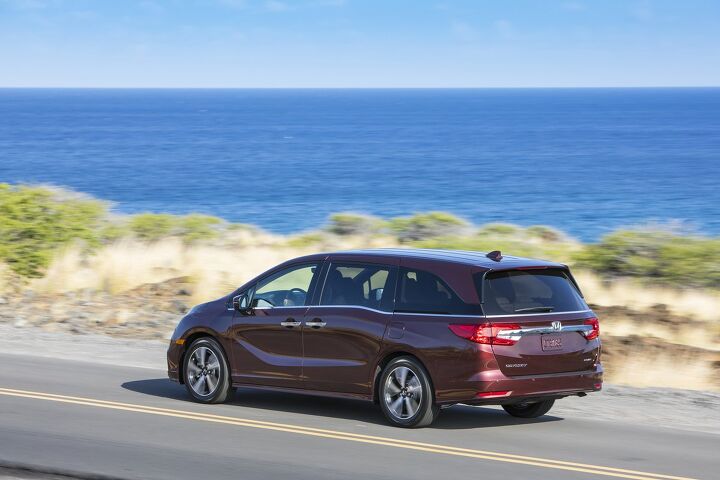
The only other automaker to see increased demand for its minivan was Honda, which flaunted its next-generation 2018 Odyssey for what seems like forever. The glowing (and sometimes tropical) press apparently helped Honda get the word out, as Odyssey sales rose 27.8 percent in March, year over year, and 9.4 percent over the course of the first quarter of 2018.
In contrast, the Toyota Sienna, the segment’s fourth best-selling minivan, headed in the exact opposite direction. Sales sank 22.6 percent in March, with year-to-date sales down 9.2 percent. The news wasn’t good for the Kia Sedona, either. The only Korean minivan on the list ( ever so slightly refreshed for 2019, Kia tells us) saw March volume decline 45.3 percent. That’s no fluke, as year-to-date volume sits 40.9 percent lower than the same period last year.
Kia’s a strange bird, of course, and seems to delight in fielding models in segments long since abandoned by other brands. Maybe those new foglights will turn the tide.
[Images: Fiat Chrysler Automobiles, Honda]

More by Steph Willems






Comments
Join the conversation
-eyes darting madly- In 1996 had reserved a Caddy in Orland form Avis. No Caddy's, nothing equivalent. I got a Chrysler Town and Country minivan instead. Two couples, all their luggage and two sets of golf clubs easily fit. Fast enough? Yes, for Orlando and Daytona roads. Acceptably Brogham-ed out, but with supple leather? Of course. John Shaft's Baby Momma would've been driving one.
Know this is anecdotal, but.... Was at a group conference last weekend, and everyone had a Chrysler Pacifica rental.