


More Evidence Pedestrian Detection Systems Have Some Problems

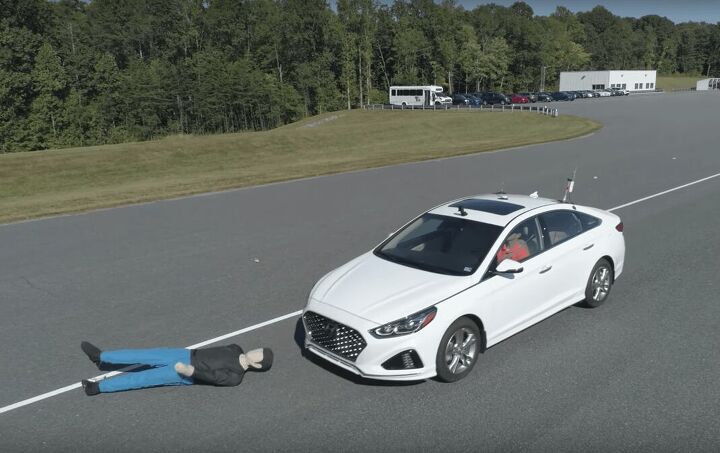
It hasn’t even been a full month since the American Automobile Association (AAA) released a study showcasing the shortcomings of advanced driving aids and another damning report has come in — this time from the Insurance Institute for Highway Safety (IIHS). While not nearly as bleak as the AAA study, the IIHS research put several models on blast for having lackluster equipment.
The gist appears to be that the quality of pedestrian detection systems varies wildly between models, with the IIHS picking a few winners and losers. That’s important information to have, especially considering automatic braking systems will be standard equipment on all cars by 2022.
From the IIHS:
The Insurance Institute for Highway Safety rated the pedestrian crash prevention systems of 16 midsize cars in the lead-up to Halloween, a holiday that consistently ranks among the deadliest days for pedestrians in the United States.
Four luxury and two nonluxury midsize cars earn a superior rating for their pedestrian crash prevention systems, while four nonluxury cars earn only a basic rating or no credit. Another six cars earn an advanced rating.
“Pedestrians are the most vulnerable road users, so it’s encouraging that pedestrian crash prevention systems are standard equipment in 12 out of the 16 midsize cars we tested, including five out of six superior-rated systems,” said IIHS President David Harkey.
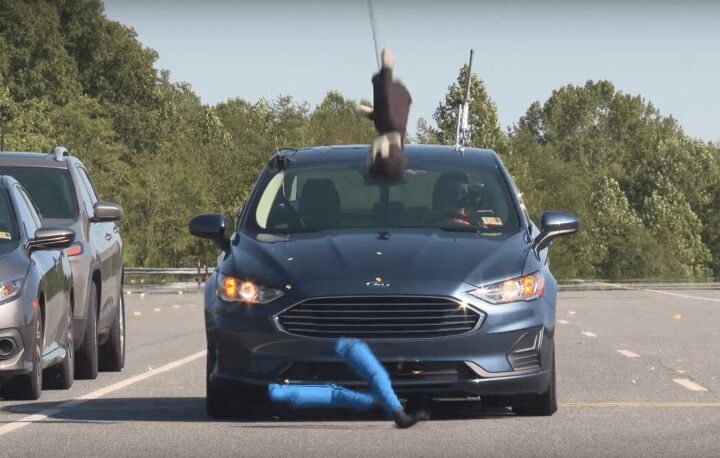
Test were conducted under three scenarios: an adult pedestrian stepping into the street in the path of the oncoming vehicle with an unobstructed view, a child darting into the street from behind two parked cars, and an adult pedestrian near the side of the road in the travel lane, facing away from traffic. Most events were conducted at speeds similar to the AAA study, though were sometimes a bit slower or faster. For example, the two perpendicular tests are conducted at 12 and 25 miles per hour, and the test simulating a pedestrian walking in a parallel path to the vehicle happens at 25 and 37 mph. The AAA report had those events occurring at different speeds — usually 20 and 30 mph.
The rankings are slightly confusing, too. Basically, no credit means the car repeatedly struck the test dummies at speed. Basic indicates fewer collar-tugging incidents, with things improving from there. But the metrics are anything but clearcut and appear to be weighted against each other more than anything else. At no point does the outlet clarify what constitutes an advanced or superior ranking — they’re just “better.”
Of the vehicle’s tested, the Ford Fusion, Hyundai Sonata and Kia Optima earned no credit because they failed to slow significantly in multiple scenarios. Meanwhile, the Audi A4, BMW 3 series, Mercedes-Benz C-Class, Nissan Maxima, Subaru Outback and Volvo S60 had systems earning superior ratings. According to the IIHS, they “avoided collisions or slowed substantially in track tests.”
While we don’t want to undermine the legitimacy of this study, it should be said that the IIHS is looking at both safety and what this new tech means for insurers. The report even mentions how certain systems (like Subaru’s EyeSight) “cut the rate of likely pedestrian-related insurance claims by 35 percent, compared with the same vehicles without the system.” It doesn’t make the results truly specious, but does help establish the angle IIHS typically takes in regard to new safety systems.
We also wonder how much extensive testing was actually done, as the Chevy Malibu was also included in the AAA study. There, it performed similarly poorly. But did manage to detect a child-sized obstacle every other car missed… before hitting it. However the IIHS issued it a basic rating in pedestrian detection, despite it outright admitting the Chevy totally failed some of the tests.
The Insurance Institute for Highway Safety also failed to test any of the vehicles at night, something AAA proved can instantly make pedestrian detection systems irrelevant. But the IIHS claimed “systems might not perform as well during the nighttime hours that account for most pedestrian fatalities, though if paired with good-performing headlights, they should be able to detect pedestrians.”
If you’re looking for harder data, we recommend sticking with the AAA report. But that doesn’t make the other study worthless. IIHS managed to put a few more cars and some crossovers through the wringer, showing that there’s a big difference between how effective advanced driving aids can be.
We wouldn’t put our complete faith in any of them right now.
[Images: IIHS]
Consumer advocate tracking industry trends and regulations. Before joining TTAC, Matt spent a decade working for marketing and research firms based in NYC. Clients included several of the world’s largest automakers, global tire brands, and aftermarket part suppliers. Dissatisfied, he pivoted to writing about cars. Since then, he has become an ardent supporter of the right-to-repair movement, been interviewed about the automotive sector by national broadcasts, participated in a few amateur rallying events, and driven more rental cars than anyone ever should. Handy with a wrench, Matt grew up surrounded by Detroit auto workers and learned to drive by twelve. A contrarian, Matt claims to prefer understeer and motorcycles.
More by Matt Posky


Comments
Join the conversation
I know I shouldn't be laughing when I watch some of the footage, but I can't help myself. Of course it wouldn't be funny at all if it was a real person, but the little robotic legs plus the idea of a killer car. ::I watched too many bad movies::
These days there are people who are completely oblivious to the world around them and assume that it is everyone else's job to look out for them. Worse, there are pedestrians who think they're asserting themselves by being inconsiderate of drivers. This may be a victimless technology, and everyone with a memorable interaction with it will probably be the sort of person who thinks computers are better drivers than people.