


Honda's Got a Brand New (Air)bag

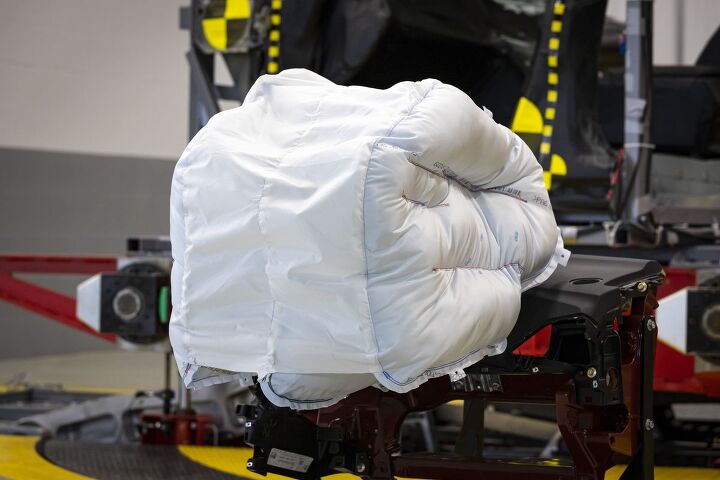
Late last week Honda announced its new airbag. Designed to reduce the potential for injuries, especially those encountered in frontal collisions that aren’t perfectly head on, the system is designed to keep vulnerable, human noggins from rolling off and impacting something firm. It’s like a sandwich of safety — where your head is the meat.
Shown to journalists at Honda R&D Americas complex last week, the bags will begin seeing active duty in new models sometime next year. Developed in conjunction with Autoliv, not Takata, the auto manufacturer claims it’s the next level automotive safety.
“This new airbag technology represents Honda’s continuing effort to advance safety performance in a wider variety of crash scenarios and reflects the innovative thinking that our engineers are bringing to the challenge of reducing traffic injuries and fatalities,” said Jim Keller, President of Honda R&D Americas, in a statement. “Guided by Honda’s ‘Safety for Everyone’ commitment, our engineers recognize that their work on this type of breakthrough safety technology will have far-reaching effects on peoples’ lives for many years to come.”
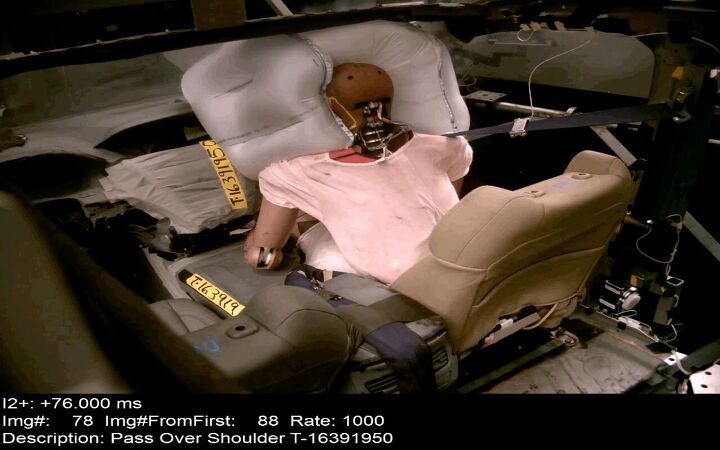
The new airbag utilizes four major components. There are three inflated compartments — a center chamber and two outward-projecting side chambers that create a wide base across the dash — s well as a “sail panel” that stretches between the two side chambers at their outermost edge. Honda used a baseball glove as an analogy, saying the sail panel catches and decelerates the occupant’s head while also engaging the side chambers, pulling them inward to cradle and protect the head like a catcher’s mitt. But referring to the panels as “super-absorbent wings” would also have been an apt metaphor.
Regardless, the theory is the same — make sure the heads/baseballs/drops of blue water end up channeled into the soft bits of the device, instead of being deflected somewhere else. The rest of the bag is focusing on decelerating craniums as gradually as possible to further mitigate head injuries.
Our own Chris Tonn shared some footage of the bag in action at sibling-site AutoGuide, while also noting that there’s currently no accepted standard for brain-specific injuries. The established cranial standard, presently used by National Highway Traffic Safety Administration, is the Head Injury Criterion (HIC). But Honda is using Brain Injury Criterion (BrIC), which the NHTSA has considered adopting, to verify the airbag’s prowess. Engineer Eric Heitkamp said the system effectively translates to a 75-percent reduction in BrIC — some of which is attributable to slowing head rotation and keeping skulls from slipping off the bag.
“Looking at the real-world data, we can tell that over 56 percent of these real-world crashes have some level of angled impact. I mean, it’s not straight into a wall or to a tree or something,” Heitkamp, told Automotive News in an interview. “So we recognized that we need a restraint system that can improve at the angle-type collisions.”
While we’ve no clue on which models the manufacturer plans on starting with in 2020, odds are good that this airbag will gradually become ubiquitous. Other manufacturers eventually gain access to the bag, as well. But they’ll have to wait for Autoliv’s exclusivity deal with Honda/Acura to expire.
[Images: Honda]
Consumer advocate tracking industry trends and regulations. Before joining TTAC, Matt spent a decade working for marketing and research firms based in NYC. Clients included several of the world’s largest automakers, global tire brands, and aftermarket part suppliers. Dissatisfied, he pivoted to writing about cars. Since then, he has become an ardent supporter of the right-to-repair movement, been interviewed about the automotive sector by national broadcasts, participated in a few amateur rallying events, and driven more rental cars than anyone ever should. Handy with a wrench, Matt grew up surrounded by Detroit auto workers and learned to drive by twelve. A contrarian, Matt claims to prefer understeer and motorcycles.
More by Matt Posky






Comments
Join the conversation
"Other manufacturers eventually gain access to the bag, as well. But they’ll have to wait for Autoliv’s exclusivity deal with Honda/Acura to expire." Methinks Honda could reap a whirlwind of deserved praise if it worked with Autoliv to reasonably license the safety tech to all other manufacturers.
Good for Honda to do something about it when they saw that there was a problem Wonder why no other automakers thought of that. Thanks, Honda !