


The Convertible Market is Shallow Enough to Start Calling Droptops Irrelevant

Convertible sales have slid steadily for a while now and “everyday” droptops like the difficult to praise Chrysler Sebring have vanished from the automotive market. With the exception of a few premium options from Germany, fun in the sun doesn’t seem to coincide with daily driving anymore.
With their sales volume now trumped even by impractical, short-ranged electric vehicles, lidless cars are less popular than ever. In fact, America’s most popular convertible isn’t even a car (Jeep Wangler), and today’s remaining open-air options are either performance focused, comically small, or extremely expensive European luxury items. That’s likely to remain the case for some time, considering it took us over a decade to get here.
According to IHS Markit (via Automotive News), the ragtop market has been shrinking since 2009, if not before, and now comprises less than 1 percent of all new car purchases. The last handful of years have been especially grim for the convertible, despite the segment’s continued willingness to exist.
“North America has always led the global convertible market, but hit a near-record low in 2014 with just 164,000 units sold in the region. While consumers returned to the automotive market, the gain has been in more practical segments, and purchases of convertibles and roadsters have lagged the general automotive market resurgence,” said Tim Urquhart, principal analyst at IHS Automotive, in last year’s analysis. “However, the North American market is expected to progress on a stable platform over the next few years, led by the launch of the latest iteration of the Ford Mustang in 2016.”
However, that predicted stability has instead become a bottoming out. The Mustang, along with the Camaro, are one of the few remaining American options for a retractable roof — and they aren’t particularly popular. While Mazda’s MX-5 managed 733 units in December, November only saw 387 U.S. sales. While that might seem like one bad month for one roadster, the better-than-ever Miata has not returned to its sales high of a decade ago and is actually a comparatively strong-selling convertible.
Haartz, the corporation that produces unique convertible tops for discerning customers, commissioned a survey for people who own or have ever owned a convertible and another for those who would ever consider buying one. While the survey only reached out to 574 consumers, it did return the knowledge that more people would consider buying a convertible if they were more practical, roomier, less expensive, and better looking. Unfortunately, these elements are all things that today’s surviving convertibles seem to have trouble with. The Haartz survey also highlighted consumer preference toward retractable hardtops over folding fabric as well as a penchant for panoramic glass.
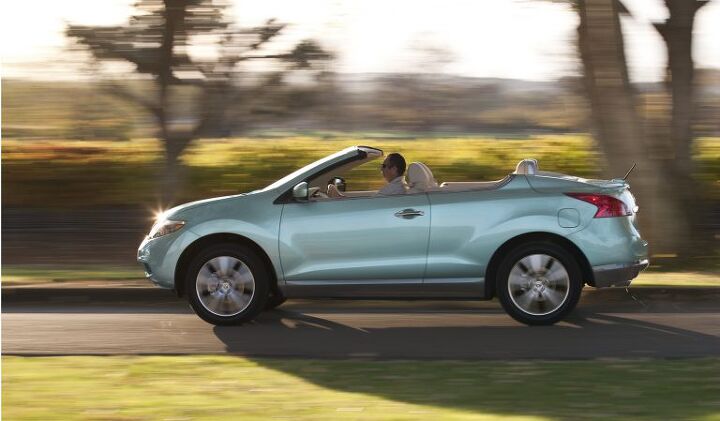
With so much working against them, droptops will likely never return their pre-Great Recession U.S. record of of 344,000 units, recorded in 2006. Even with Europe’s slightly stronger interest in convertibles, most sales will continue to be drawn from premium German models until the segment dies out entirely or undergoes some incredible metamorphosis. However, considering the abomination that was the Nissan Murano CrossCabriolet, that new form might not do the segment any favors.
[Image: Nissan]
Consumer advocate tracking industry trends and regulations. Before joining TTAC, Matt spent a decade working for marketing and research firms based in NYC. Clients included several of the world’s largest automakers, global tire brands, and aftermarket part suppliers. Dissatisfied, he pivoted to writing about cars. Since then, he has become an ardent supporter of the right-to-repair movement, been interviewed about the automotive sector by national broadcasts, participated in a few amateur rallying events, and driven more rental cars than anyone ever should. Handy with a wrench, Matt grew up surrounded by Detroit auto workers and learned to drive by twelve. A contrarian, Matt claims to prefer understeer and motorcycles.
More by Matt Posky







Comments
Join the conversation
Is that car that big, or is the driver really tiny? I miss my Miata which I enjoyed driving even in the winter. Snowy roads made me wonder if that was what driving a sprint car felt like. Just a fun vehicle all year round. Sold it due to marriage and children which was truly the dumbest thing I ever did.
I just love the "impracticable vehicle"..Two weeks ago I was diligently searching HD Long Box reg cab tucks. Not that I had any need for such a vehicle. I just wanted one. Well thats ancient history. After reading through the comments here, now i'm searching , gently used 2016 -17 V6, Stick shift Camaro, convertible. I just can't wait for my family, and friends say "Ya already have a Mustang for a DD ,what ya really need Mikey is an CUV" Excuse me while i look this up, lets see auto trader.ca.....hmmm ?