


"Enormous Delay In Delivery:" Toyota Production Back To Normal - By The End of The Year
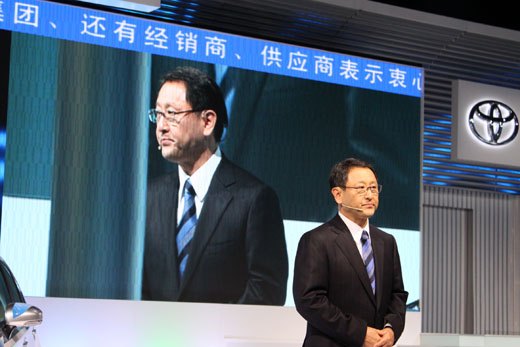
In a surprise press conference that had not been confirmed as late as last night, Toyota’s president Akio Toyoda laid out plans for Toyota getting back to normal. Bottom line: Toyota hopes to be back to normal by the end of the year.
“To all the customers who made the decision to buy a vehicle made by us, I sincerely apologize for the enormous delay in delivery,” Akio Toyoda said.
Production operations had been halted after the March 11 earthquake and tsunami. Production gingerly came back on-line at the beginning of the week. Currently, manufacturing plants in Japan are working at 50 percent of capacity due to parts availability, while those in North America are operating at 30 percent of capacity.
Today it was announced that in Japan, normalization of production is expected to start in July, with full normalization to be established at around November or December.
Outside Japan, depending on region and vehicle model, normalization of production is expected to start in August, with full normalization also expected to be completed in the November/December timeframe.
Toyota is still short approximately 150 parts positions, mainly electronic, rubber and paint-related. These shortages affect new-vehicle production. Replacement parts for service and repair are available.
The reduction in production is expected to take a good chunk out of Toyota’s 2011 production and sales numbers. Toyota Motor Corporation (Toyota, Daihatsu and Hino) ended 2010 with worldwide production of 8.56 million, and with sales of 8.42 million. Toyota had planned a very sedate increase of 2 percent for 2011. These plans obviously have been overtaken by events.
Asked for how big the hit will be, Toyota spokesman Paul Nolasco said: ”Our main focus is getting production back to normal, then we will see.”
The Nikkei [sub] already speculates that the “production cuts will likely reduce the auto giant’s overall output by some 20% to about 6.4 million vehicles in 2011. That would make Toyota the world’s No. 3 automaker, assuming production volumes at General Motors Co. and Volkswagen AG remain the same.”

Bertel Schmitt comes back to journalism after taking a 35 year break in advertising and marketing. He ran and owned advertising agencies in Duesseldorf, Germany, and New York City. Volkswagen A.G. was Bertel's most important corporate account. Schmitt's advertising and marketing career touched many corners of the industry with a special focus on automotive products and services. Since 2004, he lives in Japan and China with his wife <a href="http://www.tomokoandbertel.com"> Tomoko </a>. Bertel Schmitt is a founding board member of the <a href="http://www.offshoresuperseries.com"> Offshore Super Series </a>, an American offshore powerboat racing organization. He is co-owner of the racing team Typhoon.
More by Bertel Schmitt






Comments
Join the conversation
I'm not a big Toyota fan, but I applaud Mr. Toyoda for giving this frank assessment of the situation his company is currently faced with. Based on everything Bertel has posted here, end of the year sounds about right - but who really knows? A schedule like this has lots of moving parts that can break... I don't work in the car business, but I was talking to one of my suppliers today and they expect certain Japanese sourced parts to be on allocation until at least the third quarter. It won't affect their deliveries as they have secured what they need to meet forecast demand - but they are in a *much* lower volume business than the carmakers. I wouldn't want to be trying to source parts that are used by the thousand right about now...
Back to normal by the end of the year makes sense, I suppose. It would be interesting to see how their plight stacks up against other industries (small and large). Some will take much longer, some will never recover. Toyota has the wherewithal to make their recovery as quick as possible; others, not so much. This is a terrible shame, not because of the car shortage, but because of the many lives and livelihoods affected.