


Requiem For The Last American Car

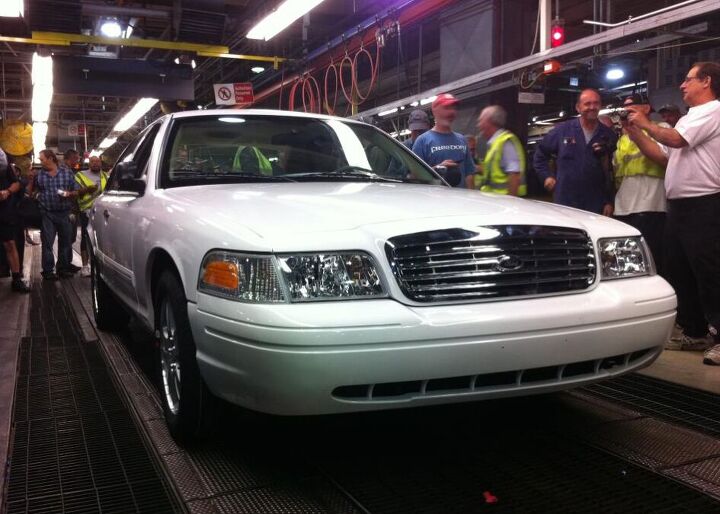
[Editor’s note: Today, at 12:25 pm, the very last Panther-platform Crown Victoria rolled off the line at St. Thomas Assembly Plant. Ryan Paradis, a.k.a. “86er,” has the honor of eulogizing the beloved beast in his first-ever contribution to TTAC]
It has become beyond trite by this point to say that, with the end of the Crown Victoria, Grand Marquis and Town Car, an era comes to an end. And yet it is thus: the last of the body-on-frame, rear wheel drive and eight cylinder engine passenger cars, once a species unique to North America, have now reached the end of an 80 year span that commenced with the advent of the 1932 Ford V-8.
Having transported generations of Americans through some of the nation’s finest decades, full-size cars like the Crown Victoria, Grand Marquis, and Town Car are now an anomaly. While large V8-powered sedans made a comeback in the 21st century, the Ford Panther chassis was one of the very few full-size, rear-drive sedans that never left. And today we bid it farewell.
Let us be clear before we go any further: increasing CAFE standards will mean that, barring a phenomenal advancement in engine technology, all large cars in their current form will be phased out before long. New realities are coming that automakers will find impossible to avoid. At the same time, without vehicles like the Ford Crown Victoria, Mercury Grand Marquis, and Lincoln Town Car, cars so steeped in our notions of a limitless frontier and freedom from tyranny (of the mobility and engine displacement varieties), we lose a potent symbol of the domestic industry’s raison d’être.
The Ford Panther chassis is a rolling respite from traffic anxiety disorder. If your only experience with one has been riding in a taxicab, or careening through city streets, you’ve been misled. Truth is, the Panther’s driving personality is far more sedate. While some cars vie for your down payment by touting driver involvement, the big Ford goes the other way, trumpeting maximum driver isolation. It regards the world around it as uncouth, bumpy and loud, and lovingly insulates you from the indignities of crumbling roads and the frenzied pace of traffic. Only when breezing along without a care in the world do these vehicles truly come into their own, not only transporting you to your destination in isolated comfort, but under the right conditions, even taking you into view of a past that is on the brink of being irrevocably lost.
Prodigious torque, smooth power delivery and the isolation of riding on (frame) rails will now become the sole purview of those who have signed the paperwork for a truck or traditional sport utility vehicle. Those loners, those holdovers clinging to a time that has passed them by, will now have to join that swollen cohort of automobile purchasers who have savored the qualities they continue to find rewarding, from a higher perch.
But I come not to praise the body-on-frame passenger car but to bury it. Aficionados of this type of automobile have had ample time through various stays of execution and luck to sample the last vestiges of what make North American motoring a unique island unto itself for the vast majority of the 20th century. Indeed, through various twists of fate, the body-on-frame passenger car has held on longer than it would seem it had the right to, and that in of itself is reason enough to observe its passing today with pride, solemnity and recognition of a notable landmark.
After today, the remaining holdover from a completely globalized design movement led by the world’s automakers remains the pickup and traditional sport utility vehicle. Can this segment, in particular pickups, remain the top sellers? Or will they too fall victim to changing tastes and new regulations that threaten their existence?
For now, the American Truck reigns supreme. Today, we honor what once was and observe the demise of the American Car. In truth, the Panther has no peer, no competitor. It is the last vestige of the American car. Let’s not kid ourselves; pretty much everything else is international in form and function.
A part of me hopes they put the last Crown Vic or Town Car in the Smithsonian, with an inscription on the plaque reading: “Once we built cars, and we were not ashamed.” But another part of me is OK with the notion that the passing of the last traditional American sedan will go mostly unnoticed. After all, it befits the nature of this car; going about its business day in and day out, stoic and laconic, its qualities unheralded except by those who came to rely on it for the past 33 years.
More by Ryan Paradis





Comments
Join the conversation
The only requiem I can really think of for the panthers is: Please buy your local police force lots of donuts, as they'll be lost without these.
Is that a still from a late 80s movie?