


Volt Birth Watch 183: Why The Volt Really Doesn't Need A Bigger Tax Break
This week saw the Volt’s price point issues return to the public eye, as GM’s Chairman and CEO made it clear that he takes the government’s $7,500 tax credit for granted. But Whitacre’s dissembling revealed once again GM’s fundamental problem with the Volt: getting people past the sticker shock. Though GM’s short-term viability doesn’t hinge on the Volt selling like gangbusters, it’s clear that the Volt’s initial success or lack thereof will be a crucial factor in GM’s ability to hold a successful IPO and extricate itself from government ownership. Which, according to The Big Money‘s Matt DeBord, is one of the reasons the government should expand the Volt’s credit of $10k. Another reason: the Volt’s competition is too good!
with the base Prius selling for just over $20,000 and the base Honda Insight hybrid for under $20,000, the feds may have to start thinking about how to enable innovative electric and gas-electric plug-ins to survive. The EPA mandate to raise fleet fuel-economy standards to average of 35.5 mpg by 2016 looms, and a component of that target should be EVs and plug-ins. Otherwise, carmakers may abandon the tech, leaving it stillborn to cynically massage their fleet numbers by importing small cars from foreign operations to North America—cars they know Americans will only grudgingly purchase and that may force the government to chuck the 35.5 requirement.
The Atlantic‘s David Indiviglio does a good job of knocking DeBord’s argument down on principle:
Essentially, this means that the government is making a bet on the future, without any particularly keen foresight… [an expanded Volt credit] would benefit if GM profits, since taxpayers own the carmaker. But this assertion falls prey to the same problem as the idea of expanding the credit: in nationalizing GM, the government chose a winner, while the market dictated the firm a loser. So the question here is really: do two wrongs make a right? Should the government throw more money at Volt tax credits in the hopes of rescuing a sinking ship that it shouldn’t have saved in the first place? I remain unconvinced.
But there’s more to this than principle: the core “fear factor” of DeBord’s thesis is fundamentally false. When he warns that automakers could abandon plug-in technology in favor of imported small cars forcing the government to “chuck the 35.5 requirement”, he ignores the fact that the 2016 standard includes credits for zero-emissions vehicles. Crazy fleet-average-multiplier “super credits” that give automakers so much credit for super-efficient vehicles that California has threatened to abandon the 2016 standard if credits aren’t reined in.
Under the proposed rules, automakers are actually over-incentivized to produce super-efficient, economically unviable vehicles like the Volt because the credits they generate could be carried forward, backward, and banked for up to five years. Plus, proposed super credits could “take the form of a multiplier that would be applied to the number of vehicles sold such that they would count as more than one vehicle in the manufacturer’s fleet average” according to EPA-DOT documents.
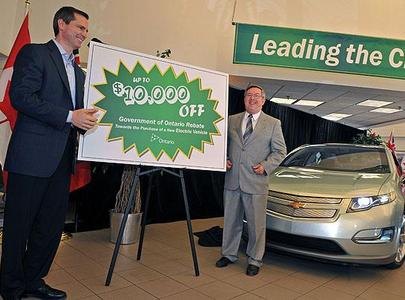
On top of the fact that DeBord’s fearmongering is without substance, there’s the huge pile of public money already sitting on the Volt’s hood. In addition to the $50b (give or take) the government has sunk into keeping GM afloat, GM got $105m from the DOE for its Brownstown Volt battery assembly plant plus another $30m for Volt testing, while the Volt’s battery cell supplier Compact Power got $150m in the same package for its Volt cell plant. Plus $10b+ in DOE retooling loans. And that’s not counting local tax abatements for Brownstown, Hamtramack and the Compact Power plant. Plus the Ontario government has already offered a $10k consumer incentive targeting the Volt, angering everyone from Toyota to Zenn. Factor in the already-existing $7,500 consumer tax credit, and soon you’re talking about real money. Where do the giveaways end?

More by Edward Niedermeyer







Comments
Join the conversation
"Where do the giveaways end?" When Government Motors goes out of business. That's why North American taxpayers/car buyers MUST boycott GM and Chrysler. Chrysler will tank first, making the unthinkable - life without GM - a concept the public can grasp and aim for.
The Volt is essentially a 2-passenger car. No usable rear seat area.