


(When) Will China Boot Foreign Car Manufacturers?
When I came to China for the first time in 2004, after-work congregations of foreign executives who worked for Chinese auto joint ventures usually went like this: Someone muttered into his Tsingtao beer, or something stronger: “The Chinese will want us out within eight years.” Upon hearing this, all others around him nodded gravely, and another round was ordered. Over the years, more and more expats were sent home to Detroit, Wolfsburg, and Aichi. The silly “twin” system (a foreigner and a Chinese on the same job) stopped. Of course, the open secret was never officially discussed, but the outcome appeared to be inevitable: The days of the foreigners are numbered.
It will be 2010 within a few weeks, and the foreign (U.S., European; Japanese) joint ventures are still seemingly safely ensconced in China. As reported umpteen times at TTAC, China has become a strategically important market for most auto manufacturers. Nobody thinks anymore that come 2012, China will kick all joint venture partners out.
Yet, here is the first step in that general direction:
50 percent homegrown by 2015 is no ambitious goal. Currently, 44 percent of all passenger cars sold in China don’t carry a foreign badge. Six percent more in 5 years, big deal.
With sedans, the matter becomes more interesting. Indigenous sedans hold a 29 percent share of the Chinese market, according to official data cited in the report. The Chinese government wants to see that share grow to 40 percent of the market by 2015.
In the first half of 2010, the Chinese government is expected to publish guidelines to the above effect. The guidelines are also expected to demand that Chinese companies hold at least 50 percent of any newly-formed joint ventures that make alternative energy cars, batteries and key components. This pours water on the hopes of foreign automakers that they could some day be the sole owner of a Chinese car manufacturer. It’s going in the opposite direction.
The bottom line is that the car executives who were crying in their beers were wrong (again…) and that the status quo will continue in the foreseeable future, albeit with a gradual, step-by-step Sinofication..
Anyway, many supposedly “domestic” cars rely heavily on foreign platforms, foreign technology, and sometimes heavy foreign design inspirations. Witness the parts of Saab being carted off to Beijing, where they will emerge as allegedly domestic cars. The total domestication of the Chinese car industry will take much, much longer. But one thing becomes clear: In the long run, China wants to stand on its own four wheels when it comes to cars. The guidelines (if they will be as reported …) will be the first official step in that direction.
Will China Boot Foreign Car Manufacturers?
When I came to China for the first time in 2004, after-work congregations of foreign executives who worked for Chinese auto joint ventures usually went like this: Someone muttered into his Tsingtao beer, or something stronger: “The Chinese will want us out within eight years.” Upon hearing this, all others around him nodded gravely, and another round was ordered. Over the years, more and more expats were sent home to Detroit, Wolfsburg, and Aichi. The silly “twin” system (a foreigner and a Chinese on the same job) stopped. Of course, the open secret was never officially discussed, but the outcome appeared to be inevitable: The days of the foreigners are numbered.
It will be 2010 within a few weeks, and the foreign (U.S., European; Japanese) joint ventures are still seemingly safely ensconced in China. As reported umpteen times at TTAC, China has become a strategically important market for most auto manufacturers. Nobody thinks anymore that come 2012, China will kick all joint venture partners out.
Yet, here is the first small step in that general direction:
By 2015, China wants half of passenger cars, including sport utility vehicles, sold in China to be self-developed by Chinese automakers, the Shanghai Securities News says (via Gasgoo.) No sources are named, but the paper is owned by the Chinese government.
50 percent homegrown by 2015 is no ambitious goal. Currently, 44 percent of all passenger cars sold in China don’t carry a foreign badge. Six percent more in 5 years, big deal.
With sedans, the matter becomes more interesting. Indigenous sedans hold a 29 percent share of the Chinese market, according to official data cited in the report. The Chinese government wants to see that share grow to 40 percent of the market by 2015.
In the first half of 2010, the Chinese government is expected to publish guidelines to the above effect. The guidelines are also expected to demand that Chinese companies hold at least 50 percent of any newly-formed joint ventures that make alternative energy cars, batteries and key components. This pours water on the hopes of foreign automakers that they could some day be the sole owner of a Chinese car manufacturer. It’s going in the opposite direction.
The bottom line is that the car executives who were crying in their beers were wrong (again…) and that the status quo will continue in the foreseeable future, albeit with a gradual, step-by-step Chinesification..
Anyway, many supposedly “domestic” cars rely heavily on foreign platforms, foreign technology, and sometimes heavy foreign design inspirations. Witness the parts of Saab being carted off to Beijing, where they will emerge as allegedly domestic cars. The total domestication of the Chinese car industry will take much, much longer. But one thing becomes clear: In the long run, China wants to stand on its own four wheels when it comes to cars. The guidelines (if they will be as reported …) will be the first official step in that direction.
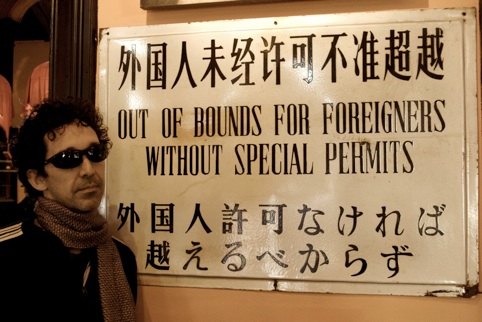
NOFORN in Chinese. Picture courtesy angelgracia.com

Bertel Schmitt comes back to journalism after taking a 35 year break in advertising and marketing. He ran and owned advertising agencies in Duesseldorf, Germany, and New York City. Volkswagen A.G. was Bertel's most important corporate account. Schmitt's advertising and marketing career touched many corners of the industry with a special focus on automotive products and services. Since 2004, he lives in Japan and China with his wife <a href="http://www.tomokoandbertel.com"> Tomoko </a>. Bertel Schmitt is a founding board member of the <a href="http://www.offshoresuperseries.com"> Offshore Super Series </a>, an American offshore powerboat racing organization. He is co-owner of the racing team Typhoon.
More by Bertel Schmitt






Comments
Join the conversation
2 very important issues that are not discussed much: 1) China has aging population. Aging populations don't produce scientific breakthroughs and neither do they produce great strides in technological achievement. That's why Chinese need all the technology they can buy or steal whichever is cheaper and easier. 2) China's environment is bad as it is and it's not gonna get better. In fact it will be a lot worse if the economy is allowed the current expansion. Between these 2 issues China will have a hard time just staying the manufacturing hub of the world it is now where workers produce what workers in other countries buy. But I think the Chinese dreams of glory may get the better of them which just may save the GM or VW. Or maybe not.
1) Aging population is a problem for Japan and Europe, not for China. The natural birth rate in China is much higher than Japan, Europe, and U.S. if immigration is excluded. All China has to do is to relax the one-child policy, and lower the legal marriage age a little bit (20/22, F/M currently). BTW, having more children is a sure way to boost consumption. 2) Cleaning up the environment over a course of 30-40 years is no big deal either. It probably will lower Chinese GDP less than 1% every year over the period. Remember, there is no lump-sum payment due for environmental damage!