Car Buyers Will Walk 500 Miles for a Car (Some Would Walk 500 More)

Ok, maybe they wouldn’t walk five hundred miles but a new study from the eggheads at an American research group suggest customers are now willing to travel an average of 469 miles in order to buy a car.
According to Automotive News, the study was undertaken by Quantrell Subaru, a dealership in Kentucky that seems to be more on the ball than others through the doors of which you author has had the misfortune of strolling. Some dealers won’t even pay for chairs with four legs or to get those mice out of the coffee machine, so commissioning a study (something which sounds like formal education, the horror) would have been out of the question for them. In any event, the Quantrell survey showed that people are far more likely to look outside their own backyard for a vehicle these days thanks to the dearth of product on hand – both new and used.
“Most of it is just availability and the type of car you have,” said Brentley Jones, GM of Quantrell Subaru in an interview with Automotive News. His dealer also goes out of their way to pick up customers from the local airport if they are flying in to buy a vehicle. He goes on to say much of his fly-n-drive (our term, not his) clientele are well-researched folks who know exactly what they want before setting foot on the lot which definitely weeds out tire kickers. Nevertheless, TTAC always advises buyers to closely examine any used car before signing a note, making sure to get a third-party inspection for good measure. Yes, it would be irritating to fly or drive 500 miles and then not buy the vehicle which you were looking at. Know what’s even more irritating? Buying a lemon and having to deal with it for the next umpteen years.
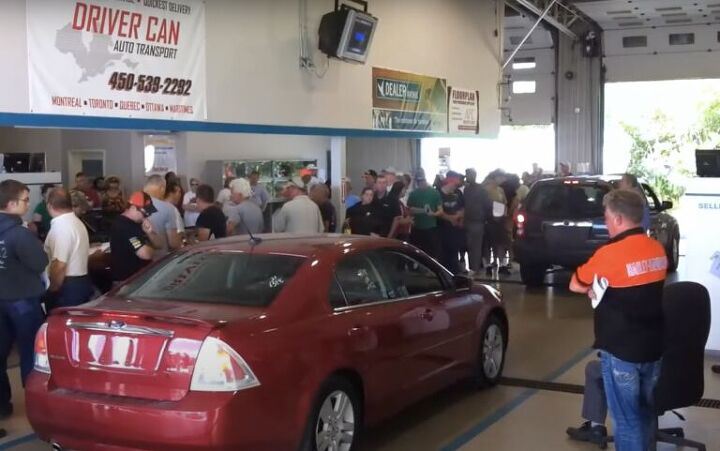
Riffing on the state of today’s used car market, AN has also been pointing out how dealer-only auctions are in a state of flux compared to their business-as-usual model which has dominated the industry for years. While the evolution to digital sales instead of crowded lanes at which auctioneers would routinely take bids from the Coke machine was already underway, the pandemic accelerated those practices and did damage to those who weren’t ready (or refused to change).
Talking heads who know the remarketing industry suggest that over four-fifths of business is now done online, up from about half prior to 2020. This is exacerbated by a cratering of available product. One source estimated that roughly 64,000 vehicles passed through traditional auction lanes in one week during the middle of May this year, down from over 111,000 during the same time period in 2019. Dealers are now experimenting with sourcing vehicles through different channels, with savvy stores that can find ways to get the inventory they need without the headache of fierce competition and high fees.
Back at Quantrell, a quick look at their website shows 23 vehicles at their Subaru store with over a hundred models available across the dealer network, suggesting their used car managers are on the ball in terms of having product on the ground. Make no wonder some people are travelling long distances to their locations.
[Image: Matthew Guy]
Matthew buys, sells, fixes, & races cars. As a human index of auto & auction knowledge, he is fond of making money and offering loud opinions.
More by Matthew Guy




Comments
Join the conversation
You've also got to watch out for scam fees when buying a car out of state. FL has the nation's highest scam fees: https://www.realcartips.com/newcars/482-documentation-fees-by-state.shtml
I took a train 290km to pick up a car I never saw in person, but it doesn't have the same lyrical bounce. Still, I made sure I still had the right to cancel the deal if I didn't like the car in person. Not all dealerships would be good with that. At the time it was a rare find (Used 2015 VW TDI wagon). From other comments I can see that people who want something specific always have been willing to go that extra distance. It just getting easier now and with ease of use comes more people adopting the idea.