Ford Lighting EPA-Estimated Range Confirmed


With window stickers of Ford’s all-electric Lightning pickup having leaked late last week, there were a lot of people interested in having their “Fuel Economy and Environment” estimates verified. Ford CEO Jim Farley has obliged by confirming the figures, adding that the vehicle’s maximum range should ballpark around 300 miles (or better) unless you snub the extended-range models.
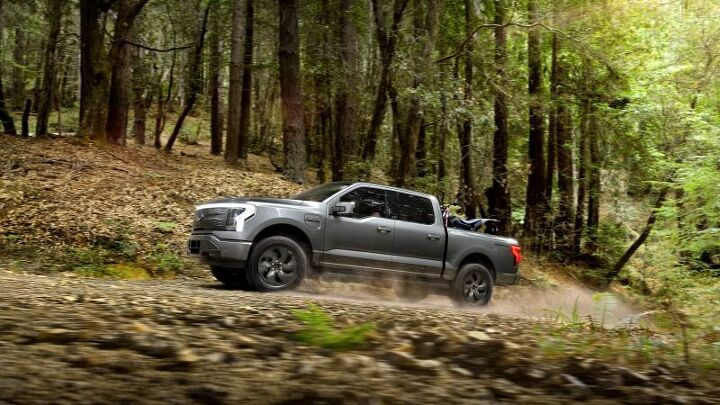
The executive confirmed the F-150 Lightning XLT, Lariat, and Pro trims at 320 miles with the bigger battery. Though those running with the standard battery pack only yield 230 miles between charging. Meanwhile, the Lightning Platinum tops out at 300 miles even due to it having gnarly tires and being less aerodynamic than its siblings.
Obviously, those estimates will come down further once payloads come into play. But it’s more or less what people were told to expect from the manufacturer.
While I’ve never found MPGe all that useful, since there’s no direct equivalent for calculating miles per gallon, the EPA had to come up with a unit of measurement that sounded familiar and offered consistency. Some might argue that 33.7 kWh of electricity sourced from any number of sources isn’t directly comparable to a gallon of burnt gasoline. But it’s the standard we have and it remains useful in making direct comparisons between EVs.

In the case of Ford, it shows just how close the Lightning is to Rivian’s R1T pickup in terms of efficiency. The overall range is also fairly close, at least until the R1T Max (400 plus miles alleged) arrives. Though it should be said that the Rivian is a slightly smaller vehicle than Ford’s Lightning, likely resulting in a lighter product in most formats.
Pricing is also extremely close. While Blue Oval’s leaked stickers show the MSRP after EV tax credits have been accounted for, the pre-credit price for an extended range Lightning XLT is $74,169. That’s only a few grand shy of the standard R1T. However, Rivian doesn’t yet offer a low-range model and has fewer choices for people seeking a more bare-bones EV. That also means Ford’s 230-mile pickup will remain a relative bargain until a valid competitor emerges. But Rivian is working on it, saying that it’s anticipating 260 miles between charges on the smaller battery packs.
[Images: Ford]
Consumer advocate tracking industry trends and regulations. Before joining TTAC, Matt spent a decade working for marketing and research firms based in NYC. Clients included several of the world’s largest automakers, global tire brands, and aftermarket part suppliers. Dissatisfied, he pivoted to writing about cars. Since then, he has become an ardent supporter of the right-to-repair movement, been interviewed about the automotive sector by national broadcasts, participated in a few amateur rallying events, and driven more rental cars than anyone ever should. Handy with a wrench, Matt grew up surrounded by Detroit auto workers and learned to drive by twelve. A contrarian, Matt claims to prefer understeer and motorcycles.
More by Matt Posky





Comments
Join the conversation
I wonder what percentage of the overall empty weight of the truck is constituted by the battery? Is it 20%? There’s an upper theoretical limit since the vehicle itself needs to get larger to carry the larger battery. Could a battery effectively be 50% of the overall weight of a vehicle? If the battery could serve two functions, such as being a true structural element, it would make the whole vehicle more efficient. Such as a motorcycle (or a tractor) where the engine and transmission housings are stressed, structural elements. Batteries have very little structural integrity but they need to be housed in a casing, so that casing might as well be part of the vehicle structure - but of course then the entire chassis would be disposable. Like a laptop where the battery is glued in place and acts to support the structure, making it all thinner, lighter and more rigid. EV as giant, disposable cell phone. This might actually be practical because if the battery can be expected to last as long as the useful life of the rest of the vehicle it might as well be a non-serviceable component. Everything else is disposable, why not?
I think the best auto manufacturer business decision in the last few decades was Ford building the first half ton crew cab pickup. It launched a sea change that eliminated most large sedans and wagons. It also became a cash cow. Any one car family could buy a cc half ton and have one vehicle that met all their needs and wants unless they needed to tow or haul very heave loads. The only difference with the lightning is that long trips towing are out. I think it will sell well but for all those families with trailers that get pulled a few times a year more than 300 miles a day this truck won't work. Otherwise it hits the sweet spot with utility, style, practicality.