Aston Martin Teases New Hybrid V6, Promises More Than 715 Horsepower

When you think about V6 engines, you’re probably reminded of mainstream family vehicles and manufacturers trying to find a way to package six cylinders in the most efficient manner. Inline sixes are great, but their length makes them difficult to install in the bulk of a manufacturer’s lineup. By splitting the cylinder count into two banks, the V6 avoids this problem — which is why you’ve seen it in everything from minivans to supercars over the last few decades.
Even Aston Martin has decided to tap the configuration for its next generation of vehicles. Developed in-house and intended for hybridization, the automaker promises its new V6 will not only live up to expectations but surpass them by outperforming the mightiest V12 in its stable. That 5.2-liter motor currently belongs to the Aston Martin DBS Superleggera and makes 715 horsepower and 664 lb-ft of torque.
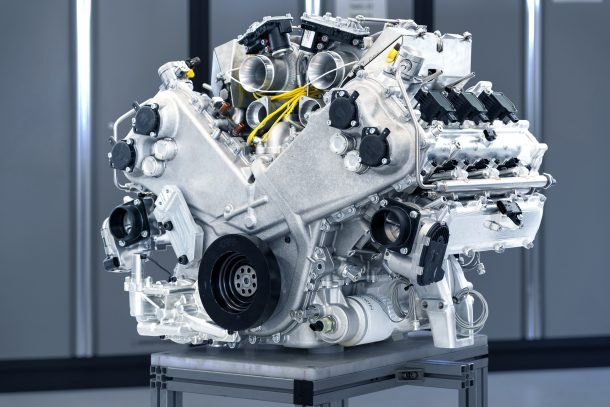
Set to debut in the upcoming Valhalla for 2022, Aston’s new motor is a 3.0-liter V6 codenamed TM01 in memory of long-passed engineer Tadek Marek. Its size is supposed to make it easy to install in an array of vehicles, with the manufacturer stipulating that it could easily slotted into both mid- and front-engined cars. This is the first motor the company has designed itself since 1969, though there are familiarities.
Previously seen on Mercedes-AMG models (which have also found their way into Aston vehicles) the V6 uses a “hot-v” configuration, with the turbos located between the cylinder banks. This helps shrink the powertrain’s overall size (mainly width) and can aid with heat management if designed properly.
Aston Martin pegged the V6’s weight at “less than 200kg,” or about 441 pounds. While not exceptionally lightweight for a V6, the manufacturer appears to be prioritizing packaging versatility and power over weight savings. The unit is also set up for hybridization by design, requiring additional components necessary for syncing up to a battery pack and electric motors. To offset the added heft and make it better suited for track-day shenanigans, Aston is implementing a dry sump system — which carries the added benefit of lowering its center of gravity (by allowing the motor to ride lower than it would with a traditional oil pan). It’s also designed to meet all future emission requirements under Euro 7 rules.
Beyond a few teasers and a handful of photographs of a motor that’s technically still in development, that info is all Aston is willing to provide. There’s a video that could give us a sense of what the unit might sound like (sort of boring, to be honest), though the company has been pretty clear that it will engineer the exhaust to make the sweetest sounds imaginable come production time.
Considering this is the engine that’s supposed to propel the brand into the next extra of motoring, there’s a lot riding on TM01’s success. The factory certainly isn’t taking things lightly; it feels that the mill offers real promise for Aston Martin to be both environmentally conscious and ludicrously powerful.
“Investing in your own powertrains is a tall order, but our team have risen to the challenge,” said Aston Martin President and Group CEO Andy Palmer. “Moving forward, this power unit will be integral to a lot of what we do and the first signs of what this engine will achieve are incredibly promising.”
[Images: Aston Martin]
Consumer advocate tracking industry trends and regulations. Before joining TTAC, Matt spent a decade working for marketing and research firms based in NYC. Clients included several of the world’s largest automakers, global tire brands, and aftermarket part suppliers. Dissatisfied, he pivoted to writing about cars. Since then, he has become an ardent supporter of the right-to-repair movement, been interviewed about the automotive sector by national broadcasts, participated in a few amateur rallying events, and driven more rental cars than anyone ever should. Handy with a wrench, Matt grew up surrounded by Detroit auto workers and learned to drive by twelve. A contrarian, Matt claims to prefer understeer and motorcycles.
More by Matt Posky




Comments
Join the conversation
Definitively, those glowing pipes do look awesome! Heat management in the actual vehicle's compartment will be a tough one, though.
Seems like a 90 degree vee to me. (A 120 would look almost flat.) Ignore the timing chest covers; they intersect at an intermediate point above the crank axis and therefore fool the eye. The crank is at that big harmonica balancer. Draw a pair of imaginary lines from the crank center to the midpoint between the pairs of cam end covers on each head. Looks like 90 degrees, at least unless they chose some other close, but unusual angle — cf the 65 degree vee angles occasionally encountered. Re heat management, that's a solved problem. There are other hot vee engines in production.