


2016 Lexus RC F Review - The Fastest Pumpkin Around

2016 Lexus RC F
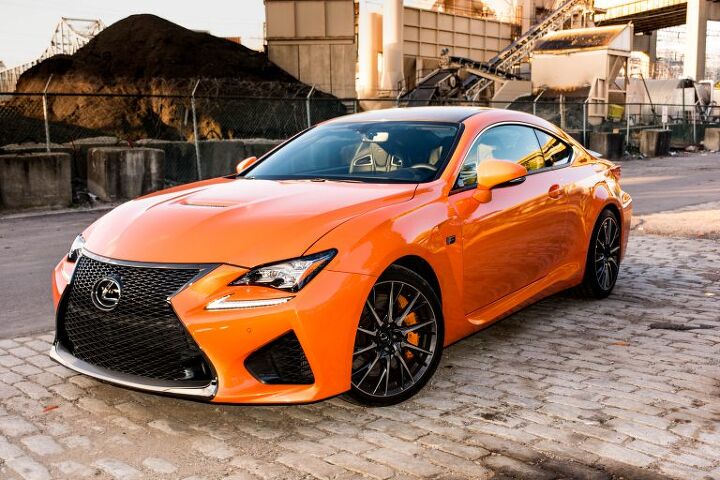
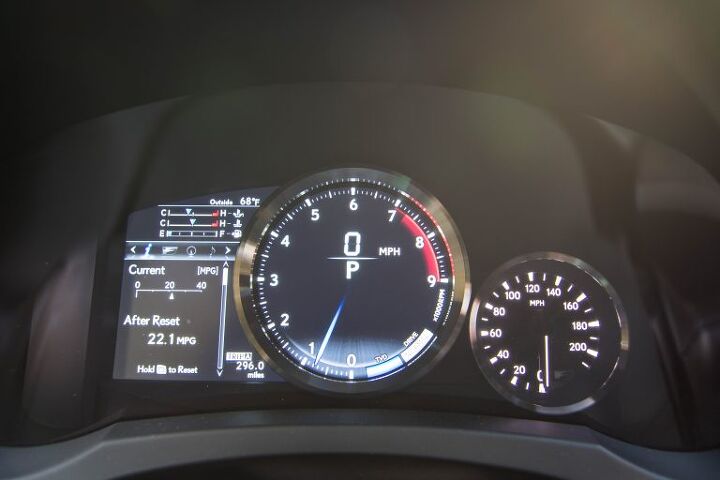
In fairness, I was going too quickly even for the interstate. Even then, I’m pretty certain I saw a third numeral flicker on the dash display as I apexed the off-ramp onto the unfamiliar rural divided four-lane.
Then I saw a black and gold Dodge Charger sitting in the median.
I immediately asked myself if I can legitimately write off a speeding ticket as a business expense.
Fortunately, the deputy sheriff was either napping or texting, as the bellowing orange 2016 Lexus RC F was distinctly conspicuous as I slowed to socially acceptable speeds. I unclenched, took a breath, and continued in search of more enjoyable roads.
And enjoy I did.
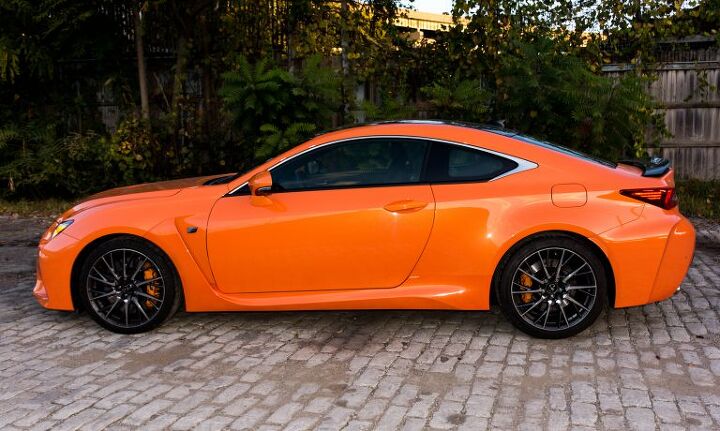
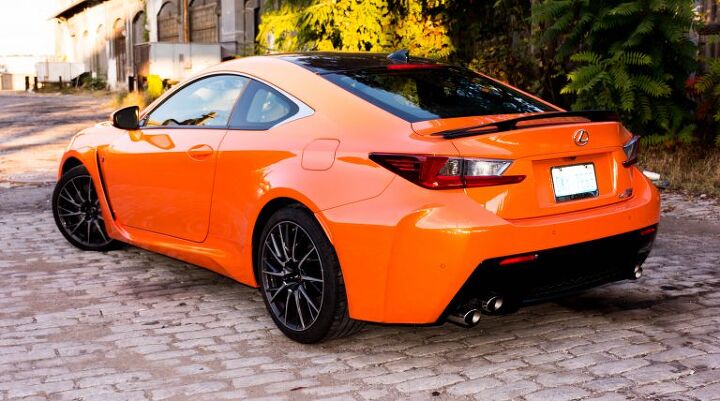
I don’t know if I can call the Lexus RC F beautiful with a straight face. It is purposeful and brutal, certainly, but it’s not an E-Type Jaguar. The various vents, intakes, and flares make a bold statement about the sporting credentials within.
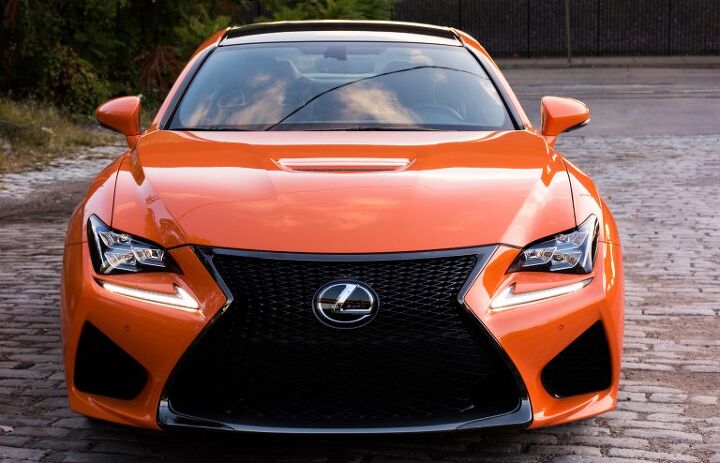
My tester had the optional $5,500 Performance Package, which adds a carbon fiber roof and rear wing, as well as a trick torque-vectoring differential. Yeah, adding extra black accents to the fabulously loud Molten Pearl gave the big Lexus a jack-o’-lantern look, which was a hit at the school drop-off line in mid-October. I loved the look, however — it seems to visually lower the car a bit more than cars with a painted roof.
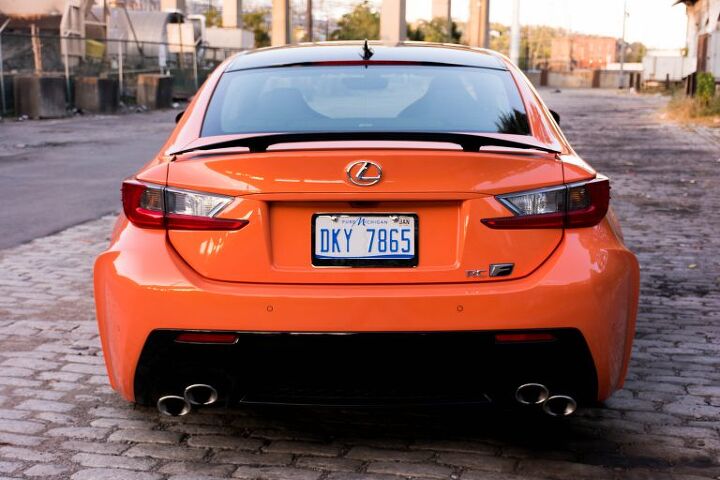
Out back, that carbon rear wing raises itself at speed, or with the push of a button for the entertainment of onlookers. The quadruple exhaust tips are a bit showy, but nothing about this Lexus is subtle. They are perfect for the character of this beast.
The well-bolstered front seats in the RC F are spectacular. Plenty of adjustment fore and aft, up and down, with heated and cooled seats on the Premium Package made my long interstate drive effortless. The $5,500 package also includes carbon fiber interior trim, primarily below the steering column and atop the glove box. It’s not completely convincing, though. Otherwise, the leather and sueded leather-like material — Alcantara? — is appropriately plush.
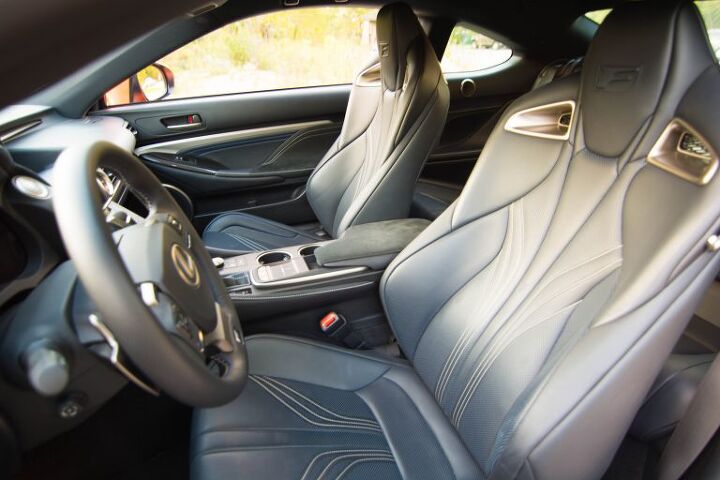
I can’t speak for the rear seats, though the tears of my eight-year-old daughter might. We had a mishap upon commencing her first RC F ride, where the power seat returned to a memory position incompatible with her booster-seated legs. Much screaming ensued. Removal of the booster seat allowed her feet to slide under the driver’s seat, and the girls rode with but one complaint for the rest of my test.
The problem they voiced loudly was the lack of any sort of handle to brace themselves, or to help extricate themselves from the deep seat bottom. Or, put delicately, there were no “Oh Feces!” handles. When I decided to “enjoy” my drive, and allow my spawn to enjoy it along with me, they would slide against the interior panels with force. Thus, my time experimenting with and exploiting the various performance settings was limited to solo drives.
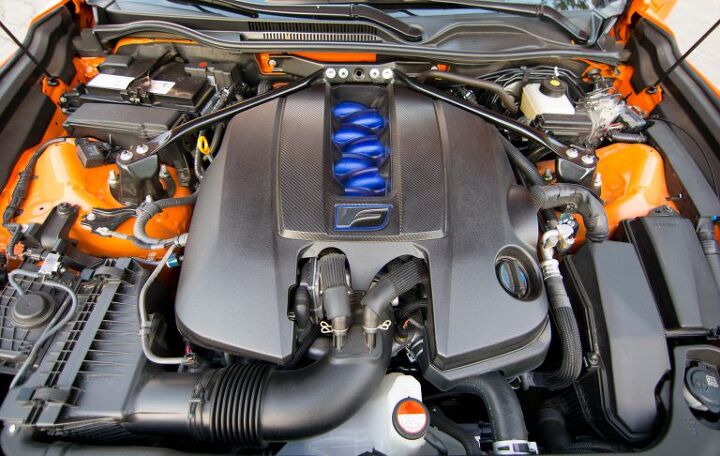
It’s the engine that is the big story here. 467 horsepower from a 5.0-liter V8 is still impressive, though most pony cars make similar power. The eight-speed automatic transmission, though certainly shiftable via paddle or lever, is a letdown — I’d love to try this with a six-speed manual. Sport and Sport Plus drive modes, selected via a knob just to the right of the shifter, do make the transmission shift more aggressively, holding gears a bit longer, especially in Sport Plus. The transmission slams firmly into each gear with the throttle pinned, and will blip the throttle during downshifts to keep the rear from becoming too unsettled.
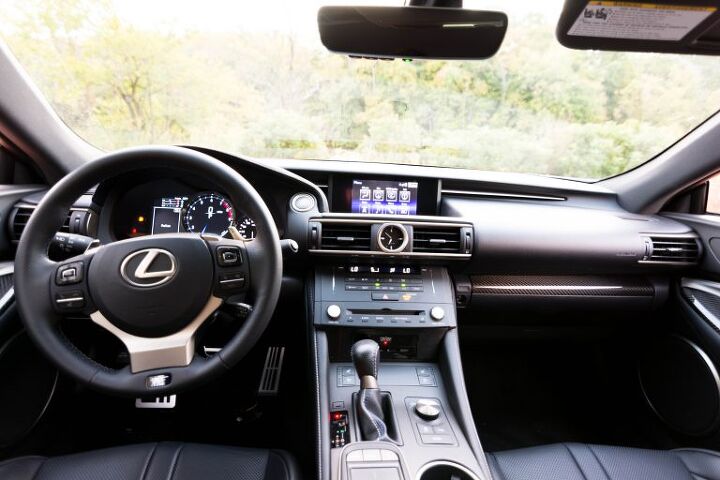
The really trick bit is the TVD button for the optional Torque-Vectoring Differential, part of the Performance Package. Rather than a traditional Torsen limited-slip as fitted to the standard RC F, the TVD allows for electronic biasing of torque to the rear wheels based on driving behavior. Between Normal, Slalom, and Track settings, the differential will change how the rear of the car drives – and importantly for your local tire dealer, how it slides.
Unlike the IS Turbo I recently sampled, this RC F uses a touchpad interface for the navigation and entertainment systems. It’s located immediately aft of the shift lever, and just ahead of an extended lip for the center console storage lid. It works well, but can be a bit sensitive. I found when driving while wearing a coat with loose sleeves, those sleeves would occasionally brush the touchpad and select different radio stations. I even sleeve-dialed my wife once.
The optional ($2,610!) navigation worked smoothly otherwise, and the the always-stellar Mark Levinson audio system had no troubles fighting the noise from the wide Michelins.
Between normal commuting, a two-hour early morning highway cruise, and a four-hour return via the curviest roads I could find, I spent plenty of time behind the wheel of the brilliant Lexus. Beyond road noise from the sticky tires and the boisterous exhaust note when exploring the deeper reaches of the right pedal, the Lexus was nearly as serene as a more staid ES sedan. The ride was firm over pockmarked Ohio freeways, but never jarring or unpleasant.
Once I encountered the twisties, the RC F woke up. I turned the selector to Sport Plus, switched the TVD to Slalom mode, and attacked the hills of southern Ohio. Set up like this, I found the Lexus would happily bring the rear around when driven enthusiastically, but it wouldn’t turn into a tire-smoking drift monster.
I wasn’t brave and/or stupid enough to try turning off the traction and stability controls — I wasn’t on the track, and thus had no reason to activate either the in-dash lap timer nor my AAA membership.
It’s basically a pony car, but with a posh twist. While it certainly compares nicely to an M4 or a C63, a Mustang GT or Camaro SS are natural alternatives. It occupies an interesting place in the market, as the Lexus buyer can choose rowdy and refined in one package.
Lexus provided the vehicle and a tank of fuel for purpose of this review.
[Images: © 2016 Chris Tonn/The Truth About Cars]
Some enthusiasts say they were born with gasoline in their veins. Chris Tonn, on the other hand, had rust flakes in his eyes nearly since birth. Living in salty Ohio and being hopelessly addicted to vintage British and Japanese steel will do that to you. His work has appeared in eBay Motors, Hagerty, The Truth About Cars, Reader's Digest, AutoGuide, Family Handyman, and Jalopnik. He is a member of the Midwest Automotive Media Association, and he's currently looking for the safety glasses he just set down somewhere.
More by Chris Tonn









Comments
Join the conversation
Because it's portly if I remember right. Probably fine for daily driving, but this thing is basically a 4,000lb car. This thing weight s 500 lbs more than a BMW M2, 300 lbs more than a Mustang GT and about 1000 lbs more than my 911. That is a fun killer.
Who in their right mind would buy this slow, frankenstein-like machine over a C63 or M3/4?