


Curbside Classic: 1987 Pontiac Sunbird GT – The Collectible Exciting Deadly Sin
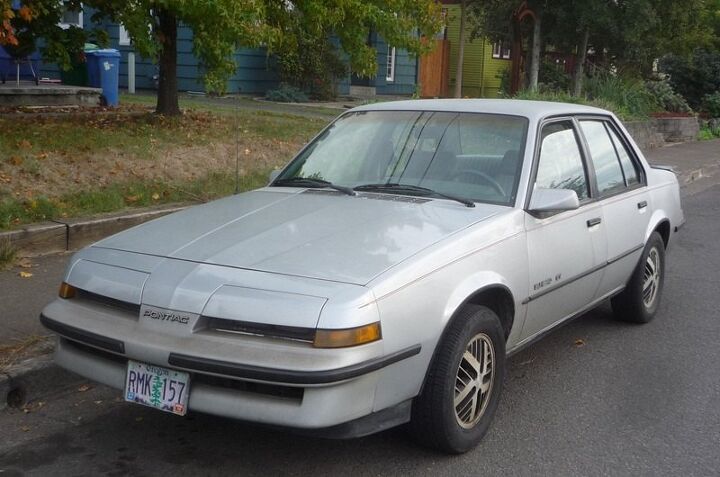
This is one of 1,540 Sunbird GT turbocharged four door sedans built in 1987. And given how few gen1 J-Cars are still on the streets, is it off the wall to guess that there might be…say… fourteen left in the world; if that many? Well, the fourteen 1970 Hemi Cuda convertibles ever built are fetching around a million bucks each. I know where this car lives, and my finder’s fee is very reasonable. But hurry; if the owner finds out what he inherited from his Aunt, he may become obstinate.
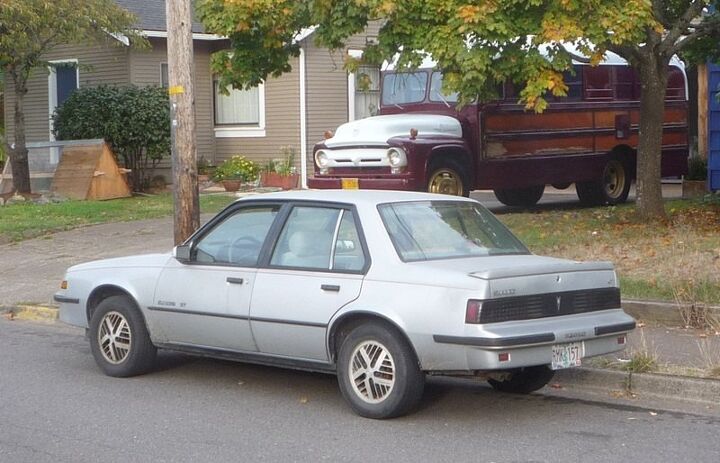
Ok, I admit I’m grasping for a proper take on this Sunbird. Here’s the deal: I’m not ready to take on the whole J-Car issue today, for a number of reasons. But go ahead, if you must, and let out all your built up love/hate for every one of the millions of J-Cars ever built around the globe in GM’s most ambitious world car program ever. I’m going to save that for one of my treasure trove of Cavaliers. But then this is Pontiac week at CC, and this rare bird appeared out nowhere, and…here we are. So how do we do it justice?
The Sunbird had an unfortunate start inasmuch as its mommy couldn’t decide on its name. Its glorious Monza-clone predecessor bore the Sunbird name. Maybe that’s why the new J-Body version appeared in 1982 as the J2000. And reappeared in 1983 as the 2000. And reappeared in 1984 as the 2000 Sunbird. The circle was squared in 1985, when just Sunbird appeared. And in 1995, a reskinned version appeared as the Sunfire. GM’s perpetual naming issues were on full display here. At least the Cavalier name stuck throughout the Chevy’s protracted lifespan.
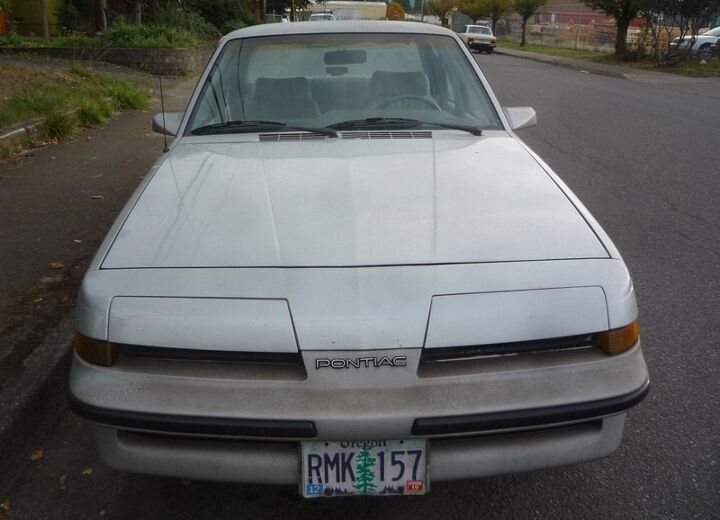
The Sunbird had a standing appointment with GM’s rhinoplasty department, going through a seemingly endless parade of new beaks. Maybe it felt self conscious about the rest of its body, which was all Cavalier, all too obviously. If you can keep track of all the front end variations, you should be writing this. I just know that they all stuck out way to far in front, and looked completely divorced from the rest of the body. A Firebirdesque nose on a Cavalier does not make for a harmonious look.
The Sunbird was also rather conflicted about its engines. It started out with the Cavalier’s dull 88 hp 1.8 L pushrod four. In its second year, an optional 1.8 L SOHC engine, designed by Opel and built in Brazil, became optional. Or was it the other way around? Curiously, it had four fewer horses on tap than the OHV Chevy, despite presumably costing more. Or did it cost less? Unresolved Sunbird mysteries. Maybe GM was using Sunbird owners as a vast field test to see which engine was better. Go figure; the eighties were GM’s worst decade for many small as well as large reasons.
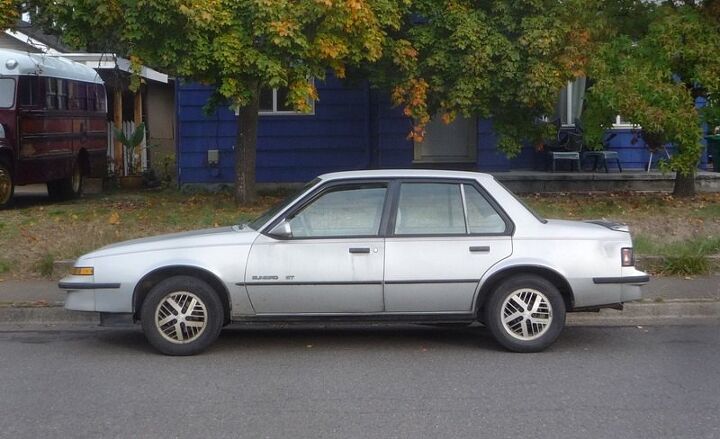
And the two engine families continued to be available for a few more years, before the rude little Chevy was shown the door. That happened about the same time that the 150 hp turbocharged SOHC 1.8 became available, which graces this GT. Now 150 horses was genuinely a big deal in 1984. Never mind that was more than any Cadillac mustered that year. It was more than my old T-Bird Turbo Coupe, and even the illustrious Saab 900 Turbo had all of 135 hp in 1984. The eighties were Pontiac’s Excitement decade, Take 2, and the Sunbird GT was trying to be a poor man’s Saab Turbo. Did it pull it off?
I can’t honestly tell, having never driven one, or having felt any desire to at the time. I can’t summon any old tests. [Update: one of our commentators, mazder3, has this summary of a PM test: Popular Mechanics did a six pocket rocket comparo in their August ’85 issue. The Sunbird turbo came in last behind, in ascending order; Civic S, Corrola GT-S, Golf GTI, Mirage Turbo, and the winner Dodge Omni GLH Turbo. PM absolutely slammed the Sunbird: although had the biggest tires, 205/60R14 (!!!), it still couldn’t stop or steer. The four speed shifter was stiff, engine balky, steering numb, brakes soft, and handling twitchy. It cost much more than its competitors but weighed too much, was cramped for its size, and was just no fun. To top every thing else their tested fuel economy was 17.8 mpg and best quarter 16.5 seconds.]
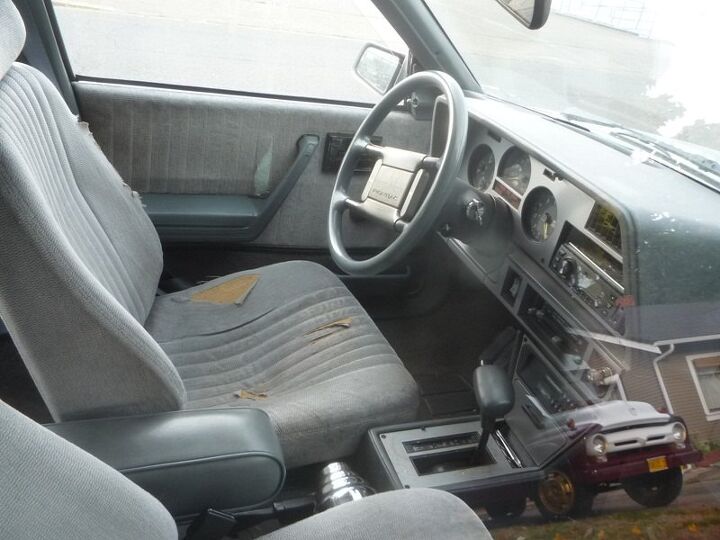
Undoubtedly, it was one of the faster affordable cars in its day. Torque steer? I strongly suspect so. Turbo lag? Standard equipment for the times. Handling? Maybe, sort of. Slick shifting? No. A tasteful interior? Don’t ask. Reliability issues? Undoubtedly, but I have been wrong before. With GM cars of the eighties though, it’s a very safe thing to say even if you’re pulling it out of your ass. Hey, this one is still on the road. Good luck trying to find another.
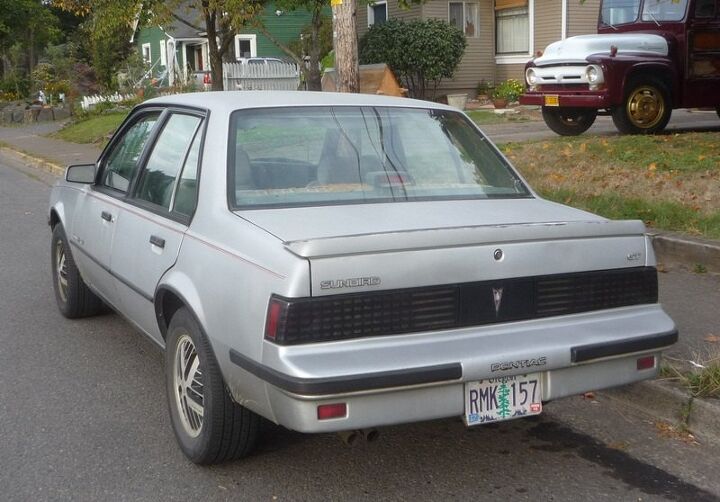
Maybe the Sunbird GT was a mammoth sleeper in its day, and it somehow got past me. I admit I didn’t spend a lot of time mulling the virtues of J Cars or reading breathless Motor Trend reviews of them. Like I said, I’m grasping here. I promise that the full brunt of my deeply etched memories of early Cavalier rentals will be employed when we do the little Chevy. But then there is the problem of the Oldsmobile Firenza and Buick Skyhawk. It least the Cimarron is out of the way. It might be a while before I can face another J-Car CC. Unless I can find a…

More by Paul Niedermeyer





Comments
Join the conversation
Man I love these things...
Mine was acquired second hand from a dealer who took it in trade it was a 1986 Sunbird GT, memory says it was two doors. Had neat flip up headlights,
I took it cross country East from California, the middle northern rout through some barren wide open land
Police an got me doing well over 120mph not sure because the speedometer was pegged at full speed. Whenever it had issues it was with leaking cooling system components, plastic radiator parts and such. I drove it too fast all the time on winding roads, untill my bank teller recognized me and said i drive way too fast, i took it to heart and decided to slow way down. Very comfortable seating, me and my friends enjoyed it toll the motor blew out second third time.