


Hammer Time: Old Volvos

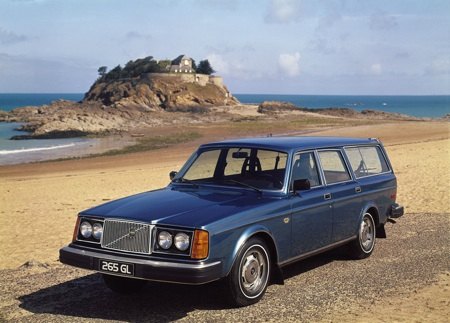
I hate the word fetish. It beckons the thoughts of neurotic foot lickers and perverts the world over. I always believed the word “aficionado” was more apt for my liking of old Volvos. It’s true that a lot of normal folks idolize the Porsches and Ferarris that embody the “speed” of the automotive experience. Some of us love the luxuruies of Rolls Royces and Bentleys . . . hell some idolize the Toyonda clones for their high quality and simplicity. In times past I’ve been ‘all’ there. I love the contributions all these manufacturers have given to our culture and our garages. But these days, I really appreciate longevity . . . and frugality . . . and functionality . . . which is why I absolutely love old Volvos.
An enclosed pickup, hauler of seven, leather, sunroof, seats that you can sit in for hours on end. Throw in a powertrain you can’t kill with live ammunition and lines that exude function and strength, and you’ve got the classic Volvo wagon. When you turn the key the red brick engine gives forth this declaration of, “Vroom!!! I’m there! Let’s go!” That 4-cylinder engine will often be attached to a wagon body that still offers better fuel economy and towing capability than many of today’s substitutes.
Servicing is grade school easy. Most everything except the heater core is in arms reach. And the prior owners? Old Volvos tend to be the most conservatively driven, well loved and well maintained vehicles out there. I can literally count on both hands the number of hour plus conversations I’ve had with prior owners after buying their Volvos at the auctions.
As for the rest of it? Well, I’ll put it this way. Volvo’s of the late 1980s and early 1990s were made to last 18 years on average . . . in Scandinavia. With Georgia having the smoothest of roads and a blissfully rust-free climate, I can probably drive one until the steel wheels finally turn as square as the rest of the vehicle. But as fate has it, I recently needed to use one to return an old favor given to me years ago. This past week I had a grandma trade in her 1992 740 wagon for a 2004 Dodge Grand Caravan. It was love. But as with that old Camry I wrote about a week ago, I knew it was time to take the good fortunes of my past and “Pass it Forward.”
Since a good friend of mine knew of a young couple starting out, I decided to sell it to them for $1000 after performing a 200-mile test drive around metro-Atlanta. High quality parts, a gentle hand, and diligent maintenance will hopefully continue to make this old Volvo a keeper car, and deservedly so.
More by Steven Lang












Comments
Join the conversation
Newer ones are decidedly worse in this respect. Got a very carefully maintained 850T-5R from 1995, with 220k miles and a 2000 S80T-6 with 105k. The 850 was bulletproof till around 125k, when the first small niggles stated appearing. It took ten or so visits over 3 years, till they could replace every single AC component to get it fixed, for instance. The first major mechanical niggle was a gearbox sensor for the autobox at 130k. Then more serious stuff happened at around 140k - the engine practically went - the conrod broke on the third cylinder and then most of the rest went rather quickly - i.e. over the next minute, while I was trying to get off the highway and stop. In any case it turned out a new engine was cheaper than fixing it. It has simply lost its reliability since - it's still fine for short trips but I got stranded several times on longer journeys in spite of immaculate maintenance. A bit sad but it seems about 8 years is the duration that one was really built for. The S-80 seems not to have been built for leaving the factory in the first place. I guess the average time between failures was perhaps 5k miles, if that. And some of the 'failures' were dramatically dangerous - like the plastic undercladding on the engine (for better aero) detaching itself at around 130mph on the highway (in Germany, where such speeds are legal - to prevent debate on that point). It was in a curve and I can only call myself and the car behind me lucky that it did not hit the rear wheels or the car following, as it would likely have been fatal. Simply lost all trust in the brand since, and all the friends with Volvos have similar horror stories to report. Quite sad how the brand slipped...