


Capsule Review: Bugatti Type 40

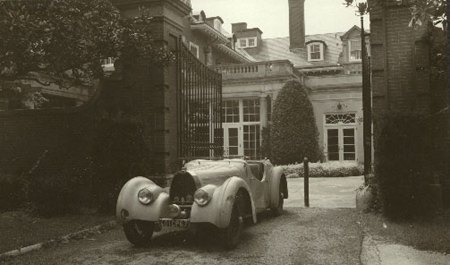
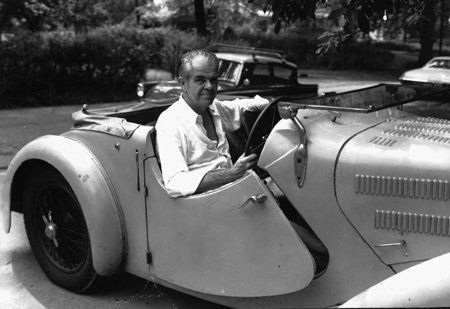
I had come into the turn way too fast. The tires broke free. “Oh God, no, I am going to crash this lovely little bus.” And then I found myself in a perfectly controllable four-wheel slide, drifting through the turn at 45mph, glee in my heart. It was probably 1964, and I was driving my father’s pride and joy, a type 40 Bugatti. But not one of the stogy little sedans. This was one of two subscale body prototypes for the ultimate Bugatti, the Type 57S Atalante. The recent fuss over a barn find in England brought our Bugatti fresh to mind…
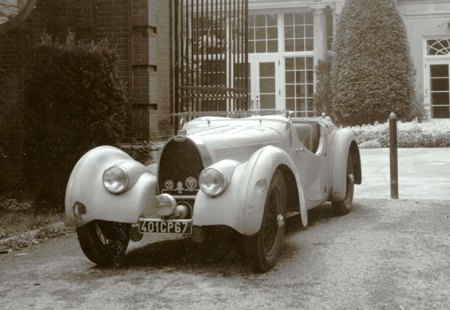
Ettore made just two examples: one for his son and one for his daughter. Our car was his son’s and Lordy, what a lovely little machine.
As the legend goes, a drunken postman on a bicycle got onto the test track when Jean was testing a Gran Prix car. Jean swerved to avoid him, hit a tree and was killed. This car went up on blocks at the works. We bought it, ex works, for $2250 in December of 1960, changed the spark plug wires and drove it… or my father and brother did. I was 13 and had to wait 3 years. Thirty years of storage and it just worked. It had no vices. It always started, was completely predictable and would do the most delightful slalom drifting turns with opposite lock steering. Pur sang. Pureblood. Most people don’t understand that machines can have breeding, style and guts.
It had suicide doors, grey paint, red leather, red painted 19″ wire wheels, with real knock-off hubs and a spare tire sunk flush into the sloping back deck. Oh, and the license plate: plexiglas letters on a black field with the light bulb behind them (a lovely touch). The engine is a straight SOHC four with a single side-draft Solex carb and has the rare pur sang scraped finish that usually only went on the works GP machines.
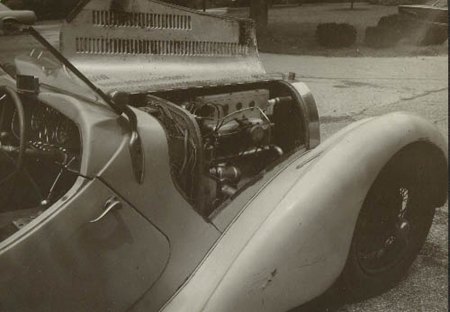
As with all Bugattis, the generator was direct drive and bolted onto the front of the engine drive shaft. Notice that, with the hood up, you could get between the firewall and the dashboard; real easy to work on. Finally, Bugatti came from a family of artists, sculptors and artisans, and his machinery is just flat beautiful. If you ever get a chance, take a look at a Bugatti front axle: it is a piece of art.
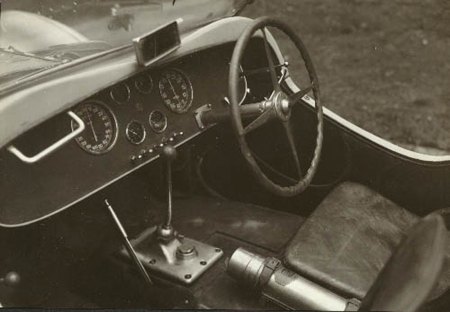
As with real Gran Prix machines , the tach had pride of place in front of the driver; the speedo is over in front of the passenger. Choke and spark and the Italian-style floor pedals. The classic Bugatti crashbox: no synchromesh, no helical gears. You. Could. Not. Downshift. If you didn’t know how to double-clutch. Performing a rare, perfect down-rev match and a silent, crash-free shift brought a smile to your face. It was like hitting a home run.
Every gear but fourth howled loudly in its own rising key: you didn’t need no effin’ tach, your ears told you what the revs were. But Bugattis were never the brutes like the Bentleys, Fiats, Benzs; they took a light hand and skill. They were rapiers. Driving them well was a “right stuff” experience. And in the late ’50’s and early ’60’s that could be had for a little less than the price of a new Chevy. If you knew. My father did.
More by Stewart Dean












Comments
Join the conversation
- Bob a) Thanks for the RHD Bugatti lore. b) Dunno about your take on helical vs straight cut. I know of straight-cut crashbox trannies in dump trucks and race cars which would seem to point to their use for strength. Doing a Google, I came up with this (Joe from Autoinfozone, who also allows that while turbocharging is nice, he's rather be blown): "helical gears operate quieter than straight cut. Straight cut will 'whine' the faster they go but offer both A. More directional application of force allowing for less power loss. and B. Higher acceptable loads until failure. Basically making the transmission stronger and more efficient. However though, like noted before, car manufacturers don't use straight cut due to the immense noise the transmission will produce." Amen to the noise. I could hear the Bugatti's gear noise a mile away...and it would tell you what gear and whether accelerating or de-accelerating in gear. I would go on point......... - Thinking about it, I realize that Bugs were really artisan built, individually or in limited runs. Of course, most medium to high-end cars were done in what would now be called limited production. When you build like that, you create.