


The Truth About the Chevrolet Malibu
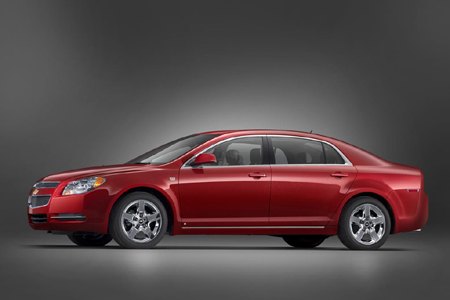
Stop the presses! GM has a hit! Well, at least a hit with the media. In fact, the mainstream automotive press loves the new Chevrolet Malibu so much they’re ready, willing and able to tell the world that this is it! The product-led turnaround that GM’s quintessential non-car guy, CEO Rick Wagoner, predicted seven years ago. Arriving as it does immediately after GM’s new two-tier labor contract with United Auto Workers, the new ‘Bu seems the literal embodiment of a corner turned. But is it? Is the new Chevy a harbinger of a new dawn for the beleaguered America automaker?
The new Chevrolet Malibu is hardly Detroit’s first “world beater” since the transplants transplanted stateside. Some of these automobiles never deserved this appellation (e.g. the old GM J-cars)– and proved the point in the commercial marketplace. Others fully deserved the plaudits. Even as its market share erosion began in earnest, The Big 2.8 has produced some genuinely remarkable, class-leading cars. So, what happened to them?
Cast your mind back to the turn of the millennium. What was the “wonder car” from Detroit that year? That’s right: the new Ford Focus. It was Car of the Year on two continents. It was an American-built small car that Americans actually wanted. And yet here it is, just seven years later: a finalist for TTAC’s Automotive Hall of Shame; an awkward-looking car that’s so uncompetitive in its class that even FoMoCo considers it little more than “place holder” for a future replacement.
Recalls were the first sign that the best of the best wasn’t so good. While the Focus never approached Vega-levels of self-destruction and lacked the “massive single flaw” of the Pinto, the Focus was recalled 14 times (steering, structure, suspension, etc.) in 2000, and another 10 times the following year. However much they liked their hatchback, the recalls had a damping effect on actual and potential customers’ enthusiasm.
All those warranty claims sliced the Focus’ thin profit margins. Rather than significantly renew or refresh the car’s mechanical components to keep pace with (never mind outpace) its inexorably improving competition, Ford “de-contented” (i.e. cheapened) the [American] Focus and used low price to keep its competitive hopes alive. Marketing support simply disappeared, as FoMoCo moved onto the Next Big Thing. Ironically, a lack of focus transformed a Car of the Year into a TTAC Ten Worst finalist.
Ford is hardly the first automaker to fail to maintain new model momentum. Volkswagen’s entire history post (original) Beetle is the same story writ large. Chrysler also has a long, sad history of slowing but surely extricating defeat from the jaws of victory.
It is hard to explain the Neon’s impact when it first hit the market in 1994. It was good looking, well-sized and American-made. The combination of the spiraling Yen and special bare-bones construction gave the Dodge Neon a solid price advantage. The ever-paranoid Japanese media even dubbed the Neon “the Japanese car killer.”
Flash forward 13 years and the Neon is toast, while the Corolla and Civic are still here, still selling in vast quantities.
While the Neon had some early mechanical issues, they were not Focus bad. The Neon’s troubles arrived later, as the model aged. Thanks to beancounting, the car’s mechanicals weren’t built to last. The Neon morphed from “new car” to “heap” after just a few years. As a result, resale value dived low and stayed there. The difference in depreciation confirmed the fact that Toyota and Honda were selling their cars on “value” not “price."
Believe it or not, this came as something of a shock to Toyonda; their management had no idea of their own strength. The men who designed the Neon literally paved the transplants’ way to prosperity. As for the former “killer,” the Neon received only one half-hearted update. By the time it vanished, most of the kids who got stuck with one had no idea how revolutionary the car had once been.
What does this mean for our friend the Malibu? First, it’s far too early to declare victory. The slow rollout brings hope that Malibu’s quality will be kept high. But no one will know what’s what until real volume hits the streets. Even then, it will take a couple of years to see if the ‘Bu’s bits are built to last— a key quality for success in this segment.
And after THAT, there remains the nagging suspicion that GM, a company with well over 100 models spread over eight brands, will repeat its history of neglect, aggressive corner cutting and itinerant marketing.
For those of you who say of course GM’s learned its lesson, two questions. What has been done to fix the Saturn Aura’s less than stellar gearbox? And when was the last time you saw an ad for the car? Well exactly.

More by Andrew Dederer







Comments
Join the conversation
I assure you I am knowledgable about vehicles. I certainly haven't read anyting here that would indicate I am out of my league when it comes to knowledge of the industry or vehicles. If you can't determine that I am somewhat well versed in these matters based on what I've written thus far I don't know what else to say. Saturn is known for excellent dealer service so I am perplexed by your comments that you cant put up with the dealer experience at Saturn. If you have driven the 2008 Malibu than you have essentially driven the Aura since they are the same size and perform in the same manner. No need to do a separate test drive. The 2007 Malibu is substantially different from the Aura however. The only other sedan I realistically considered is the Altima. I am not crazy about the tailights, the car is ubiquitous in the Phila area and the price was too dear with the options I wanted. For $3k more I would have gotten dual zone auto AC, pushbutton start and a rear armrest. I would've lost 18" wheels, remote start, Onstar and $3k. Not worth it in my opinion. I like the Mazda 6 but its old and underpowered. I like the Fusion except for the interior. All midsize sedans are capable so the idea that I missed out on something by not driving 5 of them is misguided. I didn't need to drive the Camry or Sonata or Galant because I knew from the start I wasn't interested. Not because they are "bad" cars but because they dont fit my requirements for style and performance.
It seems the 2023 Chevrolet is better than what has been written about it. Right?