


Quality Schmality
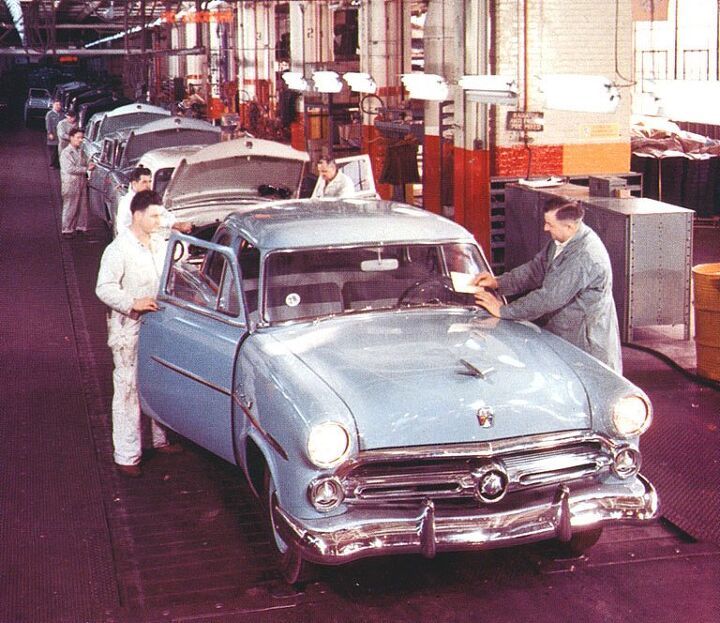
In a recent study of new vehicle owners, Ford products came second in "overall initial vehicle quality." According to Ford's PR release, Honda took the top slot, while Toyota and Nissan tied Ford for second (although Toyota actually beat Ford by three points). Yes, well, it turns out The Glass House Gang paid for the report, which mirrors the format of J.D. Power's Initial Quality Survey (IQS) without reproducing the results. Last year, JD's mob ranked Ford fifteenth in Initial Quality, one place beneath the industry average, nine places behind Honda and eleven places behind Toyota. Anyway, who cares?
Define quality. Is it design, durability, longevity, reliability, fit and finish, snob appeal, something else or a combination of these factors? How do you– or should I say "one"– calculate the relative importance of any particular attribute? Is reliability really the sine qua non of quality? Is longevity more important than fit and finish? Given the subjectivity of the term, it's virtually impossible to determine a vehicle's intrinsic "quality."
Back in the ‘70's, slipshod assembly, dubious dynamics and instant rust were the status quo. Any car good enough to win a quality award stood out from the crowd. Today's cars are the best-assembled, most defect-free, longest-lasting vehicles ever produced. Claiming a car rolling off one assembly line is higher quality than one coming off another assembly line is like claiming the Pacific Ocean will make you wetter than the Atlantic.
While pistonheads tend to fixate on minute differences between vehicles, the majority of the public are well aware that current mainstream motors offer roughly similar looks, performance, mileage, packaging, reliability and safety. Strictly speaking, Ford and other mass market automakers are selling mediocre products. To cut through the clutter and create a reason to buy one loaf of white bread over another, manufacturers use IQS studies to proclaim they're offering higher-quality mediocrity than the competition.
Quality is supposed to be a differentiator, something that shows that one item is superior to another in one or more aspects. The Ford-financed survey– and Detroit's continual harping about "the perception gap"– reflects the fact that many manufacturers don't get it. They're still stuck in the "Hey, give us a chance! We're just as good as the other guys now!" mentality. When the average person determines whether or not a vehicle is a quality product, they're not looking for "as good as." They're looking for "the best."
To achieve that, today's automakers must produce profound reliability AND sweat ALL the small stuff. Our reviewers have been continually criticized for continually criticizing the quality of a given car's plastic surfaces. Yet the look, feel, shape and smell of a vehicle's polymer's reveal a great deal about its overall quality. Just by prodding the dashboard, even a layman can tell if he or she's sitting in a beancounted beater or an upmarket luxobarge. Same goes for closing a door, or listening to the radio, or pressing the gas pedal.
Yes, it's a challenge to create the highest possible quality at a specific price point. But that's the challenge all automakers face. And in today's hyper-competitive automotive market, there's simply no margin for error. MINI's IQS scores took a beating when they introduced the car without cupholders. Many pundits asked, has it really come to this? Yes, it has.
Anyway, if automakers were truly interested in determining the quality of their products, they'd survey owners long after the new-car honeymoon had ended. They'd ask for feedback on reliability, fit and finish, repairs, out-of-pocket expenses, performance and how well the vehicle held up overall. If the buyer no longer owned the vehicle, they'd find out why their customer got rid of it.
After collecting several years' data, they'd know more about their vehicles' quality than any IQS would ever tell them. This information would be far more relevant to the consumer than knowing that car A averaged 0.043 fewer defects when new than car B. If a manufacturer came out on top of this kind of survey, they'd have something to brag about. And it would be interesting to see how their IQS ratings correlated to their "real world" results after a few years.
I have no idea why manufacturers haven't embarked on a project like this. The only reason I can think of: they don't want to take a beating from the reality stick. They'd rather go on blithely believing surveys that tell them their brand-new cars look, feel and act brand-new than watch their self-aggrandizement shrivel to nothing in the face of cold, hard data.
I know I'm tilting at windmills here. But it's high time the manufacturers stop hiding behind bogus quality ratings and start producing vehicles that are designed to be class leaders in every aspect. Then they wouldn't need contrived crutches like initial quality surveys. The product would sell itself and customers would be lining up for more.

More by Frank Williams




Comments
Join the conversation
jthorner: April 19th, 2007 at 8:16 pm ... "You can find a summary of warranty cost rates by major manufacturer here:" http://www.warrantyweek.com/archive/ww20060620.html --------------------------------------- Quote from the above website: "Of course, Ford, GM, and DaimlerChrysler each sell automobiles under multiple brand names. In the U.S., the primary brand names used by GM are Buick, Cadillac, Chevrolet, GMC, Hummer, Pontiac, Saab, and Saturn. GM also has an equity interest in Suzuki and Isuzu. Ford also uses multiple brand names, including Aston Martin, Jaguar, Land Rover, Lincoln, Mercury, and Volvo. It also has an equity interest in Mazda. For passenger cars, DaimlerChrysler uses the Chrysler, Dodge, Jeep, and Mercedes-Benz nameplates, but it also has multiple brand names involved in truck and engine production. It also has an equity interest in Mitsubishi. The reason we mention this is because each company reports only one set of warranty figures. Warranty claims are not broken out either by nameplate or by the size or type of vehicle. We just can't tell which of the brands account for the most or the least warranty cost." So what this means is that you can't really say what the waranty rate is for a Ford, Buick, or Dodge because the entire company is taken as whole. What if Pontiacs have so many problems they skew the results for the rest of GM? Who wants to bet that Jag is pulling up Fords overall warranty costs? I would not be surprised if Mercedes is the one pulling up DCX's numbers and not Chrysler, Dodge, and Jeep. Also it seems that commercial units (Freightliner for example) may be included. To me this data is not a good indicator for any individual brand.
How do you define quality or relability on a vehicle that is several years old? It seems like this would come down to maintenance. The manufacturer can not control how you treat a car once you buy it. I've sent a car to the junkyard at 97K miles because the last owner beat it to death and it wasn't worth it to fix. Someone like most of us reading this are pretty anal-retentive with car maintenance. I'd be willing to bet most of us get 200K plus out of our cars regarless of where they were built.