Clocking In: Timepieces In Yer Car
Being able to tell the current time in the cabin of recent vehicles has become an easy game to win. Infotainment tablets in the center stack can be configured a million different ways, almost all of which include at least one time-of-day notation. Activating smartphone mirroring via Apple CarPlay or Android Auto reliably brings up another digital clock. And modern gauge clusters are screens with yet more configuration options - at least one of which is sure to include a clock.
[Images: Hrach Hovhannisyan/Shutterstock.com, JoshBryan/Shutterstock.com, Wirestock Creators/Shutterstock.com, Murilee Martin, Infiniti]
Become a TTAC insider. Get the latest news, features, TTAC takes, and everything else that gets to the truth about cars first by subscribing to our newsletter.

It wasn’t always so. This author’s family owned a streak of Fords from the ‘80s and ‘90s, all of which had that single-DIN head unit with a small, green window or LCD readout in which the time would sometimes be displayed in a slightly different shade of green. I say ‘sometimes’ because it quickly became apparent that a clock was optional equipment in some base Fords of the era, despite their radio readouts all looking identical. Glass House accountants strike again.

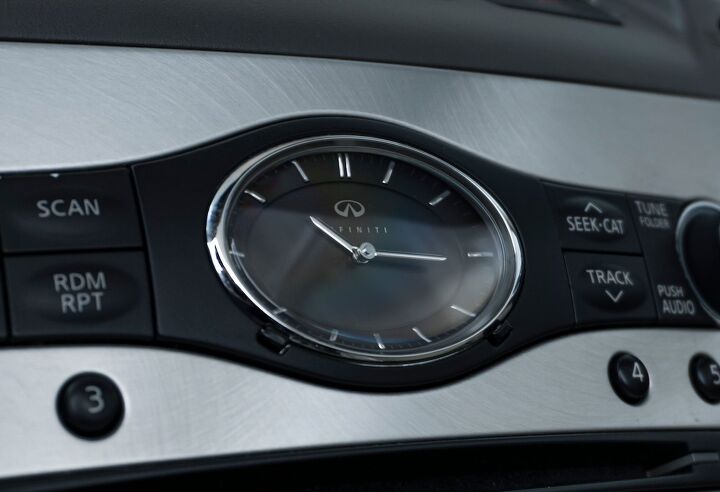
Our own Murilee Martin has a tremendous collection of clocks collected from his various and sundry junkyard ventures. Some of his photos will show up here. Back in the day, it wasn’t uncommon for a brand to try and inject a skiff of luxury into a car’s cabin by installing an analog clock, probably one with some sort of fancy typeface. Gearheads of my generation probably think of Infiniti as one of the more recent brands to lean heavily into this trope, making sure all of their wares had a gold tinged analog clock as a dashboard centerpiece. Was it successful? Well, at least it was notable, though we should point out that Lexus soundly beats Infiniti on the sales charts despite the latter beating the former to the punch in America.
Detroit barges from the Malaise Era (which is a term invented by Murilee, by the way) often tried to simulate digital clocks with some form of Rube Goldberg device. While the example given above was of a brand trying to inject a feeling of luxury with an elegant analog clock, all digital everything was chased by some in the Malaise Era as part of an effort to convey a feeling of technological superiority. Witness these dashboard clocks which used barrel-type numbers; surely there had to be at least one or two which used flip-style digits, as well.

And then there were times in which brands put an analog clock in a car’s dashboard just to fill up space. Hyundai was pretty good at this in its early days, back when it launched on our shores with cars like the Excel and Sonata (or the Pony and Stellar up north). The brand figured out pretty quickly that while it could just plunk a blank-off plate, usually a branded one, in place of a tachometer, customers were less apt to feel that something was missing if a clock was in its place instead. Some manufacturers from Detroit pulled similar ideas, such as with the so-called Squarebody pickup trucks and the myriad of gauges which could be spec’d in the quartet of round holes just to the left of the driver. The Cougar shown above is another example.
