


In Defense Of The Chevrolet Volt

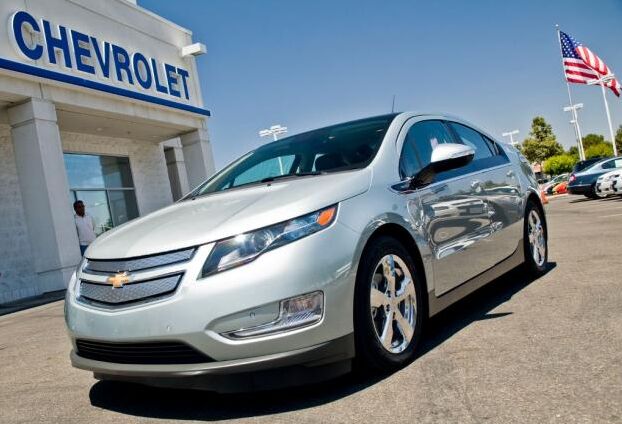
[Editor’s note: In the absence of an official rebuttal to Edward Niedermeyer’s NY Times Op-Ed on the Chevrolet Volt, TTAC’s own Ken Elias has volunteered to come to the Volt’s defense.]
The Chevy Volt should be a brilliant piece of engineering achievement if it works as advertised. That’s a big “if” and I wouldn’t bet my life that GM’s first iteration of the car will live up to the hype. And that’s only because of the long string of overhyped vehicles that came out of the former GM that simply never delivered. But that’s three decades of history talking – and GM’s a new company today with a different mindset and competitive spirit. Its newest products – the LaCrosse, SRX, Equinox, and Camaro for example – have been well received by the public and there’s no shame putting one of these rigs in your driveway. So let’s start out giving GM the benefit of the big doubt that the new Volt will work as advertised.
When Toyota first assembled and sold the Prius in 2000 in the States (1997 in Japan) you can bet that the price tag of the car was well below that real cost of the car. How much is a corporate secret – but Toyota was deathly afraid that Bill Clinton’s accelerated investment in advanced technology programs in the 1990’s would give the domestic OEMs a chance to gain a leg up on Toyota. (And while some think that the first Prius cost only $32k per copy – well that was just for the parts.) It was a huge bet by Toyota that its Hybrid Synergy Drive would eventually form the basis of a new generation of vehicles which would allow it to remain competitive with whatever came out of Detroit. Looking back, we didn’t get much from Clinton’s investment other than encouraging Toyota to make the leap and jumpstart the entire hybrid movement. (And again, we don’t know what kind of funding Toyota if any it may have gotten from its government. No point telling anyone now is there?)
The question of whether it made sense for GM to continue investing in the Volt before and after the bankruptcy is also irrelevant. For starters, the old GM was going to go broke whether or not it poured money into the Volt. So dropping the Volt then may have given GM a few more days of life although GM had countless holes where it was bleeding cash so it’s impossible to know. The bankruptcy outcome for GM was preordained by 2005 or thereabouts anyway (if you were an early TTAC reader). And throwing taxpayer money at the Volt during and after the bankruptcy – even if the PTFOA thought it was too expensive for commercial success – misses the point too. It’s a disruptive technology that over time could significantly alter gasoline usage in this country for a large segment of drivers. And that’s the real goal after all, isn’t it?
We have to look at the low volume production of the first gen Volt as merely an “on the road” experiment to perfect the technology. As with any new technology (e.g., the Prius), the second and third generations of the Volt will be the real winners as component prices fall, volumes increase, and sales start to generate real profits. Of course, the price tag will have to drop as well since it’s a better economic decision to buy a new Cruze for $17k and put gas into it until the wheels fall off rather than invest $34,000 (net of tax credits) in a new Volt today.
Comparing the Nissan Leaf to the Chevy Volt makes no sense whatsoever. For starters, the Leaf has potential only for those folks that have no fear of range anxiety – that is those that have a defined commute each day (and maybe 60 miles tops round trip) and have no extra-curricular needs for their car. One can count on both hands the likely number of Americans that fit that description. Oh yea, you had better to remember to plug it in each night or else it’s a no-go the following morning. The Volt overcomes that objection easily – forget to plug it in, no problem. Need to drive more than the allotted battery power – no problem. No charging station nearby – no problem. Want to take a weekend trip – no problem. It just makes sense to get a Volt rather than a Leaf if the lease prices are the same.
So let’s not worry if a couple of billion dollars of taxpayer money went into the Volt. For starters, there’s a chance we’ll get back the bulk of the money anyways. And taxpayer credits? Heck, lots of industries have benefited from such programs before. Why single out the Volt? Even the Leaf will qualify for credits. We just have to hope that GM can lead the way in technology – and that will make us all better off.
More by Ken Elias













Comments
Join the conversation
Steven02: "The fact is, the Prius lost money, judging by some estimates, 10k per unit at first." Pure speculation. Steven02: "Criticism of another product for the same thing doesn’t make any sense." Toyota was making money. GM was not making money. GM's first responsibility it to make money. Unprofitable companies don't have the luxury of running unprofitable marketing experiments. GM had and still has much more pressing priorities than the Volt. Especially since the Volt is something that any other manufacturer can do when the time is right. Steven02: "Or, like most families, I could have a second vehicle." Most families do. In such a case, the Leaf, which is substantially cheaper, makes much sense. The other car can be used when long range is necessary. Steven02: "On the 50 mpg link, it isn’t just gm-volt who has stated this. Many news outlets picked up the 50 mpg." I'd bet all those articles circle back to the same Detroit News source. Two of them cite it explicitly. If this gizmo had superb gas mileage, why would they be requiring premium, "for the efficiency?" That phrase is straight from Tony Posawatz. Requiring premium on a car whose sole purpose is to cut fuel consumption is lunacy. They are in deep trouble with the DBFE (Dead Battery Fuel Economy) or they wouldn't do this. Steven02: "You missed my point on the fill up as well. " I didn't miss anything. You did not read the entire sentence. The Prius will go about the same distance on $2.40 of gas as the Volt will go on $2.40 of electricity. $.30/kwh in California is not at all unusual and there are other places around the country where electricity can be fairly spendy. And after that electric fillup, the Prius is going to be going 50 miles on every $2.79 worth of gas (price around the corner) while the Volt is going 38 miles (my prediction) on $3.09 of gas (price around the corner). Steven02: "I have seen some estimates of the Prius plug in that price it higher than a Volt." Well, I admit that Bob-sahi Lutz-san, Vice Chair of Toyota Product Development and Toyota's "Car-Emperor", didn't say, "$25K" but I'd still be perfectly happy to bet that the Prius will be much less than the Volt. The Prius, as it rolls out today, is $22.8K. Subtract the current battery (parts window price, $2.3K, let's say the manufacturers cost is $1K) and then add 5KWH of Li-Ion at $1K/KWH. That's $26.8K. Add another $1K for a charger and electric "filler" port and you're looking at $27.8K. Now back out $2.5K for the tax credit and it's possibly as low as $25.3K, net. Yes, I my back of the envelope calculation may be wrong but you're purely speculating. Steven02: "The rebate isn’t capped. READ THE BILL. If the vehicle weighs 10000 pounds or more, you can get more money for having more kW." Technically, I may be wrong. However, for any reasonably-sized family sedan, the rebate is capped to make sure the Leaf doesn't get any more tax credit than the Volt, in spite of its much larger battery. GM's Congressional delegation did its job well. Steven02: "GM doesn’t make batteries. Neither does Toyota. " Toyota is in a JV with Panasonic. They are working to get as close to ownership of the important technology as they can. By contrast, didn't GM sell off Cobasys?
I read some of the posts. Life is too short to read the back and forth. So, for the price, you get a 25 mile range (dead of winter, heater on), worse gas mileage than a VW diesel (although my background in repair can confirm that even GM's 2nd-rate quality surpasses VW/Audi-cheaper repairs too), and zero smiles-per-gallon. They can't sell what they're making now, which should go in the red flag column as "the public has spoken". I cry bull#*@t on the cars being N/A to the public; at least in this market, and w/no dealer surcharge. Maybe GE CEO/Obama's appointed Head of Economic Advisory Panel Jeff Immelt will buy another 10,000 or so Volts on the taxpayer's dime for his "fleet" at GE this year. That should help. No conflict of interest or anything to worry about, eh?