


UK: Speed Camera Ticketing Slowed Advance in Road Safety
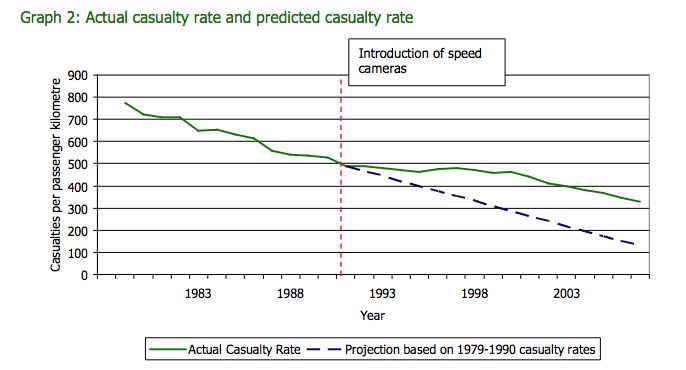
The TaxPayers’ Alliance and Drivers’ Alliance last week calculated that UK speed cameras issued £87,368,227 (US $131,256,380) worth of tickets in fiscal 2009 without any demonstrable safety benefit. Since speed cameras were first installed on British roads in 1991, the roads became more dangerous than they would have been without photo enforcement, according to the report.
“The road casualty rate has declined at a slower rate since speed cameras were introduced in the early 1990s,” the study explained. “Using the road casualty rate from 1978-1990 it can be estimated that 1,555,244 more road casualties have occurred from 1991-2007 than would have if the 1978-1990 trend had continued.”
Such figures should see a continuous steady decline because advances in automotive technology including anti-lock brakes, stability control, crumple zones and airbags have made vehicles significantly safer over time. Those who are injured in an accident are also more likely to survive as medical treatments and trauma care likewise advance.
In terms of the number of fatal accidents per billion passenger miles traveled, the casualty rate fell from 773 in 1979 to 331 in 2007. The pre-camera fall, however, was far more impressive. Had cameras never been installed, the group projected the casualty rate would have been 128 in 2007.
Automated ticketing machines in the UK are operated by speed camera partnerships representing local city and county officials teaming up with police. Beginning in 2007, the revenue generated by each partnership was sent directly to the national treasury with money reallocated back to the partnership through road safety grants. This setup was designed to remove the impression that the cameras were merely being used to raise revenue. Newly elected Prime Minister David Cameron now pledges to stop grants for the purposes of adding new fixed speed cameras.
This was the first count of tickets that included magistrates’ courts along with the national figures. Partnerships in England and Wales accounted for the greatest number of tickets — £65,748,850 (US $98,721,524). Another pound;19,214,594 (US $28,850,691) went through magistrates courts in England and Wales. Scotland issued £1,641,630 (US $2,464,905) in automated citations while Northern Ireland collected £763,153 (US $1,145,909).
View a copy of the report in a 200k PDF file at the source link below.
Research Notes No. 3 — speeding fines (TaxPayers Alliance and Drivers Alliance, 7/12/2010)

More by The Newspaper








Comments
Join the conversation
Money people. It is all about money. Change the penalty to community service and would the cameras exist? Probably not. All this "safety argument" is really just spin. Everyone will argue one way or the other (just like politics) over the non-issue (safety) while they cotinue to suck money out of the population.
The y axis reads "casualties per passenger kilometre". WTF - so there are several hundred people killed for each passenger traveling 1 km? Sounds more like the charge of the light brigade than road traffic. Also, “Using the road casualty rate from 1978-1990 it can be estimated that 1,555,244 more road casualties have occurred from 1991-2007 than would have if the 1978-1990 trend had continued.” WTF again - 1.5 million incremental casualties? There is some serious innumeracy here. Several aspiring journalists should have gone to school a little longer.