


Minivan Design Origins Disputed: The Designer Of The Espace Fires Back At TTAC
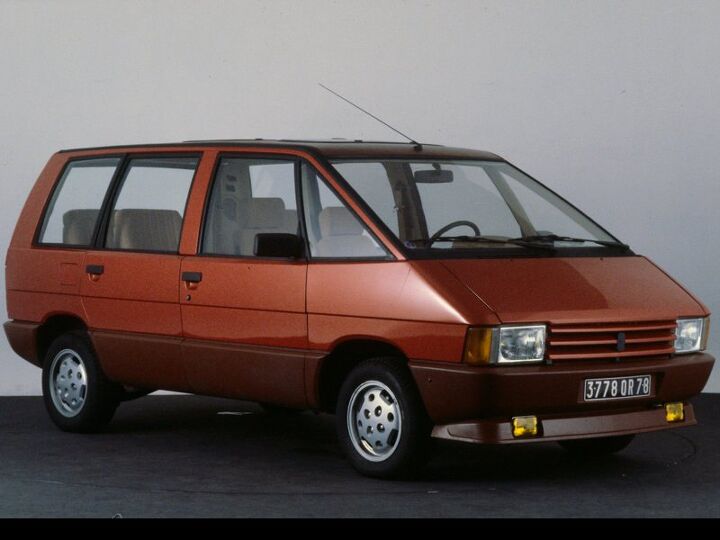
In our recent 1984 Dodge Caravan Curbside Classic, we explored the origins of the minivan. The question as to who first penned the modern FWD people mover is a bit of thorny one, and one which has been argued endlessly. In that CC, I gave credit to Rootes (later Chrysler Europe) designer Fergus Pollock for his work in developing a van project that eventually ended up at Renault as the 1984 Espace. I thought I made it pretty clear that his work was specifically on a one-box approach, and that I had given him due credit for that, whereas Ital Design’s Megagamma had the vestigial hood that ended up on the 1981 Nssan Prairie/Stanza Wagon and the Chrysler minivans. But designers are (rightfully) a sensitive and protective bunch, and I got a rather terse e-mail from Mr. Pollock setting the record (somewhat) straight(er).
Here’s what I said:
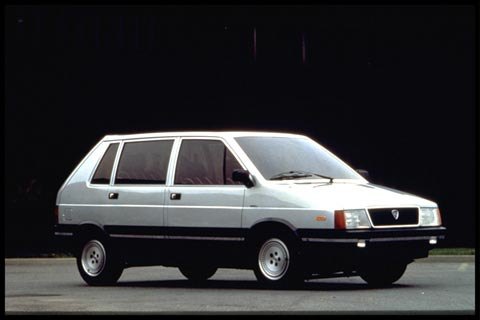
“Before we get into the guts of the so-called Magic Vans, lets quickly pick up the story of that other 1984 mini-van pioneer, the Espace, because it also got its start under Chrysler’s roof, but in England. Europe UK (formerly Rootes) designer Fergus Pollock, who later was senior design manager at Jaguar, developed a van project in the seventies, about the same time as Giorgetto Giugiario’s highly influential 1978 Megagamma concept for Lancia. Pollock’s design focused on the one-box approach, whereas the Megagamma retained the vestigial hood that the Caravan also appeared with. Of course one can likely find numerous earlier designs, even production ones, that will be thrown at this argument, but the Megagamma’s FWD layout, package and lines are unmistakably apparent in the Voyager/Caravan, and to some extent in the Espace.” (emphasis added)
Pollock wants to set the record straight, in no uncertain terms:
Hello Paul, I read with some interest your article on the Dodge minivan and Espace. However, just to put the record straight I can tell you the Megagamma had absolutely no influence on the design of the Espace. The Espace was conceived in 1976 as a skunk project – it was not part of any cycle plan, but became a live programme after I presented the idea to Dick Macadam around the Spring of 1977. The whole point of Espace was that it was a one box volume. It was not only completed months before Megagamma was announced, but was light years ahead in design terms. This was carried through virtually unchanged into production – the Megagamma by comparison,was perceived as traditional and lacklustre, but became in the Prairie a visual bag of shit,clunky and old in the extreme. Get it right next time.
I like to be corrected, although I’m not exactly sure of my transgression. Regardless, you heard it from the horse’s mouth. Anyway, the key line in that article was this, at the very begining: “There’s nothing truly original in the car business. Everyone begs, steals and borrows from everyone else. Or sometimes, the same (and usually obvious) idea ferments for years in various heads or companies, and then suddenly appears in the same format at the same time in totally different places. How about the modern FWD mini-van?”
If Mr. Pollock thinks that he truly designed the first FWD one-box minivan, I encourage him to check back later today at TTAC, for another take on this subject. And I’d feel even more convinced about the similarities of the “lines” on the sides of both the Megagamma and the Espace, if Mr. Pollock could show us some early photos of his Espace, before it ended up for final development at Matra and Renault. Because it’s still very possible that they were added later. Can we take a look, Mr. Pollock?

More by Paul Niedermeyer





Comments
Join the conversation
Paul, I am surprised that no mention is made about the longitude-mounted, front-wheel-drive Mercedes-Benz L206D/L207D/L306D (Harburger Transporter). It is often mistaken for Volkswagen bus and is perhaps the first front-wheel-drive Mercedes-Benz vehicle, which predates the A-Class by twenty-eight years. http://hanomagmercedes.spacequadrat.de/plaene/schmierplan.htm http://www.autoweek.com/article/20080829/FREE/808279991 The second edition, MB100, was built from 1988 to 1995. http://de.wikipedia.org/wiki/Mercedes-Benz_MB_100 (German) Cheerios, Oliver
Wasn't MeggaGamma one of Godzilla's arch-enemies back in the day?