


Curbside Classic: 1965 GMC Handi-Van
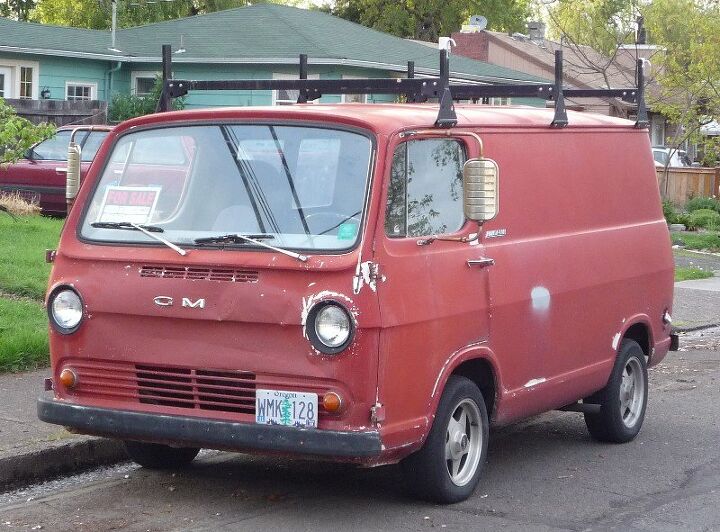
Regression to the mean. Lowest common denominator. Thinking inside the box. These over-used expressions are all-too often applied to Detroit iron. But which vehicle most fully lives down to them? Here it is: the crudest, simplest, most wretched-handling and least-safe vehicle made by the Big Three in the sixties. It’s a box with two cart axles, a motor and transmission, and useless brakes. Throw in a couple of milking stools, and you have yourself a Handi-Van.
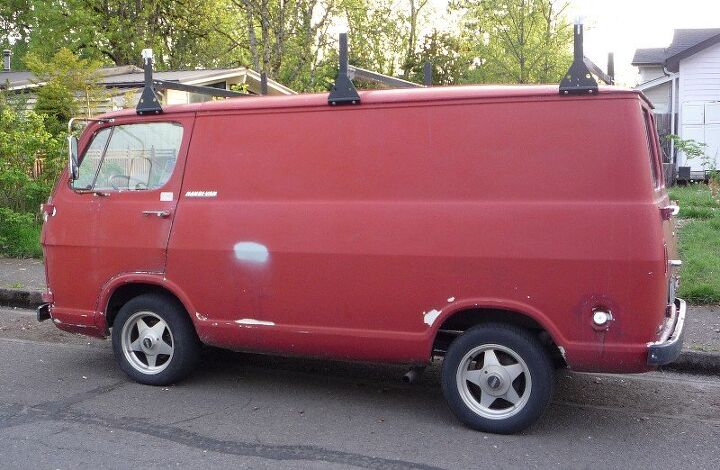
GM once had technically ambitious plans for small vans, but had to notch it down two big steps to compete with the lowest but winning common denominator. The 1955 GMC L’Universelle concept was very forward looking for the times: a FWD van with a low, flat floor. Lacking any kind of transaxle, GM cobbled up a complicated V-drive arrangement. High production costs killed before it saw the light of day.
In 1961, the CorVan, or Corvair 95 (Greenbrier in passenger format) appeared, using the Corvair’s platform and mechanicals. The rear engine allowed a very low floor, but only in the middle section. Handling, steering, traction and braking were all well above the norm. Meanwhile, Ford defined the modern cargo and passenger van with its 1961 Econoline. With the engine in a dog-house between the front seats, it wasn’t exactly an original configuration, having been used by the Jeep FC pickup, and the rather L’Universelle-styling inspired FC van concept. I’m sure that wasn’t the first either.
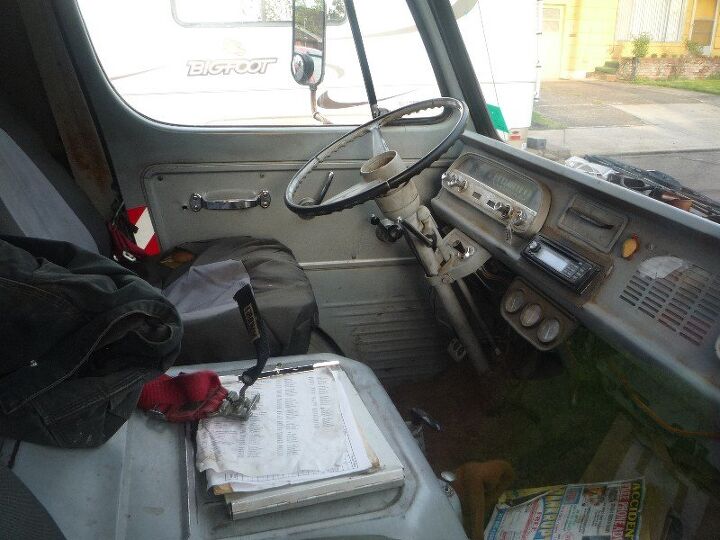
The Econoline, like its Falcon donor, was a more pragmatic and cheaper to build solution than the CorVan. But with all that weight in front, and none in the back, traction, steering handling and braking were all atrocious. But it sold. GM realized the limitations and expense of the Corvair, both car and van, and a crash program resulted in the utterly uninspired pragmatic Chevy II, and its van offshoot, the ChevyVan (Sportvan; passenger version). And of course, GMC got its version with that eminently memorable name, Handi-Van. They appeared in 1964, and by 1965, the Corvair vans were history. I will find one.
The original Econoline/Handi-Van format is a concept that just won’t go away either. Asian brand vans with this configuration abound around the globe, especially in developing nations. At least they’ve moved on to independent front suspension. The vans from the Big Three were the last mass produced American non-4WD vehicles with solid beam front axles. They were as simple and crude as it gets, but they got the job done, no matter what. Well, unless you had to brake quickly. A tired Dodge A100 with a bed in the back was my car, home, love pad, work vehicle and desert explorer all wrapped in one. And I could change the perpetually fouling plugs even when it was raining outside. A mighty Handi Van indeed.

More by Paul Niedermeyer





Comments
Join the conversation
Is this beautiful example of American engineering still for sale, or did some lucky stiff already grab it up?
I have a 1966 GMC Handivan, ---not running, rusted out rocker panels. I have owned it for about ten years. It hasn't run in about six years. I know the feeling of terror when someone else (my son, an aggressive driver) is at the wheel, and, as a passenger, looking out the vast expanse of windshield and knowing there is nothing but glass between me and some telephone pole. But, knowing its' tendency to tip a little on corners, if prudently driven, it is a great ride. To me it is a (--an extremely simple, functional) Cadillac. I am in the process of having it completely restored in every respect, body, springs, crate engine, (Holly carburetor as the rebuilt originals are no good). I can't wait.