


Book Review: Zoom: The Race to Fuel the Car of the Future
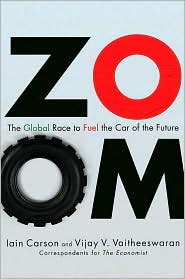
When new acquaintances find out that I cover the automotive industry, the response is often a flood of pent-up questions on the topic. Though much of the interest converges on the future of the American automakers, the future of cars, fuel and mobility in general attract a lot of curiosity. Facile blogger that I am, I usually cop out by saying that telecommuting is the true future of mobility. In reality, the interplay of energy, economics, politics, technology and the environment that defines the cars and fuels of the future is a topic of near infinite complexity. Luckily, two correspondents for the Economist have tackled the issues in a new book entitled Zoom: The Global Race To Fuel The Car Of The Future.
One major advantage that Zoom enjoys over other titles in its genre: its authors tackle the subject with the methodical pragmatism of their day-job employers, the Economist. Iain Carson and Vijay Vaitheeswaran’s global perspective and big-time access pervade the prose. And though they work from a solidly market- and enterprise-oriented framework, they give both environmental alarmists and government interventionists a chance to present their ideas.
The first chapter’s entitled “The Terrible Twins.” But don’t worry: the oil- and auto-industry bashing is not an exercise in political point-scoring. In fact, the authors treat this history of the industries’ unique challenges and tortured symbiosis with sensitivity. From FDR and OPEC to NOCs and CAFE, Zoom hurtles towards the present (copyright 2007), and the looming question that lends Zoom‘s second section its name: “Can The Dinosaurs Dance?”
In “The Parable Of The Prius,” the authors compare Toyota’s debut of its new Camry at the 2006 Detroit Auto Show to Tommy LaSorda driving a Grand Cherokee through a plate-glass window. And the point isn’t just that Toyota is a fossil fuel-addicted “dinosaur” that is dancing to a tune that will only get louder over time. Toyota’s ability to dance at all is the product of aggressive and foresighted business practices. Meanwhile, Chrysler is, well, Chrysler. Though climate concerns are discussed, the focus is clearly on the economic impacts of oil addiction: price shocks, the oil curse and inefficiency. These factors, argue the authors, are creating new business paradigms for big oil and auto which are far more meaningful and effective than global warming hysteria.
Whether discussing the geopolitical entanglements of ever-draining oil reserves or the myriad pretenders to petroleum’s crown, Zoom manages an admirable balance between factual accuracy and narrative flow. From any fixed ideological standpoint, there are elements to both love and hate. In between, a wealth of information will tempt you to embrace the complexity and ambiguity inherent in the book’s subject matter.
Unfortunately, such committed even-handedness can cause some editorial frustration. Nearly every compelling argument and prediction in Zoom is quickly followed by a flurry of equally convincing equivocations. Accordingly, the lessons you do take away from Zoom tend to be of the simplicity-amidst-chaos nature. Understanding and embracing the reality that no single energy source will replace petroleum is one such deceptively straightforward “lesson.”
The importance of a moderate approach is another of the authors’ valuable insights—that’s both obvious and widely ignored in discourse on the topic. In the words of Amory Lovins, whose Defense Department-funded efficiency studies define much of Zoom‘s approach, “optimism and pessimism are two sides of the same coin—both dangerous!” Carson and Vaitheeswaran’s limited editorializing clearly pursues Lovins’ goal of “efficiency, not a hair shirt.”
Contrary to their own advice though, optimism gets Zoom‘s authors run into trouble. Though they quickly denounce US corn ethanol subsidies, both ethanol and vigorous government energy policy receive qualified praise. They never explain how we can enjoy the latter two without ending up with the former.
Similarly, many pages of speculation are devoted to the promise of hydrogen fuel cells. And though the caveat that fuel cells have been “the future” for a good 30 years is dutifully mentioned, descriptions of micropower- and hydrogen-based futures tend to be glimpsed through a futurist’s rose-colored glasses.
In fact, hydrogen hype infects the book’s introduction. “The Great Awakening” is bad enough to make the reader contemplate giving up on Zoom after the first five pages. Stanford Ovshinsky of Energy Conversion Devices (“no hydrogen hypester,” insist the authors) is quickly given free reign to declare a dawning “Hydrogen Age.” How did I miss it?
Then again, I don’t license technology to the likes of Sony, Samsung and BYD. Ovshinsky does. As a blogger, though, I do know that enough has changed since Zoom’s 2007 copyright date to take some shine off of its predictions. Political, economic and technological changes are coming so fast, no book could possibly keep up. Instead of reading Zoom for some repeatable, comprehensive take on “the future of mobility,” skip the introduction and read it as an admirably even-handed history of hydrocarbons and their discontents.

More by Edward Niedermeyer







Comments
Join the conversation
Scartooth, assuming all you say is true (and that takes quite the salt shaker), wouldn't the future belong to FORD? They already have a good hybrid, more feasible business plan and better management... Americans ARE innovators, GM is not.
@Scartooth, If only I'd known you were going to fire up the old flame, I'd have brought some marshmallows.