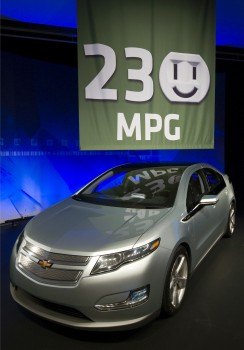


GM announced today that it expects the Volt to receive the first-ever triple-digit EPA rating (including 230 city MPG). GM’s John Lauckner goes into a little more detail at a Fastlane livechat:
Guest: Can you please explain the 230 mpg rating. I must say I balked at your gamble on EREV instead of full hybrid like toyota, but this validates your gamble.
Jon Lauckner: Yes, having a vehicle that achieves triple digit fuel economy is a game changer. The 230 mpg refers to the city fuel economy, but we also expect to have a triple digit combined fuel economy value. These preliminary numbers are based on Volt development testing with our pre-production vehicles and the draft federal fuel economy methodology developed by EPA for EREV vehicles like the Volt.
But, as usual, everything is not what it seems . . .
In fact, even Lauckner seems to admit that the whole 230 MPG hype campaign is a smokescreen. A comment further into the livechat seems to reveal that actual EPA testing may invalidate GM’s day-one Volt slogan of 40 miles without a drop of gasoline. Surprised?
Statik: The EPA rated the Volt at 25 kilowatt hours/100 miles electrical efficiency in city cycle. Does that not now mean with the Volt (which uses approximately 8 kWh of power) the AER in the city is officially 32 miles?
Jon Lauckner: We are still confident that we will deliver 40 miles of autonomous electric range (AER) on both the official EPA city and highway tests, so no change there. The EPA draft methodology reduces the laboratory result take into account a number of factors such as the use of air-conditioning, more passengers in the vehicle, cargo, etc. So, that’s the difference between the “up to 40 miles” that we stated for some time (based on EPA city and highway) and the methodology used by EPA. And, nothing is final until we run an official test which won’t happen for several months.
And with that, Lauckner sweeps aside the curtain of illusion. Testing is not official, nor does it take passengers or air conditioning into account. And when official testing takes place the Volt’s “up to 40 miles” raison d’être could fall.

59 Comments on “Volt Birth Watch 155: The 230 MPG (Alleged) Game Changer...”
Back to TopLeave a Reply
You must be logged in to post a comment.
You can also login using Facebook Connect.


If you can’t put a gallon of gas in it and go 230 miles, then 230mpg is a lie.
Write your representatives.
It’s BS (no offense to Bertel), and GM has so overshot the mark in lobbying for a test method that would yield such a number that even the most clueless person will know it’s BS. If they’d finagled a number in the 80 to 100 range then perhaps the average person might have been misled into thinking it was real.
Mike Duoba from Argonne National Lab devised a method to determine the MPG of an EREV; first the car is driven from a full battery until it reaches charge-sustaining mode, then one more cycle is driven. If we use the highway schedule, the first 40 miles are electric. One more cycle is 11 more miles. If the Volt gets 50 MPG in charge sustaining mode, it will use .22 gallons of gas for that 11 miles. Thus 51 miles/.22 gallons = 231.8 MPG.
Did GM do that by plugging in the car and then carrying around a jerry can of petrol? Lies, damned lies, and statistics…
KixStart got it absolutely right.
Even more than that, it ignores the fact that the Volt is not a closed system, like a Prius (where ALL energy is derived directly or indirectly from gasoline). The cost and time of charging isn’t reflected at all.
On the other hand, it’s about as honest as the typical GM dealer newspaper ad.
And yes anyone driving over 52 miles at a time will not be happy with the rating, if you drive less than that…
(I drive 22-32 miles a day, except for the occasional trip, if the techology works (IF), then I am beginning to see a market, GM would just have to honestly (another IF) market it to right group)
Edited –
All I ever see is old people driving Prius’s (Priuses?) if any group would be willing to give GM another try they are it. Why they as a group love not spending money on gas and being environmental I do not know. Does anyone else see that trend (old people = Prius) in thier area.
I would hope that Joe Sixpack knows that EPA ratings have historically been too high and don’t match the real world.
In a perfect world, the rating would make sense and people could use it to compare costs. But even Toyota didn’t have a problem with promoting the previously generous EPA rating of 50 MPG on the Prius when the real world was closer to 40, so I don’t have much faith GM will do any different.
This ‘test on mileage’ does not reflect the real world. Consumers expecting this kind of mileage will be ‘duped’ and misled..leading to many unhappy customers. The mileage ratings need to be real world and not some cooked-books scheme to make headlines. Once customer start to buy, the headlines will be very negative and point out again that GM cannot be trusted.
For a company whose recent past has been filled with “jump the shark” moments, this b.s. has got to be the “jump the sharkiest”. Anyone foolish enough to believe this hype who subsequently buys a Volt deserves what they get.
If the car delivers a gas-free runabout for the average person on the average day, I don’t think you will see a lot of outrage or disappointment.
…that Statik guy is never happy
It’s a given that it won’t get anywhere near 230 MPG on the highway. I think GM’s quoting a number of “over 100 MPG” on the combined city/highway cycle. Either way, perhaps this’ll give GM some wiggle room to keep building Corvettes and Camaros.
Meanwhile, here’s a comment from a Huffington Post reader on the Volt’s numbers…
“Well, well, well. After decades of nothing but testosterone enhanced SUVs, here is the wonder car! Now that the industry has sucked the taxpayer dry here is efficiency. My bet…they sat on this technology long enough to fleece us and then miraculously return to power. Meanwhile, back in DC, our reps keep getting richer.”
::facepalm::
GM has become too much of a political football at this point.
@toxicroach,
I think there will when people look at their electricity bill and realize that their “savings” are about as imaginary as their EPA MPG.
At a price point – less than $40K for me – there is a place for an electric car that can get 40 miles on a charge. I need 25 to 30 miles per day; so do many others. Why sell this car’s capabilities with what appears to be gross exaggeration? All it does is make those who might consider it consider what else GM is lying about, instead. This is a narrow focus car; people from the western states need not apply – they commute too far.
In slightly related news, the Camaro convertible is officially on for a Summer 2010 release.
Perhaps the Volt’s CAFE wiggle room is coming to fruition…
If you can’t put a gallon of gas in it and go 230 miles, then 230mpg is a lie.
Write your representatives.
Exactly. MPG is a rate, not “gee, if you only drive this far this is what it used.” Government Motors is in bed with the EPA for sure.
John
Well, the thing obviously gets good gas mileage, but saying it gets 230 seems a bit ridiculous.
Whats funny is a Honda Ruckus gets 85-100 mpg without any fancy electric motors. Oh, and it retails new for $2500. Although the whole carrying more than one person thing could be an issue.
Not sure why everyone is so pissed off. This rating system will be used by all makers of EREVs, not just GM. Its undoubtedly true that there are many real world driving situations where an owner would not achieve a 230mpg rating.
However, there are also many real world driving situations where an owner would exceed that. How many people drive more than 40 miles daily? I suspect most people dont and would probably acheive an mpg even higher than 230. Funny how nobody brings that little factoid up. (on TTAC anyway)
Everyone is on TTAC is so geeked up for GM and the Volt to fail. Just maybe this could be the beginning of a really good thing for the US and GM if the technology succeeds.
I’m not all rose colored glasses, I realize there are a lot of “ifs” with the Volt, and the volume or profitability simply wont be there initially, but seriously, why is any of this upsetting to anyone? Unless of course you simply dont want to see it succeed.
Michael Karesh, you’re absolutely right. GM shouldn’t even want to market such an outrageous number. That can’t not backfire.
On a separate note, how do you calculate how much the electricity costs to charge it for the initial 40 miles? Can anyone roughly describe the calculation or point a link to the math?
I think the proposed method of mileage calculation for EREV’s is correct but doesn’t go far enough.
My reasoning is that if a standard ICE powered car were to be tested for a full tank of gas rather than a mileage limit, it should theoretically produce the same mileage ratings. For the EREV, test it with a full charge and burn up a full tank, then calculate the mileage. If the Volt has a 16 gallon tank (I don’t know the correct number,) and we use the 50MPG guess, than in my mind the mileage should be ((50*16)+ 40)/16.
Doesn’t 52.5 MPG sound more likely?
The unfortunate problem even with this methodology is that the more times you fill up the tank on a long trip without charging the batteries, the closer to the mythical 50 MPG you get.
Amen to Kixstart. I don’t get this. This has to be a “what were they thinking?” moment for both GM and the government stoolies who buy into this.
The whole point of these EPA ratings is credibility. If people’s actual experience is wildly inconsistent with the ratings, they’ll think the whole enterprise is b.s. Unless we’re going to identify and qualify the Volt (and any other plug-in hybrid) as a limited-purpose commuter car, then it shouldn’t be rated like this, or by any other method that uses stored energy in the battery that comes from an outside source.
The problem is, once you start using the stored energy that comes from the power company in the calculation, the ratings become meaningless.
For example, I have a 10-mile commute in the city, each way. With the Volt in that duty, my MPG would be infinitely high. But let’s say I have a 25 mile commute each way. I’m probably going to use some gasoline, because that exceeds the operating range of the battery. But my MPG will still be very high.
If I commute 40 miles each way, even with the exact same driving conditions, my gasoline use is going to be higher (because more of my trip will be fueled by gasoline) that it would have been in the shorter trip, so my MPG will be accordingly worse.
My point is, that calculating the MPG this way is entirely dependent on what portion of the trip is powered by gasoline, so the measurement is highly idiosyncratic and not useful to anyone else in terms of what they might expect.
It seems to me that the fair way to rate these kinds of cars is to do the usual city/highway test starting off with the battery depleted to the point where the operating software tells the engine to start, and then to tell people what the battery-only operating range is in a simulated city test.
That, at least, would give people an idea of what to expect, depending upon how they use the car and it also would give them a uniform yardstick to use in comparing two different cars.
For example, if the Volt really does have a battery-only operating range of 40 miles in city conditions and, let’s say its depleted-battery city/highway mileage is the same as the Prius, then the car’s price premium over the Prius might make sense for someone who routinely drives the car less than 40 miles a day between recharging at home overnight, since the cost of electricity will be cheaper than the cost of the gasoline required to run the Prius in similar duty. And, on those occasions when the Volt owner goes for longer drives, he won’t be using any more fuel than he would with the Prius.
But advertising “200 MPG” seems to me to be just b.s. which will blowback against both the company and the government, when people’s real-world experience varies so much.
Actual mileage may vary.
This isn’t about truth, this is about CAFE.
If this allows GM to keep making Corvettes, CTSes, CTS-Vs, Camaros and maybe even G8s rebadges as Impalas then great, who cares if the they have to twist the numbers on the Volt to do it.
This will also be good for plug-in series hybrid development. If a company is only going to get a 80-100 mpg CAFE offset for a plug-in series hybrid then it won’t be worth its time, but if it can get a 230 mpg CAFE offset then every major auto company is going to be working to develop this technology.
I do worry about consumer protection, but for a $40,000 car caveat emptor. 80-100 mpg will be good enough for the show-off early adopters.
Anybody who is committed to spend $40K for this sort of indulgence can understand the concept of different driving scenarios. GM should present a few different ones – less than 40 miles, 100 miles and a day’s driving – 400-500 miles. And toss in the effect of running the AC full blast or half power on those three figures.
I’ve seen various versions of the “230 MPG” logo device and each time I see it I find myself reading;
TWENTY-THREE PLUG mpg.
In today’s auto world, $40k is not going to put people off from this car. What will piss people off is when you go out and claim to get 230 mpg and then Joe Blow buys one and drives across the country thinking he can do it on a few tanks of gas and ends up with 35 or 40 mpg because he didn’t understand how this car was intended to be used. Yes, it may get a “theoretical” 230 mpg in their unique test, but if people don’t understand that this car is mainly an errand runner, they will be very dissapointed when they try to take long trips. And GM is NOT helping at all when they start up the hype machine and go full speed ahead with this 230 mpg thing without a good explaination. And we all know we will be hearing this 230 thing until the damn car comes out in “2010!!!”. It’s the same thing as the Camaro over hype. By the time you can buy the car it’s already stale. The Camaro may be less than a year old, but it’s been out there for going on 5 years now so it’s already due for a refresh.
Badger,
Yes. The press-release states that the Volt uses 25kwh per 100-miles. My electric bill says it costs $0.13 per kwh at my house, so it would cost me $3.25. (This is assuming I do it over the course of several charge/recharge cycles. Which I would, since it’s 5 miles round trip from my house to my office, and 20 miles round trip to the big box stores.)
Now, suppose I’m driving my Prius at 50mpg. That’s 2 gal per 100 miles. At $2.75/gal, that means I pay $5.50 to drive my Prius that same distance. At $4/gal, the price would be $8.
The problem with the Volt is that it makes analyzing what you’ll get out of it more complicated than the multiplication/division of the regular MPG calculations. You actually have to analyze your driving pattern. Also, at $40k, it’s not going to save anyone money, until the price comes down a bit — but it might be worth it for those of us who need a car but want to get off of the oil roller-coaster ASAP. (Money isn’t everything.)
gamper : Not sure why everyone is so pissed off. This rating system will be used by all makers of EREVs, not just GM.
As a consumer you should be pissed off because it gives automakers the right to straight up lie to consumers. If the range in city and highway and the EREV mpg in city and highway aren’t given, which it doesn’t sound like it will be, the consumer cannot do the math to determine if the EREV makes any sense in their personal situation. I have a 5 mile commute to work. I do a lot of long distance travel on the weekends. Based on approximations (45mpg highway gen mode, 35 mi EV range), it would take 11 years with $5.00/gallon gas for the Volt to break even with a Prius with my personal driving needs. Flat rate numbers do not allow me to get that sort of information.
Remember the angry owners when their Prius didn’t see the 60mpg city rating from the old rating system? You haven’t seen anything yet.
Yet another data point clearly displaying the kind of contempt GM has for it’s intended customers.
They must really believe their customers are dumb as rocks to believe this.
All compliments of the Ch. 11 that was anything but, and holding on to “Leaders” that do anything but.
A miles per fuel/energy input would not put this issue to rest, but if a few different metrics were used it would at least help people understand.
For example:
a. Miles per kwh
b. Miles per btuh (a version of this could be miler per btuh input at the electric power plant)
c. Miles per equivalent gallon (then publish how many kwhrs are equivalent to a gallon, it could even be broken down.
What GM is doing is insulting our intelligence for those of us that understand their data manipulation.
My own calcs put it around 50 miles per gallon of equivalent gasoline.
After thinking about this for awhile the comment above about the EPA is correct, but not necessarily for lying. The MPG rating accomplishes two things, one it gives automakers a way to make the 2015+ levels without completely butchering there current cars and using 2 cyl. engines while not having to sell huge amounts of complex/expensive vehicles, so basically a loophole that accomplishes something very important, it will make all major automakers manufacture some sort of equivalent, this is the most important aspect, it will begin to drive down the cost and perfect the technology (weed out good and bad) and allow for mass adoption around 2025 (hopefully on the government part). The government made GM manufacture this car(as part of life saving DIP financing) so that it could assign the MPG rating that will make other manufacture similar cars driving the technology costs down long term to allow mass-adoption and reducing consumption of oil. Taken from that perspective its quite brilliant actually.
Within the metric system, our measurement for fuel economy is L/100km (number of litres of gas consumed/100 km driven). Perhaps this would be a more effective way of measuring this car’s fuel rating. Of course it will be a cold day in hell before Americans adopt the metric system, so for the sake of posterity I believe that would work out to around US gallons/235 miles.
How many gallons of gas would the Volt have consumed by the 235 miles mark?
@rnc,
I’d say the third thing it accomplishes is making people who don’t understand math or science feel good that 230 mpg is here. Those same people will always reference the GM Volt when saying it is possible to get this mpg all in a midsize car.
However the cold truth is we’re still at 50 mpg. And if we really wanted 230 mpg we’d would be driving something like VW’s “One Litre” or the Aptera.
If the Volt gets 50 MPG in charge sustaining mode, it will use .22 gallons of gas for that 11 miles. Thus 51 miles/.22 gallons = 231.8 MPG.
I just can’t shake the thought that if GM can make a car that gets 50 mpg and actually has usable performance while doing it, why bother with the rest of it?
This leads me to suspect that either the milage (while actually using gasoline) isn’t going to be there, or that the Volt’s performance is going to make a 36 HP VW look like a road-king.
If “the Volt uses 25kwh per 100-miles”, does this mean that it takes 25kwh to charge the battery enough to go 100 miles, or is it 25kwh coming out of the battery to go 100?
I am sure that the battery will not be 100% efficient.
I have to echo those who wonder what GM was thinking with this. No matter how efficient the car winds up being, how can you live up to 230 MPG?
People are going to expect that they can fill their tank with 12 gallons of gas or whatever, and not have to go back for more until their odo hits 2750 freakin’ miles. That’s like a fill up before each oil change. Do you really want to set up the expectation with your customer, that if they have to visit a gas station more than once every 3 months they’d been ripped off?
Didn’t the Prius cause a huge commotion among irate buyers when real world performance was 50 MPG instead of 60?
Unbelievable.
My 5000 lb BMW gets 1000 miles per gallon. I drove it off a cliff and it travelled 800 feet on fumes.
chuckR:
“…there is a place for an electric car that can get 40 miles on a charge…”
I’m sure there is, but that 40 miles is heavily dependent on a number of factors (note that it’s “up to 40 miles”) and is no more guaranteed than the overall “230 MPG” claim.
# Badger :
August 11th, 2009 at 11:10 am
On a separate note, how do you calculate how much the electricity costs to charge it for the initial 40 miles? Can anyone roughly describe the calculation or point a link to the math?
——————————————-
Here is my proposal:
Use a cash equivalent.
Say if a full charge up uses $x of electricity and that amount of money can buy y gallons of gas. Then the real mpg would be:
m/(y+z)
where
m = total miles traveled when both a full charge and a full tank are depleted
z = size of a full tank
Cool! I can’t wait to pour one gallon of gasoline into my Volt and then enjoy a nice 230 mile drive around (and around and around) town all afternoon. If the government says it, it must be true.
After some thought…
The Law of Unintended Consequences is probably going to strike GM pretty hard over this one.
Toyota was probably expecting some rational number from the EPA (40 miles electric plus NN mpg afterwards). The Prius competes with that OK and the consumer can see what he’s getting for his extra $18K. All square. GM proceeds with the Volt, for all the good that it will do them and Toyota marches on with the Prius.
Now, Toyota is looking at what is probably considered something of a PR disaster. And they’re going to be more than a little angry because this isn’t a fair use of the 230mpg number (as in, good luck actually going 230 miles with your gallon of gas).
Toyota’s response isn’t going to be to roll over and play dead, they are going to find a way to counter this. A 2011 Toyota Prius IV that gets 250mpg and costs somewhat less than a Volt will not surprise me at all.
i can’t help but to compare this to the ipod debut fiasco where apple guaranteed (x) amount of hours but customers were only seeing (x-y) amount of hours, thus creating an uproar.
good luck with this one GM. and i too saw 23 plug mpg when i initially saw that advertisement.
i thought it was incredibly mediocre, then realized it was 230 mpg, and realized that there might be a case of foot-in-mouth disease rampant at GM.
Why not just calculate the total cost of energy over multiple (say 10) drive cycles. The 1st few will use battery and the remaining will use more traditional hybrid propulsion.
Then….
It should be fairly easy to work out equivalent gasoline consumption to charge the battery.
i.e. X hrs * Y kW/h * Z Charging efficiency. Assume and electrical generation efficiency and relate that in to gallons of gasoline based on energy density.
Now add the 2 mpg equivalent figures (1 from drive cycle and 1 from charging)and divide by the number of drive cycles
HaHa! You’re all assuming that the Volt will actually see the light of day!
There’s some irony for you! Everybody’s complaining about GM jumping the gun with this car, and now you’re all jumping the gun on the EPA ratings for a car that doesn’t even quite exist.
Based on the 25 kwh number the Volt can’t get any better than 134 mpg.
http://killwithfire.blogspot.com/2009/08/chevy-volt-to-possibly-get-230-mpg.html
Do the payback calculation for a Volt that uses no fuel at all.
There is no reasonable payback period for an economy car that costs $40k, when compared to a similar-sized vehicle.
I see GM has fixed it marketing department; now they look like braggarts instead of just foolish and inept.
People will balk at the duel-fuel requirement, and the ICE performance will be unsatisfying. No gas means you get a range of 40 miles; no charging means you get 30 mpg – how many people will enjoy managing two fuels?
Just imagine how much more credibility GM would have if they actually used the Volt as an opportunity to communicate accurately about EV vs Hybrid VS ICE engine tradeoffs, instead of this kind of BS stunts. Not that they couldn’t mention this, but they should be very upfront about how it reflects outdated EPA measurement methodology, not some magical property of their car.
If this thing, while being at least as big as a Prius and carrying around much more battery and a bigger electrical motor, still manages to get Prius like 50mpg starting with a depleted battery, that’s something GM should rightfully be proud off and emphasize. Same goes for the plug in ability and all electric range. That’s world class by anyone’s measuring stick. Heck, they could even play the responsible corporate citizen card, by pointing out how they’re the car company breaking out of the chicken-egg problem of no charging stations / no cars to charge on them, paving the way for other makes to follow suit.
But instead, they, true to form, choose to drag out the marketing equivalent of some sleazy, polyester suit wearing BS artist, trying to scam a presumed to be stupid car buying public by gimmickry and nonsense that bears no resemblance to anyone’s observed reality.
Today on CNBC Lutz said that the volt will only cost 32,500 as there is a 7500 govt subsidy. Also the Volt is much nicer than the Prius in terms of modern amenities.
Thanks for the response, Luke. The EPA # then doesn’t at all translate into a fuel cost estimate, which is what most people use it for.
Here’s the math I come up with:
Electricity Cost per 100 miles of electric use:
kwh/100 miles
20 25 30
0.10 2.00 2.50 3.00
$/kwh 0.15 3.00 3.75 4.50
0.20 4.00 5.00 6.00
Gas Cost per 100 miles of gas use:
mpg
25 30 40 50
2.00 8.00 6.67 5.00 4.00
2.50 10.00 8.33 6.25 5.00
$/gal 3.00 12.00 10.00 7.50 6.00
3.50 14.00 11.67 8.75 7.00
4.00 16.00 13.33 10.00 8.00
Depending on what assumptions you want to use for electricity prices, gas prices & fuel efficiency, its pretty easy to calculate the breakeven. Unless this comes with major subsidies – which I wouldn’t rule out – it doesn’t make economic sense.
How much is the green status symbol worth?
edit- screw that, formatting doesn’t work.
A $7500 subsidy may be enough to get some butts into showrooms. Hopefully, GM can get the price under $30K once production ramps up, subsidy or not.
Allright, it’s official: GM is banking on the Volt to give them a CAFE cushion. Why? They plan on refreshing the Camaro five years from now. Of course, plans can and will change, but still, I’m ready to believe again…