By Robert Farago
March 26, 2007 -
Tesla Motors says it's taken 350 deposits for their Lotus Elise-based, lithium ion-propelled, $92k Roadster. Despite this success, Tesla's hyper-exotic may offer more hype than hope. The company won't allow expert evaluation of their product until it's "ready for market." Even before they've delivered a single Roadster, they're promising two additional, mass market electric vehicles– whose enabling technology is, at best, under-developed. Meanwhile, they've raised $60m in venture capital and secured $20m in state subsidies to build a New Mexican factory. To find out if the Tesla Roadster is keeping it real for planet Earth, or DeLorean/Tucker redux, we sent our man Shoemaker to Tesla for a "test drive."
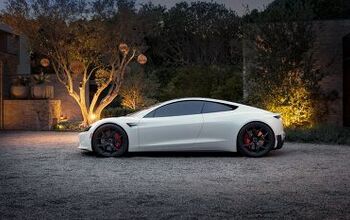
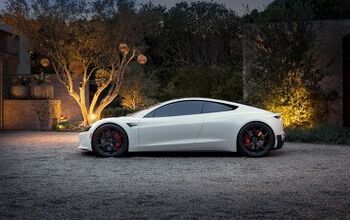
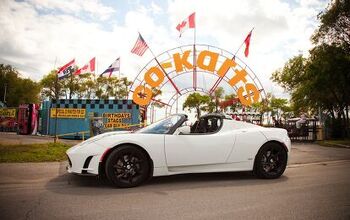
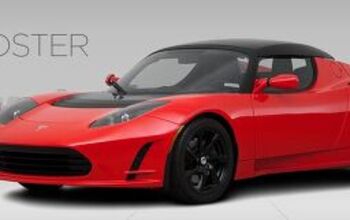
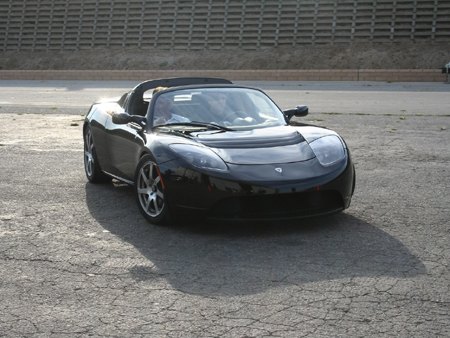
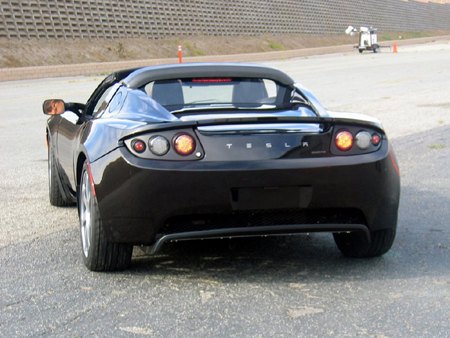
Jay reports that the carbon fiber Tesla is far more attractive than the fiberglass Elise. Lotus’ engineers added two inches to the Elise’s wheelbase to holster Tesla's LiIon batteries and attendant cooling and heating gear. Lotus' boffins also lowered the sports car’s door sills and modified all the bodywork, adding Tesla-specific design cues. The finished Roadster includes 2.5mph bumpers, HID headlights and all LED rear lights.
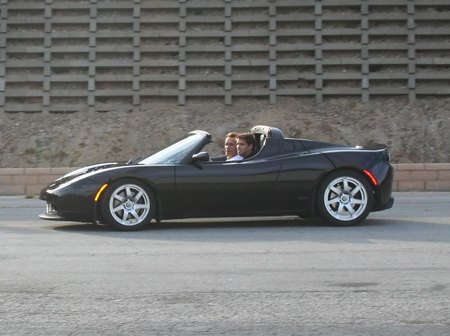
Shoes says the new dimensions and finely rendered jewelry (e.g. the distinctive hood motif and the taillights standing proud from the body) transform the British sports car’s look from insectoid to exotic. There's a bit of Ferrari F355, a bit of Lotus Europa, a lot of style. It’s no wonder the Tesla Roadster has become the plug-in poster boy.
Jay also reports that the Roadster’s interior is so Elise it hurts. Literally.
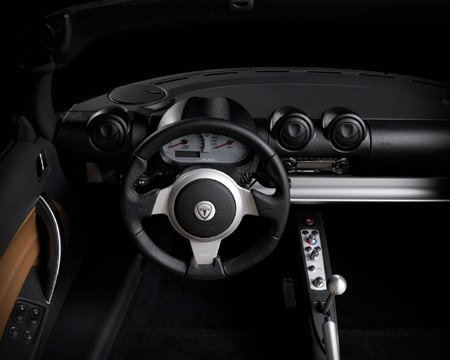
Tesla modded the cabin to appease their upmarket customers. They’ve widened the narrow seats and fitted them with “the finest space-age foam available.” They carpeted the floor, leather-trimmed the door panels and Blaupunked the ICE. The overall effect is like adding a space heater to a drafty classroom. “If it holstered a small block Chevy, the Roadster would be the official car of ‘The 300.’”
Instead, the Roadster houses 6831 lithium ion cells. The battery pack weighs 900 pounds and costs $20k to replace (try not to misplace it Bond). Tesla rates the four pole electric motor at 248 horsepower. It can be charged in six hours (if your home has 30 - 40 Amps of power) or as little as three hours (if you’re rigged with 90 Amps). Although the Roadster’s maximum range is 250 miles, the company says spirited driving will yield “substantially less.”
Before we share Shoemaker’s “driving” impressions, keep in mind that all these numbers reflect Tesla's ambitions, not demonstrable reality. Again, no independent organization has evaluated any aspect of the Roadster's performance or construction. While Tesla Motors is happy admitting their Roadster's range could be “substantially less” than advertised, anyone thinking about buying a Roadster should consider those words carefully. Would you purchase a sports car that can only drive 90 miles between 12 hour recharges?
Tesla admirers/intenders also note: our man was not allowed behind the wheel. Indeed, all Tesla’s media coverage has been carefully supervised and controlled. While "you can't touch this" restrictions are not unknown in an industry that produces million dollar plus prototypes, there are plenty of electric car companies happy to let responsible journos do what responsible journos are supposed to do.
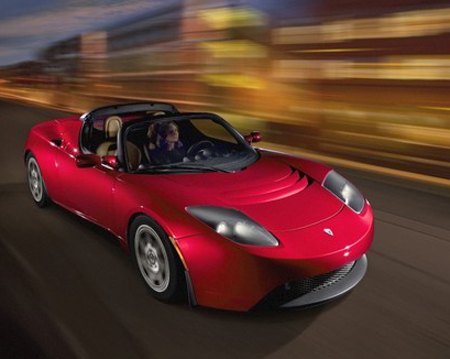
Tesla says the Roadster sprints from zero to 60mph in about four seconds, which would make it faster than the Elise. According to Shoemaker, the Roadster felt every bit as quick as his E63 AMG. The Roadster's all-electric engine doesn’t free wheel, so the car slows when pressure diminishes on the accelerator. Although the Roadster doesn’t generate any engine noise and very little transmission whine, Shoes says there’s virtually no insulation from significant road or wind noise.
In terms of handling, “fast and darty sums it up.” Tesla says that although the Roadster’s batteries add 25 percent to the weight of the elongated Elise; the weight distribution is still 40 - 60 front to rear. Jay says the Tesla Roadster’s low center of gravity and relative light weight maintain the Lotus’ slot car handling. The Roadster uses regenerative braking; as a passenger, Jay couldn’t rate the system’s feel or effectiveness.
The enthusiastic staff at Tesla Motors describes the Roadster’s selling proposition as “performance without guilt.” But if you set aside the media’s PC fawning over an eco-friendly sports car, there are serious questions about the Roadster’s ability to deliver on its manufacturer's promises.
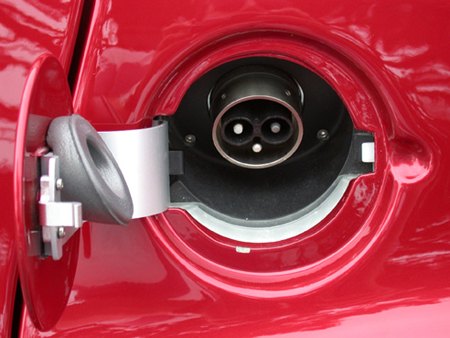
For example, Tesla says its engineers have placed the Roadster’s LiIon batteries away from each other in steel and aluminum containers. Even so, if one of its batteries ignites, it could cause a virtually unstoppable series of fires and/or explosions. Roadster deliveries are now scheduled for fall; federal approval for the vehicle has not yet been granted.
Safety, range, reliability, recharge time, battery life, build quality, manufacturing costs– Tesla has yet to prove that they’ve overcome any of these obstacles for their lightweight Roadster (never mind their planned family car). Until they do, until they allow the press to thoroughly evaluate the car’s real world capabilities, their Roadster should be viewed as nothing more than another well-meaning concept car. Or, if you prefer, a fabulous toy.

Subscribe to New Content Alerts
Back to Top
End of Comments
More Reviews
March 26th, 2007 at 7:15 am
Good point Robert. I’m afraid I had initially gotten caught up in the idea of a high performance, Elise-like, electric car, but the reality, as you have stated, is that the concept is still entirely unproven. Hopefully the Tesla Roadster makes good on the hype, as it would then embody an exciting technological step forward. I guess we’ll all see later this year…maybe.
March 26th, 2007 at 7:42 am
Being a child of the 1980s, all I can do is quote O.M.D.:
Tesla girls, tesla girls
Testing out theories
Electric chairs and dynamos
Dressed to kill they’re killing me
But heaven knows their recipe
March 26th, 2007 at 7:49 am
They’re still not letting anyone else drive the car, not even a potential customer like Jay? Wow.
Since I’ve driven an Elise and it made my rough, noisy Protege5 feel like a Lincoln Navigator, I love the “like setting up a space heater in a drafty classroom” analogy.
So I take it the center console still has a considerable amount of lateral wobble?
March 26th, 2007 at 7:57 am
For what its worth, I have seen their design/manufacturing facility and spoken at length with their chief mechanical engineer and came away very impressed. Unfortunately, I was also denied the ride and drive.
March 26th, 2007 at 8:02 am
I always remember when the UK magazine “Car”, which was pretty damn good, produced a whole article about the the 1988 Lotus Elan, about a year before it was launched.
My, how they gushed.
A friend of mine was very interested, he asked me, were the prototypes /that/ good? No, sadly, the journos had not driven a car. They hadn’t even sat in one for a hot lap. Journalism at its best.
March 26th, 2007 at 8:26 am
Is a matching Nomex suit available?
More seriously, what is the spontaneous rate of catastrophic failure in a lithium-ion cell? I’m guessing its one in 20 million+ based on the little I read in the tech blogs, but perhaps someone in the know can say?
350 Tesla Roadsters = 2.39 million cells.
March 26th, 2007 at 8:28 am
Just their choice of batteries and the over-the-top measures to keep them “safe” speaks of an initally good idea being rushed to market (to satisfy investors?). I’ll wait for the $25K “safer-battery” version (Prius Roadster, anyone?)
March 26th, 2007 at 8:30 am
starlightmica:
As Dell will tell you, improperly designed or poorly manufactured LiIon batteries have a nasty tendency to burst into flames. Experts estimate the chances of a lithium ion battery fire are one in ten million. Tesla says it will build 1325 Roadsters by the end of ’08. Achieving that goal would require 9,051,075 LiIon batteries.
If one of those nine million batteries ignites…
March 26th, 2007 at 8:30 am
Sounds to me like another Tucker or Davis. using unproved technology in utter secrecy. If you have something good you would not keep it under wraps before you launch. Especially in this day in age when “buzz” is so important.
March 26th, 2007 at 8:41 am
Finally, someone reaches in and finds out that the Emperor really isn’t wearing any clothes.
The Tesla is a perfect example of just how gullible and technically uneducated, the popular media really are.
These are the same people who are giving “A convenient lie” enough credibility to vault Al Gore into the Presidential race.
March 26th, 2007 at 8:55 am
Wow, all this biatch-slap of reality and we didn’t even make it to the point that the electricity is dirty and only makes sense if (a) you are in an area that receives 100% nuke/hydro/wind power and/or (b) you’re an ostrich-headed NIMBY “environmentalist”
March 26th, 2007 at 9:05 am
philbaily: A better example of the uneducated popular media is fuel cells.
Tesla is currently unable to prove their claims independently. That hardly qualifies as a lie, or failure. After launch, their ambitions will be proven or disproven pretty quickly. They have every right to be paranoid and cagey for now.
The best way for American automaking to survive is with a high-tech startup, away from Detroit, with fresh leadership and engineering. The other option is that the taxpayers can just bail Detroit out over and over.
March 26th, 2007 at 9:05 am
An expensive toy? Well, sure, isn’t that kind of the point? A small number of people with a large amount of money will buy it because it makes them feel good about themselves. If someone wants to drop $100K on a tempermental, expensive-to-own electric exotic car rather than a tempermental, expensive-to-own conventional exotic car, what’s the harm in it?
March 26th, 2007 at 9:16 am
RF -
I see on the Tesla FAQ that they’ve intentionally set a cell on fire within the battery pack to make sure that it’s contained.
http://www.teslamotors.com/engineering/safety.php?js_enabled=1
March 26th, 2007 at 9:20 am
Brendan:
Point taken. This is precisely the argument Tesla used with me when I confronted them on these issues: judge us when we're ready. Yes but…
The company is already soaking up a LOT of OPM (Other People's Money), including the taxpayers of New Mexico. When Tucker went belly-up, the company lost Shoemaker's boss' father's cash. When DeLorean's dream died, lots of people were hurt.
Caveat emptor? OK. But Tesla's taking investment money that might have helped more established and transparent companies that have a better chance of achieving the goal of a practical electric car for the masses.
Also, they are not shy about making claims. These claims are being reported as fact. These facts may not be realized. If they aren't true, if Tesla sinks under the weight of its own ambitions, it could put potential consumers off the whole electric car concept.
Perhaps it's a question of style, rather than a lack of substance. I hope so, but the question should be raised. For the media to jump on the Tesla bandwagon without questioning the company and product's viability is an abrogation of their journalistic responsibilities.
starlightmica:
Setting a single cell on fire is not the same as running the car into a barrier at speed. Or proper NHTSA side and (especially) rear crash tests. I will believe that the vehicle is safe when the feds pronounce it so.
But does the vagueness of Tesla’s text bother anyone else?
“Tesla Motors’s engineers selected cells from a reputable Fortune 500 battery supplier.”
“We then collaborated with an outside firm known for expertise in lithium ion battery safety to perform hundreds of tests to validate the safety of our design.”
Proprietary information? Perhaps. But that’s not the way these things are usually done by the serious players.
March 26th, 2007 at 9:38 am
Following the link from starlightmica, there’s this:
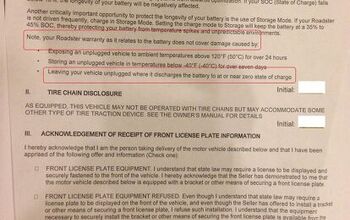
That’s nice - no rotating tires for you, little sportscar!
March 26th, 2007 at 10:01 am
FreeMan–
There’s no tire rotation on a lot of cars. Unidirectional tread with different width tires front/rear means no rotation. Corvettes, vipers, etc…
March 26th, 2007 at 10:05 am
IMO, the 1st true electric car will be from Honda, the greenest of all automakers and the one that always delivers on its promise. If Honda cannot (yet), no one else can do it safely or reliably or economically.
March 26th, 2007 at 10:06 am
RF -
For better or for worse, it’s the penalty of being the leader. The Tesla won’t have any problems passing the federal crash tests thanks to lots of computer simulations, but all it takes is one bad unforseen hit from a tractor trailer to splatter the bad news everywhere, because it will be the first.
Contrast that with the previous Mustang: a picture of a 50mph rear-ended SN95 Mustang convertible graced the front page of blueovalnews.com a while back. The ‘Stang had but empty air where the trunk and fuel tank were previously located, with a gallon of fuel leaked and the doors jammed shut. Yes, people have been burned alive, and Google turns articles about this, but I doubt this is well known.
March 26th, 2007 at 10:11 am
starlightmica:
Don’t be so sure about those NHTSA crash tests. The feds are rigorous and diligent in their work, and they use real cars, not simulations (if that’s what you meant).
March 26th, 2007 at 10:15 am
Yes, but NHTSA also gives freebies to manufacturers that somehow show that US jobs are at stake if they are forced to throw their car against the wall.
Example? Elise.
March 26th, 2007 at 10:16 am
We rightfully bash GM for a lot of things they do, but you do have to give them credit for putting effort/time/money into things outside the mainstream once in a while. The EV1 for example (though driven by California’s mandate.)
My point is, that GM is saying that the current state of battery technology does not allow the Volt to become reality. In fact, it seems the Volt was simply a publicity stunt that got out of hand.
So, if GM (and Toyota) do not feel that electric cars are ready for the road en masse, how is it that a startup with very limited resources (relatively) can do it? Yes - unlimited creativity, forward thinking, hard work, dedication - all things that are typically stifled in a large corporation.
But still, if it was ready to go I gotta believe Toyota or Honda or GM would be doing it, if only for the “green” halo effect.
March 26th, 2007 at 10:18 am
Might as well make the wheels out of magnesium for further weight savings. Would also add to the light show if the battery pack does flare up.
March 26th, 2007 at 10:29 am
Sid:
“if it was ready to go I gotta believe Toyota or Honda or GM would be doing it”
The only reason I question that is that those are mass-market companies locked into their own assumptions about what consumers will and won’t buy. From what I read here and on other sites, it sounds like an all-electric vehicle with a 100 mile range from an overnight charge for around $20K is probably feasible. GM, Toyota et. al. rightly conclude that doesn’t sound like a value proposition that’s going to talk many Americans out of an Impala or Camry for their next ride. And they can’t operate producing cars that only a few thousand people will buy. Weren’t annual sales of the Insight something like 3,000 units?
I have no idea if Tesla’s cars are for real, but one thing they did right was to start with a very small, very profitable niche market. If the things work at all, they’ll sell a few hundred to wealthy indviduals who want to make a point, do something to feel good about themselves, or just have a cool new toy their friends don’t have. It sounds like their plan is to use the money from the roadster to continue developing the “real world” car. Or maybe just sell it to a company that can actually manufacture, market and distribute in scale. Either way, what comes next will be interesting.
March 26th, 2007 at 10:29 am
It wasn’t very long ago that the world was going to be saved by a magical device from Dean Kamen. John Doerr of venture capital fame and Jeff Bezos of Amazon did their role in hyping “IT” before anyone knew what “IT” was. In 2001 “IT” finally appeared in the form of the constantly hyped Segway electric scooter. Laws were changed around the world to enable a new more efficient future. Countless news stories were printed and aired. But in the end, almost nobody buys the silly things and the first generation was recalled 100% at least once. I bet that many Tesla intenders already of a Segway, and never use it.
It is bad enough that we have self-igniting cell phones and laptops on the market now. Lithium ion batteries in cars strikes me as a horrible idea.
By the way, how long do you think it will be until a hydrogen fueled car does a Hindenberg?
BTW, another interesting automotive start-up is Carbon Motors in Georgia. They intend to make a purpose built police car.
http://www.carbonmotors.com/
March 26th, 2007 at 10:31 am
Good points, hadn’t really thought of them in regards to the Tesla although a 90k toy isn’t in my future anyway. The question I have is doesn’t making an electric sports car with no conventional motor, no exhaust and I guess no need to shift defeat the entire purpose of a sports car to begin with?
March 26th, 2007 at 10:35 am
This sounds for all the world like the late, and unlamented Shelby Series 1. Fortunately the Tesla was not beat with the same ugly stick.
March 26th, 2007 at 10:47 am
Note:
1) The company that provides the batteries for Tesla is also “under serious consideration” to provide batteries for a new plug-in vehicle by GM.
2) Collaborating with Lotus has its pros (weight, dynamics) and cons (build quality). For a pioneering supertoy for wealthy techno geeks (give me some money and count me in), the level of forgiveness for the latter should be pretty high.
March 26th, 2007 at 10:48 am
Farago - This at best is a muckraking piece which does a fine job at slinging FUD (fear, uncertainty and doubt). The whole point was to criticize Tesla before it’s even in the marketplace, right? I thought this was ‘The “Truth” about Cars’ not The Negative Conjecture about Cars.
Your first gripe is that you can’t drive it whenever you request to. I didn’t know that journalist had a god given right to drive whatever un-launched car they wanted to. How well does it work when you demand that Toyota give you a preproduction car to review? Does BMW or GM do that for you? I doubt it. Obviously Tesla has some bugs to work out, but they don’t want a blog to pass judgment on a work that is still in progress.
Next you hammer them on the possibility that the battery could ignite. Do you have any inside knowledge of the safety systems that Tesla has implemented or are you assuming that the highly educated engineers are just throwing batteries into a box and hoping for the best? News flash: Did you know that gasoline is highly explosive? Holy crap! They use this explosive the current cars. Let’s condemn all cars.
March 26th, 2007 at 10:53 am
Hey gents,
I’ve got alot of thoughts on this that I’ll try to compress into a short period of space:
1. Tesla’s in a tough spot. They are trying to build a limited production vehicle using advanced technology and have limited funds and resources to do it. Therefore, they need tons of good publicity (to keep the money flowing) but can’t reveal much of their technology for fear of competition. If Toyota/Honda truely got involved or saw a profit from this venture, they have alot more money and manpower and would hurt Tesla’s upstart effort.
2. I believe I just read that Tesla sent 2 cars to be crash tested. This indicates readiness. I didn’t search for the source, so my apologies if I’m wrong on this information
3. This, to my knowledge, is the first all-electric sports car. And it’s seriously capable, if it’s doing 0-60 in 4.0. I wouldn’t want it put in the hands of journalists yet either. They need nothing but glowing publicity right now, because (see #1) they need money and suspense.
4. Range: Lets say with conservative driving you get 250 miles, and aggressive driving you get 100. I don’t know about you guys, but I get about 250 miles to one tank in my 06 Honda Civic SI under back-road driving fairly aggressive. I can get it to under 200 when alot of aggression. My car doesn’t offer the same level of performance. If the Tesla can get 100 miles when driven in serious anger, then it is a success to me. How many miles can that RS4 go?
This is a sports car, utilizing new technology. Sure, you’ll get some owners that don’t realize they can’t bomb up and down the California coast all day, and get stuck out there….but range, as long as it’s 100 miles of “spirited” driving, is good enough.
5. I pray Tesla has a fire supression system in place, and that they offer free replacement for a few years on any failed battery packs. This would be responsible, and show maturity and long-term seriousness.
I’ll give Tesla credit for doing something that’s pretty freaking hard. They are a start-up company operating with new technology in a hot market (read: buzz for all-electric). They are dangerously close to delivering a product that meets alot of their original claims; claims that were made probably in the earliest of prototype phases. 0-60 in 4.0 and can be recharged at home in a reasonable amount of time.
Joe O.
March 26th, 2007 at 11:12 am
New-Thinker:
I think Robert’s point is that extraordinary claims require extraordinary proof. Tesla is making some rather bold claims about its product, but when asked for some seat time, Tesla refuses. This should be worrying to him and anyone considering buying one; if the car is really that great, they would be practically begging auto journalists to take it for a spin, knowing they’ll rave about it later.
BTW, yes, gasoline is explosive, but it is at least a known danger. LiIon batteries are relatively new to us. It’s worth noting that if gasoline-powered cars didn’t exist already, they would never be introduced today. Threat of litigation would scare the car companies completely away from dangerous, highly explosive gasoline. It’s a different world today.
March 26th, 2007 at 11:28 am
This product isn’t entirely far-fetched as it sounds. There are a few warranty-voiding enterprises willing to convert your Prius into a fully-electric, plug-in vehicle. The fact that Tesla’s using a Lotus platform indicates that there more than a few knowns about this car.
It’s Tesla’s over-protective, secretive attitude that worries me, not because it could lead to this roadster’s failure, but if the car falls short of its promises (or worse), the company’s hopes of producing mass-market cars would evaporate overnight. The general public would be firmly sceptical (or scared) of the technology, and that would make things difficult for the mainstream automakers.
The world needs motoring alternatives, let’s hope Tesla doesn’t mess things up for Toyota, Honda, GM’s Volt, and the like.
March 26th, 2007 at 11:28 am
Joe O: 4. Range: Lets say with conservative driving you get 250 miles, and aggressive driving you get 100. I don’t know about you guys, but I get about 250 miles to one tank in my 06 Honda Civic SI under back-road driving fairly aggressive
But when you empty the tank in your SI, you can refill it in a matter of minutes at a number of convenient locations. When the Tesla's "tank" is empty it takes hours to "refill" after you find somewhere to plug it in. That seriously limits its usefulness to nothing more than a limited-range toy. And unless they can overcome this limitation before they bring out their sports sedan (codename Whitestar), it won't find a very large audience either.
March 26th, 2007 at 11:29 am
Posted by Darryl SIry: VP Marketing at Tesla
I think we are the only company that allows a very large number of people to take rides in the Engineering Prototypes and gives tours in their facility. We also spend a lot of time on the phone talking to people like Robert Farago and many others giving them as much information as we can about our progress. We have a corporate blog that goes into a great amount of detail as to this progress as well, and answers many of the questions (and speculations) raised here. This is about as transparent as a car company can be at this stage of product development. It’s not accurate to say we are vaporware, especially since your guy showmaker was at our facility and took a ride in the EP.

It is accurate to say that we have not yet offered a car to automotive journalists for independent verification of the performance. That is because we are at the EP stage of development, and no company has ever done that. It isn’t wise to hand over early stage prototypes for evaluation since they are not yet fully developed and quite expensive if crashed. First drives are usually offered to the press when the Validation Prototype” is ready for prime time. In between that is a lot of engineering and refinement.
Our first VP is in San Carlos now. When I get my VPs (numbers 9 and 10) and when we have the car in full pre-production readiness, I will happily hand over the keys for third party validation. I will do that as soon as possible, probably late summer.
I told Robert Farago all this in a lengthy phone call.
Bottom line is that serious car makers follow a lengthy process of product development with multiple stages of prototype development before the cars are ready for prime time. That is what we are doing.
March 26th, 2007 at 11:41 am
On Crash Testing:
We have already crash tested our EPs as a natural course of development - and they performed very well. You can find a blog that goes into great detail on the crash tests that include photos on the Tesla blog (http://www.teslamotors.com/blog1/?p=28)
We plan to crash another 4 VPs to verify conformance with the Federally Mandated Vehicle Safety Standards. Contrary to Robert’s comments above, no one hands cars to the “feds” for them to crash. The government sets standards that you must demonstrate compliance to with your own testing. The manufacturer certifies that they meet all FMVSS requirements, not the government. Crash testing cars costs a lot of money. If we were a vaporware company we wouldn’t bother, would we?
March 26th, 2007 at 11:50 am
On Batteries:
As another commenter pointed out, on our website you can learn that we have designed the ESS specifically to prevent any thermal runaway event in a cell from propagating to another cell in the pack. If a cell goes into thermal runaway the group of cells it belongs to will “drop off” the circuit and the driver will see a “check engine” light. If there is sufficient smoke in the pack the ESS will shut itself down. In either case there is little or no danger to the occupants. All of this is public information on our website and with the depth that Robert Farago went into reporting this piece (including an “inside” look), I wish he had read up on these issues before writing his piece.
As far as GM saying that the battery technology is not there yet - GM is setting out to build a series hybrid with the Volt. The battery requirements for a series hybrid are very different from a pure EV like the Tesla. They need cells with extremely high cycle life since their pack is small and will be discharged and recharged many more times over the same distance driven than the Tesla pack.
While on the subject - If anyone has the opportunity they can ask the GM team involved with Volt if they think Tesla is vaporware. They know enough about us to tell you their views.
March 26th, 2007 at 11:51 am
Along with 250 optimal miles, I’d like to know how long the batteries last at WOT. That might be enough to judge the real-world range for yourself.
While I appreciate the need for a startup to keep a distance from journos and hard data, there’s a lot of money at stake here. Being a little more forthcoming about information presented here is a good idea.
I bet the folks in Dunmurry needed some of that from DeLorean.
March 26th, 2007 at 11:54 am
I’ve been following the Tesla fairly closely for a while. I do think this piece has a bit of “Chicken Little” feeling to it.
There is no question that if Tesla fails to meet their claims by a material matgin, they will be a disappointment. But don’t worry about the poor investors; this is not a Tucker stock scheme.
The investors have plenty of money to play with. They’re like the prospective buyers - they can afford the possible risks.
Do you realize how much money is floating around silicon valley? I went back to Los Gatos recently - the Ford dealer went out of business, but there’s a full size Lamborghini showroom. As well as two other showrooms full of every exotic you could want to drool over.
You need to put the Tesla roadster in that context. Why worry about their rich kids’ toys. Are you going to cry for George Clooney if his Tesla only goes 200 miles?
BTW: Toyota has confirmed that Li-ion batteries will be in the next 2009 Prius. That says something about their readiness.
March 26th, 2007 at 12:00 pm
i suspect a lot more than one in 10 million gasoline powered cars end up in flames. i saw one yesterday at the side of I-95, in fact. will be expecting a big (well, 800 words anyway) follow up on the dangers of gasoline cars.
nice response by siry.
March 26th, 2007 at 12:04 pm
A final comment for now:
I think it is natural that we will have some people who are skeptical about the actual performance of our car until we have delivered cars to testers and to customers. That is why we have decided to be as transparent as we can about things, and go into depth on many of these issues on our website (www.teslamotors.com). Serious journalists who are skeptical of the company can get a lot of answers there and can call the company for more answers to their questions.
March 26th, 2007 at 12:05 pm
Sajeev:
I could see an ironic accessory: a 240V gas-powered generator compact enough to fit in the trunk to get you home from the track.
March 26th, 2007 at 12:20 pm
Ok here’s my take on this little toy. This is not the EV-1, it’s not a green grocery getter. It’s a high performance car in the $100,000 dollar range. Therefore, you’re going to want to take it to a track on occasion. So you show up at Nurburgring and you dazzle everyone with your 0-60 time out of the gate, you maybe even pass a Porche 911 Turbo or two. Then less than 8 laps into it you have to call the tow truck because you’re battery is dead and you are heading back to the hotel room for the night while the car recharges.
Are you f***ing kidding me?
March 26th, 2007 at 12:20 pm
ash78: .. and we didn’t even make it to the point that the electricity is dirty and only makes sense if (a) you are in an area that receives 100% nuke/hydro/wind power and/or (b) you’re an ostrich-headed NIMBY “environmentalist”
I assume you derive (b) from (a), however your (a) is largely incorrect :-)
Electric power is transmitted efficiently over thousands of miles by the high-voltage transmission grid. There’s really no such thing as a local area which supplies your energy; switch on another light and a little more energy is pulled from wherever it’s available (might be the other side of the country). As such, everyone shares the same mix of sources (coal, nuclear, hydro etc).
If every house in the US switched off a light at 10 pm, more than likely a couple of large coal-fired power stations somewhere would come off-line.
Another way of looking at it; when the 2000 MW power station down the road from your house has its annual maintenance shut-down, you still have power. It just comes from all the other power stations on the grid. Grids span continents (US and Canada are connected, as is most of Europe).
That’s simplified - but essentially correct.
It’s also not correct to think that thermal power stations (coal and natural gas) plus the associated transmission are as inefficient as a typical internal combustion engine and therefore no better from a CO2 or sulphate pollution perspective. Thermal power stations are generally more efficient (particularly modern combined-cycle gas turbine stations) and of course pollution mitigation is more practical at a small number of large producers.
I don’t mean to pick on your comment, but I often see this misconception, even on TTAC :-).
One big advantage of electric cars (or more likely plug-in hybrids) is that they will improve the economics of intermittent renewable energy sources (e.g. wind and solar), as they can store the cheap energy when it’s available. Most electrical energy is sold at a fixed price, irrespective of when you consume it. This favours predictable but expensive energy (nuclear, coal etc), over intermittent but unit-cheap energy (wind, solar, run-of-the-river hydro etc).
Electricity is sold in a very inefficient way - there’s effectively no price signal to match supply and demand in the short term. This disadvantages the cheap-get-it-while-its-available producers (wind, solar etc) and everyone pays more accordingly. Of course at the moment there aren’t a lot of uses of electricity which can store it until needed.
Plug-in hybrids and electric cars will change this. Of course, the one-price-whenever system will go and you’ll need an internet connection so your car plug-in hybrid decide when to recharge.
Apologies for the long posting.
Cheers
Malcolm
March 26th, 2007 at 12:36 pm
Perhaps when batteries get light enough to swap them out like you would on say, a cordless power tool, then this concept might fly.
March 26th, 2007 at 12:41 pm
Robert: you summed it up in your last three words: “a fabulous toy”. That’s what it is, and that’s how it’s being marketed. So what’s the problem?
If you had wanted to look for vaporware or questionable financing arrangements; there are other electric car companies out there that would have been much juicier plums: ZAP, Phoenix, etc.
The Tesla folks have been very smart and transparent, unlike much that has gone on in this sector before.
Tankd0g, Sajeev, Frank W: why are you bringing up the profoundly obvious issue of range and charge time? The buyers of the Tesla are intelligent enough to understand those realities. Tip: don’t buy one.
You guys are sounding a bit like what the folks probably sounded like in 1889 when Carl Benz had to buy fuel for his car at the drug store- dry cleaning fluid- because there were no gas stations. I’m sure they were naysaying him from their horse and buggies.
If Tesla were being financed through some government grant, and planning to sell millions to poor folks, I could begin to see some of your concerns. Let rich folks play with their Teslas, and very likely, we’ll all learn something useful from the exercise.
March 26th, 2007 at 12:41 pm
It’s a bit incorrect to say our power grid spans the entire continent. We have basically separate eastern and a western grids, with some very small back to back converter stations in between in places like Montana. I also think that plug in hybrids/total electric are going to exacerbate an existing problem: aging power infrastructure. Both the east and west coast have seen major outages, often precipitated by higher than normal loading and temperatures.
The problem with plug in vehicles is more social, than technical. Our current peak power demand comes as people head home. Firing up AC, ovens, lights, etc, put a huge demand on our transmission and generation infrastructure. Add in every Joe America coming home, plugging in his 90A/240V load (very substantial in a home so he can go out at might, and we will have a problem.
It’s easy to say, “build more generation”, but this is easy for Seattle, less so for Wyoming where the coal fired power plants are constructed. Add other problems, such as power corridors that are already at maximum capacity in the LA area, and we are looking at some rather serious technical problems. Much of the existing protection in this country is still using state of the art, 1960’s technology. Updating will be costly, and American consumers have shown they are very unwilling to pay for this in the form of a higher utility bill.
As an Electrical Engineer, I would love to be excited by electric vehicles, but I realize the future for them isn’t so rosy.
March 26th, 2007 at 12:49 pm
LastResort: The DOE has issued a report saying that the existing US grid can handle up to 185 million plug-in vehicles at night.
You’re right in that plugging in during “prime time” could be a problem. The electric companies are eager for this business, and smart meters are increasingly available. This would allow lower rates for night-time use. Europe has had these forever.
A smart plug that doesn’t turn on until the right hour would be a microchip away. Plug in when you come home, and the juice starts flowing at the pre-determined time.
March 26th, 2007 at 12:49 pm
LastResort,
Did you see the study by the DOE stating that the current grid could handle charging 180 Million plug-in vehicles at night? Sounds sufficient to me. Besides, even if the grid is strained in a few areas by America switching to plug-ins, there would be plenty of $ incentive for utilities to upgrade.
Additionally, there would be incentive for homeowners to install solar panels as their cost falls and government incentives rise (if only to avoid invovlement in another war in the MidEast).
March 26th, 2007 at 12:49 pm
siry:
So the reason you won't let journalists drive the Roadster on a closed course is…?
Never mind road testing your precious prototypes. How about proving that you can recharge the battery pack in three hours? Would you agree to let a mutually agreeable expert test that claim?
As for your assertions about the Roadster's safety, range, reliability and recharge times, they are just that: claims.
I hope Tesla produces a product that lives up to ALL your hopes, dreams and assertions. I admire your entrepreneurial spirit. But I reckon you've been given a free ride by the automotive press.
You want TTAC's respect? You've got to earn it. To paraphrase Henry Ford, you make your reputation by what you do, not what you say.
March 26th, 2007 at 12:50 pm
jinx!
March 26th, 2007 at 12:52 pm
SherbornSean:
Yes, notice I didn’t say overnight would be the problem. Many of the utilities that were excited about Plug in vehicles discovered that American consumers were not interested in charging overnight, but would come home, and plug in immediately so they could go out at night. Hence why the problem is more social, than technical.
March 26th, 2007 at 12:52 pm
And to paraphrase Bill Ford, you soil your grandfather’s firm’s reputation by what you say and don’t do?
March 26th, 2007 at 12:53 pm
As Paul Niedermeyer stated, Silicon Valley has a lot of money to play with.
Tesla, is the perfect example of a Silicon Valley start up. Rich people and VCs in silicon valley gamble on 20-30 different companies and front them money with the hopes that at least one will pay off big. In the realm of technology companies, Tesla seems far more promising than many of the other companies earning VC money in these parts.
Tesla has the big funding not because that they are guaranteed to make it, but because they have at least a 1 in 20 shot of hitting it really big. Make no mistake, if tesla does make it, they will be huge because they hold out the promise of a non-penalty box electric car.
Second, I think it’s bulls*** that TTAC takes the domestics to task on a daily basis for not innovating and not taking risks and then turns around and rips the most innovative and risk taking company in the business.
Finally, articles like this really dampen my hopes for what TTAC could be. On one hand I think TTAC is great because they obviously do not cower automakers and they are earnest and honest. But then TTAC takes all that well-earned objectivity and squanders it by posting completely unbalanced over-the-top screeds like this. What’s the use of avoiding the bribes of automakers when your not putting your well earned respectability to good use?
March 26th, 2007 at 12:57 pm
LastResort,
I have 3 preschoolers at home, so maybe you can explain to me what this “go out at night” concept is?
Anyhow, I think the electric will be a good second car for a lot of families, so long as their commute/errands requirements are less than the range of say 40-50 miles. But I wouldn’t expect electrics to replace ICE/diesel completely, at least not over the next 20 years.
Of course, technological change comes fast. When’s the last time you went shopping for a CRT or VHS?
March 26th, 2007 at 1:01 pm
zoomzit:
I don't remember taking The Big 2.5 to task for not innovating enough. As I recall, both myself and other writers (we are not a monolithic organization) have taken them to task for "innovating" too much (introducing too many models for too many brands, not supporting existing models, etc.).
Now, as most of you know, TTAC has a strict policy prohibiting flaming the website, its authors or fellow commentators.
For this post, Frank and I have agreed to waive the restriction against criticizing TTAC for publishing this article. It is my opinion that we have an obligation to hold Tesla to their claims. To suggest that they may not be able to meet them. If you think I've been premature or unfair, well, feel free to say so.
March 26th, 2007 at 1:02 pm
Paul Niedermeyer: I’m bringing it up as the main reason this thing won’t be seen on the roads. Sure, some absurdly rich people will buy them, but will they actually use them for anything? Doubtful.
March 26th, 2007 at 1:02 pm
RF: Wonderful, fascinating article, can’t wait to finish reading the comments. Having said that, I would like them, or someone like them to succeed. I wouldn’t be surprised if some of these upstarts grew up out of the ashes of the 2.5.
March 26th, 2007 at 1:02 pm
Robert - As I said, I will let automotive journalists drive the Roadster on the streets and on a closed course when the Validation Prototype is ready, which will be later this summer. That is the appropriate car to test because it will be closest to production, so there will be little or no caveats. Why is it so strange that we don’t hand over early prototype cars for full blown testing? No one does.
March 26th, 2007 at 1:05 pm
siry:
Full-blown testing? How about just letting them drive the thing?
And what of the recharge test? Or letting an expert examine your safety systems?
March 26th, 2007 at 1:07 pm
SherbornSean:
Soccer games, Concert recitals, Karate classes, etc. Can’t blame this all on the DINK’s, I know I kept my parents very busy in the evenings when I was young.
Technology may come fast in some sectors, but the power industry is notoriously slow to change. For good reason. You can’t recall or issue a patch for a 500MVA transformer.
March 26th, 2007 at 1:08 pm
The “is the electrical grid big enough” isn’t a factor if you are selling a couple hundred of these a year. And even if it becomes a problem in the distant future, the solution is to build more power plants-the additional demand won’t happen all at once; it can be planned for.
As for whether or not they are vaporware or not-the cars exist, that’s for sure. They are still prototypes, of course. The only potentially “sleazy” thing here is that they are selling vehicles before the design has been approved and finalized (which is not typical, although one can probably put down a deposit on a 2009 Camaro too).
March 26th, 2007 at 1:18 pm
The Tesla Roadster is a silly concept - and I speak as one who is convinced that EVs are part of the future of automobiles.
Why silly? Because its “have your cake and eat it too” philosophy. “Have an EV, and drive as if you’re in a Mustang GT!”
That is just not going to happen — or rather, as someone points out above, it’s back to the motel after eight laps while your car is recharging.
WTF! What’s the point of creating an EV racer that’s going to juice out half-way to the weekend spot you’re aiming for? Build one that gets me to the Hamptons, allows me to fool around while I’m there, and then gets me back through the late Sunday stampede - on one charge. Now that would be impressive.
EVs should be an alternative to the gas guzzlers, instead of replacing them with power guzzlers. The energy available for consumption in the future is, as far as we know today, not going to increase in leaps and bounds. It’s finite, it’s got to be shared by more people than ever before, and there’s apparently a check-out fee in the form of global warming that’s entering into the equation. The Tesla is sending all the wrong signals, for all the wrong reasons, in that respect.
March 26th, 2007 at 1:18 pm
Robert: regarding the Henry Ford quote: Henry did a lot of talking to finance his dreams. Don’t forget, he failed two times before his company finally took off.
It was easy for him to say that in hindsight,after he succeeded. Who had the money to build their dreams? And what about the investors that lost their money in Henry’s first two tries? Are we going to cry for them too?
March 26th, 2007 at 1:20 pm
Tankd0g, Sajeev, Frank W: why are you bringing up the profoundly obvious issue of range and charge time? The buyers of the Tesla are intelligent enough to understand those realities.
———
Paul: even rich people are reluctant to trust their dreams with others. Asking questions isn’t a sign of weakness, this car must fit their lifestyle: be it a Sunday cruise or hot-laps on a 3.5 mile roadcourse.
Its not like asking Mr. Benz why he’s inventing the car, it’s more like Johnny Carson wondering why his Delorean (a gift for his generous investment, IIRC) left him stranded several times.
March 26th, 2007 at 1:21 pm
You have to hand it to those Tesla guys — can you imagine GM (or Ford) taking their lumps and taking the time give their side of the story in a rational, non-dismissive, serious manner?
There is talk about this is the 1880’s and we are talking about Mr. Daimler and Mr. Benz.
Michael Crichton’s long-winded critique of Global Warming alarmists points out that technology can change things — even as late as the 1920’s, the big social-environmental-health issue was urban horse plops and I guess they are not much of a concern these days.
On the other hand, I believe that the groundbreaking tech of the next 50 years or perhaps the next 100 years is not some occult (meaning hidden) yet-to-be-discovered eureka moment for some future inventor. I think that what we will go with is here, but in some primitive form. Think of auto’s in the 1880-1890 timeframe. Not only where the early auto’s very experimental and somewhat tempermental, one had to be a visionary to see how you would get from that to the modern automotive society — there had to be a lot of infrastructure of roads and the whole petroleum industry growing up alongside. On the other hand, all of the elements of modern auto tech existed in some form in the late 1800’s.
My visionary bet for auto of the future is some form of automated highway-autonomous driving car — for reasons of safety and highway capacity in a more crowded future world. My guess is that it won’t come from top-down initiatives like government research into automated highways, but it may come from Lexus and others introducing radar cruise control in luxury cars and gradually increasing the capability to cooperate with other cars to form “convoys” or “platoons” to increase roadway capacity.
As to the hybrid/fuel cell/electric/improved IC engine burning switch grass, I don’t have a good crystal ball, but I imagine the car of the future that runs on the fuel of the future is here now in some impractical form, which will require some parallel evolution of all of the supporting elements (fuel and road infrastructure) to happen.
As to automated and autonomously driving cars, my computer-scientist brother relates a story told by our momma about life in the 1930’s Yugoslavia. Turns out that in the horse and buggy days you had autonomous-driving vehicles. You could go to a party, get knee-knocking drunk, and all you had to do was get a friend to dump you into your carriage and tell the horse “Home!” That horse would reliably, safely, and enthusiastically take you home because that horse knew were the stables were and were its next mouthful of hay came from. Of course if your friend wanted to play a practical joke on you in your soused state instead, well, that is the plot to the comic opera “Die Fleidermaus”, and momma told me that such practical jokes were a common occurence in her home town.
March 26th, 2007 at 1:31 pm
Stein: Tesla’s initial goal wasn’t specifically to build a hot sports car per se. To get maximum range out of an electric car, it has to be very light and very aerodynamic. That’s what led them to the Elise: it has an aluminum frame, and low drag.
If they were starting from scratch, it would have taken them the same general direction, out of necessity.
Keep in mind a parallel: the first Porsche 356. In 1949 Europe, gas was very expensive and folks were poor. The first Porsche, with all of 40 hp, represented a way to go 90 mph ans still get 30+ mpg. It wasn’t primarily a hot-rod racer, but a very efficient way to get around reasonably quickly.
The Tesla Roadster is the way for Tesla to get off the ground. They know that every one of their Roadster buyers has at least one, more likely several other cars in their garage. Range and performance is not going to be their primary concern.
It allows Silicon Valley and Hollywood types to get to work and back. I’m very convinced that Tesla’s going to be fine with the roadster sales and their buyer’s happiness with them.
Their real challenge is the next project, the $50k sedan; and the project after that, the $25-30k small car. That’s where the real market-place challenge will be. Are there enough folks willing to accept the range limitations?
Personally, that’s why I like the Volt concept. It has a generator on board.
March 26th, 2007 at 1:34 pm
Farago, the following is an excerpt from your article:
“Although the Roadster’s batteries [allegedly] add 25 percent to the weight of the elongated Elise, the weight distribution is still [supposedly] 40 - 60 front to rear. Jay says the Tesla Roadster’s low center of gravity and relative light weight maintain the Lotus’ slot car handling. The Roadster [purportedly]…”
I understand and agree that there is much to be suspicious of regarding Tesla, when no one can actually drive their car. But at the same time it is obviously more than vaporware as they have working prototypes that have been driven. I suggest that you may want to point out the merits of the vehicle (as there are many) and also spend significant time critiquing the fact that Tesla does not have a vehicle that they will allow people to drive and perhaps they will never have a vehicle that actually sees public roads.
Your right to critique the fact that the press has given Tesla a free pass and only sung it’s praises. However your use of parenthetical critique in this article completely swings in the opposite direction and cuts any praise of the car at the knees and focuses almost entirely on the faults of the company and car.
From a layman’s standpoint, the automotive press was asleep at the switch and didn’t do it’s job in balancing it’s review of Telsa. But TTAC did the same thing, just on the opposite extreme. Neither approach displays balance or serious journalism.
March 26th, 2007 at 1:43 pm
Hot topic!
Kudos to Tesla for taking this critique seriously, and for posting their view.
Kudos to Farago and Williams for letting the discussion get a bit more heated than usual.
Transparency rules!
Here are my two Eurocents.
* Concept: I have no problem with an electric sports car. The point is to make it sexy. There are too many spartanmobiles out there. Getting Bradpitt and Benaff to drive your car is worth a million in advertising.
* “Other people’s money”: That is the principle of venture capitalism, and it has worked wonders.
* No tester: no wonder. I am on Tesla’s side here.
* CO2 footprint: That may be the problem. Is a full-electric really more efficient than a hybrid in stop-and-go, or a Diesel in mixed urban/heavy duty? I doubt it. But here, as in all other points, I am willing to give Tesla the benefit of the doubt till they get to the market.
March 26th, 2007 at 1:44 pm
zoomzit:
Point taken on the tone. I've edited the section in question.
March 26th, 2007 at 1:45 pm
Sajeev: I said “intelligent”, not “rich”. I have found the two to be surprisingly often mutually exclusive.
The folks that are putting down their deposits for the Tesla know the risks and limitations. Carson was given his DeLorean. If he had been “intelligent” about cars (and DeLorean, the person), he would have refused the gift.
March 26th, 2007 at 1:50 pm
Here’s the really important thing to understand about the Tesla phenomena: EV enthusiasts are fanatics. Look at how they lamented the passing of the EV-1, with its ridiculously short range and other limitations.
The Tesla Roadster buyers are going to love it, even if range comes up a bit short. It’s a huge jump over anything else available to them.
Tesla doesn’t expect YOU to buy the Roadster. It’s for EV enthusiasts, not ‘Ring enthusiasts.
That’s the critical difference.
March 26th, 2007 at 1:57 pm
Ever since I first heard about this car it has been heralded as some kind of “breakthrough”. By the information listed here it seems that the Tesla likely where the EV1 would be in terms of range and recharge times if GM kept developing it.
As for a performance vehicle, I am not sure what this tells me. Make something light enough with enough available power and it can go fast. Tesla hasn’t solved the electric vehicle’s biggest problem: compact energy. You still get more efficient energy out of a volume of gas than you do out of batteries.
I haven’t even heard how this car might perform in climates other than SoCal’s.
I agree with Robert, this is a fun toy for fair-weather climate-dwellers. EV’s still have a long way to go.
March 26th, 2007 at 1:59 pm
Farago,
Props to you my friend. I appreciate it.
By the way, you should be madly proud about this site. You have serious editorial discussions and informative automotive dialog (with Tesla’s VP of Marketing, no less) all happening within the same thread. Gives me hope for this thing they call the “internet.”
March 26th, 2007 at 2:03 pm
If Tesla is going to open up prototypes by summer then that’s early enough I think. Again this isn’t a mass market vehicle. I’m still interested in a driving dynamics aspect more so then charge range, battery safety and so forth at this point. Does an electric vehicle provide the kind of joy that something like a 911, Elise, or even a Mustang GT does?
March 26th, 2007 at 2:07 pm
Paul Niedermeyer: If you think there’s a former EV-1 owner out there besides E.B.J. that could afford this thing I think you are mistaken.
March 26th, 2007 at 2:07 pm
Would I buy a roadster that only went 90 miles between overnight charges? Sure — because with at-home recharging, that’s almost 33,000 miles per year. Most people simply don’t drive their regular cars that much, let alone their two-seat roadsters. Furthermore, 90 miles is, I think, a ridiculously low figure — cars like the EV Plus and RAV4 EV, with an “optimistic” range estimate of 120 to 140 miles, generally had real-world ranges around 100 miles, 90 if you lead-footed it. I’m sure real-world range on the Tesla will turn out be at least 100 to 150 miles, if not more — more than enough for a spirited Saturday drive.
Furthermore, do we know that charging on these batteries is linear? My experience with NiCd EVs was that the bulk of the charging time required was to top off the batteries — the cars could pick up (and I’m using my rusty old memory for these figures, so if someone knows better, please correct me) 80 to 90% of their charge in 3 to 4 hours, and that’s with a pretty well depleted battery.
I’d miss the clutch pedal in a sporting EV, but I think the prospect of 100% torque from 0 RPM to redline would make up for that, just a wee bit.
This is the kind of “black PR” that killed the EVs in the first place. It wasn’t lack of demand; every EV from a major manufacturer that was sold to the general public (GM EV1, Toyota RAV4, Honda EV Plus, even the Ford Th!nk EV) had a waiting list when it was taken off the market. EVs are expensive to produce and the automakers didn’t want to make them, so they allowed myths like “too little range” (3x the national average with nightly recharging), “not enough power” (EV1, 0-60 in
March 26th, 2007 at 2:09 pm
While we wait to hear siry’s answer to my request for a test of recharge times and expert evaluation of their safety systems, I’d like to quote from his blog on the subject of the media’s responsibilities in this matter.
“The trouble here is that many journalists are not taking the time or making the effort to discriminate between vehicles that are mere concepts or science experiments and vehicles that are designed for mass production and mass adoption by discerning customers.
In their coverage of the various companies in the “EV space,” they also do not distinguish between companies that are wholesale distributors of products, companies that engage in the conversion of existing vehicles to electric cars, and companies that are Original Equipment Manufacturers (OEMs) of electric cars.
Sometimes they don’t even distinguish companies that are outright scams.”
and
“I want the media to ask all the tough questions that they should be asking and that few are actually asking.
They should be asking about the product development process. They should be asking about the safety of the vehicles, the performance of the vehicles, and the durability of the vehicles. They should be asking about the viability of the technology and the verifiability of claims.
They should be asking how the company intends to finance the design, manufacture, distribution, and service of the cars that it sells to the public.”
and
“Reporters in this exciting, emerging field shouldn’t let any companies off the hook – they should be tough and get to the bottom of the story. Unfortunately, the reporter I find myself talking to sometimes cares a lot more about which celebrity has bought the car or who will be riding to the Oscars in the Tesla Roadster.”
and finally
“If things are going to change for the better, real companies with solid business models and solid products will have to rise to meet the growing public demand for alternatives. The media can do a better job at helping the public sort out the good from the bad, make informed decisions, and avoid feeling like they are being scammed.
All the media need to do is step up to the plate and start asking the tough questions. We’re looking forward to it.”
Go back and read siry’s original reply to this review/editorial and ask yourself who’s kidding whom here.
March 26th, 2007 at 2:10 pm
Oops, guess my comment was too long.
Anyway, the gist of the rest was that I was surprised that TTAC took the same line as most other automotive journalists on EVs: “We don’t need to drive it to tell you that it won’t work.”
Come on, guys — spend a week with an electric vehicle, then tell the TRUTH about electric cars!
March 26th, 2007 at 2:13 pm
Plug in hybrid running on bio fuel gets my vote as the only viable design for mass market right now. Not that I would buy one, give me a car that just runs on bio fuel and forget the batteries altogether.
March 26th, 2007 at 2:13 pm
The blog entry which Robert references above is titled The Media Need to Toughen Up on the Subject of EVs . The title is linked to it.
March 26th, 2007 at 2:14 pm
autonerd:
I don’t know who you’re reading on the subject of EV’s.
“The Tesla Roadster delivers on its promise,” the L.A. Times announced. “Good news does indeed travel fast,” Popular Mechanics proclaimed.
Forbes named the Tesla roadster one of its “Best Cars of 2006” and awarded it “new car that best lived up to the hype.” Time magazine labeled the Roadster the “best transportation invention of 2006.”
Despite siry’s “bring it on” entreaty, I couldn’t find a single critical news story about Tesla. From treehugger.com to Wikipedia, every description of the Tesla Roadster relies entirely upon Tesla-provided data and loves it to death.
March 26th, 2007 at 2:15 pm
Hey gents-
Frank Williams: People are becoming very spectacular in their speculations in these comments. We’ve gone from a range of 250 miles to one that won’t last a lap at the ‘ring at full throttle. The truth is, we have no idea. My point is if the car can get you through a 30 mile (each way) commute, and some errands, and then be plugged in, then it is, in effect, being useful. I think this car is being built as a “halo” expensive sports car model. It’ll accelerate like a bat-out-o’-hell upon judicious right-foot application, but it can do other things too. Besides, if you are tracking the car, than I imagine you are using those regenerative brakes to full effect :)
In regards to infrastructure, they are talking about making 200-300 of these cars. Not exactly a big drain at this time.
From an environmental standpoint, electric vehicles are probably the best option I’ve seen thus far. The infrastructure is practically in place; sure, you might need to increase generation and transmission capability, but that happens as demand increases.
Further, the cost of electricity “miles-per-gallon” is significnantly less than gasoline. Sure, it’ll increase as demand goes up, but it’s still pennies on the dollar.
And again, going further: If you use electricity to power cars, then you limit the regions of pollution generation to power-plants. If power-plants are generating the pollution that used to be created by automobiles, then you have a highly-localized, well-regulated, location that is generating your pollution. As opposed to millions and millions of little pollution generators running around. You gain control, and you have options on how to disperse/clean/manipulate those emissions.
Robert F.: I don’t think you’ve directly addressed some of Tesla’s points. Why should they be required, at this point, to independently prove their recharging and safety claims? If it’s still in development, what’s the point? It’s not like they’re getting ready for delivery. Why allow a journalist to circle the thing on a track if it’s got kinks that still need to be worked out?
It’s like the journalists that drove the camaro concept at 20 MPH and wrote about it. A pointless exercise of automotive dreaming. Allow the mfr the time until they say it’s ready to be tested; then test their claims with the biggest magnifying glass available.
Joe O.
P.s. In ~5 months the next gen. Honda Accord should be going on sale. Honda has made claims about it in regards to engine advancements, safety, etc.
All I’ve seen, 5 months out from sale, is a concept vehicle that’s still fairly concepty. No spy shots, no journalist drives, no pictures of what it’s going to look like. Am I critical? No; it’ll happen when it comes closer. Why aren’t they criticized for making claims so early? Because they are Honda, and they have a solid reputation.
Since Tesla hasn’t earned, or lost, our respect, I suggest we give them a chance.
March 26th, 2007 at 2:23 pm
Joe O:
“Why should they be required, at this point, to independently prove their recharging and safety claims?”
Because they’re already selling cars based on those claims.
March 26th, 2007 at 2:26 pm
Perhaps he’s refering to my comment “Are you f***ing kidding me?” When I said it would only do less than 8 laps around the ‘ring. Which it will, 7.5 laps is 100 miles. Now some have questioned the relevance of that, and if this was a Prius or EV-1 I might agree, but this is a $100,000 sports car for the driving elite. It has no cargo room, it is not a mass market grocery getter, it serves no other purpose than to have fun, about an hour of it by their own estimates.
As for Joe O’s comments, Honda didn’t ask any customers to make a $50,000 deposit to fund the development of the car that does not yet exist in hopes of being first in line to pay the other $50,000 to take delivery.
I stand by my comments.
March 26th, 2007 at 2:38 pm
TankDog:
I don’t think the market for the Tesla will be ‘ring dwellers. They only want to sell 200-300 cars, and you have to assume that these are going to young rich people who need to look like they care about the environment yet feel the prius is a bit pedestrian. Sergey Brin and Larry Page, of Google fame (and Tesla backers) are prime examples.
Telsa only need to sell 200-300 cars to people who like the IDEA of electric cars. In this regard, being practical, handling well, or accelerating quickly are irrelevant. The car only needs to be street legal and be (somewhat) drivable.
As it was pointed out previously, selling electric sports sedans and small cars is another issue altogether.
March 26th, 2007 at 2:39 pm
LastResort: “It’s a bit incorrect to say our power grid spans the entire continent. We have basically separate eastern and a western grids, with some very small back to back converter stations in between in places like Montana. ”
OK, I didn’t want to get too detailed, as my point is: there’s a grid, and it’s sufficiently interconnected that your energy come from a great diversity of sources, and certainly not just from your ‘local’ power stations.
LastResort: “I also think that plug in hybrids/total electric are going to exacerbate an existing problem: aging power infrastructure. Both the east and west coast have seen major outages, often precipitated by higher than normal loading and temperatures.”
Sure, the grid ages and needs to be repaired, rebuild and augmented. Same for the power stations connected to it. But HV power transmission is very efficient and if it makes sense to move to electric and plug-in hybrids (C02 emissions etc) then just upgrade /extend the grid over time. In most Western countries the HV transmission system was largely build in the 50 - 70s and we’ve been slowly eroding the fat in the system ever since. No one ever says “oh we should never have build the HV grid, and gotten all the attendant efficiency and reliability gains from connecting our generation together - it wasn’t worth the trouble”. On the contrary, it’s so successful and efficient that it’s taken for granted.
I’m also a power system engineer and I hear this “oh it’s almost impossible to build new transmission lines/substations now-days” line of thinking all the time. Frankly it’s just a luxury which can be enjoyed while there is still fat in the transmission system. In many countries this has been eroded to the point that new capacity is needed. But grids are very forgiving - you can always push it a bit harder and no politician wants to force through a new transmission line. Until of course, the wall is hit. A few months of rolling black-out and people will say “What, some pylons running across farmland and a new cable tunnel - do it - what have you been waiting for?”. The politics are simple: An obvious need. An environmentally sound and highly efficient way to do it. Get on with it. Just like when most of it was built 30, 40, 50 years ago.
LastResort: “The problem with plug in vehicles is more social, than technical. Our current peak power demand comes as people head home. Firing up AC, ovens, lights, etc, put a huge demand on our transmission and generation infrastructure. Add in every Joe America coming home, plugging in his 90A/240V load (very substantial in a home so he can go out at might, and we will have a problem.”
Agreed, but that’s partly because of the crude one-fixed-price-anytime-irrespective-of-the-underlying-cost way in which electrical energy is currently sold. Granted, most electrical consumption is for immediate uses (lighting, cooking, computer etc), but plug-in hybrids are different. They represent a large load which can take advantage of cheap intermittent energy and wind/solar is one source of that. We need a better market - i.e. instantaneous pricing and an ability for loads (plug-in hybrids etc) to take advantage of this (via the internet).
And if there wasn’t any cheap electricity on offer the previous night, the your car runs on gasoline the next day.
I’m not pretending that plug-in hybrids will not mean more generation is required, but if the electricity market was more sophisticated (and the internet could make it so), then the existing transmission and generation capacity could be used more efficiently and more of the new generation could be from renewables.
LastResort: “Much of the existing protection in this country is still using state of the art, 1960’s technology. Updating will be costly, and American consumers have shown they are very unwilling to pay for this in the form of a higher utility bill.”
Agreed, but the HV transmission system is relatively cheap. What proportion of the household electricity bill is it: 10-15%. Cheap at twice the price. I think the HV transmission system is so good at what it does, that people take it for granted. It should promote itself more :-)
OK, slightly off-topic.
Cheers
Malcolm
March 26th, 2007 at 2:42 pm
zoomzit: Well if this car is intended only for posers, they should dial down the claimed performance and up the range.
March 26th, 2007 at 2:53 pm
Tankdog:
Simple. If it didn’t have these claims, we wouldn’t be talking (at least, not so much) about it.
This is a halo car to get Telsa on the map. They need people to talk about it. They need people to see that electric cars don’t have to be quite as boring as the EV1.
Think of it this way. If the car only makes it to 60 in sub 7 seconds, only goes 60 miles before it needs to charge and handles like a dog… it’s owners will still be happy and Telsa can still claim that they made the first somewhat sporty electric car.
March 26th, 2007 at 2:55 pm
I guess you’re right. It would be interesting to see what range it would get if it only performed as well as say, a Mazda Miata, though.
Side note, look at all the paper we have saved on this thread so far!
March 26th, 2007 at 3:11 pm
“You want TTAC’s respect? You’ve got to earn it. To paraphrase Henry Ford, you make your reputation by what you do, not what you say.”
Alright - I was disappointed with the piece, but this drove me to comment.
Tesla might have to earn TTAC’s respect, but there is no need for you to be disrespectful in the meantime. There’s a difference between skepticism and disrespectfullness. I’m sorry to say, Robert, that you’ve fallen into the latter.
We’d all do well to remember that “absence of evidence is not evidence of absence”.
How about simply raising the questions that need asking without attacking? I really don’t understand the source of the vitriol in this piece.
March 26th, 2007 at 3:12 pm
Sorry about the long time since the last post - I had to drive in to work.
Robert - I meant every word in my blog. I appreciate you (or anyone) asking tough questions because it allows Tesla to demonstrate it is a serious car company. I would like to think you would ask similar questions of other companies out there also claiming to be offering EVs in the near future.
To that end, I am spending a lot of effort to answer those questions in a straightforward manner - just as I promised on my blog.
Regarding verifiability of claims - if the standard of proof is an independent third party evaluation of the car, I have written here that we will not do that until I have a near production VP ready to test. At that point, I am happy to do whatever reasonable thing anyone wants to do, such as verify charge times and verify safety of the ESS. I’m looking forward to that.
Many of the companies out there don’t even have a prototype and are making grand claims that would not remotely hold up under similar questions. They wouldn’t even answer them. They certainly wouldn’t invest the time we are engaging in dialogue on your blog. I encourage you to do similar writeups on them as well.
Regarding your comment about Tesla already selling cars based on our claims. Customers are voluntarily placing deposits to reserve cars for the future. The car is not sold (and revenue is not realized by Tesla) until the car is delivered to the customer. Customers can get a full refund of their deposit at any time prior to delivery. The reason people are willing to place such large reservations is that there is great demand for the car and there is confidence that we will deliver a great car. I am sure there are many other people out there who are also excited about the Roadster but will wait for third party verification and testing before they place their order. That is their choice and it is perfectly fine. When we are ready to hand over the keys to the car magazines I am sure that many others will place orders because I am confident the cars will be received well.
We have many people eager to reserve a WhiteStar. We are not accepting deposits for the car because it is too early. The earliest we might do that is after we have a functioning prototype for potential customers to see and experience. Even then we may choose to hold off on pre-orders if it is appropriate.
March 26th, 2007 at 3:15 pm
Robert F. - Good point. But those people put their money down when they knew the claims weren’t going to be individually verified initially.
So then who do we want independent testing for? For us, the people who want to judge whether it’s a good product or not.
Tankdog - It’s a $100k all-electric car capable of great acceleration and solid handling based upon a lightweight, low COG frame. But it weighs ALOT more than a lotus elise (per the above article).
Maybe it can do 100 miles at a blistering pace with lots of heavy braking. I’d be pretty freaking impressed if it could :)
This car is, to me, about a dream. Instead of building a low-cost EV for the masses as a starting point, they went the opposite direction. I think it was a good move.
I don’t think this company, which needs to come out of the gate on fire, needs to reveal alot before they start delivering. I think they’ve found a good balance, thus far, between keeping proprietary technology away from prying eyes while providing a fair amount of information for consumers.
I think you can look at that one of two ways. Either they’re just making claims to keep the money coming, or they’re operating a smart start-up business.
Joe O.
March 26th, 2007 at 3:18 pm
I say hats off to siry for taking the criticism and responding to Robert’s concerns. The heat will be on Tesla (figuratively speaking, one hopes) to meet the high expectations it has set with the public, and I know TTAC will be watching them every step of the way, telling it like it is.
Who knows, the Tesla may be a huge success, at which point, TTAC will be singing “to siry with love.”
Sorry.
March 26th, 2007 at 3:23 pm
Joe O:
Why should they be required, at this point, to independently prove their recharging and safety claims? If it’s still in develo