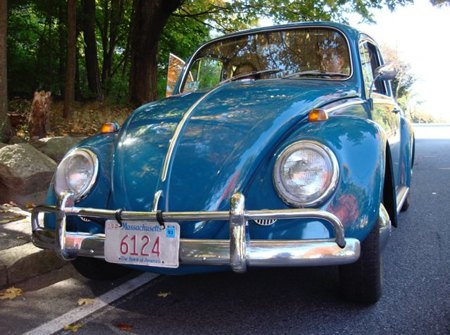
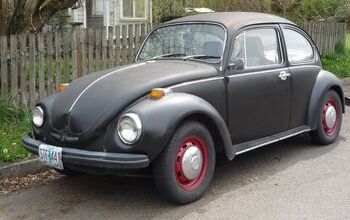
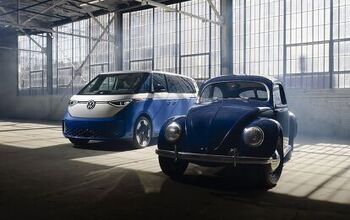
Unlike the New Beetle, an impractical fashion statement of a car, the (Real) Beetle eschewed style for utility. The ads of my youth played that up relentlessly, amusingly, logically. The Beetle was cheap. It was a cinch to fix. Fender-bender? Just undo several bolts, pop the old one off, put a new one on. The car was so tightly constructed that you had to open a window to close the door. Heck, the Beetle was so tight it could float. “If Senator Kennedy had been driving a VW, he’d be President today,” the National Lampoon opined.
Like the Smart and unlike the land barges of the classic car era, the Beetle was so light that the steering was surprisingly responsive, When a Washington Post editorial on the New Beetle dissed the original’s lack of oomph, I wrote in a published LTE that “The car is so light that its low horsepower would have been plenty adequate to leave my parents’ six-cylinder ’57 Chevy wagon in the dust.” I knew that because I’d taken a spin in a ‘63 Beetle about five years earlier, and also once in the late ‘60s.
But I was wrong. Recently, John MacDonald let me drive his ’65 on behalf of TTAC. It had a bad case of the slows. Granted, he AND his friend came along for the ride, and our combined mass, an estimated 400-450 lbs, trimmed the weight to horsepower ratio of the 1675 lb Beetle from a barely acceptable 42 lbs/hp empty to a pathetic 52.5 lbs/hp. (For comparison, in a 4-cyl Accord, each HP pulls around 20 lbs.)
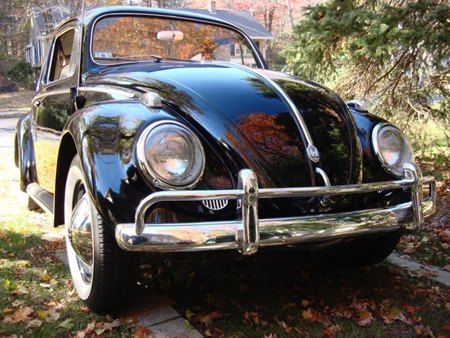
But maybe MacDonald’s 43-year-old car was simply showing its age. I decided I needed to do due diligence. Peter Cook, an official with the Bay State VW Owners’ Club, let me pilot his ‘58.
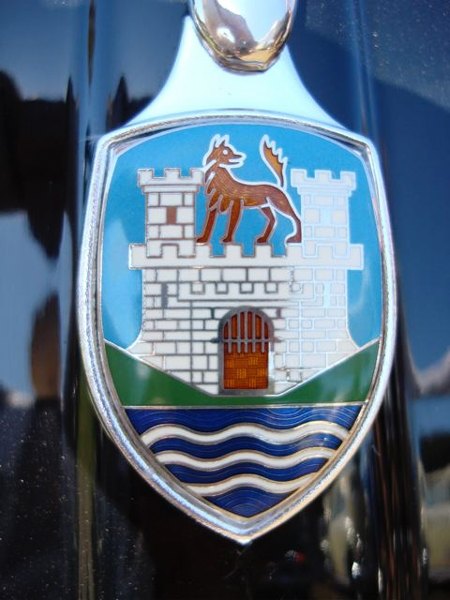
Cook has owned the car for about ten years. He drives only about 1,000 miles a year, and doesn’t– wouldn’t –use it for a daily driver. But he once drove it about four hours from his home near Boston to Norwalk, CT. He reckons the Big gets around 35 mpg. The odo says 92k, and Cook says it’s turned-over either once or twice. Each of the car’s 36 horses pushes 44.7 lbs of Wolfsburg icon. It was reportedly in good tune. We took a spin.
There wasn’t much difference between the two Beetles. Both cars’ steering felt distinctly heavier than I remembered, leading me to suspect that steering the parental ‘57 Chevy must have felt like churning molasses (I last drove that car during the Johnson Administration). Moreover, there was play. Lots of it. But what did I expect for ball and nut?
Most surprising was the way both cars seemed to resist turning as if the camber was set for straight ahead, with a vengeance. As I steered, I could almost hear each car complaining, “do we really hafta turn? Do we really hafta turn? What’s the matter with going straight?” And I could swear that as I cornered that I could feel the frame flexing under the centripetal force.
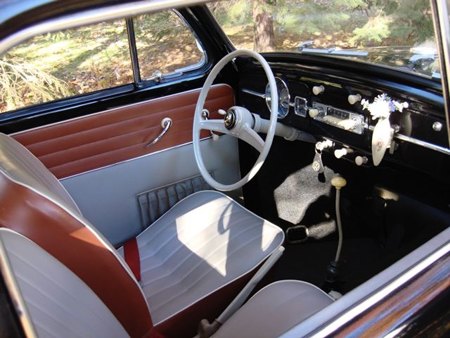
But then the famous oversteer would kick in–frighteningly in MacDonald’s ‘65, at speeds as low as 15-20 mph. Suddenly I could understand how my friend Polly Matzinger, an immunologist who has changed scientific understanding of how the immune system works, who was a wild woman in her youth, had managed to flip Beetles on three occasions.
As I applied the brakes, in my mind’s eye I could see myself trying to slow my childhood go-kart, feeling the impotence of the little wooden lever pressing down upon the rim of the solid rubber wheel.
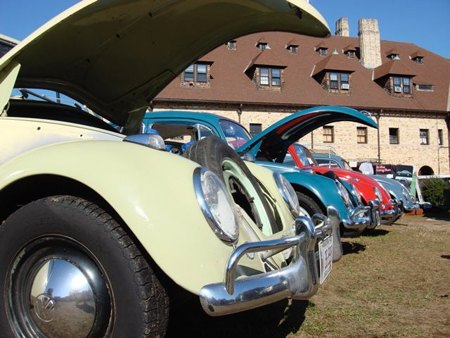
The one thing I really liked in both cars was the snick-snick of the shifter. But if you want to get the effect, don’t hold the knob. Hold the middle of the stem, because the smaller leverage allows greater sensitivity to the synchros. (I do this in my Accord.)
My inner child protests this mostly unflattering review. At six or seven, I had loved riding in the little way-back of the Dorfmans’ VW. The cozily-carpeted hidey hole was a kid’s dream. In contrast, the way-back in the parental ’57 Chevy was too cold and hard and expansive to be the least bit cozy.
But for the driver, the Beetle is spartan, and the lack of space between your head and the windshield makes one feel exceptionally vulnerable. I’m glad not to have accompanied Cook to Norwalk.
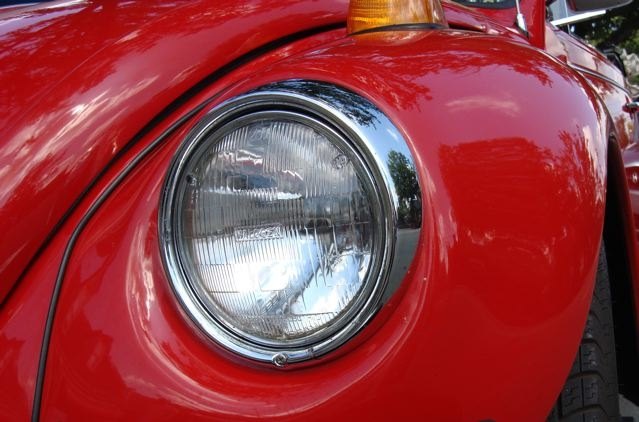
Before my test drives, I was appalled to find that Richard Porter rates the Beetle 5th worst of 50 in his humorous book, Crap Cars, calling it “…slow… noisy… and uncomfortable.” But now I understand, wistfully, because I love the philosophy behind the Beetle, and I can’t think of a car that better deserves to be displayed in the Museum of Modern Art (MOMA) in New York City. The Beetle has more artistic integrity than almost anything else on the road, and until they put those little vents behind the rear windows, in ‘68, the execution was almost flawless.
The lesson of this story is that they don’t make ‘em like they used to, and part of that is good, and part of that is sad.
93 Comments on “Review: Used Car Classic: VW Beetle...”
Back to TopLeave a Reply
You must be logged in to post a comment.
You can also login using Facebook Connect.


From my youth I can remember that the Beetle had four virtues (and little else):
- it was cheap
- it was easy to repair
- it was easy to push out of mud and, more importantly, snow
- it was easily turned into a dune buggy
You can get a damn fast Beetle now though…I have seen Beetles that have been bored and stroke, turbocharged, and even with a shot of nitrous. But of a handful to drive, I suspect.
My mom had one in the 70s. It was a torture chamber. Especially in the winter as the rear engine/broken heater combo meant the most bone chilling cold. I remember shivering constantly in that car even under the blankets that were kept in the back seat as the only source of warmth.
The Mini was better.
Especially in the winter as the rear engine/broken heater combo meant the most bone chilling cold.
Our neighbours had a Microbus with the same setup. The heater never worked in it, either. And thus was my first experience with what has become typical German engineering: great in theory, perhaps not such a smart idea in real life.
I had both Beetles, a ‘72 Beetle with the 1 + 2 gear (clutchless manual) and a ‘98 Beetle. I had the ‘72 at the perfect time in life, during high-school. Yes, it was dead slow, but everyone loved it and it created a lot of fond memories.
The ‘98 Beetle was decent, but it had the usual slew of VW’s gremlins at that time (I rarely had both headlights working at the same time for instance). But it was very, very reliable and no serious issues whatsoever, so I can’t put it down too much. You definitely can’t get that with an automatic, thankfully I had a manual.
That “cozily carpeted hidey-hole” was always called “the sleeping place” when I was a kid and my dad had a ‘62 Beetle. It fit my little sister perfectly.
The best thing about the old beetles was that they were really fun to drive slow.. because it seemed so fast. You could drive those cars on the absolute edge of crashing at speeds far too low to really hurt you.
The worst thing (as has been pointed out) was the heaters. You could melt a pair of rubber boots placed on the floor in front of the back seat, but it was going to be May before you could actually defrost the windshield.
I had an ‘89 Jetta diesel with manual steering a few years ago. That thing wasn’t fun to turn either, but it was great at building up my arm muscles. Great car overall though for the price I paid. I’ve never driven an old Beetle, but have driven an NB, and I didn’t like the lack of visibility compared to my Jetta. Maybe someday I’ll drive an old model. Nice review.
Here come the 100’s of nostalgic comments!
The car I learned to drive on… at age 12. Our 1960 model (lacking a synchro transmission) was an unkillable vehicle. The old Beetle’s faults are obvious but its charms sneak up on you. I remember my dad spraying the running engine with the garden hose just for kicks (don’t ask me why)… and it having no effect! A car a 12-year-old can fix. Eventually it was vaporized by rust.
It set my personal automotive benchmark: A basic vehicle masterfully engineered.
Great review!
What products from childhood wasn’t complete garbage by today’s standards? You just gotta smile and enjoy the memories anyway.
@psarhjinian :
I assume you are talking about the original Mini.
Well,as them then being part of Leyland what can I say. Calling them better as the original Beetle?
In terms of design and average traffic space usage -yes, you might be right.As for modern engineering and plowing the direction for the FWD vehicle generations to come? Probably yes.
But those things virtually had zero safety at all , so they never passed any regulations for the U.S.
They also never achieved a substantial sales volume- worldwide.The dealer service was of no value.Needles to speak about the vehicle’s resale value. If you had one is was a marriage until death.In comparison to the VW, I would like to make following comment: Perfect design, poorly executed.For the VW, poor design- perfectly executed.
My mother used to rave about her ‘66 Beetle for many years after the floors fell out of it in 1971. What a horrible vehicle. Of course if you say that to the wrong person you are flirting with disaster.
My sister had a 71 or 72 Super Beetle. Because the engineers at VW thought it was a good idea to put large cooling vents in the engine cover (hood, hatch whatever) the car would not start when it rained. Sister would put a plastic bag over the vents when rain threatened. Then one day she forgot it was there and the bag melted all over the back of her car. Car had constant problems.
But I will say one of the more entertaining vehicles I’ve had was a ‘69 Bus. Bought for like $200 with a dead cylinder.
Rebuilt the engine with new heads, 45 minutes to instal and I was good to go. Slow, weird sensation steering being over the front wheels, but fun.
The European Beetle was also a lot more stripped down than the US one. My ‘62 Canadian Standard is halfway between the two with less chrome, no gas gauge, less headliner, etc than its US cousins.
I bought mine for $500 recently – just needs a brake bleeding, tires and track down an electrical gremlin then I can report on how it drives.
http://flickr.com/photos/daveseven/2952835980/in/set-72157607579623807/
How much power can you get out of those old Beetles sans forced induction?
And oversteer at 15-20mph? That I gotta see to believe.
My Dad had a 72 Beetle but sadly he sold it before I was born. Drat…
VW’s engineering reminds me a lot of Henry Ford’s Model T. Nothing wasted. My favorite example, not mentioned in the review, is the windshield washer system. The force to propel the fluid from the reservoir to the windshield was the air in the spare tire. Seriously.
My wife grew up in a family loaded with VWs in the 60s and 70s. It was drummed into her head that you NEVER use the windshield washer.
As noted elsewhere, the heater design was a problem, though. In the upper midwest, the road salt would rust out the sheetmetal tunnels that carried engine heat from the engine in back to the footwells in front. So, the only places where the heaters really worked long term were in warm climates where you don’t need it anyway.
The correct term for the “clutchless 1-2 speed manual” is A.S.S. as in automatic stick shift, a marketing blunder that is only exceeded by the insanity of what was, essentially, a two-speed transmission (assuming that you drove it as recommended by starting off in D1). My dad used to give me crap because he heard me using all three gears. The day he bought it, he reneged on his promise to involve me in the purchase process (I was 14 and a confirmed gearhead). Had he not done so, I would have told him to run like hell. The irony is that the damned thing almost killed me when I couldn’t quite get out of the way of the bozo who ran the red light and almost t-boned me at 55mph.
I don’t believe in anything supernatural, but if I did I’d have to say that I have a magical VW fairy that follows me everywhere. I’ve owned a small fleet of Volkswagens over my lifetime and every one of them has been reliable, long-lived, and a joy to own.
One of those was a 1973 1303 (aka ‘Super Beetle’) in Sumatra Green. It had over 350,000 miles on the clock, and other than me neglecting points maintenance once, it never let me down in any way. It was a commuter car for me in the late 80s and early 90s here in Seattle. I sold it when I was transferred overseas to the UK in 1996 and have regretted that sale ever since, and will for the rest of my days. That car was indeed perfectly executed. The design was late-30s, and filled with stupid compromises throughout… but those damn Krauts over-engineered every little imperfection to the point of… perfection.
Oil changes and valve adjustments for me were like analog therapy in my Digital Life. Working on that lovely boxer-four filled my weekends with the joy of certainty after my weeks of wrestling with immature Information Technology.
It never failed to start or run, rain (and we have months of that here) or shine. It looked almost showroom new at an age where it could have legally bought me a beer.
I was hit by inattentive drivers (both women in the pre-cell phone era) twice and one time was able to literally fix it myself with bolt-on spares, pocketing several hundred Insurance Claim bucks in the process.
Yes. It was ugly. Yes, it was slow. But damn that car was a true Quality Product.
–chuck
A ‘57 Chevy six had a substantially better power/weight ratio (25 lbs/hp) than a 36 or 40hp Beetle, and would have easily ran away from it.
Regarding the oversteer you experienced at low speed: rear-engined cars like the VW, Corvair and Porsche are very sensitive to front/rear tire air pressure differences. If the air pressure is the same front and back, like many folks do not knowing otherwise, the oversteer will be dramatically worse.
Keep the fronts some 6-8 lbs lower, and it’s much more reasonable.
My memories:
http://www.thetruthaboutcars.com/auto-biography-14-bug-eyed-and-painless/
I had a couple of beetles, including the “Super” beetle in my teens.
What a fun car to learn on, I think it was only 8 bolts to pull the motor and it was light enough to lug over to the workbench for a teardown by yourself. I once drove for a week using a very large rubber band as the main belt since i was too broke to buy a new one. I think I paid $150 for the first beetle, and less than $500 for the superbeetle.
Stuffed a 1850CC engine in the back and later a converted 914 setup in another one just for fun.
Fast in a straight line, scary as hell in a turn. Those torson bars just could not handle any real HP, and made for some interesting off road adventures.
But if you think the beetle was hard to turn, try sporting around in a “thing”, the beetle is a slot car by comparison. . .
In 1962 my pappy bought a brand new anthracite grey Beetle. All options: sunroof (not because it was neet– it was a safety feature: if you crashed or drove into the Chappaquidik you could climb out), AM radio, white walls and lap belts. To this day I remember going to the dealer to pick it up.
I remember the fuel filler under the hood right next to the vacation luggage we wedged in there. And of course the air-pressurized windshield washer fluid tank.
Several years later I was always eatin’ shit cuz we still had that thing and all my li’l buddies dads had Dodge Polaras [sp?], Electras, LTDs and GTOs. (My grade school math teach had a new ‘64 black/black GTO ragtop… later traded in for a fully loaded ‘67 Gran Prix.
Th e bug was cold, cold, cold in the winter. I remember dad had installed some kinda defroster reflectors that diverted some air from the vent wings to the defrost vents to “improve” things. Actually the things did work. (My air cooled 911’s heat was like a toaster oven… what did they do that VW didn’t??)
Bug was reliable as an anvil. And slow. 36 hp = 72 mph on a still-wind day; but also usually 32mpg.
In ‘69 we bought a LeSabre 4-door/ 350/4 barrel. That expanse of hood shouted “this is America goddamnit!!”. Then a ‘76 Buick Regal 350-4 w/ rallye suspension.
In ‘89 he bought a new Accord DX. The Buicks really were good cars. (The Regal was slower w/ less mpg than the LeSabre, though.) The Honda he raved about as being the only car as good as the Bug. 102,000 miles later that Honda is my commuter and still gets 29-31mpg on I-696.
I hated that Bug growin’ up. Now I wish I had it back. (The kid we sold it to turned it into a dune buggy. It was still registered in the mid-’70s.)
‘71 Super Beetle here. Bought it used in ‘75, my first car. Already starting to show rust staining along the front hood/trunk seals. But had no major problems with it, easy to fix and maintain. Could even drive it at full throttle without much fear; taking on the Vegas and Pintos of the time wasn’t such a big deal since their engines were always on the edge of self destructing if they tried to keep up……I took it all over the Midwest on trips to visit friends and such, with 25-30 mpg. Oh, and the heaters worked! I even remember a day with freezing rain, and I followed the instructions (shut off the footwell vents, and let the heat rise up from the windshield defroster vents–the car even had a blower fan for it) and got by fine, even while all the American cars were stuck in the ice. Bequeathed it to my brother, who drove it a few more years in upstate NY winters until the bottom rusted out and we sold it to someone who rebuilt them.
Paul,
Somehow I missed your Beetle story. Great!
My recollection on the ‘57 Chevy is that there were two sixes, and the parental model, a totally stripped 210, had the smaller engine. Also, that the car was a total dog, with lousy pickup and lousy handling. (The ‘57 Ply, a POS in terms of reliability and rust [loads of it] was a much better drive. And in those days–both cars were sold in summer, ‘65, when we went off to France–to me GM was the One True Car Company, and I absolutely hated Chrysler Corp, and I still remember the Ply as better to drive.) Nonetheless, I was 12, and had driven them mostly around parking lots, and perhaps the Chevy was better than I remember.
I assume you are talking about the original Mini.
Yup.
Calling them better as the original Beetle?
In terms of design and average traffic space usage -yes, you might be right.
Oh yes, I am. The Beetle is decent car, but the Mini was a much better take on basic transportation. More space, less stupid engineering gimmicks, handling that wasn’t creepy.
There’s a reason you can, e.g., stuff a Honda B18C in an original Mini and not kill yourself driving it down the street. Granted, the Beetle is several years older a design, but it’s still a bad one that spoke to the (still-omnipresent) German engineer’s need to design something cool at the expense of something pedantic but functional.
There’s something wrong when you’ve engineered a 40 horse Death Car.
As for modern engineering and plowing the direction for the FWD vehicle generations to come? Probably yes.
Nice pun on plowing. Yeah, the Mini plowed. I’ll take plowing over snap oversteer.
In comparison to the VW, I would like to make following comment: Perfect design, poorly executed.For the VW, poor design- perfectly executed.
And that “poor design, perfectly executed” also applies to the 911.
You’re right, though. The Mini failed because of Leyland; VW succeeded despite the Beetle. And yes, the Beetle was, if nothing else, simple and fairly mechanically robust as long as you lived somewhere that wasn’t cold, snowy and/or wet.
Small death traps have come a long way over the past 1/3rd of a century.
My favorite Beetle was a dark green 66 that went across the country twice. Spartan except for a Bendix AM radio. In today’s world we would definitely call it a penalty box. It was a $200 purchase. The heater worked when on the open road, but you had to move your foot away from the vent at the foot well.
I still have a 71 Westy. With 1776 jugs, acceleration is still glacial. 4,000 rpms in 4th gear will get you down the highway at 65 mph with an unimpressive 20 mpg – slightly less with a headwind. It just made the 550 mile Thanksgiving journey to NOLA and back. 11 hours each way.
So now we know what “old and slow” refers to.
Polly Matzinger, the woman I refer to in the article, has several VW buses from the early ’80s (backup in case one isn’t working). The main one has a Subaru engine. She still drives those things half way across the country for sheep dog trials, and once had to get a VW engine rebuilt in some podunk town in North Dakotas, and managed to cajole a retired VW mechanic into doing it.
I don’t believe in anything supernatural, but if I did I’d have to say that I have a magical VW fairy that follows me everywhere.
Chuck,
Did you own a VW when you lived in a snowbelt area, or anywhere with dramatic (say +30C to -30C) swings? I’ve noted that a lot of Bug fans (or VW fans in general) seem to live where they don’t need to face Jack Frost on a regular basis. Maybe the cars don’t handle winter better, or those of us who’ve had to suffer the lack of heat in an older Beetle or Bus are Bitter.
On a related note, I had a Lada Niva for a year. It was about the only car I could afford at the age of 16 that wasn’t a American land yacht, and they could be had new, in Canada, for not a whole lot of money. Total crap, but it didn’t suffer in the snow nearly as much our neighbour’s Microbus. In fact, I think winter was the only time I actually liked the car.
The old Beetles were good in their time as economical cars. But much like rotary telephones, who would want to use one today.
I had one of the 67 models with the 1500 engine. While far from being a hot rod, it was much better than the 1200 or 1300 cc engines.
Strange to hear the disparaging comments about Beetles in the winter. Their bad-weather traction was legendary, with all the weight right over the drive wheels. Compare that to their contemporary competition.
I do yield to the criticism of heat & defrost. I remember doing lots of scraping on the inside of the windshield.
The Beetle is my personal Terminator. Mom flipped hers on an icy road and nearly got killed, several years before I was born. I’ve always found them to be the subject of pure, unadulterated nostalgia – people completely forget how terrible they were in favour of warm, fluffy rose-tinted memories. If Freud lived today I’m sure he’d have some interesting things to say about repressed memory and the Beetle, maybe something about suppressed sexual urges.
A friend of mine in highschool had an old Beetle. Perfect car fro the responsible non-hooligan kid. It was cheap and easy to fix and generally fun.
Their bad-weather traction was legendary, with all the weight right over the drive wheels. Compare that to their contemporary competition.
Snap oversteer and primitive suspension. It was bad on dry roads. It was lethal on ice. It still is, if you drive a 911 with the nanny off.
@ JEC
Memory tends towards the positive. It’s been shown scientifically, although unfortunately I can’t quote chapter and verse offhand.
In the 60’s I knew a guy who was bringing in bootleg VW’s, bought really cheaply in Germany, and making the minor modifications to turn them into more-or-less US-spec cars. He called them “ten dollar cars with hundred dollar paint jobs.” But in an America accustomed to cars that came in three sizes–large, larger and ludicrous–the Bug was revolutionary.
I keep seeing barbs about slow steering and gawdawful tail-happiness– In the 9 years I lived in the “back seat” of the bug it was never unpredictable. Great in snow. Dad was in the Detroit Police and in the blizzards Buglie was the one vehicle that picked up his buddies & got everyone there in time for shift-change.
I drove a friend’s ‘66 when I was in high schoole (’73) and while it weren’t no Loutus it was sharper than the same year Pontiacs and Fords in its steering response. We used to go “baha-ing” in the hinterlands in Bugs an if you weren’t suicidal they were very predictable. Anyone who whines about tail happy needs to take a road racing driver’s school…
A friend had a Beetle in high school… in 1988. The car was a POS. Positive memories of this car must have more to do with memory lane than actual experiences with this car.
I keep seeing barbs about slow steering and gawdawful tail-happiness– In the 9 years I lived in the “back seat” of the bug it was never unpredictable. Great in snow. Dad was in the Detroit Police and in the blizzards Buglie was the one vehicle that picked up his buddies & got everyone there in time for shift-change.
I drove a friend’s ‘66 when I was in high schoole (’73) and while it weren’t no Loutus it was sharper than the same year Pontiacs and Fords in its steering response. We used to go “baha-ing” in the hinterlands in Bugs an if you weren’t suicidal they were very predictable. Anyone who whines about tail happy needs to take a road racing driver’s school… sprint to the corner, use the heavy backend to you advantage under heavy brakes, enter “slowly” and hard gas on the exit…
My last post didn’t… so I hope this doesn’t show as a rerun…
I keep seeing barbs about slow steering and gawdawful tail-happiness– In the 9 years I lived in the “back seat” of the bug it was never unpredictable. Great in snow. Dad was in the Detroit Police and in the blizzards Buglie was the one vehicle that picked up his buddies & got everyone there in time for shift-change.
I drove a friend’s ‘66 when I was in high school (’73) and while it weren’t no Loutus it was sharper than the same year Pontiacs and Fords in its steering response. We used to go “baha-ing” in the hinterlands in Bugs an if you weren’t suicidal they were very predictable. Anyone who whines about tail happy needs to take a road racing driver’s school… sprint to the corner, use the heavy backend to you advantage under heavy brakes, enter “slowly” and hard gas on the exit…
In high school my best friend had a 1967. I’m the class of 98 so it was ancient by the time we got it.
We would cram 5-6 people into it to make it quite possibly the most underpowered passenger vehicle ever.
psarhjinian, what car of its era wasn’t lethal on ice? That’s just silly. Compare the car to its competition at the time and it fared very well in the snow, primitive suspension or not.
I agree the car is a tin can relative to current cars but gimme a break.
Fact is if one can`t handle a rear engine/ rear wheel dricen car (VW, Porsche,Renault Alpine) stay with public transportation.
A lot of post`s are talking about rusted out heaps where due to little or no maintenance over 20 plus some years half the stuff stopped working. Very few people here had the experience of owning a new Bug.It was a fine small automobile, dependable, economical, had off road capabilities and the heater did work.Someone was wondering why the 911 had a better heater output.Well, they all had auxillary heaters installed.Which by the way could have been purchased as an option with the VW.(Alaska had `em standard).
Talking about primitive suspension:All the Super`s had the same rear suspension as the 911. Until today you can interchange 944 rear suspension parts with the Bug.The Mini`s did not even have shocks.They had rubber cushions- spot on as the mate`s say.
The largest european car manufacturer was founded and prospered through the Bug and it`s siblings.
In comparison to “other car manufactures” long gone and soon to be gone,they had a late start.But came out amongst the best and brightest in the industry.
The Bug had it`s defficiencies no doubt,but it was a genuine article well build, well supported in Service and perfectly marketed.
I think this is a near-perfect review. It tells you how a car feels when you drive it. Also, the review helps you to understand the car in its social, historical and psychological context. Written in beautiful, plain English, to boot. Thanks, David!
what car of its era wasn’t lethal on ice? That’s just silly. Compare the car to its competition at the time and it fared very well in the snow, primitive suspension or not.
It’s era was pre-WWII. By that measure, yes, you’re right. The problem is that it continued well, well past that date with the same fundamental structure.
The Mini is one example. Yes, you could lose it on ice, but when you did it was a slow, easy push, not a “goodbye, Mr Tail-End, hello, Mr Guard Rail” moment. Even import-fighters like the Valiant and Falcon were better: they didn’t have the weight/traction advantage of the rear engine, but a sandbag in the trunk and a decent set of snows would get you moving, and you wouldn’t swap ends quite so easily.
Hey, I like the Bug, but between the heater and the handling it wasn’t a good winter car.
@psarhjinian :
It’s era was pre-WWII. By that measure, yes, you’re right. The problem is that it continued well, well past that date with the same fundamental structure.
You are right, it`s design origins dates back to that era.But let me ask you, what does it tell you that such an outdated design outsold anything on the market(in it´s class) in it`s heydays in the 60`s to 70`s.
How many Minis were sold in the US grand total? 10.000? This is about what VW sold in a week.
How many BMC,Austin, Innocenti,Leyland and last but not least Rover Minis were build( did I catch all the parent companies that owned that car?) 5 Million? This is just about what VW sold in the US and less than 25% of what VW built.
So regardless, success speaks for itself especially when transferred into any currency.
The Beetle was an old design. But it fulfilled its design intent wonderfully– for 40+ years. If the “Big 2.8″ had offered a vehicle with the same reliablity and character the imports would have had a serious fight for market share. Anyone remember the old Mopar ads that showed the “road hugging weight” Chrysler cracking the “fragile” import egg??
I was wondering… in light of the response to this trip down memory lane… would a thread of “I remember growing up with a ????” be a nice bit o’ history of our B&B’s?
Before we got our LeSabre dad came really close to buying a ‘69 383 Road Runner. “The back seat didn’t have enough room…” Mind you I never voiced that concern. I still remember that car: 383-4bbl, light blue, auto, a/c, am/fm & not much else… Pa asked me if I was disappointed he bought the Buick… In an extraordinary display of diplomacy I said “No”. God forgive me…
SupaMan :
“How much power can you get out of those old Beetles sans forced induction?”
A lot. Tafel makes a 231hp kit, 0-62 in 4.7 seconds and 150 mph top speed, if you also take their custom 5-speed gearbox and suspension upgrades.
http://www.autobild.de/artikel/getunte-kaefer_43341.html
Neidermayer is right.
They handled a whole lot better if you observed engineering recommendation for tire pressure. 17psi front. (I forget rear but likely 28.) Few did. Then or now on any car.
I remember argument with a non-car guy cousin who owned one. He told me I was reading the tire pressure sticker wrong. That the number on the tire was the right one (max PSI of 32 I think.) Successful lawyer driving a skittish bug with concrete tires and not liking it.
I had a few, they rusted, same as Detroit and europe and japan.
For a late 30s design they certainly fit the bill for many millions for many decades on every continent.
I have it on my list to buy a nice clean one to have as 4th car (Ghia is preferable to me). I would want to really seal it and get some form of modern heat and windshield air. I bet its out there. This is, when I get to where I can afford more than 2 cars, ie, never. Still I want one.
Anyone who expected any serious performance from these fails to understand the basic premise of these cars: Basic transportation. Safe, if you drove sanely. Economical, easy to repair. Reliable.
I grew up in the 70’s, and I remember that these were sensible cars for college students. I had a ‘71 Super Beetle convertible, yellow of course, with the black top. My buddy had a blue Karmann Ghia convertible.
Mine survived two front end crashes, and kept me safe, as well. Parts were dirt cheap, and owning and maintaining those cars taught you self-reliance and respect for machinery and basic engineering. I swapped the engine in mine, me and my brother, who had, like, one shop class between us. Just followed the pictures in the Chilton repair manual. Fired right up, and the whole thing took two hours.
Yes, they were drafty in the winter. Okay, truth be told, damned cold. At 18, we didn’t dive a damn. They were the shit on hot summer nights going to Pine Knob.
And, as much as my Mustangs and Charger did, this car always got me laid. Girls loved its cuteness factor, and always wanted to drive it.
So there.
The 1974 Super Beetle I drove:
1. Loved to spin out on icy roads (I practiced in parking lots to learn how to drive it safely).
2. Semi-auto transmission made it absolutely bog slow getting on freeways.
3. Recirculating ball steering became incredibly sloppy after 40K miles, while front struts began leaking at 45K.
4. Heater was a joke; air was heated passing through cores inside mufflers (CO, anyone?), and it took ages for defrosters to warm up as their air channeled through cold metal passages within the frame.
5. It was relatively airtight, which made summers hotter than blazes as air vents into passenger compartment were minuscule: you drove with windows open, or roasted.
In CA, it would have been OK as basic transportation. In PA, no way – it was traded off in ‘75.
I had two of them — a ‘62 with 40 hp and a ‘68 with 53 hp. The ‘62 did 0-60 in 30 seconds, topped out at 80 mph and got 33 mpg. The ‘68 did 0-60 in 18 seconds, was 10 mph faster and got 30 mpg. Although both cars had swing axles, the ‘68 handled significantly better because I equipped it with a camber compensator and Michelin XAS tires (130 mph tires on a 90 mph car).
The trick to making reasonable progress in either car was conservation of speed. Slowing down was absolutely the last resort. To pass a slower car on a two lane road, you had to drop back and build up speed.
I was satisfied with both cars. They met my needs in high school and college. But I wouldn’t want one now, not even a Karman Ghia convertible. (I have given some thought to a decent Porsche 356.)