

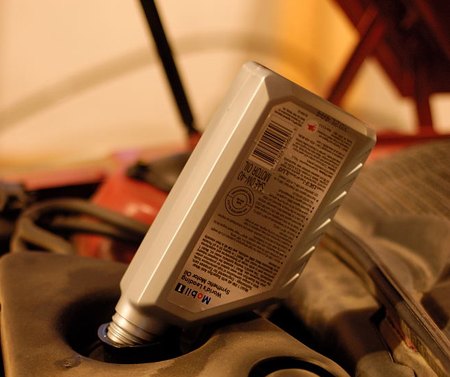
It’s easier to convince an Evangelical that Christ was a grifter than to persuade pistonheads to give up their regular oil change. Yea, verily, the maniacal motorists believe in the healing power of regular visits to the Church of St. Pennzoil. And they certainly have the Gospel of Jiffy Lube on their sides: Thou shalt change thy oil every 3k miles or your engine will blow up in an explosion of fire and brimstone. Well I hereby give pistonheads permission to skip their next regularly scheduled motor oil change. And the one after that one. In fact, if you’re not planning to keep your car for all eternity, consider forgetting oil changes altogether.
Many decades ago, when metallurgy, tolerances, manufacturing precision and various aspects of engine controls (as well as the oil itself) were profoundly more primitive, the 3k mile oil change interval had a logical basis. Crude carburetor chokes caused overly rich mixtures, dumping raw gas onto cylinder walls that worked its way down into the crankcase. Poorly fitted rings caused blow-by, which had the same effect with nasty combustion byproducts. And poor tolerances created rapid wear, which released and circulated metal particles throughout the engine. People drove shorter distances, and cars often didn’t warm up enough to burn off contaminants. To travel 100k miles without an engine rebuild was a genuine accomplishment.
By the sixties, improvements in all of these mission critical areas led manufacturers to adopt an industry standard 6k mile oil change interval. Since then, recommended oil change intervals have risen as high as 10k miles. At the same time, many high end cars ECU’s (e.g. BMW, Porsche) now monitor engine and environmental operating conditions and calculate the ideal interval for an oil change– sometimes well into the teens.
When is the last time you heard of someone experiencing an engine failure (in normal use) that could be verifiably traced to damage from insufficient lubrication due to infrequent oil changes? Oil never wears out. It can become contaminated and certain additive characteristics can change. But in normal operational use in modern engines, this usually happens quite slowly.
And yet the 3k mile mantra can be heard everywhere: newspaper and magazine articles, on-line forums, radio talk shows and, of course, all the obvious and more subtle forms of advertising by the oil manufacturers and the oil change industry. When Jiffy Lube puts a sticker on my windshield warning me that my next oil change is due in 3k miles, it’s clear who benefits most from these regular visits, and it ain’t me or my car.
These days, it’s common to hear of documented engine life of 500k miles and more. A fleet of Chevy gasoline V8 pickups pulling trailers delivering car parts overnight all over the Midwest has run a number of bow tie bombers to over 600K without failure. A 1987 Saab 900 just hit the million mile mark without an engine rebuild. Yes, the Saab owner used expensive synthetic oil and changed it regularly in his million mile quest. But how long are you planning to keep your car?
Still not convinced? Da Vinci Code time. In the mid-80’s, Germany’s leading car magazine Auto, Motor und Sport ran a VW Golf with a 1.6 liter gasoline engine for 100,000 kilometers (62,000 miles) without changing the motor oil or filter. They then tore down the engine completely and examined every single moving part [microscopically] for signs of wear and tear. What little wear they could find was not engine life threatening and fit within normal operating parameters for the given mileage.
Obviously, I don’t expect pistonheads to forgo engine oil changes completely– if only because following manufacturer’s recommendations safeguards your potential warranty claims. Still, if warranty isn’t an issue and you’re not planning on keeping your car past 150k or so, and you run it under favorable conditions– a long commute, lots of highway miles, milder climate, etc. — consider extended intervals. If you have a three year lease, well, that’s between you and your conscience.
Meanwhile, the situation with gasoline and octane levels is roughly analogous. A couple of years ago, AM&S did another extensive test, running cars whose manufacturers called for premium fuel on regular gas. The result: performance and fuel economy losses ranged from zero to mid-single digit percentages. I don’t need to tell you that it can be a LOT cheaper to fill your car’s tank with a lower grade of fuel. And don’t worry about damaging your engine; modern detonation sensors constantly adjust ignition timing to be optimal for the fuel being burned and prevent pre-ignition.
Pistonheads who lavish low interval oil changes and high octane go-juice on the cherishd machines do so more for their own peace of mind than their car’s mechanical needs. It’s sweet, but unnecessary.
175 Comments on “Peek Oil?...”
Back to TopLeave a Reply
You must be logged in to post a comment.
You can also login using Facebook Connect.


Thank you, its about time that this was publicized. Years ago I was told by a friend that had a fleet of rental vehicles that 7500 was the new 3000 interval for oil changes for the same reasons mentioned in this article. I have followed that advice and have had no mechanical or lubrication problems with the 6 odd cars I have owned since, a few with over 100,000. In fact most manufacturers now specify 7500 miles oil change intervals, but also hedge their bets for “Heavy Use.” How many of us drive taxis or drive on dirt roads pulling a trailer?
well halleluja! at last some common sense and reason in a sea of hype. excellent piece, thank you.
you didn’t mention the environmental pollution caused by the dumping of who knows how many tons of used oil into the environment (yes some is recylced but far from all).
i always supected this issue had become a scam for the oil and oil changing folks. quite a few years ago Consumer Reports did a test of oil change intervals in New York city cabs, surely one of the most stringent environments. they found no difference in 3, 5, and 6.5 thousand intervals (i may be off a little off on the mileage, it was years ago) but the point was that they could determine no wear on the engines (they tore them apart and measured tolerances) at these longer intervals (for the time).
the octane ratings is a little more hazy, and my M3 always gets premium (i paid for 333 horses and i want them all) but thank you for shedding some objective light on this important subject.
Even the best engine will release some particulates into the oil, and as the oil gets contaminated fuel economy will begin to suffer. Like Mr Niedermeyer says though, the oil itself deteriorates very slowly, if at all, especially in a car that’s driven every day. The primary cause of oil deterioration is actually moisture which accumulates in the oil when the engine is not running. The water forms oxides in the oil which reduce its lubricating abilities. Fortunately, for regular drivers, when the engine reaches operating temperature, the moisture is burned off.

For those looking to save some green I’d go with the Amsoil philosophy: change your oil filter every 6k miles or so, to keep the particulates out, but keep the oil for 12k, 24k or more miles. This doesn’t mean use Amsoil products, although they are high quality, it simply means that I think their recommendations are good.
I agree with Phil that the octane issue is a bit hazier. Mr. Niedermeyer is correct that modern ECUs will immediately adjust ignition timings when running crappier fuel, but in my RSX (11:1 compression ratio) the timing adjustment would lead to unburned fuel reaching the exhaust system and sometimes even triggering a dummy light about the catalytic converter. Point being that you may not damage the engine by causing knock or full-on detonation when you run lower octane fuel, but something is going to suffer, especially in high performance, high compression engines.

I recall the CR test on oil from years ago. As I recall CR found that all oils are pretty much the same if they meet SAE, which they all seem to. Also they found that oil change intervals could be extended. Since then I have changed oil on 5K or 6 month intervals, which ever comes first. To me the condensation in the engines cause sulphuric acid to form. This is the only reason IMO that oil needs to be changed on a regular basis. The acid will react with internal engine surfaces and cause long term damage.
I too had a high performance car that required premium fuel. I used standard 87 octane for 42K miles and never noticed a problem. The ECU adjusted for the lower octane and it still got very good mileage. I didn’t notice any performance drop but there may have been a slight one. Personally I think 87 octane fuel can be used in any car, unless you drive in a professional automobile race.
On the oil, you have some good points – 3k miles may indeed be too short an interval for modern formulations. I stick with ~5k on my car (less on motorcycles), although I don’t freak out if it happens to go a little while longer.
I’m afraid I disagree with you on the octane thing, though. As folks have already pointed out, the ECU on most cars will adjust for lower octane, so there’s no risk of damage, but for vehicles designed to actually use it (typically higher compression engines, I think), my experience is that there’s definitely a benefit – small, but noticeable (at this point, I should insert the obligatory note that using an octane higher than your car recommends gains you nothing).
On a side note: for motorcycles, the effect of using less than recommended octane has, in my experience, been more pronounced. They don’t have fully closed-loop systems, generally speaking, and have less sophisticated sensors and ECUs than cars. They therefore really do actually need the octane that the manual asks for (again, see note above about running higher than recommended octane)…
I agree about the wear not being a big issue. However, sludge problems can be nasty. Certain poorly designed engines are susceptible – including some later Saab models and Toyota.
You hear more and more about sludge these days. Can’t say I’ve looked into it enough to know what causes it, but common sense says changing the oil should help. Maybe not?
The next likely myth to go after is the “break-in period.” With the much tighter tolerances of today’s engines, I’ve heard some powertrain engineers say no break-in is necessary. But people continue to swear by the “go easy on it for the first 1,000 miles,” etc. This is endlessly debated on forums.
But is there any recent research on the issue?
How about on turbocharged engines? Are the temperatures higher and more destructive to oil? Is the biggest problem with turbos when people forget to cool them down before shutting down–baking the oil inside the turbo?
As for sludge, turbosaab, don’t forget the 1.8T in the Passat and A4 (but strangely not in the golf or jetta)
As for oils being the same if they meet SAE, does that mean that there’s no real benefit to synthetic?
I do 10K changes with Mobil 1 in my turbo four. I just did a change and took an oil sample to send to Blackstone Labs for analysis to see what’s what. If it’s OK, I’m going to go to 15K and maybe up to 20K from there. Beyond that, the cost savings aren’t worth the peace of mind to me.
phil: i always supected this issue had become a scam for the oil and oil changing folks. quite a few years ago Consumer Reports did a test of oil change intervals in New York city cabs, surely one of the most stringent environments. they found no difference in 3, 5, and 6.5 thousand intervals (i may be off a little off on the mileage, it was years ago) but the point was that they could determine no wear on the engines (they tore them apart and measured tolerances) at these longer intervals (for the time).
I suspect NYC cabs don’t have one of the most stringent environments, for the simple reason that they’re on all day. Hard use is associated with short trips.
I believe in mostly following what the MANUFACTURER says.
On my Saturn its 3K or 6K, depending on how much city driving. It gets 3K and the hamster engine has been happy.
The Mazda manual says 7K or 10K, so it gets 7K.
I do worry about sludging, I think its heat-transforming the oil to sludge, and it really depends on the engine in detail.
Also, I know the saturn burns about a quart every 1.5K miles now, used to be every 3K miles. As such, SOME junk from the oil is getting concentrated in there.
Overly simplistic and flat wrong. Not only the Saab and Toyota engines have sludge problems, but also the 1.8/2.0 WV/Audi four, which is famous, because of the configuration of its internal vents, for forming sludge that then drops into the crankcase and clogs the oil pickup. There are numerous well-documented cases of VW/Audi engines failing due to totally clogged oil pickups.
This sort of situation is increasingly seen due to leased vehicles and owners who do exactly what Neidermayer recommends: “Hey, it’s not my car, goes back in 36,000 miles, I’ll save a few bucks and send it back with the same oil in it that I got when I leased it…” Smart owners of these cars change their oil every 5,000 miles and use Mobil 1, which admittedly may be overkill.
Oil is also time-limited. If you run the same oil for about a year, it begins to break down from contamination by combustion byproducts, and acids form that do very bad things to the metals inside an engine. This has nothing to do with particulates or to long-molecule shearing (which also inevitably happens) but is solely chronological, assuming that the engine is run a normal amount. (Actually, oil will deteriorate with time if it’s simply left open to the air and not even used in an engine.
This is a dangerous piece because some simpletons could actually believe it and never change their oil. Certainly 3,000 miles is ridiculous, 5,000 miles is compulsively excessive perhaps except in the case of engines proven to be configured to create sludge, and 15,000 miles is certainly fine, assuming you don’t use oil that’s more than a year old.
But to say that engines will run forever with the same oil is a bit like those tests we’ve all seen on infomercials where they put some mouse milk into the oil of a brightly painted “new” V8, run it awhile, then drain the oil and restart the engine. Miraculously, it runs “with no oil in it,” just the remains of the mouse milk that has “coated the moving surfaces with Kryptonite.”
What you’re actually seeing is a repainted 300,000-mile-old engine with clearances you could stick a pencil through, and immediately after being run, the drain plug is pulled until “all the oil” has run out, then the plug is torqued back into place, leaving a couple of quarts still up in the valve covers, etc., which is plenty to lube the engine for five minutes under no load.
I agree with the principal of extended oil change intervals. BobIsTheOilGuy is a pretty good resource for those interested in this topic as they perform engine analysis on a wide variety of cars and report the results. I suggest reading the standard info as well as the forums on that site.
http://www.bobistheoilguy.com/
For our 2001 Mazda once the warranty was up, I switched to twice yearly oil changes done at the same time as the tire switchover. No noticeable difference after 3 years so far.
A good quality filter and decent “real” synthetic oil (read any automotive forum for endeless debates on this issue) will last a long time.
Sludge is a real concern in some engines as others have notes including the 1.8t “sludge-o-matic” from VW, the 2.7 “100k suicide” from DCX and even (dare I mention it) the Toyota 3L 1MZ V6.
All of the above-mentioned manufacturers blamed insufficient oil-changes.
I’m sticking to our current oil change schedule, because the way things look now, we WILL be keeping our cars for “all eternity.”
PN: Thanks for the article, I’ve been trying to tell people this for years. I’m a chemist and have friends who work with hydrocarbon lubricants and all of their research shows that oils can go for a very long time. And from what I’ve seen, I do think that synthetic is significantly better oil. Is it worth the cost difference? I don’t know (but I use it).
As long as you’re not baking the oil in a hot turbo, or using the oil to actuate the injectors (as in old diesels), probably once a year is fine to change the oil. As mentioned earlier, sludge happens in localized areas (like SW said about the bad configuration of the internal vents), so new oil has the same opportunity to sludge up as old oil. You don’t really win with more frequent changes.
Just so that I don’t have to keep track of mileage or dates, my oil change schedule is to put a light weight synthetic in my cars just before the snow starts flying (usually 0W-30 in the truck which sits out at night, and 5W-30 for the cars in the garage). And then In the early spring after all the hard cold starts are done, I put in a normal 10W-30 synthetic for the summer.
My feeling is that in the winter you have tons of cold starts, the engine may not get fully warmed up, it spends lots of time idling at low oil pressure, more condensation gets formed in the crankcase, all kinds of bad things. So I get that oil out in early spring just so that things like the organic acids and extra water don’t hang around not because the oil is bad. Then in the summer, you have all of your long road trips, and the engine is always warm, so you can run that oil all the way until next winter.
I tend to change the oil every 3k-4k (depending on when I get to it). Maybe I’m wasting money but I have a Ford with 210K miles on it that still runs great.
I’ve never done the research on the octane ratings. My only experiance was a high performance car that required premium fuel. Once or twice I tried regular (87) octane in it. Lord did that car whine and complain about it. Too much hesitation and just did not run smoothly.
so if the car is using any oil, does that mean one should change the oil more often? And should determine the frequency of oil changes by the opacity? That is, if the oil is pretty black, should one change it regardless of how long it’s been in there?
DH: If the cars is using oil, then I’d just add oil. It’s doing the work of changing it for you :)
Just my two cents…
I like 5k mile oil change intervals because that makes the math easy. 5, 10, 15, 20, etc. instead of 7.5, 15, 22.5, 30, 37.5, etc.
It’s also about the time that tires should be rotated, if possible.
I use synthetic oil because A) it makes me feel warm and fuzzy (like I’m doing something special for my ride) and B) If there’s a catastrophic loss of oil or oil pressure, synthetic oil may protect the engine slightly longer than dino-juice,
giving me a better chance to shut down before lasting harm is done.
Also, when I turned wrenches on BMWs at a dealership, one of the factory reps said that big part of BMW paying for maintenance (oil changes about every 15k miles or 1 year) is that many BMW lessees adopted the “It’ll last 2 years, after that who cares?” attitude. That caused a lot of Certified Pre-Owned cars to develop problems after 40-50k miles.
By making BMW owers pay for their maintenance up front (I’m sure it’s folded into the purchase price….:-D..), they get customers to take car of the cars and avoid problems down the road.
The new generation of BMW engines don’t even have a dip stick for the owner to examine the condition (color) of the oil. Sensors only identify the level in the sump.
Also, BMW now has extremely high oil change service intervals for these engines. Something like 15000 miles. So, superior oil filter technology now becomes critical.
I believe that this policy has more to do with the cost savings of BMW’s so called “free maintenance”, then actually protecting your long term investment.
The next likely myth to go after is the “break-in period.” With the much tighter tolerances of today’s engines, I’ve heard some powertrain engineers say no break-in is necessary. But people continue to swear by the “go easy on it for the first 1,000 miles,” etc. This is endlessly debated on forums.
But is there any recent research on the issue?
Michael, I don’t know. There’s been a ton of debate about this in the BMW forums. BMW suggests a 1200 mile break-in for all of its engines. I’d say it’s to allow the valves to properly seat, but, oops, modern BMW engines don’t have mechanical valves.
BUT – BMW must have a reason for asking its buyers to do this. If it wasn’t needed, they wouldn’t, no?
Oil: I changed my oil after I clocked the first 1000 mi on the odo, based on the old idea that a new engine – any new engine – is bound to have metal shavings floating around; and flushing them out with an oil change is a good idea. (The service advisor looked at me like I was crazy.)
The oil life indicator goes approximately 16,000 between changes in most BMW’s. BMW recommends synthetic oil only. However, since oil changes are part of the car’s purchase price for the first 4 year, and since the car bugs the hell out of you if you don’t do it, everybody gets them done.
Stephan Wilkinson: “smart owners of these cars (leased) will change oil every 5,000 miles and use Mobil 1″
I disagree with that advice as much as you disagree with my article. Mobil 1 (full synthetic) is what, $5 a quart, and I cannot find any convincing evidence that synthetic oil is better than dino oil, especially with a 5,000 mile change. I spent some time at the bobistheoilguy.com site, and most would agree with me. Want to run it in your gold plated Porsche, fine; but “smart owners” are wasting money to change the oil more frequently than manufacturers recommendations with overpriced oil on a leased car.
Why is BMW letting their engines go 10-15K between oil changes, when they have warranty costs and their almighty reputation at stake?
I’ve never seen the infomercials you talked about (I avoid commercial tv), but the 100km no-oilchange test was conducted by a very reputable outfit, that had nothing to sell or prove. I posed the 100km no-oil change issue on bobistheoilguy.com forum, and got huge response. Given the conditions (oil topped up, lots of highway miles) the overwhelming majority had no problem believing it. They had seen cars self destruct from no oil changes, but in each case, the oil had not been replenished, and there was about a quart of sludge at the bottom of the crankcase.
Regarding high octane gas: Yes, if I had an NSX, or some other exotic, I would run premium too (and probably change the oil more frequently). I’m referring to more everyday vehicles, that have been set up to give optimum power and economy on premium, as part of the horsepower war and to help with manufacturer’s EPA numbers for CAFE. And yes, if your particular car doesn’t like regular, by all means, go back to premium. My main point about both issues (gas and oil) is to use your common sense and don’t let someone put a guilt trip on you.
In Europe you don’t loose warranty if you don’t change oil every 3k miles, only if you don’t bring your car to the dealership every 10k miles or every year (whichever comes first) you might loose warranty.
About the octane levels; here in the Netherlands the lowest level is “Euro 95″, followed by “Super 98″. Cool names…
Apart from that you can get special fuels for environmentalists like for instance Shell Pura (97 in the Netherlands, 100 in Germany) or petrolheads, like Shell V-power (also diesel). Anyway, on average octane levels are higher, and so is the HP output for some manufacturers, like BMW (often around 10HP more out of the same engine).
I just listen to my car for the oil change. My engine starts to feel a little sluggish and has a small, but noticable vibration when the oil is dirty. That’s when I get it changed. It usually happens to be about every 3k miles, but I drive it every day in nyc, pretty much all stop and go and a lot of dirt/dust in the air, so I wouldn’t be surprised if I didn’t need it as often out in the burbs. Still I think if you’ve driven your car for a bit you can tell when the engine needs fresh oil. Also, I can feel the difference between 89 and 93 octane. But not so much 91 and 93.
JJ: The reason that the octane values are higher in Europe is because they report the “Research Octane Number”. In the US they report the average of the RON and the “Motor Octane Number”. It’s the same gas in both places. See: http://en.wikipedia.org/wiki/Octane_rating
Three words: Group IV synthetics! While the marketing just says “synthetic,” neither Castrol Syntec nor Valvoline Synpower are the top-tier Group IV classification (Mobil 1 and most of the more esoteric ones are)
Beyond all the marketing hype and hearsay, this is an actual grading system that doesn’t get much attention in the US. You just need to look at oil marketing over the past few years to see how confusing it’s gotten.
I’ll echo the VW 1.8t issues…whether you believe the source of the problems or not, the fact is that if you don’t use a Group IV 0w-40, you can forget about the powertrain warranty if you get sludge.
FWIW, I have a naturally aspirated VW 2.8 V6 and use Mobil1 5w-40 (or 0w40), 6k miles between changes. For me, that’s about once a year.
“Overpriced oil” (Mobil 1, according to Niedermayer) is like “overpriced film.” back when cameras still used celluloid: pro photographers knew that the cheapest part of photography was the film, and the cheapest protection you can give an engine is oil.
Yeah, the gold-plated Porsche is indeed well-fed: $110 worth of Red Line synthetic once a year, which is about every 2,500 miles.
As for that AM&S test, I’ve got a new drug that I thoroughly tested on one patient, and she got better. Funny, though, the Food & Drug Administration won’t approve it…
Great article. Interesting points, Paul.
But if I was in the market for a used BMW or Porsche, I would definitely be more interested a vehicle who’s owner disregarded the manufactures 15000 mile recommendations, and changed it every 7000 miles. I’d also be inclined to pay extra for that car.
You mention that ECUs on expensive cars monitor engine operation, to calculate ideal oil change frequency. Would you please elaborate on this. I didn’t know that a ECU could identify Steve McQueen style driving habits, then alter the factory pre-set oil change schedule.
Most neglected fluid in an automobile ? Brake fluid.
Let me reiterate a key line in my article, and pose it as a challenge to you all: “When was the last time you heard of someone experiencing an engine failure (in normal use) that could be verifiably traced to damage from insufficient lubrication due (directly) to infrequent oil changes?”
I got over a thousand hits to this question at the oil change forum (lots of mechanics, manufacturers reps and motor oil professionals) and not one could come up with an incident. Numerous fried engines from drivers who never changed and topped up their oil (engines ran dry), but not one verifiable incident of engine damage from infrequent oil changes.
Come on, we’re spendind how many millions a year on frequent oil changes, and no one can come up with one incident? That’s like spending hundreds of billions protecting us from WMD in Iraq.
Johnny Canada
I know BMW (and Mini) and some M-B cars have true “oil quality monitors.” Even my wife’s Saturn has a rev monitor that bases intervals on that (I disregard it and use miles instead).
Brake fluid, absolutely. I shudder to think how many people out there in 5-6 year old cars have never had it changed. It’s hygroscopic and slowly sucks up all the moisture from the surrounding air, some of which seeps into the system over time. Then the boiling point goes down, along with effectiveness. Every 2 years, regardless of mileage!
Johnny Canada: Actually the ECU knows everything in a modern car, with all this drive by wire nonsense and such. If a manufacturer really wanted to, it would be an easy addition to have the ECU collect info such as the RPM, Speed, Engine load, Throttle Position, Acceleration, Power Output, Temperature (Water and Oil), just about anything. With memory as cheap as it is, I be you could store this information every couple of seconds for about 10-20,000 miles. Then you can do some data mining on that and see when the oil should be changed, Steve McQueen driving would look totally different than Little Old Lady driving. I can see exactly how this would be done, and if I were a chemist for an auto company, I’d start writing my proposal to start R&D on this.
Of course, the simple solution would be to have a small particulate sensor that just sees how dirty the oil is, and maybe one other sensor that can detect if the oil is broken down, and I’m sure that’s what the manufacturers actually do.
Admittedly, it’s from the motorcycle side, but during my times working in the bike shops, I was told by both the Ducati and Triumph tech support guys that if you change fully synthetic oil any sooner than 6000 miles, you are flat out wasting your money.
Now, we’re talking sportbike engines, which are usually run a lot more stressfully than your run-of-the-mill Impala or Camry. Makes you wonder how long they can go?
Anectdotally, I know a lady I used to work with who had a first-year Lexus ES250 (1989 or 90?).
She had driven it since nearly new and claimed she had never changed the oil, not once–just topped it off when needed. No smoke, and it was still a daily driver. Hard to believe, but mile-for-mile, I’ll still pay for the Mobil1…I have never used my auto insurance before, but I’m not cancelling just because I’m a safe driver. Just like many things, the peace of mind even from the placebo effect is immeasurable.
Nicknick,
Yes, the turbos do subject the oil to very high temperatures. I believe most modern turbos are water cooled (Saab turbos have been since ‘87) which does help and basically eliminates the need for cooldown.
I’ve had several high-mileage turbo Saabs, driven them hard, and never had a turbo related problem. I shoot for 5000 mile intervals with conventional and 10,000 mile intervals with synthetic, but don’t lose any sleep if I go over.
On a side note, I find it interesting that the manual transmissions in my car are lubricated with 10-30W motor oil with no specified change interval, in fact no drain plug even. If what has been said about oil going bad over time is true, I wonder how mine is doing after 15 years and 150,000 miles…
Paul,
forget about “engine failure”, what about engine wear ?
I think everyone at TTAC knows what it’s like to drive an engine that has lost some compression, valve lash, and timing accuracy.
That loss of factory freshness, is caused by engine wear. And black, carbon contaminated oil causes wear.
Personally, I like to maintain that fresh feeling for me, and my car.
I guess there could be a whole list of “Things that have changed in the last 50 years of car evolution”: besides oil changes and octane, and like someone mentioned, engine break-in, I would like to add the 55 mph (and other) speed limits, the don’t buy RWD in wet/snowy climates and probably for europe mostly: driving automatic is for old people… I am sure we can find lots more.
I change the oil and filter on my vehicles at 3500 mile intervals. The used oil is very dark when it drains out, so I think I am doing the motor some good by putting in fresh oil. I have a 13 year old Pontiac 350 V8 with 130k and a 11 year old Chevy 262 V6 with 160k. I use oil filters (Fram) that have an anti-draindown gasket, to keep the oil up in the block at start-up. The Chevy motor tends to have a slight rod knock at start-up, and the special filter eliminates this noise.
It’s pretty generally agreed among people who know oil filters that Fram makes the worst ones in the business.
Johnny Canada: By “engine failure” I also mean any unusual sign of wear on engine components. The AMS 100,000km test didn’t find any. My own fleet includes a ‘66 Ford F100 with well over 200k, a ‘92 Caravan with 180k, and a ‘00 Forester with 100k, and none show any noticable loss of compression, wear, etc. Just checked the ‘66 Ford; 155lbs, no more than 10lbs variation among all cylinders. It feels “fresh” despite its age.
Your statement “black, carbon contaminated oil causes wear” is not really verifiable, but I fully respect your wanting to “maintaining that fresh feeling”.
Stephan Wilkinson: “Fram makes the worst ones (oil filters) in the business”
Well, we agree on something.
Niedermayer asks when was the last time an engine failed because the oil wasn’t changed. Thousands of Audis and Toyotas have failed due to sludge. You won’t have a sludge problem if you change your oil, particularly if it’s a good synthetic. “Verifiable”? Well, there are still people who say it hasn’t been _proven_ that smoking causes lung cancer…so this is one I won’t get into a micturating match over.
Paul:
Not only high-end cars like BMW & Porsche monitor oil life: My ‘06 Civic coupe also uses the ECU to monitor conditions and there’s a digital “oil life” display (which you can call up) that shows the (1.8 liter) engine oil life.
According to the Owners Manual, the ECU bases this on “the engine operating conditions and accumulated engine revolutions.” The oil life display starts at 100%, and counts down to zero. After 0%, the display shows a negative number, but now in miles: -25 (miles from zero percent oil life); etc.
In my car, the ECU first indicated an oil change was due after its first 6,000 miles. (Changed to Mobil 1 then, and will stick with synthetic oil.) For future oil changes, I intend to follow the ECU-suggested oil-change intervals; and why not? If Honda says it’s okay to go 6,000-ish miles between oil changes, I’m good with that.
One annoyance: After 15% oil life, the usual trip odometer (or outside temp) display automatically changes to the oil life indicator. (And a graphic of a wrench shows up too.) The oil life readout shows up each and every time you start the car, to remind you—and does it with a blinking negative mileage number (start the car: -54 *blink, blink, blink*; next startup: -82 *blinking*; and the next: -91 *blink, blink*). Grrrrr.
Perhaps such light shows are for those who don’t pay much attention to things like recommended oil changes, but a blinking reminder at each ignition start–until you press a button to restore the trip odometer, is annoying.
Good article, Paul!
The next likely myth to go after is the “break-in period.” This is endlessly debated on forums.
But is there any recent research on the issue?
Doubtful, Michael.
However, if Honda, for example, says to ‘take it easy’ for the first 600 miles, then why not?
From my Civic Owners Manual under Break-in Period:
“Help assure your vehicles future reliability and performance by paying extra attention to how you drive for the first 600 miles (1,000 km). During this period:
- Avoid full-throttle starts and rapid acceleration.
- Do not change the oil until the scheduled maintenance time.
- Avoid hard braking for the first 200 miles (300 km).”
Where’s the room for debate here? The people that engineered and built the car, and warrenty it, say ‘go easy’ at first. That’s the end of the story in my book.
As for” …I cannot find any convincing evidence that synthetic oil is better than dino oil, especially with a 5,000 mile change.
Agreed, but I feel better using synthetic oil for two different reasons: Synthetic may be benificial when starting the car on, say, a 5-degree morning. Brrrr.
And, over the lifetime of my car, I’ll use that much less foreign-sourced oil. Even if it’s a trivial amount in the grand scheme of things, I just feel better–patriotic, even . ;-)
Here’s another olde time myth I’d like to see research on:
Should you allow your (non-diesel) engine to warm up on a cold morning before driving away? Aside from getting the heater ready for you, does it help, or hurt, the car?
Regards,
Glenn in CT
In no particular order:
BMW: Yeah they are just trying to cheat the buyers with those long service intervals, that’s why there are no high mileage 3 series out there because they have all blown up. Oh, wait. Try to find a 3 series over 5 years old with less than 100k on the odo…
3,000 mile oil change: Wadda waste. After a few months with my latest bike and 3,000 miles I decided since I bought it used I should change my oil, being a little uncertain about its’ last change. Should have just poured it right back in. 7500 miles from now on (the same as on all my cars, and I haven’t done any engine work on a car (other that routine) in 30 years – not counting older Fiats but they are exempt. The 3,000 mile interval is being sold primarily to old folk who remember when 75,000 miles on a car meant get rid of the damn thing right now before the engine needed serious rebuilding.
Oooh ….. I’m with Stephan and Ash78 on this — I don’t drive for reliability, I drive for performance.
Full-synthetic, and a K&N filter every 5,000 miles, whether the WRX needs it or not.
Why? The last WRX went 105,000 miles (before being destroyed by a drunk, uninsured 19-year-old) and I had to change the battery.
My regiment costs me $70-80 every five-thousand miles. Big whoop.
Also — Paul, you’re way off target on the Premium fuel thing.
Stephan Wilkinson: “Fram makes the worst ones (oil filters) in the business”
Who makes better oil filters?
Slightly OT, during my last struggle to pass smog check the mechanic poured some additive into the engine that was supposed to burn off oil that had accumulated in the catalytic converter. Anyone know what this product is?
Stephan Wilkinson: regarding sludge, how come all the problems are in just four engine families, and just certain years: Toyota 2.2 and 3.0, VW/Audi 1.8, and Chrysler 2.7? It’s obvious that there are issues with slow oil circulation, etc. Since redesigns on these engine, the problems seem to have gone away. Of course the manufacturers said it was the drivers fault, even if many kept to the recomended intervals, but they ended up extending warranties and making design changes.
According to Bob Orlee, GM’s engine engineer specializing in oil issues: “Synthetic (oil) likely won’t prevent sludge buildup”.
JJ: The reason that the octane values are higher in Europe is because they report the “Research Octane Number”. In the US they report the average of the RON and the “Motor Octane Number”. It’s the same gas in both places.
Ah…didn’t know that. Kind of figures though, thinking about it, but you never know till you know. Thanks for the info.
So I guess the higher HP output of some engines here in Europe is simply because of emission regulations…
Jonny: You just proved my point: most driver don’t keep their cars that long, even if it may be because of unintended circumstances, like yours. But help yourself. Some of us drink $300 wine, others $2 Chuck (with what I save on not doing 3k oil changes/synthetic, I spend on good wine).
Would you like to define how I am “way off on target on the Premium fuel thing?” If you regularly use the last 3-5% of your engine’s maximum horsepower (and you probably do), help yourself. Did I say you shoudn’t?
I agree with the sentiment of the article but there are some exceptions
1. Oil does wear out. The long carbon chains eventually break down into shorter chains which inhibits the oils physical qualities.
2. Some engines, such as the VW 1.8 20V, have sludge problems and need regular oil changes.
But for most car owners who change every 3000 miles – your wasting your money and polluting the environment. Stick to the manufacturer’s recommendations.