By Frank Williams on August 14, 2006

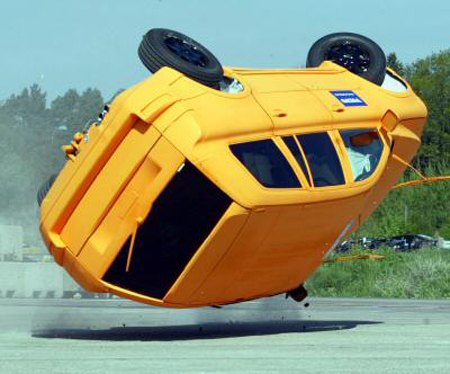
28002-rollover-accidents-2222.jpg The National Highway Traffic Safety Administration (NHTSA) has a mission: “Save lives, prevent injuries, reduce vehicle-related crashes.” NHTSA also commits itself to “providing the most accurate and complete information available to its customers, the American traveling public.” While NHTSA’s progress towards its stated goals is (and always will be) a matter of debate, the agency has failed us. They’ve failed to tell the truth about ABS.

Modern ABS consists of a computer (CPU), four speed sensors (one on each wheel) and hydraulic valves (attached to the brake circuit). When the CPU senses that one or more of the wheels are turning significantly more slowly than the others, it decreases the pressure on the braking circuit. If the wheel or wheels then turn too fast (freed from braking), the force is reapplied, creating a pulsing sensation through the brake pedal.

When Bosch’s Antiblockiersystem appeared on the US automotive scene in the late ‘70’s, safety advocates hailed electronically assisted braking as a life-saving technology that would reduce the number and severity of accidents. Tests under controlled conditions seemed to support the contention. NHTSA and the insurance industry quickly embraced and promoted the technology.

Thanks (in part) to insurance industry discounts, almost every passenger vehicle now sold in America is fitted with ABS. NHTSA’s web site proclaims “…an antilock brake system (ABS) is a safe and effective braking system. ABS allows the driver to maintain directional stability, control over steering, and in some situations, to reduce stopping distances during emergency braking situation, particularly on wet and slippery road surfaces.” The real-world evidence doesn’t support their claims. 

Researchers have compared accident and fatality rates for vehicles with and without ABS. Other studies have examined the driving records of ABS and non-ABS equipped taxi drivers in Munich and Oslo. The accident and fatality data shows that ABS exacerbates the severity of accidents in certain situations. The taxi study proved that drivers tend to take greater risks in cars equipped with ABS (although the difference in collision rates was not significant).  In short, ABS may do more harm than good.

More specifically, the studies show that ABS has no real-world effect on dry-surface braking, ABS-equipped vehicles take longer to stop on ice than non-ABS vehicles, ABS-equipped vehicles are more prone to roll-over accidents than non-ABS vehicles, ABS-equipped vehicles are involved more often in single car fatal accidents than non-ABS vehicles, and drivers of ABS-equipped vehicles tend to drive faster and apply their brakes later than non-ABS drivers.

The AAA Foundation for Traffic safety has determined that improper driver steering in an ABS-equipped vehicle can send it veering out of control. In their tests, jerking the wheel (as if trying to steer around an obstacle) in a 35 mph panic stop sent ABS-equipped cars careening across two lane widths. (Without the ABS, the car skidded in a straight line.) This behavior may account for the higher roll-over rates for ABS-equipped vehicles. Other research revealed that many drivers don’t use ABS properly; they pump the pedal as they would regular brakes.

NHTSA, the insurance industry, manufacturers and engineers are all well aware of ABS’ shortcomings. In 1994, Dr. Charles J. Kahane published a paper for NHTSA entitled “Preliminary Evaluation of the Effectiveness of Antilock Brake Systems for Passenger Cars." Kahane reported that “All types of run-off-road crashes – rollovers, side impacts with fixed objects and frontal impacts with fixed objects – increased significantly with ABS. Nonfatal run-off-road crashes increased by an estimated 19 percent, and fatal crashes by 28 percent.” Kahane also concluded that “Rollovers and side impacts with fixed objects… had the highest increases with ABS. Nonfatal crashes increased by 28 percent, and fatal crashes by 40 percent.”

In 1996, the Insurance Institute for Highway Safety published a news release titled “Antilock Brakes Don’t Reduce Fatal Crashes; People in Cars With Antilocks at Greater Risks- But Unclear Why.”  In 1998, Leonard Evans of General Motors’ Global R&D Operations checked NHTSA’s ABS crash data and concluded “it is unlikely that on dry roads ABS can materially reduce risk” and, more shockingly, “ABS is associated with a 44% increase in rollover risk.” In 1999, the Society of Automotive Engineers reported that “ABS was found to be associated with a 51 percent increase in fatal rollover crashes on dry roads. For fatal side impact crashes, ABS produced a 69 percent increase for unfavorable road conditions, and a 61 percent increase for favorable road conditions.”

The average cost of an ABS system is $240. Multiply that figure by millions of vehicles, add the number of lives lost and the injuries suffered because of ABS' ill effects, and the true cost of this potentially lethal braking systems is evident. At the very least, NHSTA should launch an immediate investigation into the advisability of fitting SUV’s with ABS. Meanwhile, you’ve been warned: ABS can kill. 

107 Comments on “Killer ABS...”


  • Jonny Lieberman
    Jonny Lieberman

    Yes, but ABS conbimed with traction control without question saves lives (traction control/stability control cannot exhist without ABS).

    It has saved mine.

  • michael deskevich
    miked

    Ah ha! I’ve always thought ABS was the devil incarnate! Now I see there are studies that support my own personal experiences. It would be nice if this would get enough press so that at the very least manufacturers would let us choose if we want ABS on a new car or not. I’m not looking to take away ABS from those who truely want it, I just want to be able to not have it. I know if I pull the ABS fuse my insurance company would not cover me if i got into an accident, so I’d love a way to legally not have ABS.

    Frank – can you post links to those studies. I’m too lazy to do the research you did, but I’d love to read the source material.

  • gearhead455

    ABS brakes can only offer directional control during a brake induced skid. It’s entirely up to the driver what happens next.

  • Sajeev Mehta

    It may not help on dry roads as mentioned, but ABS on wet roads is a Godsend. We need some stats on that. I’m reminded of my time with the Toyota Tundra towing a load. Jamming on the brakes going downhill with ABS meant I had to modulate nothing, it just worked.

    Frank, these figures don’t work for me. ABS stops a car faster in most every condition.

    The problems with ABS (rollovers, etc) mentioned here sound like poor driver education for emergency maneuvers. Then again, that’s almost always the problem these days.

  • Jon
    imageWIS

    Yeah, but Jonny, that’s because you were driving Fords…

    Jon.

  • Nicholas Weaver
    Nicholas Weaver

    On my motorcycle, I locked the front wheel up once. Scared the crap outta me.

    My next motorcycle WILL have ABS.

    On consistant pavement, a good driver/rider can outbreak ABS by a couple of percent, as they can threshhold brake.

    But once you get some dirt, gravel, water, pothole, any other variable condition, you need the lock & release of the ABS to prevent a lot of big problems.

  • dolo54

    technology is not a good substitute for good driving skills. I much prefer modulating my braking or doing a controlled skid if I choose to over ABS. my current car has ABS, but it’s so light it still allows me to skid if I slam the brakes. unlike other cars I have driven with over-zealous ABS which drove me nuts and made the car way more dangerous. I think the main problem is people never get experience at controlled skidding, braking on slick/icy/snowy surfaces. everybody should do themselves a favor and the next time it snows, drive to an empty parking lot and practice skidding around in the snow. eventually you will be able to really handle it and over time it will become second nature. then you won’t need or want ABS.

  • gearhead455

    ABS brakes ARE conventional brakes until you lock them up. The brake skid threshold is the same on cars with or without so really it’s up to the driver.

    Also not mentioned, ABS brakes are excellent for braking on surfaces that do not have the same traction properties on both sides of the car (like when two wheels are on gravel and two wheels are on pavement).

  • George Denzinger
    geozinger

    I seem to remember reading a similar article about ABS several years ago maybe in Car and Driver. ABS wasn’t as effective on gravel, several inches of snow and some other conditions.

    Up until 15 or so years ago, we didn’t have ABS as standard equipment on most cars, so on the occasions that I managed to invoke the ABS on my cars (that do have it), it was a little unnerving. With that I would take my foot off the brake thinking that something was wrong with the car. Then, stomp the brake pedal again, to prevent smashing into whatever was in front of me. I finally spent some time in deserted church parking lots getting used to the feel, but even now, it still startles me when it kicks in.

    As some one else pointed out here, inexpensive traction and stability control(s) won’t work without ABS. I guess I would like to see a switch, similar to the passenger airbag switches that could turn off ABS (and by default traction control and whatever else is linked with it) for the occasions I am on one of those less-than-ideal surfaces.

  • Robert Farago

    Links from Frank (in a meeting):

    http://www.iihs.org/news/1996/iihs_news_121096.pdf

    http://www.nhtsa.dot.gov/cars/rules/regrev/evaluate/808206.html

    http://www.accidentreconstruction.com/newsletter/jul06/ABS_Risks_of_crashes.pdf

    http://ej.iop.org/links/q15/C42GOGNbgobK0l2UPGaOwg/ejp5_6_008.pdf

    http://www.nhtsa.dot.gov/esv/16/98S2O12.PDF

    http://www.edmunds.com/edweb/antilock.html

    http://www.iihs.org/news/1996/iihs_news_121096.pdf

    http://www.aaafoundation.org/pdf/absprobe.pdf

    http://www-nrd.nhtsa.dot.gov/vrtc/ca/lvabs.htm

    http://www.iihs.org/research/advisories/iihs_advisory_17.pdf

  • Jan Werner
    TireGuy

    This feeling against ABS has been persistent nearly only in the US, and mostly with reference to longer breaking distance on completely dry surface.

    However, as some have said already, ABS gives you excellent performance in any other breaking situation, and this is mostly where it counts. ABS even helps the driver keeping in line when the surface is different for the wheels. I myself experienced a breaking test on a testing ground in Germany. The ABS of the car could be switched off. The driver showed us the reaction of the car in the situation where the two left wheels were on wet surface and the two right ones on dry surface (this can happen in winter, or if the driver is a bit off the lane in the countryside). Without ABS the car went completely out of control, turning 3 times around its axis. With ABS on, the car simply stopped in a straight line when the brakes were pushed.

    Everyone can experience the effects of ABS in wintertime, when you have snow: Break with full power if you have ABS – and the car will still go straight and come to a stop, while cars without ABS will skid.

    Regarding Motorcylces, it is estimated that about 11% of people killed today would still live, if they had ABS – nothing worse than if you have to brake, and you fear that the front wheel will block and you might fly off. So people do not break hard enough without ABS, or will flip over. In a recent motorcycle testing event, we had to brake full power from about 50 miles/hr. The reference mark was the mark which can be achieved with ABS!

    Frank, if you fear to flip over: do not buy an SUV, there are enough editorials on TTAC about this. Or equip the SUV right away with ESP, the stability program, which will help you stay in line even if you just go too fast through a corner, and which is the advanced ABS system.

  • Jonny Lieberman
    Jonny Lieberman

    imageWIS,

    It was in a Porsche 997

  • Are these accidents the fault of ABS or the driver if ABS allows average drivers to get closer to the edge of the stability of their car without fearing it? For average driving ABS may come on now and then leaving the driver more confident in their driving, but in a very dangerous situation they will quickly outrun their ability to control the direction of the car.

  • Glenn Arlt
    Glenn

    We need better drivers, trained to understand physics are not overcome by technological advances. Instead of idiots saying “oh, yeah, this car has xyz technology, so that means I can go faster” and then they go kill themselves because they drive past the physical capabilities of the vehicle, tires and road, we need well trained people using common sense.

    Not very likely, is it?

    I’ve read before that now that cars have such fantastic brakes compared to years ago, that everyone leaves braking until way late compared to what they used to. How stupid.

    My experiences? Well I can give you two.

    One. My buddy was showing off, screamed into his garage with a Chevy
    S-10 and was going to jump on the brakes to make noise and smoke (and leave some nice black marks) just for laughs. Drove right through the back of his own garage when the ABS kicked in. If only I’d have had a video camera.

    Two. I was driving my Prius along a winding road alongside a lake at about 45 mph (the speed limit, believe it or not yeah, I was actually going the limit) and this youth ran right in front of me with a wheelbarrow filled with yard trash. I don’t know how he couldn’t have seen me (I drive with my headlights on). My Prius has ABS as well as computerized brake assist, which means that the computer programmers “know” that we humans never push hard enough on the brake pedal when stopping in an emergency stop, so the computer recognized the fact that it was a panic stop from the short time it took to go from the “go” pedal to the “stop” pedal and essentially maxed out the brakes.

    It was incredible how short we stopped. I JUST missed the kid. Yeah, it was a dry road. ABS did not kick in to my knowledge, but who knows? As the saying goes “it happened so fast.”

    Had I been driving my “conventional” car with no brake assist (and no ABS), I know from 65000 miles of driving, and knowing how fast it can stop, that I would have driven right over the kid and the wheelbarrow too.

    As for needing better drivers, you only need come out for a ride with me any time of any day to watch the other drivers on Michigan roads.

    Going to town yesterday evening, a 17 mile run, I had the misfortune of having a cop pull out from a gas station behind me. He didn’t bother going after the guy who turned left across my lane RIGHT in front of me, no, he just “had” to go to town, right? No sweat, I’m at the speed limit.

    About 5 miles down the road as I crest a small hill, I’m suddenly aware that there is a car in MY lane except he is coming my way at about 75 (in a 55 zone) and I’m going 55, so that is obviously a closing speed of 130 miles per hour. I jump on the brakes, pull the wheel to the right, give the idiot who just “had” to pass another car on a double yellow line room enough to go by.

    Wow, miracles DO occur. The cop actually turned around and busted him.

    On the way back home from town, I had some bingo the evil clown driving 75 fly up on my tail (we’re talking about a 2-lane highway here) and get all upset because I was actually going the limit (the sign of an extremely bad, selfish and dangerous driver. In my 30 plus years of driving I’ve seen it all). He tailgated me for a moment, passed, then proceeded to tailgate the car in front of me SO closely (the 2nd driver was – guess what? – going the speed limit), flashed his lights in impatience, and was rewarded by the car in front slowing down to 30 mph. And why not? The Honda driver in front clearly was being threatened by an idiot wielding a deadly weapon. Or, hadn’t you thought of it like that before?

    That was 2 incidents out of about 6 that I saw in one 35 mile drive to and from town, and it is generally worse than that on my weekday commute.

    Perhaps a tongue-in-cheek solution to the idiots on the road is to mandate that ALL safety equipment is taken out, and cars return to 1962 technology, like my Corvair Monza.

    Steering colunn? A solid piece of steel ready to impale your chest. Brakes? Drum, no power assist, no ABS, no nothin’. Handling? Swing axles, rear engine bias, watch out for snow/ice/rain/sidewinds/trucks going by. Steering? The original “Lucy Goosy”. Seat belts? Whadaya think you are, race car driver? You don’t need any seat belts. Roof? It’s cloth, after all it’s a convertible, isn’t it? Halogen headlights? Ha. Not a chance. Air bags? I don’t want any politicians in my Corvair, thanks. Safety door latches? Didn’t you close the door?! Whatsamatterwithyou?

    This would sure cut down on the idiot drivers and their progeny.

  • gearhead455

    Steering colunn? A solid piece of steel ready to impale your chest. Brakes? Drum, no power assist, no ABS, no nothin’. Handling? Swing axles, rear engine bias, watch out for snow/ice/rain/sidewinds/trucks going by. Steering? The original “Lucy Goosy”. Seat belts? Whadaya think you are, race car driver? You don’t need any seat belts. Roof? It’s cloth, after all it’s a convertible, isn’t it? Halogen headlights? Ha. Not a chance. Air bags? I don’t want any politicians in my Corvair, thanks. Safety door latches? Didn’t you close the door?! Whatsamatterwithyou?

    LOL!

  • Jonny Lieberman
    Jonny Lieberman

    The reason the kid didn’t see you if one of the inherant faults with Hybrids.

    They are nearly silent and people are used to being able to head approaching cars.

  • Robert Farago

    Your pro-ABS comments are all well and good, and the article clearly suggests that driver behavior under braking may be at fault (rather than the technology itself), but the stats say it all: ABS = increased risk.

  • Darwin Hatheway
    dhathewa

    How very strange this is. ABS appears to make the roads safer, yet my insurance company still gives me a break for ABS on my cars.

    I’m well acquainted with my insurance compnay and they are ALL ABOUT MAKING MONEY. Trust me on this, they’ve taken away a lot of my money over the years and they dole out payments grudgingly, if at all. Consequently, if ABS was costing my insurance company money, they’d take pains to stamp it out.

  • Jonny Lieberman
    Jonny Lieberman

    yeah, but RF, what about ABS coupled with Traction Control?

  • Logan

    ABS is only as good as it’s tuning… Try driving a FWD car with ABS and a big (stock) front swaybar in the snow with proper snow tires. The car was freakin’ useless until the ABS was disabled.
    I say the auto manufacturers should spend the $240 on driver training that is included with every new car purchase, instead of on an ABS system.
    Oh wait, I forgot, every driver in North America is already a great driver. It’s the other guy that sucks.

  • Robert Farago

    Forgot this one (home of the 51% increased risk stat):

    http://www-nrd.nhtsa.dot.gov/vrtc/ca/capubs/sae1999-01-1288.pdf

  • gearhead455

    I have read the links and not all of it was “bad”… why where the “good” statistics left out?

    Also, most of the data is really old. Drawing Comparisons from the early/mid 90’s ABS units is not really fair.

  • chuck goolsbee

    There are far too many vairables (like drivers!) involved to point to a SINGLE factor like ABS. It is a contributor, yes, but I wonder what else must be at play here? Vehicle weight could be another. Cars are getting heavier and heavier. CoG is getting higher and higher on average as well.

    Tell me why a very small car like an Audi TT should weight 3500 pounds? A car that size could (and should) be 700-1000 lbs lighter.

    As for the NHTSA and it’s mission… in some ways it would be better if a little Darwinism in action on the roads would thin the herd. ;)

    –chuck

  • Todd Roth

    I drove Lincoln Town Car/s (with ABS) for an executive car service in Seattle for three years. With rain and wet/frozen streets the norm, ABS brakes were a great feature. In an emergency, you don’t usually have time to do much except stuff the brake petal through the floor. It was great to have the ABS system provide me with a little optional steering control, not available when all four wheels are skidding.

  • bfg9k

    The AAA Foundation for Traffic safety has determined that improper driver steering in an ABS-equipped vehicle can send it veering out of control. In their tests, jerking the wheel (as if trying to steer around an obstacle) in a 35 mph panic stop sent ABS-equipped cars careening across two lane widths. (Without the ABS, the car skidded in a straight line.)

    So without ABS the car hits the obstacle, with ABS the driver can steer the car around it, and with proper emergency handling skills (i.e. not making a large correction) the car would controllably miss the obstacle. ABS is bad why?

  • Glenn Arlt
    Glenn

    To quote: “Jonny Lieberman:
    August 14th, 2006 at 2:04 pm
    The reason the kid didn’t see you if one of the inherant faults with Hybrids.

    They are nearly silent and people are used to being able to head approaching cars.”

    I was going 45 mph, Jonny. Anything on the flat & level above 40 mph means the Atkinson cycle gasoline engine is running. The Prius was therefore NOT dead silent when the kid ran in front of me.

    Once again, it is simply down to courtesy and being mindful of other people’s needs. Being a mature adult, in other words.

    In electric mode, I don’t go flying around parking lots trying to scare people just for laughs. I’m careful and watch out since people might NOT be paying enough attention, or they may be hearing impaired.

    Is the Prius any different than a guy in a big nearly silent luxury car? Believe it or not, there is a little electric motor noise and tire noise in the Prius.

    If people think this is a problem now, wait until hydrogen fuelled fuel cell cars come about. I understand they are very quiet.

  • Jonny Lieberman
    Jonny Lieberman

    Small tires, low drag co-efficent compared to 19″ low profiles and a huge V* with blocky styling?

    Yes, you are quieter.

    And are you positive your gas engine was off?

  • Jon
    imageWIS

    Jonny,

    I was being factious. Of course ESP / ABS serve a purpose.

    Jon.

  • Glenn Arlt
    Glenn

    A lot of vehicles are quieter rather than louder, Johnny. I don’t think the impulsiveness of a young teen boy running across a road (his parents were there watching and he scared both us and them badly) has anything to do with the fact that my Prius is relatively quiet. Teens just do stuff.

    Back to topic, I think that a lower center of gravity also helps to prevent cars and other road vehicles (read: stupid utility vehicles, pickup trucks and vans) from going greasy side up and (once) shiny side down.

    Some of the most idiotic vehicles out there are the monster pickups and Jeeps with outrageous lift kits. Death traps, in my opinion. Accidents waiting to happen, ABS or no.

    My wife (a nurse) and I came across a very bad accident near our home about 2 years ago (the same highway we go to town on – in fact, we were running to town). A drunk in an SUV had his girlfriend’s baby in the back seat, his on-frame SUV flipped onto it’s side. The drunk was pretty smashed up, the baby was thankfully in the baby seat and only bruised up.

    Had he not been in such a tall, tippy vehicle I think he may have not flipped over. But then, he also should have not been driving drunk. The fact that he endangered a child while drunk driving will gain him extra time in Jackson (prison) – at least, that is the law and I hope they didn’t let him cop a plea.

  • dean

    I have seen several car reviews wherein the writer shames the manufacturer for not putting ABS brakes on as standard equipment. Obviously the superior braking of ABS-equipped vehicles is taken for granted. Whether its the truth or not, I don’t know.

    When I have a chance I will check some of those cites. But as mentioned above, it does sound like some of the data is pretty old. Like everything, control sophistication increases regularly. Modern ABS control modules are no doubt much faster, and more “intelligent” than earlier versions. Perhaps some of these negative consequences are better managed now.

    I think the abundance of safety equipment has lead to a complacency. Not only are drivers more complacent, but licensing authorities may be tempted to take driving skills less seriously, counting on engineers to design out the risks.

  • Bob Beamesderfer
    MX5bob

    Steering colunn? A solid piece of steel ready to impale your chest.

    Steering columns are still solid pieces of steel. The “collapsible” column from the ’60s was a failure as a safety device. That’s we now have shoulder belts and airbags.

  • Shawn Lanier
    Schmu

    not sure about that. tech manuals still describe my shaft as being collapsable, or break away.

  • Bob Beamesderfer
    MX5bob

    Breakaway perhaps, but the one I took out of my first ‘94 Miata had no means of collapsing.

  • Stephan Wilkinson
    Stephan Wilkinson

    ABS is lousy on truly slippery surfaces. I have a quarter-mile-long, relatively steeply downhill, paved asphalt driveway here in the Hudson Highlands. If there’s fresh snow on it, I can slide all the way to the bottom (admittedly in a straight line) by getting firmly into the ABS: the brakes go on briefly, detect the sliding wheels, release, go on again, release…over and over again all the way to the bottom of the hill.

    Had a neighbor come to me awhile ago–similar driveway, similar situation–and she asked me why her brakes had “broken.” Said her Range Rover slid all the way to the bottom of her hill, “the car making an awful groaning noise,” whiule she tried to floor the brake the whole way. ABS.

    If I carefully modulate the brakes, I can stop pretty much anywhere on the driveway I want, given that the stopping distance will be somewhat lengthened.

    I’m the driver-training officer for our local volunteer ambulance corps. The National Safety council CEVO course (Coaching the Emergency Vehicle Operator) that I use teaches that stopping distances can often be longer with ABS.

  • Jonny Lieberman
    Jonny Lieberman

    MX5Bob,

    I’m 100% certain that all cars since “Unsafe At Any Speed” have collapsable Steering columns. Maybe “breakaway” is another term for it, but no major manufacturer is going to open themselves up to a lawsuit like that.

  • Benjamin Stryker
    stryker1

    Maybe for the greater populous this is true. I can even see an increased incidence of roll over (though I’d really like to know if thats just SUVs and trucks) but I don’t believe for a second that ABS brakes don’t stop as effectively as power brakes. If you’re an expert, and know how to pump brakes like a god, then maybe. Most people, even those with power brakes, just put their foot down, and wait. In that case ABS rules the school.

  • Stephan Wilkinson
    Stephan Wilkinson

    stryker, you either live where it’s flat, or where there’s no snow. Or perhaps both.

  • Aditya Kasarekar
    a_d_y_a

    Where are the high quality articles on TTAC?

    Sensationalism at its finest. Sounds like Fox News. Killer ABS. Jeez. Sounds like the killer bees.

    Please dont convert one of my favourite sites into headline whore.

  • Robert Farago

    Point taken.

  • Bob Beamesderfer
    MX5bob

    MX5Bob,

    I’m 100% certain that all cars since “Unsafe At Any Speed” have collapsable Steering columns. Maybe “breakaway” is another term for it, but no major manufacturer is going to open themselves up to a lawsuit like that.

    Jonny, I’ll send you a picture of the steering column from my Mazda. There isn’t anything that would collapse. Breakaway at the universal joint maybe.

  • Tore Softing
    tsofting

    I have heard of these studies, and I think the only conclusion that can be drawn from them is that drivers will (from time to time) use their vehicles to their full potentials, meaning that if you drive an old clunker on bald tires on a snowy road, you will be very, very careful, whereas if you drive a new car with ABS and skid control systems, you tend to feel a little too safe and go a little too fast. Being located solidly in the snow belt with months of winter driving in a normal year, I would certainly not have forfeited ABS and Traction Control on my BMW 5-series E39. The dude behind the wheel will always be the most important variable that decides the outcome of the journey. I mean, you cannot seriously suggest that it would be a boost to safety to go back to nose-heavy, RWD, solid-axle, drumbraked, non-ABS vehicles!

  • Chris Coulter
    ret

    To: Stephan Wilkinson

    I grew up and learned to drive in northern New Hampshire (pretty much the same climate as NY) and I’m really curious to know what you mean by “carefully modulating” the brakes and how that differs from the way you would approach the same hill using ABS? Do you drive ABS equipped vehicles with reckless abandon?

    And can you be certain that ABS is at fault? Did you ever try driving down the same hill during the exact same conditions with two vehicles that are identical but for the presence of ABS?

    I don’t mean to single your story out, but all of the articles posted (and the anecdotes in the comments) point to the culprit as being driver error or, at best, an undetermined cause for the correlation. Whether it’s lack of driver education, lack of confidence, or just rampant Luddism on everyone’s part, the difference doesn’t point squarely at ABS being the bad guy.

    There are situations in which wheel lock-up can stop you faster (e.g. – soft gravel or deep snow) or is preferrable form a performance standpoint (e.g. – driving a rally car or initiating a drift) but for 99% of real world driving situations, ABS seems the better choice. I refer you to quotes from the posted articles:

    “Involvements in multivehicle crashes on wet roads were significantly reduced in the cars equipped with ABS: fatal crashes were reduced by 24 percent, and nonfatal crashes by 14 percent. Fatal collisions with pedestrian and bicyclists were down a significant 27 percent with ABS.”

    “ABS confers the capability to steer a car while slamming on the brakes, but the average driver in a panic situation might not always use this capability to advantage, and might even steer the car into a worse situation than the one which the driver was trying to avoid.” [emphasis added]

    “Experts and insurance representatives appear to be evenly split on whether drivers or ABS engineers are to blame”

    “People who buy vehicles equipped with these systems need to re-educate themselves and lose those old ingrained habits. They need to go to a vacant parking lot on a wet or snowy day, and practice using ABS so they know what to expect when an emergency situation presents itself.”

    In fact, the AAA article is entitled Improper Steering Endangers Drivers With Antilock Brakes! I don’t know how much clearer the evidence can be. Despite Mr. Williams’ attempt to portray ABS as a “potentially lethal braking system” the only dangerous thing in these cars would appear to be the drivers. Why not complain that the 400hp engine in a Corvette is a “potentially lethal propulsion system” since a great number of ‘Vette drivers haven’t got a f’ing clue how to control 400hp? I’ve no sympathy for someone who wraps themselves or their vehicle around a tree due to their own incompetence or their failure to familiarize themselves with the characteristics of their vehicle.

    Honestly, all of the data point to ABS reducing the likelyhood of someone else killing me and increasing the likelyhood (if they can’t drive) of killing themselves. As long as ABS doesn’t increase the danger to me, I couldn’t care less about other drivers’ single vehicle crashes.

  • Robert Farago

    I’m not buying that arguement. If people are morons (or incompetent drivers), safety systems must take that into account. You’re blaming the victim.

  • Lucas Zaffuto
    lzaffuto

    Where is the data on new vehicles? If you’re going to base a conclusion on old data, maybe electronic fuel injection and computer management is a bad idea too… after all, so many vehicles in the late 80s and early 90s had problems with it.

    I’m not saying it’s not true, but I’d have an easier time swallowing it if the studies said “on 2000 or newer vehicles(6 years should provide plenty of data), ABS has caused more accidents than non-ABS equipped models”. Of course, then you have the issue of almost everything in those years coming with ABS, so it would skew the results. You would have to compare only models that ABS was an option.

  • Doug Allen
    Blunozer

    Quote=:a_d_y_a:
    ___________________________
    “Where are the high quality articles on TTAC?

    Sensationalism at its finest. Sounds like Fox News. Killer ABS. Jeez. Sounds like the killer bees.

    Please dont convert one of my favourite sites into headline whore. ”
    ____________________________

    My thoughts exactly.

    What’s next, an unintended acceleration article? Exploding GM pickups? Don’t bother… It’s been done.

  • Stephan Wilkinson
    Stephan Wilkinson

    Ret:

    I’m not saying you don’t know how to drive in snow, I’m just questioning how much experience you have using ABS in snow. If you’re 25 and grew up in NH, probably plenty. If you’re 55 and now live in Socal, possibly none.

    All I’m saying is that driven as most people do–my neighbor who braked her Range Rover hard, terrified as it simply slid all the way down her driveway in the snow–ABS can increase stopping distances greatly on very slippery surfaces, since it simply constantly “unbrakes.” Whether this is the result of “driver error” is debatable, since many drivers are taught, “Do not back off or pump the brakes if you have ABS, Depend on the ABS to stop you.”

    By “carefully modulating” the brakes, all I mean is that I brake lightly enough to get some grip out of the tire treads against the snow. It takes awhile, but you can slow the car more and more until finally you can get it stopped.

    And yes, of course it’s the ABS that’s causing it. I can feel it and hear it. Have I tried it with two identical cars, one with and one without ABS? No, but last winter I remember having a Toyota Camry on test and I slid it all the way down the driveway (intentionally) by depending on the ABS, then turned around and went back up and stopped the same car a quarter of the way down the hill by modulating the brakes. (And no, I didn’t go down the tire tracks established by the first run, I moved over six inches into fresh snow.)

    This is neither a secret nor a mystery among car writers. I’ve discussed it with a number of people far more skilled and knowledgeable than I am. Don Sherman, for one.

    ABS is excellent in most situations. I think it’s great. Just don’t be surprised if your car won’t stop on snow, and prepare to back out of the brakes some.

  • Chris Coulter
    ret

    “If people are morons (or incompetent drivers), safety systems must take that into account.”

    Why? If you start making that argument you end up with things like automated seatbelts and daytime running lights. And don’t the test data point to ABS being safer in terms of reducing multi-car accidents? I may be arrogant to say this, but I fear the incompetence of other drivers a lot more than anything else on the road. As I said, if ABS keeps other a$$holes from crashing into me, I’m all in favor. I don’t care if they end up in a ditch on their own.

    Why do safety systems have to protect people from themselves? What ever happened to taking personal responsibility for your actions, posessions, and education? Shouldn’t our driver’s education programs make it a priority to familiarize people with the functions of a modern vehicle? Let’s take a look at that pathetic system which requires less skill and involvment from the participants than if you asked them to get their license out of a Cracker Jack box! Seems a better place to start than with a 25 year-old, constantly improving technology which is proven (by the very same studies cited no less) to be safer in most instances.

    “You’re blaming the victim.”

    It seems appropriate given the articles posted. Not to blame the victim opens to door for: “Oh no! Big bad BMW/GM/DCX/FMC sold me a car with a system that’s proven to be safer to everyone else on the road around my stupid ass, but I’m too much of a chucklehead to bother to learn how to handle the vehicle.” Look, I’m not wishing for anyone to actually get hurt, but when I read the studies cited by Mr. Williams, I don’t see “ABS is dangerous”. I see, “People don’t know how to handle ABS”.

    There’s a parallel with the debate over gun control. Some people would have us blame the ABC Gun Company when someone commits a murder with one of their guns. Well, this would be like blaming the gun manufacturer for someone blowing their own head off. I’m sorry, but talk about specious arguments…

  • Chris Coulter
    ret

    I’m 32 and been in NH all my life. Not as much snow experience as some, but more than a lot of folks. Regarding the Camry incident; I’m fulling willing to admit that some manufacturers need to retune their ABS algorithms, but the basic theory is solid. More importantly though, you were able to use an ABS equipped car to stop exactly the way you wanted it to. That simply proves my position, that superior driver skill is the more important factor.

    The bottom line (which I believe is supported by the cited studies) is the following. Rather than kill off ABS, let’s make sure people know:

    1) what it’s supposed to do,
    2) what it’s supposed to feel like,
    3) when it’s going to improve your stopping distance,
    4) when your stopping distance may increase,
    5) how well the car will/won’t steer when ABS kick in.

    Do this, and you will maintain the safety improvements of ABS and very likely remove the more dangerous instances.

  • noley

    I agree with Stephan’s last post. I’ve done the same thing and found ABS can increase stopping distances. But most people have no clue when it comes to brake modulation, so ABS is probably good for them. And in some limited traction conditons it really does work well. But not all.

    I was on a one way dirt road in Death Valley in a rented Taurus that had ABS. Knowing no one would be likely to come the other way, I threw the U-Wreck-Em down that road with abandon, the ABS really working in every corner. It did it’s job and the car was very stable under heavy braking, but there was a lot more additional traction on the dirt than on snow.

    It a few real and practice emergency maneuvers on snow and rain in our since-departed Exploder the ABS was merely OK; the truck steered around stuff, but it definitely didn’t like it. Some of this was the handling of the truck, and our Saabs are a lot better, but in practicing this stuff with ABS I’ve come to realize that is really has it’s limits and I can see how people can get in trouble with it, mostly by over connfidence. I mostly tend to drive as if I don’t have it, and it’s there if I need it.

    Overall is it good? I think so, and I’m especially glad my wife and daughter have it in their cars, but it’s too bad that it requires some training to really use effectively. In fact, there are a couple of driving schools in New England that have courses in energency driving maneuvers and a big part of the courses focus is on ABS.

  • Brian Hendrickson
    ZoomZoom

    This is why I don’t believe them when they say…

    Coffee is bad for you…
    Soda is bad for you…
    Cell phones are bad for your brain waves…
    The planet is warming up…

    You hear one study where these things are going to be the death of us all, and six months later, there’s another study saying that it’s not that big of a deal.

    “They” can just never decide. Fear-mongers are despicable!


Back to TopLeave a Reply

You must be logged in to post a comment.

You can also login using Facebook Connect. Connect with Facebook

Subscribe without commenting

Recent Comments


Auto Insurance GPS Navigation
Car Loans Auto Parts
Car Warranty Wheels
Automotive Tires Car Care