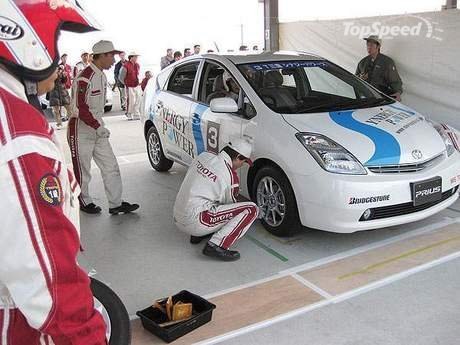


Let’s get one thing straight: There are very few inanimate objects which inspire my personal distaste, contempt, and revulsion as much as the Toyota Prius does. It’s a sad, sick, suppository-shaped little plastic box which exists for the sole purpose of letting spoiled, faux-progressive Americans feel virtuous as they continue to consume the lion’s share of the world’s finite resources. I will go to my grave believing that the Japanese Government subsidized its development for the purposes of economic warfare on the United States, and that the Prius lost money for years in a way that no automotive nameplate that does not begin with “Aston” would consider even vaguely defensible. Sometimes, the Prius even kills its own assembly-line workers. In my perfect world, it would extend the same service to its smug, open-mouthed, emo-glasses-wearing, lane-blocking owners.
I could go on, but you get the point: I hate the car. And yet, when I read Jay Shoemaker’s infamous single-star review of the latest model, I cannot help but think that in his place, I would have given the blandmobile from Toyota City four stars . . . or, whisper it, five.
TTAC stands virtually alone among major automotive news sources in providing its reviewers carte blanche to review a vehicle as they see fit. The flip side to this is that the reviewer is understood to speak for himself, not for the site as a whole. The road tests in magazines like Car and Driver are intended to represent the opinion of that magazine, not that of Tony Swan or Patrick Bedard in particular, so the opinions of the individual writer are smothered beneath a leveling flow of groupthink. The reader is therefore reassured that Car and Driver conducts all its reviews using approximately the same standard, and that one may read individual reviews of competing products and obtain a useful comparison by doing so.
Bland consistency is the secret behind Ray Kroc’s billions and billions served, but it holds no sway on this website. Our reviewers judge cars by widely different standards. The new Mustang? I loved it, but Farago thinks it’s lousy! Our methodologies differ widely. Sajeev Mehta examines assembly quality, Robert considers market positioning, I recently took a drum-rear-braked Ford Focus to a public trackday and passed an Exige by cutting an entire corner on the track and showering the Hethel hearse with dirt and rocks. We’re all different and we’re all permitted to have our say.
With this in mind, I’d like to receive some guidance from TTAC readers as to how I rate cars, and if the other reviewers choose to take heed as well, that is up to them. From my reading of the comments surrounding Jay’s test, I have concluded that there are three major suggested rating methodologies:
1. Rate the car in accordance with how well it performs its particular intended mission. We rate the Prius on its efficiency, the Veyron on top speed, and the Sonata on how well it matches up to the Accord.
2. Take the core qualities of a car for granted and rate it on its ability to perform other tasks. We assume the Prius is efficient, so we judge it based on excitement or aesthetics. We know a Veyron is quick, so we rate it based on its usability.
3. Consider how the vehicle stands within the overall automotive marketplace and rate it accordingly, adjusting for price or not as you see fit.
Let me take those in reverse order. I’m not a fan of “overall rating”. Consider the Honda Civic. Compared to a BMW 335i, the Civic is a piece of garbage. Compared to an Elantra . . . not so much. Which comparison is more important? Nor do I like the idea of rigorously price-adjusting ratings, because it leads to comparison tests where the Infiniti G37 “beats” the aforementioned 335i despite being wholeheartedly inferior.
The second idea, advanced by several TTACers in the Prius-test comments, also leaves me a bit nervous. I don’t like the idea of rating a Lotus Elise on storage capacity. You could argue that most of the major magazines use #2 as their guide, which leads to universal praise for well-rounded cars like the Honda Accord. The Accord’s a great car, but for some people the Altima is better and for others the Camry would satisfy more, precisely because those two vehicles stray from the “all-rounder” idea to emphasize individual features.
Which leaves us with #1. That’s how I like to rate a car. The Mustang GT500 is a five-star car because it’s the best ponycar you can get, the Prius is probably a five-star car because no other hybrid delivers the unique features and experience to the same extent, and the BMW Z4 is not a five-star car because it falls short to the Boxster in all the ways that really matter.
What do you, the TTACer, think? I’ll read all the comments, attempt to figure out what the majority opinion is, and deliver my next review (the 2010 Ford Fusion SE Duratec six-speed) to your specifications.
93 Comments on “Editorial: Star Search...”
Back to TopLeave a Reply
You must be logged in to post a comment.
You can also login using Facebook Connect.


Get rid of the stars, period. It just doesn’t work, given that there aren’t any consistent parameters. Even if the feedback from this editorial gives you the parameters you’re looking for, who is to say that any other reviewers will adopt them? As long as TTAC works like it does – giving their reviewers the long leash, the star system intrinsically makes no sense.
The recent Prius review strongly reinforced my position. I agree with you that it should have been rated (at least partially) on these two things: Is the new Prius better than the old one (every other review says yes, including the handling); and is it an effective high-efficiency car? Let me clarify:I have no problem with the Prius review as it, given its obvious subjective tone. But to marry it with stars makes no sense.
On the rare occasion I do a review, I omit the stars, period.
The only thing I dislike about any of the reviews are when the thinly-disguised political agenda rants creep in. For example from your post:
…plastic box which exists for the sole purpose of letting spoiled, faux-progressive Americans feel virtuous as they continue to consume the lion’s share of the world’s finite resources…
That’s about as subjective statement with nothing but anecdotal evidence to support it at best. Furthermore, it has *nothing* to do with what car nuts may or may not like about the car.
Drop that kind of stuff and keep the reviews the way the are, ie. all over the map. *That* is one of the few things that keep many of us coming back to the site. I often like the reviews of cars you hate more because that typically highlights aspects of the vehicle that others may find appealing. It also makes one thing a bit harder in terms of “defending why I think this is a good car” when somebody rips off a great screed about why (insert hated car of choice here) sucks so bad.
I don’t like stars. I like reviews that are interesting and indicate that the writer spent some time thinking about how to communicate his experience with the item to the audience while also taking the interests of the audience into account. So purely personal reviews filled with a lot of unjustified invective are also not that effective to me.
All in all though, I never even look at the stars.
Consider the cars intended mission (period)
I say screw ratings/stars/thumbs/et.al. They appeal to the lowest common denominator, not TBTB.
BTW, screw how we feel. Just keep writing from the heart.
PS: Your diatribe of the Prius was dead-on and I give it a “10″ (wink-wink).
Jack,
Assign it as many or as few stars as you like.
Shoemaker’s one star tells me he’d rather drive an Aveo. I’ve driven the Prius myself and it’s nowhere near that bad.
It would be equally crazy for you, I think, to assign it five stars. That suggests you’d be equally happy driving it as you would that 300hp Lotus. I believe this is not the case. Five stars would not be Baruth’s review, which is the review I want to read.
The Prius will just have to wait for the KixStart review to get a chance at five stars. And, if that ever happens, I’ll be rating it as the transportation-oriented person that I am and I’ll be thinking about the other transportation appliances that I know and {love | loathe}.
Maybe the right solution here is for the reviewer to review the kinds of cars that the reviewer would really consider. Would ever have a reason to consider an Aveo? No? Don’t review it. Someone who’d consider the likes of a Yaris, a Fit and an Aveo should probably review those cars.
Your upcoming review would IMHO serve to highlight difficulties of choosing a singular methodology for determining a star rating. What should a Fusion be? Another Camcordimabu? What are they?
Like psu I don’t really pay attention to the stars. I read the review, take note of the specific points and try to draw from the review and the author’s other articles what perspective they take. Then I glance at the stars and either they jive with the article (and author) or they don’t. It is neither here nor there…the writeup is what leaves the impression on me.
BTW looking forward to the Fusion review. Previous review of 2009 (08?) S-trim left me wondering if the SE would be better, and the Fusions are on my constantly maintained irrespective of buying schedule short list.
If you’re going to have stars at all, can you please include a key so we know exactly what X number of stars means? I.e., whether one star is just poor or godawful and terrible, etc.
I call this the “Prius phenomenon”–conserving in one very conspicuous area but guzzling energy elsewhere. For example, some people at my company drive 5 miles to the train station and take a 10-person van 5 miles from the end of the rail line to work as part of their daily commute, but are strangely horrified that I sometimes drive 2 miles directly to work in a vehicle that makes merely average fuel economy numbers.
Personal vehicle use is just the start. A few years ago I estimated that $1 of electricity puts about the same amount of carbon into the air as $1 of natural gas or $1 of gasoline. One Prius driver I know has $200/month electricity bills year-round and $200/month natural gas bills during the “winter” months. (”winter” = temperatures range from 35 to 75 degrees) They are emitting carbon dioxide at the equivalent rate of 1800 gallons of gasoline a year, but they managed to cut 100 gallons of actual gasoline use.
Oh, there are stars at the end of the reviews? I never noticed them before!
That said, the great thing about this website is that the reviews are well-written, opinionated, and entertaining. What more could you ask for in a car/music/food/movie review? Who cares how many stars the car gets?
I like the stars – it lets me know what’s coming. Perhaps have a by-line: This car’s mission is __________. I may or may not agree with the review and that’s ok.
I like if politicizing is done in a humorous way, but not as a social jab (like the comment above). Although the Prius is not for me (I’d like a Fusion hybrid wagon myself), I’m thankful there are thousands of people who like them enough to save a lot of fuel by driving a high mpg car. Their purposes for doing so (and in broadcasting the fact through such a notorious vehicle) I could care less about. They’re saving fuel.
Thanks for meeting my needs.
Vehicles should be rated on how well it performs its intended purpose with additional feedback based on personal taste but as an example if your predisposed to dislike small economy cars you shouldn’t review them. Just as someone who hates truck shouldn’t review trucks etc.
Option # 1 is what I’m looking for.
Thanks.
Why not just have a set of star ratings:
Fuel economy (1-5)
Transportation appliance function (1-5)
Fun to drive (1-5)
etc?
Your last paragraph makes a lot of sense. Keep the stars, but make them subjective within the car’s context.
Your first paragraph is why I’ve been losing interest in the online automotive community. I love cars, but the car community seems to be radicalizing and pushing people like me away. You guys can expect to lose the support of politically liberal car guys even though you’ll probably be needing it in the upcoming years.
I look at the star ratings section for the comments that accompany them. The entire review is reduced to a set of 11 one-liners, and they’re usually pretty entertaining.
I agree with Jack, and find it best to rate cars in their context.
That said, I assign stars according to competitiveness, desirability and lack of serious flaws.
The best car in any segment easily gets four stars in my book. Often five, if it’s not boring.
A sexy car is desirable. A car that has a certain joie de vivre is desirable. If it’d be embarassing to own, it can’t be desirable. Thus, no toff cars and no a**hole cars top my lists.
Obviously this is all very subjective. Which doesn’t matter, as long as it’s transparent.
Finally, lack of serious flaws means I’d never give a runflat-tired BMW or a uglybland Geely more than two or three stars.
Grog is correct. Keep politics out of it.
Although, I agreed with your description of Prius owners, but it probably needlessly upset some readers.
Oops. I just did it myself.
Sorry.
4thed or 5thed on the politics. The attacks on ownership groups of certain models add nothing. And I’ve seen them on more than just Prius owners. It’s annoying and childish.
I fully agree that the car should be judged on both its market segment and what it’s trying to accomplish as a vehicle.
I’d keep the star system, but with the understanding that it’s the author’s personal opinion on how well the car fulfills its mission, and not TTAC’s as a whole entity. I’d also like more Second Takes on vehicles when possible: if Baruth hates a car and Farago loves it, tell me.
Suitability for the intended mission profile is the most important factor in my view. How well does the model being tested do the job it is being sold to do, particularly in comparison to its direct competitors?
A level of fit and finish which would be excellent in the $20k sedan category would be abysmal if found in a Maybach.
But, slandering the owners of a particular make or model adds nothing to the discussion of a car and pushes people away for no good reason. I’m with Carlisimo when he says: “Your first paragraph is why I’ve been losing interest in the online automotive community. I love cars, but the car community seems to be radicalizing and pushing people like me away.”
I agnostic on the stars but one of my pet peeves would be a “review” of a car that’s more like a roast, i.e. the reviewer starts off with a preconcieved notion of what the vehicle is (and who the intended buyer/driver is) and then uses his “review” to excoriate the car and/or it’s presumed purchaser.
Examples would be a right-wing sports car guy reviewing a Prius (as in this article) or a left wing sports car guy reviewing a pickup or SUV and using the “review” as an excuse to make baseless and stereotypical judgments about the drivers of said vehicles (Sanctimonius NPR-listening democrats or uptight Limbaugh-listening republicans.)
Slamming a Prius because it doesn’t accelerate well, or a Trailblazer because it “rides like a truck” makes no more sense than slamming a Boxster because it doesn’t have enough ground clearance to take on even a mild jeep trail, or slamming a BMW M-series because it can’t tow a 5,000lb trailer.
Those “reviews” may be entertaining to read but they aren’t really “reviews” since they start off with a premise and then every detail is used to reinforce the premise. And no, the occasional damning-with-faint-praise comment (as in “this vehicle doesn’t suck as much as I’d assumed it would) doesn’t change that fact.
It also provides no value to the potential customer who might be cross-shopping several vehicles in the same category.
I’d favor a system of like/dislike. You could do it with smilies, or thumbs up/thumbs down. What did you like or dislike about the car?
On the Focus: I like the fact that I could toss it around the corners faster than a Lotus Elise. I dislike the fact that the Focus isn’t sold in the US. And so on…
On the Prius: I dislike the fact that people buying it buys it because of… and so on. I like it because it actually is a pretty competent vehicle in the usual Toyota fashion, and that it’s the best hybrid sedan out there.
At the end of the review, the likes/dislikes rows up into an overall impression. Was the car good or not? Did you like it or not? Does it hold up to the competition or not? Smilies, thumbs up, and so on…
WHere I live (outside Seattle) the Prius is just a car. I’m not sure how Prius owners in other parts of the country are, but here they seem to have picked it because it suits them and the traffic in the area we live in well. I’m not lining up to trade in my vehicles for one, but I’ve ridden in them plenty of times and they are good, sound transportation that meets the needs of a lot of drivers. If more people drove them, there’d be even more oil left for the people who’d rather drive something more interesting.
Keep the stars. Especially on a site where a car reviewed can at the same time be the greatest ever at one thing and the worst ever at another, the stars are often the only way to tell how the reviewer weighed all the opposing qualities.
And I don’t get your hate for the Prius. It’s one of the most well designed cars in years for lane sharing. Reasonably narrow, properly sized mirrors, not too tall and sufficiently slow witted there is little chance of one suddenly swerving unannounced the way a similarly well proportioned Civic with a fart can is wont to.
Stars??? I seriously didn’t realize the reviewers quantified their reviews with a rating system. I had to look to find them in the previous review, of the Jetta TDI.
Personally, I don’t read the reviews for the information quotient, I read them for the entertainment quotient. Each reviewer has their own style and biases, which provide for much amusement. (I would love to read a Jack Baruth review of a Toyota Yaris, or a Eric Stepans review of a Hyundai/Kia mini-van!)

Frankly, I enjoy each review on it’s own merits. Change the basis of the reviews, and they will still be enjoyable due to the madskillz of the authors.
I read TTAC precisely because it isn’t R&T or C&D or Motortrend. I get the unvarnished truth, from the author’s perspective, which is exactly as it should be.
If you must keep the stars – frankly I ignore them and just enjoy reading the descriptions of the cars – then I vote for rating the car relative to other cars in its class. This is slightly different than method #1. For the aforementioned Prius, I would rate it compared to other small economy cars (yeah, I know, I know, it’s a midsized hatch, whatever) that people might be cross-shopping it against, in other words against its competition. In this manner, price is not strictly a factor nor is how well it acheives its goals, but they are factors in the overall evaluation. To use the Prius example again, compare the Prius to a Civic, Corolla, Mazda3, etc. The Prius would get the nod in terms of capacity and gas mileage, while the Mazda3 comes out on top in terms of smiles per mile (IMO) and cost and the Civic and Corolla fall somewhere in between in those four categories. In this manner you are not comparing a Ford Mustang GT500 to a Civic, yet you are also not judging it based on what you believe its intended goal is (does the Aveo meet its goal of being a cheap, in all senses of the word, competitor in the compact car market; therefore, it deserves 5 stars?), which could result in some pretty interesting star ratings, at least if I were writing the review.
@grog, @shabster – Respectfully, I couldn’t disagree more. First, individual personality is part of what makes TTAC, TTAC, as illustrated in Jack’s C&D example. I’m adult enough to understand that I don’t agree with everyone else’s politics. Besides being impossible, it typically matters very little in a car review. And when it’s obvious, it’s easy to put it into context.
“If you don’t read the newspaper, you’re uninformed, if you do read the newspaper, you’re misinformed.” Mark Twain
I think that most people are viewing the stars incorrectly – as having a perfectly direct correlation to the car being reviewed. This is not Consumer Reports, TrueDelta or TheTruthAboutCamparos. This is a site about great writing, open biases, and submitting to the best audience on the web. The stars are a reflection of the author more so than the vehicle.
For example, how is the marketing miracle that is the Prius a one-star car? I want to read that review. Who in their right mind would give the live-axled Mustangsaurus five stars? I must read that review. Liebermann and I would be on opposite sides of the tear gas at a polical demonstration, but he’s a damn fine writer. If someone reviews a Taurus and gives it three stars, I’ll fall asleep before I can click the link. It’s a so-so car compared to other so-so cars where the winner has the most cup holders and I could give a shit.
@Jack Baruth – I want to know your opinion based on whatever you can back up. The review and the star rating are judged in that context – as should be all writing.

@TTAC – Please keep up the snark, the politics, the great writing. Consider TB&B to be grown-ups and ignore whining liberals! (I kid.)
Rate the cars compared to their competition.
Oh, and regarding “politics”, slurring owner groups etc., as long as it’s entertaining and kept below some sane fraction of total TTAC output, why not? It goes both ways. I know plenty of Prius owners and such who delight in making comments much more derogatory than the above about self evident anatomic deficiencies of those preferring the kind of big V8’s I suppose Mr. Baruth likes.
If such a thing exists, rather than stifling the “creativity” of current reviewers, maybe TTAC could look into hiring a reviewer or two more into cars as “socially responsible” transportation than as high powered playthings; if nothing else to lose the reputation of being “right wing.”
Jack, you raise valid points. I’ve said all along: drop the star ratings. They lack purity of form and only serve to confuse. I see their point for the people, often 1st time visitors, who glance at a review, get a bit lost in the jargon and obscure jokes (which I love, by the way), and just want to see if the car is good.
However, it does not really fit with the site’s mission or “brand positioning”, and should therefore be dropped.
The only way I could see to make them endure would be to rate a vehicle against the segment’s benchmark, without price adjustment. The prius could be compared to, well, another economy car such as a toyota corolla or honda civic, the G37 against a 335i, a Volvo XC60 against a Mazda CX-7 or possibly a Lexus RX350, and a lamborghini against a ferrari.
When a car reviewed IS the benchmark, then it could be compared to the previous generation of that car.
Obviously, that implies that said benchmarks have been tested too, which is not necessarily easy to do.
For starters, I support a contextual review of any car. Begin with asking the manufacturer what the intended mission/purpose of the car is and then proceed to test whether it meets the mission criteria as well as or better than competitors with the same price/mission profile. This is the simplest and most objective way of reviewing. Everything else is merely subjective/personal statements of preference and taste. I may be a petrolhead but I realize that a majority of car buyers aren’t like me. All they want is a reliable, fuel-efficient A to B transportation appliance and I don’t begrudge their preference. Hence, even though I personally dislike the Prius, it does meet the above criteria very well, a mission statement that I’m sure Toyota was also hoping for.
Oh! and the political rants and thinly veiled attacks on buyers of certain cars aren’t necessary!
@M1EK – It exists. Click the link to the right of the stars to get the star breakdown by category. That would be the less subjective area of the review.
I say it’s important to write from your heart. You can also include one paragraph that looks at the reviewed car within the context of its mission. That way we can have the best of both worlds. Having a car reviewed by two or more different dudes helps, as well. The star rating might be kinda useless ultimately, but it gives us a quick-to-the-point idea on what the reviewer thinks.
Very simple system:
1) The reviewer has to be a good fit for the model. Shoemaker would never consider a Prius. Frank Williams would not be at home in a Yaris. I would be a bad candidate for a full-sized SUV. Put us in a Maybach, an Audi, and an Insight respectively, and you would have three great reviews.
2) The comments are TTAC’s self-correcting mechanism. It’s actually pretty interesting for me to read all the feedback because I hear perspectives from a very wide and articulate spectrum. So long as the writer isn’t flamed we should keep it this way.
3) I like the stars. So long as the reviewer doesn’t have an extreme dislike or preconceived bias, the star system works quite well.
Politics? I don’t mind. If it gets too silly I just scroll down and read something else.
I’d also like more Second Takes on vehicles when possible: if Baruth hates a car and Farago loves it, tell me.
Particularly if you can do it in the vein of the old SNL “Count/Pointercount” skit ala “Jane, you ignorant slut.” Some good natured chops busting between two car reviewers who have different takes on cars always makes for fine snarky reading.
That’ll also fill in all the spots where you’ve by now pulled the political stuff. ;)
Seriously, the ole Siskel/Ebert approach to car reviews would be pretty cool.
Rate the vehicle for its intended purpose. But that means you have to define what the vehicle’s intended purpose is, which can be tricky. Especially in these days of crossover fever.
Lose the star scale if it is not a constant measure applied by all reviewers. If each writer has his own idea of what makes a car star-worthy, than the scale is nearly useless.
I say keep the politics in! Makes for much more entertaining reading. Funnier too. Plus now that the government has become a part of the automobile industry, how do you factor politics out?
And then there’s this pet peeve of mine about TTAC and most of the auto reviewing press: TTAC and its reviewers seem a little too obsessed with interiors. I’m pretty sure I’ve read reviews where half the article is dedicated to the center console. I do want to know if the interior is made of cheap materials, exhibits poor ergonomics, or has non-functional controls. Beyond that, spare me the aesthetic studies of interior design. This isn’t Architectural Digest. I’d rather get more info on the mechanicals. And more on the reviewer’s driving impressions.
Otherwise don’t mess with success! You have a winning formula here. Minor tweaks and updates are welcomed, but you don’t need to go to the drawing board and release a brand new model for 2010.
Write what you have to say. It’s how you communicate your ideas that keep me coming back. If the language becomes objectionable, I can read something else. But I enjoy the candidness of the reviews. The rating system is somewhat irrelevant other than the author’s recommendation to check out. It is highly subjective.
If Toyota really wanted to sell more Priuses, (Prei?), they should take it racing. I would like to see how well the Prius does in, say, the GT2 or GT3 category of Le Mans.
I don’t really care about reviews that much. With very few exceptions, they usually bore the crap out of me, so use whatever rating method you think makes sense.
Jack Baruth (about the Prius):

It’s a sad, sick, suppository-shaped little plastic box…
Well, bearing in mind the visual you just gave us all, then you’d better move out of the way quick when my Prius approaches your car from behind and I flash my headlights to pass you. I wish more people would move over instead of hogging the left lane.
I’m speaking in generalities here, I know Jack is a rabbit off the line…
Jack Baruth (about Prius drivers):
…spoiled, faux-progressive Americans…smug, open-mouthed, emo-glasses-wearing, lane-blocking owners.
I’m not spoiled or “faux-progressive” (whatever that means). Who’s smug; I’m just trying to get to my destination with all body parts still attached. And what are emo-glasses (I don’t know because I only wear reading glasses, and never while I’m driving).
I don’t block lanes (see above). I do commonly find myself being blocked by big SUVs and minivans, although that perception may simply be my frustration at having my vision of the road blocked. I do think that even busses often go faster than some drivers (of all types of vehicles), and that’s even when the school bus is stopping to load/unload!
Just goes to show, not everybody fits your perceptions.
Jack, I would like to see the following rating system used:
German: The best thing ever, ignore the reliability and the fact that it is on fire.
Ford: The best thing ever for other people to drive, ignore the Chinese fit and finish from the world’s most notorious supplier abuser.
Japanese or Korean: Sucks, not German. Unless you are using it in a race and actually have to win.
GM or Chrysler: Sucks, not a Ford.
Oh, wait, you’ve already taken care of it.
I like leaving the stars undefined. It makes the system a parody of magazines who rate cars on absurd scales of 312 points on 45 subjective criteria. If the reviews are individual, why does the star system have to be standardized?
I just wanted to say that if you rate all vehicles with the same honesty you rated the Prius above and by the same standard of freedom, beauty, and function that a car SHOULD provide… you’re doing it perfectly in my opinion.
I also like the star system as it gives me a quick look at what to expect after the jump.
I would like reviewers to list what cars they own or lease.
I never put too much faith in a single review because I usually don’t fully know the reviewer’s point of reference in relation to mine. You think a Miata sucks compared to a Boxter (rightly so) but I don’t care because I am only looking at the Miata price range and I am comparing it directly to it’s competitors. I devour the comparison tests because they usually point out the minor differences in the cars that people actually make buying decisions on.
Perfect example: when Toyota brought (back) out the MRSpyder and GM produced the Solstice/Sky. Every publication out there did a standard review (good car for it’s mission) and a head-to-head comparison against the Miata. Both nudged out the Miata in hard numbers, and it was duly noted. Bench racers stop here! But when you drove them side by side on real roads and compared them directly as a whole package the Miata was almost always declared the better car because of other things like storage space and “feel”. These are the wonderful, important things that come out in a direct comparison.
There are very few inanimate objects which inspire my personal distaste, contempt, and revulsion as much as the Toyota Prius does.
Exactly fits the definition of hyperbole.
And I guess that’s where I went to the next item. BTW – maybe you should get around more, if you mean this? And I’m not just talking about cars.
For me the wildly variable, personally charged, “ratings” of the cars by some TTAC contributors has led me to regrad this as the least important, most irrelevant part of this site.
Don’t get me wrong, I don’t mind hearing a strong opinion on a vehicle that may differ from mine (irrational, unsupported, jingoistic caricatures of the alleged owners on the other hand are pathetic-no I don’t own a Prius).
Prius, Hummer, Vette or Super7. I buy a car for what I want from it, not what someone else projects on it.
But tying an opinion in with a value statement (stars) is not meaningful, IMO.
Rate it on how it does it’s job.
If you hate cars that aren’t oriented to enthusiasts why test them? You aren’t in the target group anyway so your view is probably less than relevant.
Since this is an enthusiast site perhaps a twin rating would be of use.
Primary rating on how well the vehicle does it’s job.
Secondary rating on enthusiast’s considerations.
Then maybe a personal rant/rave comment on the end.
BTW Jack, thanks for asking. Seriously.
Let’s raise the bar a bit here.
Bunter
rodster-might want to go back and read the Miata/Solstice comparos.
The Miata consistently stomped the Slowstice in the numbers.
Pretty much handed it it’s hat in every area but styling.
That said, you have some good points.
Take care.
Bunter
I recently took a drum-rear-braked Ford Focus to a public trackday and passed an Exige by cutting an entire corner on the track and showering the Hethel hearse with dirt and rocks.
Jack, you know, there is this thing called YouTube for just that sort of thing.
So far I am the only person to pick #2… must be the C/D brainwashing. I think it is safe to say that the Prius (to pick a picked-on car) will easily meet its intended goal of saving gas, so to me the other aspects of the car (performance, handling, utility, etc.) should become the primary subjects of the reviewer’s review.
Aesthetics are subjective, but then so is almost every other aspect of a car –so why focus on the car’s intended purpose in life? We need to know about the other aspects and with only 800 words to go around, every adjective becomes doubly important.
I agree with the person above who said we need more Take Twos or a Siskel/Ebert style review.
Stars, what stars? As with movie ratings I ignore them. But, if you must have them, the stars should be applied within context of its market positioning (i.e., how well does a Prius do X vs. the Insight).
Its interesting that you mentioned CarandDriver as producing an Orwellian “Groupthink” in its car reviews. Before the rag decided to update itself, it used to have five bar graphs on their sides to show you how the rated car compared to its competition in price, speed to 60, gas mileage, braking, and handling. The So-What to this is the reader instantly identified his 1995 Taurus as being in league with the likes of Camry, Accord, and whatever POS GM pooped out at the time.
Every car is designed for a specific mission. A Minivan is not a 12 sec car, autobahn burner or Heavy duty pickup and is successful if it doesn’t pretend to be anything else.