
Good morning, class. Welcome to GM’s Deadly Sins 101. In this seminar we will review and analyze some of the most critical blunders GM made over the decades, focusing on the ill-conceived, unreliable, ugly, and just plain mediocre products that destroyed the company. I struggled mightily with the decision as to the first example, given all the boners available to me. But here it is, GM’s Deadly Sin #1: The 1986 Buick Riviera.
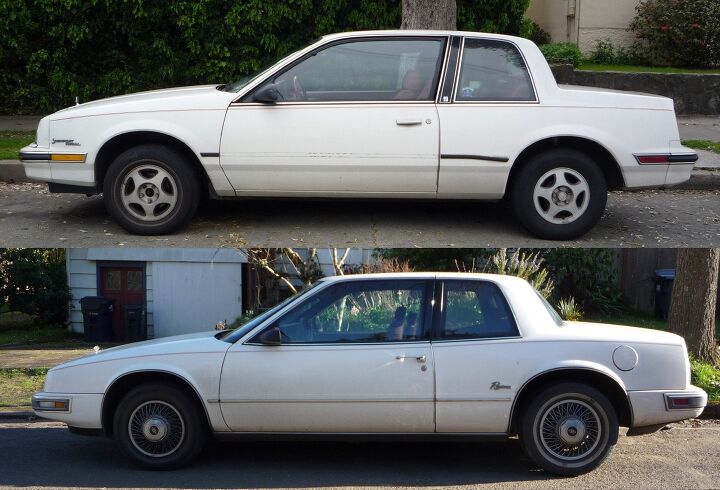
Please take a close look at the image on the overhead projector. You see two very similar looking cars, both Buick coupes from the year 1986. They are very close in size, concept, shape, and even surface details. They share the same basic engine. There’s only one really material difference: the price. One of these two cars cost more than twice as much (125% more) than the other one.
The car on top is a Somerset Regal coupe, which appeared in 1985 and competed with such other august GM compact products like the Pontiac Grand Am and the Olds Cutlass Calais in the popular priced segment (approx. $9K ($18K adjusted)). The fact that it was fairly difficult to distinguish these N-Body cars from one another will undoubtedly be the subject of another GMDS.
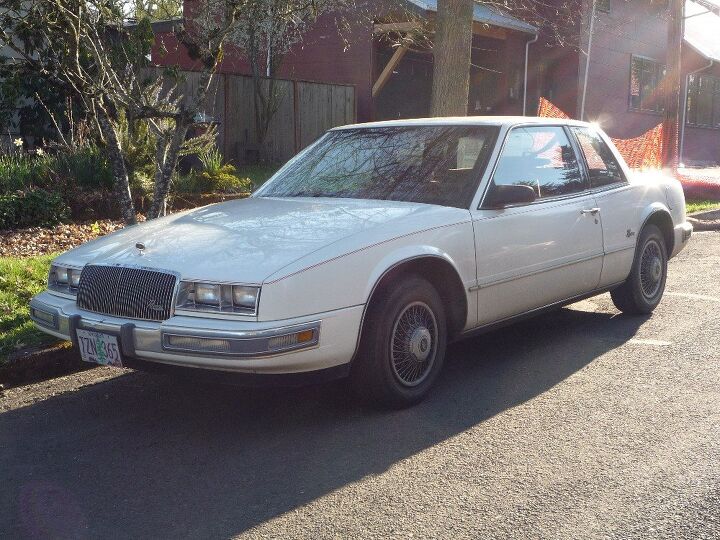
The car below it is the Riviera, which GM released in this form one year after(!) the much cheaper Somerset. Its list
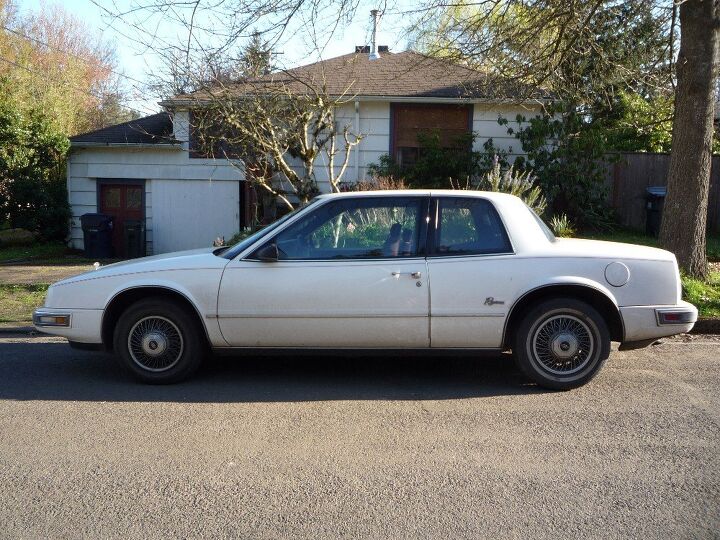
price started at $20,000 ($39,000 adjusted). Since all of you spent $249 to buy my mandatory Curbside Classics textbook and DVD, you undoubtedly remember the chapter on the 1964 Riviera. It was one of the finest, if not the ultimate, post-war American cars. The Riviera and its stable mates Olds Toronado and Cadillac Eldorado were a belated response to the category that the 1958 Thunderbird first defined: the premium personal coupe.
While the T-Bird eventually lost its way and morphed (several times) into something else, the GM coupes came to own that market segment and generated healthy profits as well as the halo effect for the premium divisions. The success of the Riviera, Toronado and Eldorado were one of the key vital signs of health in GM’s far-distant profitable past.
That’s not to say that there weren’t challenges presented by the changing times, especially the energy crises. While the Riviera started out a reasonable sized 208″ length, it suffered the same obesity crisis along with all of GM’s cars. By 1974, the boat-tailed Riviera was up to 223″. But the successful downsizing of 1979 resulted in a fairly handsome coupe, now with FWD and an available turbocharged 3.8 V6. It wasn’t as stunning as the original, but stunning is hard to replicate. But it was back to the original size, at 206″ overall, and substantially more efficient.
It sold well, too. In its last year, 1985, Buick moved 65k Rivs, the all-time high. And then, disaster arrived. The downsized E-body coupes for 1986 were the knock-out punch after the set up of the 1985 C-body sedans, shriveled shadows of the former DeVille, Electra and 98. Sales of the C-body sedans dropped considerably, and Lincoln’s proud RWD Town Car quickly surpassed the DeVille. But that was nothing compared the the E-body nightmare in the making.
All three of GM’s former cash cows suddenly developed cold cow syndrome, with the Riviera’s udders drying up the most. In its first year, 1986, sales were down a stunning 70%. And the drop didn’t stop; by 1988, unit sales were a mere 8,500, an 87% reduction from 1985. I challenge all of you students to find a comparable or worse drop in sales in direct response to a restyle, not economic conditions. Keep in mind that these years were during an economic growth cycle.
The Eldorado gave the Riviera a good run for the money in the first year sales drop, with a 69% reduction. But after another small drop in ’87, Eldo stabilized, for a while anyway. And Toronado came in third, with a mere 62% drop in ’86.
But all three models were mortally wounded by the mummified 1986 re-design, and the ludicrous efforts in subsequent restyles to add overhang to the front and rear of these dwarves became ever-more embarrassing. Bill Mitchell must have been mortified in his retirement.
Buick made a last-ditch attempt to revive the Riviera with the dramatic 1995 model. The G-platform was shared with Olds’ Aurora, but they were one-year mini-wonders, at best. After a brief wave of interest, their auto-pilots were programmed to terminal dive mode. The 1999 model managed just 1,956 units, before the breathing tube was finally pulled on the Riviera.
It wasn’t only the loss of sales of these once glorious coupes that was such a mortal blow. It was what these cars
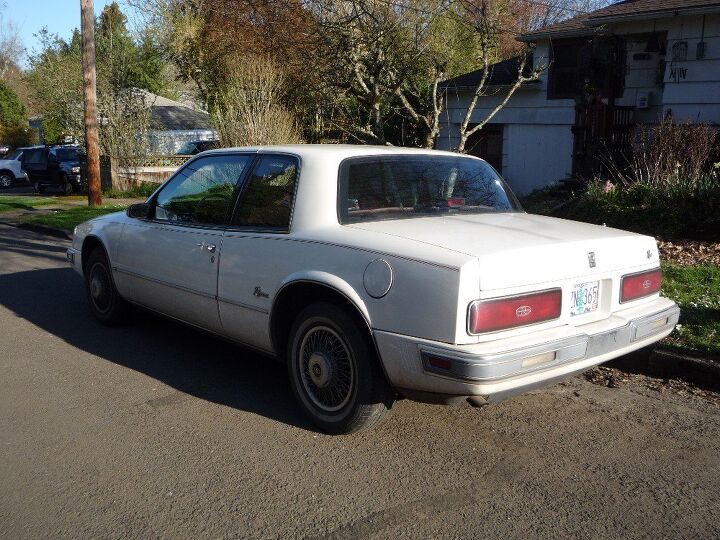
once represented: GM as a purveyor of excellent design, desirable image, decent build quality, and a stranglehold on the mid-upper premium market segment. All these were utterly destroyed. Olds is long gone, Buicks are driven once a day to the senior special at God’s Waiting Room Café, and Cadillac is trying to start from scratch.
We’ll see you again for GM’s Deadly Sin #2. Any questions or comments? Class dismissed.
101 Comments on “Curbside Classic: GM’s Deadly Sin #1: 1986 Buick Riviera...”
Back to TopLeave a Reply
You must be logged in to post a comment.
You can also login using Facebook Connect.


As someone who floated serenely by this debacle with family cars a la Panther, this is a “required course”.
Many were probably under the impression that GM would’ve observed the crash and burn of the ‘62 Dodge/Plymouth downsizing disaster, but no, they were pushing towards the brave new future as they started to plan these platforms in the late 70s/early 80s and found out consumers weren’t quite ready for it.
And when I say ready for it, I mean honestly thinking they’d pay twice as much money for an identical-looking car.
What a coincidence . . . reading your latest post and my having as a renter an ‘09 Buick Lucerne CXL (as I am on a business trip and I thought I would check out what my tax dollars are keeping alive . . an ‘01 Z3, an ‘02 Saab 9-5 aero wagon and an ‘08 Honda Pilot are my personal vehicles). Unlike the model you trash here, this one I am driving is pretty nice looking inside and out (if you can overlook certain things like the vestigial Buick ‘portholes’), the build quality is pretty good and the interior stuff works well. But even now, no one sweated the details of the basic quality of what makes a car a car . . . how it moves down the road. This is a car that I found myself subconsciously not wanting to drive at the speed of the prevailing freeway traffic here in LA (about 70). Repeatedly, I found myself slowing down until I noticed that lots of drivers were passing me . . . and I noticed that I was doing something like 60. This is a car that is work to drive at 70, even in an unchallenging environment like an LA freeway without much traffic. The steering is so numb that constant corrections are needed to follow a straight line or maintain a constant radius in a curve. The car floats on its suspension, threatening to change direction when it comes back to earth. The tall gearing of the 4-speed autobox (1750 rpm at 70 mph) and the modest engine power combine to produce an anemic throttle response until the engine kicks down into 3rd, at which point rpms go up by nearly 1000 with an accompanying increase in NVH and some additional thrust.
Sadly, this car drives worse in every respect than my Honda Pilot, which is basically a truck (and, no, I don’t have any problem being comfortable driving the Pilot at 70 or higher).
I don’t understand why a car that is not a stripper (as this car clearly isn’t) has to suffer with such stupid gearing on the trannie (or, better yet, do without a 5-speed) or without speed-sensitive power steering (recognizing that the car’s target market no doubt wants very low effort steering for the parking lot) or why the shock valving can’t be just a little more damped.
GM is busy advertising the “new, improved” ‘10 version of this car, but how many decades has it been since GM got something right the first time?
The 1964 Riviera was one of the finest, if not the ULTIMATE, post-war cars. Please check the definition of “penultimate”.
Did the trim fall off the door of the Somerset Regal Coupe or what the door replaced in an accident? On the Riviera, why does it appear that the fuel filler door stands proud of the fender?
That’s two other reasons why GM is where it is. Back when these cars were sold, people, who are now in their 40s, may have looked at them and thought the cars were falling apart, right before their very eyes.
And so they bought Toyotas and Hondas, and thus, the Accord Coupe is the Buick Regal and Riviera of the early 21s Century.
I was just reading an old ’80s issue of Car and Driver the other day, and they had an article about the revised and lengthened Toronado. All they did was add sheet metal behind the rear wheels. Sounds like a typical GM solution to me.
How many luxury coupe buyers want a bigger trunk?
The problem with the N/E-Body of that vintage, is its awkward stance. Cab-forward by all means, but the greenhouse seems to be pushed too far ahead, it looks ungainly. The C-post has its visual balance forward of the rear wheel, at the same time that the rear wheel seems pushed back and up into the body. The rear deck seems to low, according to the wheel well. That and the long front overhang vis á vis the distance from the door to the wheel makes it look really awkward. It’s like it had to break really hard from full speed, shifting the weight of the entire body and actually moving it forward towards the front wheels.
baabthesaab: Oops; fixed.
Bruce from DC: the same transmission was in this Riviera!
Very interesting article on a major GM debacle.
GM dramatically downsized its full-size cars because it believed that gasoline would be $3 a gallon by 1985 (and in 1981 dollars).
Ford didn’t have enough money to anything that drastic. It was forced to “make do” with the Panther-based cars and the Fox-based Thunderbird/Cougar/Mark VII. All of which allowed Ford to capture these market segments by default.
By 1988, the Ford Thunderbird had more presence -and arguably more prestige – than the Cadillac Eldorado!
The early Rivs were sweet rides. I owned a ‘66 and to this day would rank it as one of the best and beautiful cars I ever have owned.
Based on my experience as a lot attendant for an Olds dealer in the late 80s, the drawback to the Somerset/Calais was that if you parked them in the sun, the glue holding the dash down would fail and the dash would pop up. There’s one reason to opt for the Riviera!
(How could the engineers possibly have anticipated that some people might park their cars min the sun?)
Moving to transverse FWD in the 1980’s finally killed GM.
GM was a pioneer with longitudinal FWD (in the US, other than the US market footnotes of Cord and Citroen) in premium coupes like the Toronado and Eldorado, but cheap transverse FWD has no place in premium cars. Even Audi knows this. And GM’s large sedans were too big for FWD period.
Moving its premium cars to cheap transverse FWD platforms was the ultimate expression of GM’s “The customer is too stupid to notice” attitude. Except that the customers, to Lincoln, BMW and Mercedes’ benefit, did notice. Maybe they actually understood the mechanics of RWD, maybe they noticed the cars drove worse, or maybe they just noticed that the proportion were ruined.
In doing some research on a 1971 Fleetwood 75 factory limo that I found for $1000 on craigslist I found this rather interesting perspective on the FWD switch, claiming it killed GM’s profitable factory limo business (Part III, second to last paragraph):
http://www.ridedrive.com/blast/limousine-1-401.html
And if you want a Cadillac 75 factory limo for $1K (a very cool car, an American Maybach that cost $12-$13K in 1971, but I don’t have the time to mess with it and my GF won’t let me park it my back yard):
http://chicago.craigslist.org/chc/cto/1213304659.html
Aesthetically, the Riv was the most successful of the 1986 E-Bodies…the others were even worse. The rushed revisions did improve the appearance of all three cars, and sales did pick up a bit.
The odd thing about this radical downsizing is that fuel economy didn’t improve much.
What will be next? Vega? Cimarron?
Hmmm… my father had an ‘87 (I think) Oldsmobile Toronado Troféo with the FE3 package (suspension), which I think was probably the best of the bunch from an aesthetic perspective; I found the overhangs on the other models a little long; the tight proportions of the Olds were almost Germanic in styling. It was also an extremely enjoyable vehicle to drive – fairly tossable (for it’s time) with the upgraded suspension, yet still quite comfortable for cruising. My father put a good 100k miles of trouble free driving on it before trading it on another GM product, a Buick Riviera Coupe…
carguy622 – was it the 4th gen Toronado? The overhangs were significant shorter on the Toronado vs. the Buick…
GM went way too far in there 80’s downsizing program on both the H/C body full size models and these E-body cars. They were as dramatically downsized as the 1977 and 1979 models before them.The worst part was that GM put most of there eggs in the FWD V6 basket. Only one Cadillac was left after 1985 that was RWD in the shape of the full sized Brougham with anemic 140HP 307 Olds V8 and Chevy did thankfully keep the RWD Caprice Classic around in big car form with optional V8 power until 1996 when our favorite car company pulled another GM and discontinued all 3 full sized BOF cars and instead convertedthe plant over to trucks and SUV’s.
Personally i’m not seeing massive long overhangs on the E-body cars of 1986-1991 vintage. If anything they look pretty stubby. If you want to talk large overhangs take a look at the 70’s versions of these cars. Driving one of those looked like you had a mile of hood in front of you. I always found the 1995 style Riviera far more pleasing and distinctive and it also had a larger interior and a SC 3800 option that was lacking in the 86 derived previous gen models.
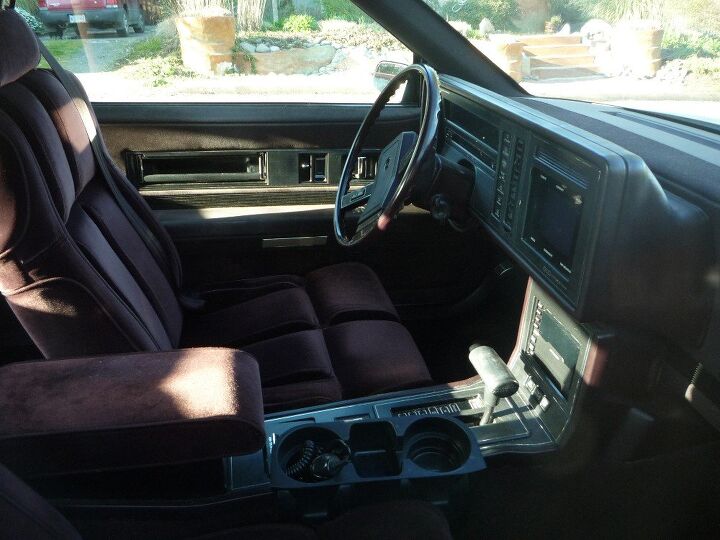
I drove an ‘87 Riviera to 290k miles. While I agree that the styling was too understated and similar to cheaper products, the Riviera had a lot of good qualities. The ride with the rear air struts is smooth, controlled, and not at all “floaty” like traditional Buicks. The seats are exceptionally comfortable. The engine, unlike what the article states, was not shared with the Somerset. The only engine available was a multipoint fuel injected 3.8 V6 with distributorless ignition, about as high tech as GM got in 1986. While not the smoothest, it provided good low end torgue, 150hp, and decent fuel economy. I averaged about 23mpg, getting up to 27mpg on some trips. The same engine was used in the LeSabre and Park Avenue. While the touchscreen control center in the dash drew mixed reviews, I loved it and could access most of the functions without even looking. Similar screens (now LCD) were offered in other company’s luxury cars a decade or more later. The size was quite practical for a personal luxury coupe, being comparable to the foreign models that everyone argues GM should have copied. Still the size and bland styling offered too little for customers being asked to pay top dollar and wanting something that would stand out.
ponchoman,
By overhang, we mean past the front or rear wheel line. Yes, the 1986-88 didn’t have much, but then GM extended the overhangs to make the cars look longer. It’s the proportional amount of overhang that looks excessive; yes some of the old cars may have had more, but they also were more balanced overall.
mburm201,
The 3.0 V6 in the Somerset had a shorter stroke, but otherwise was the same “basic engine”. And a total of 15 hp difference: 125hp in the Somerset; 140 in the ‘86 Riviera. Not a good return on the extra cost, eh?
Vega next. My first new car 1974 Vega wagon. POS. And the reason I never have and never will buy a GM car.
ohhh baby…great topic!
I always thought the last generation Riviera (95-99) was a gorgeous vehicle. It still is.
Clearly, there are many choices for the GM Deadly sins series. For a more modern version, try the Saturn Ion…the car that ruined America’s hopes for Saturn, which was actually a great concept (and a good car) when first started.
This class is just too depressing. Where’s the drop and add line ? I think I’ll take the class in Seppuku 101.
I only vaguely remember these cars from high school. I wanted an Audi 4000Q at the time.
What’s funny to me is that I can see the difference between the two cars. Wheels, handles, trim, discrete badging, etc. I’ve been so well trained by Audi and BMW that I can see why you can charge more for, say, a clear side blinker rather than a yellow one.
Alex Taylor did a much more effective Problem with GM Fortune article in the late ’80’s. He too used the the N-Body (Regal) E-Body(Rivera) comparo, but his was a nose-to-nose picture of a Cadillac (E) Eldo and an Olds (N)Calais spread over two pages with a challeng to readers to pick the $13K versus the $30K offering. At the same time, Lincoln was ridiculing GM’s look-alike luxury sedans with an ad that had mass confusion at a valet parking stand due to look-alike Electras, 98’s, and Deville’s versus a Town Car.
GM’s “miss” in downsizing was nothing, if not consistent with their persistent belief that there was no money to be made in smaller cars.
The E Bodies also had pretty crappy quality.
My mom had a Cutlass Calais from that vintage and I was looking at a Toronado Trofeo on the showroom floor. I worked for DuPont at the time and was shocked at how many visible paint defects the Toronado had. The car was like a textbook on paint problems: orange peel, fisheyes and even debris in the paint.
I have a couple suggestions for your “Deadly Sin” series (although they may be too far back in the past for your taste):
The late 70’s: Putting Chevy engines into Olds Cutlass bodies w/o telling the customers; only ‘fessing up when a lawsuit was filed….
The really late ’70’s: The Olds Diesel 350; a (way too cheaply) converted gasoline engine…
Around 1980: The infamous Cadillac V8-6-4. ‘Nuff said…
The revived ‘95 Riv is one of GM’s best styled cars. Ever. Period. Definitely the high water mark of the 80’s and 90’s styling wise. The original ‘64 was awesome, but for my money it’s the ‘95 by a mile(and I would like to add that the Olds Aurora, which the ‘95 Riv was based on, was also a stunner, looks-wise, and 15 years later still looks contemporary).
I have a friend who bought one of these new, and she will likely die before she parts with it. “They’ll have to pry my cold dead hands from this car.” was how she put it. Her’s is pearlescent white with a white leather interior. It’s absolutely freakin’ beautiful.
Sad, isn’t it? When GM did it right, they really did it right. Why couldn’t they ever learn from that?
TomH:
I think Time or one of the other mainstream news rags did a story with cover photo of the mid-80s GM cars, all maroon, that were difficult to distinguish from each other. Tried to find it but failed.
tirving: It was Fortune, and the magazine used the Celebrity/Ciera/Century/6000 on the cover.
So if you were a Buick customer in 1986 you could either buy a Grand National or this Riviera.
I think that the top picture is really a Calais, not a Somerset. But I digress.
These cars are pathetic. In GM’s defense, though (gad, did I really say that?) these cars were being put on paper shortly after the birth of CAFE regulations. GM’s decision to comply with the regs so as not to pay any gas guzzler taxes can be second-guessed today, but these cars are as much a product of the government as they are GM. Also, it wasn’t just GM. Remember the Chrysler K-based New Yorkers of this era? Yeeeech!
Recall that the only decent larger cars of the mid 80s were those from the 70s that the companies couldn’t kill because demand rebounded so stongly after 1983. Ford picked up a lot of GM customers with Crown Vics and Grand Marqs in the 80s. Still, they were pathetically underpowered due to CAFE.
Back in ‘86, my friends mom had the Rivera. At the time, it was pretty fantastic. It had a touch screen for HVAC, etc., that was incredibly high tech for the day. Of course it was an actual tube in the dash, but it worked.
I moved right after that, so I’m not sure how it worked out for her. But new, it was a pretty impressive ride.
This family of vehicles (Buick or Olds) from the product run are alive and not-so-well here in Flyover Country as the car of choice (or only car we can afford) of the region’s TT. I’m constantly amazed that whenever I see one on the road, it’s not shedding parts like a zombie.
Next up? As mentioned, the Vega’s a good one but I’d posit that the Chevette is a better case study. Like the POS shown here, many people who today wouldn’t be caught dead in a GM vehicle can trace that antipathy to a Chevette. Or a Fiero or most likely anything else GM built during the entire decade of the 80s.
Never say never tho. I owned a 1970 Maverick, another POS and swore I’d never own a Ford again. I eventually purchased a 93 Explorer and it’s been a great vehicle.
Paul,
You can point to a lot of cars that were big disasters for GM including Olds Diesels, Chevmobiles, Azteks, Cimmarons, Vegas, Caprices, Avelcades, and a whole bunch of others, but as this purports to be a list of GM’s Deadly Sins, I think you missed the opportunity to lead off with the #1 Sin, Hubris.
For too long, decades actually, GM acted as if they were the only game in town and that they were the only guys that really mattered. How else do you explain continuing the practice of pattern bargaining oblivious to the increasing presence of non-union automotive assembly, or failure to seize the opportunity afforded by the VRA and instead raising prices dramatically in the face of hobbled competition. (Ironically creating a price umbrella for their import competitors and a favorable economic climate to incubate foreign manufacturers setting up shop in the US and moving upmarket into the luxury and truck watersheds of GM profitability.)
Hubris allowed the GM board to sleep through the loss of over half their market share and blame their circumstances on external forces right up to and through the bankruptcy filing. In the past 7-8 years, hubris helps explain how Maximum Bob could claim that GM had “world class” (no excuses) products while upstart Hyundai was quietly waxing them in product and marketing innovation. It was hubris that enabled Rick Wagoner to do his best “steady as she goes, keep doing what we’re doing lines for GM NA” so it’s safe to say that he either didn’t see it coming or was incapable of dealing with it if he did. (As defined by our former President, i.e. whatever “it” is.)
Finally, the best evidence that Hubris is #1 is found in Wagoner & his board successfully diminishing what was once “the standard of excellence” down to such a wretched mess that a team with zero automotive experience feels capable of calling the big moves and dictating the strategic direction for the company.
So, when can we expect the next installment?
I’m pretty certain these cars always came with a heavy factory smoked-in scent. That interior just sucked up cigarette smoke like none other.
@carguy622
How many luxury coupe buyers want a bigger trunk?
(jalopnik mode on)The ones who need to carry more dead hookers (jalopnik mode off)
Seriously, this looks like the model Car & Driver had as a long term test car that GM repo-ed after they gave it a bad review. Proving that stupidity has a long history at GM. My mother had GM stock for years that was a gift from her grandfather and the anger in her voice when she said “they had a 54% market share in 1962″ says it all. That and the fact that the only GM car she ever bought was a Saturn.
My girlfriend had a used Riv. Hers was the revised version with the extended trunk. What a difference. The problem with the Riv in the pic is that the trunk abruptly ends. There’s no style to it like you would expect for near lux coupe. The revised one was much better looking and all in all it wasn’t a bad car, but I don’t understand why GM didn’t know right off the bat that that chopped off trunk was hideous. Who approved this design?
Monty,
have to agree with you. Last generation Riv and 1st generation Aurora still look good today. And friend of mine ‘98 Aurora is very reliable. Only thing changed being radiator. He’s very handy with tools, but prefers to pay to mechanic to change his spark plugs, as two of them are very hard to reach.
Other GM deadly sins:
The Vega aluminum 4 banger
The Caddy 8-6-4 in 1981
The Caddy HT 4100 V8 with 125 HP to move around 2 ton full sized sedans and coupes in 1982
The Olds Diesel of 1978-1985 vintage
The Buick 3.8/4.1 liter carbureted V6 of 1975-1987 vintage that went in everything from Monzas to Cadillac Fleetwood Broughams
The tech-IV 2.5 clatterbuckets that went in 1982 Camaros and Firebirds with but 92 HP.
Installing Chevy engines in Olds Delta 88’s, Pontiac engines in Buicks and so on
This is the era I grew up in and it must be noted than much of what is seen here was not as big a deal back then as it is now. Other manufactueres were installing low calorie V6 and V8 engines in there big cars. Other manufacturers were experimenting with different engine technologies. But it was GM that produced the most numerous follies and made the wrong predictions about consumer buying habits. Even with all the mistakes I still really enjoyed growing up with the 60’s, 70’s, 80’s and 90’s cars. Each car manufacturer had a nice full line up of coupes, convertibles, compact/mid size and full sized sedans, station wagons and trucks. They offered vibrant interior color schemes which are totally lacking today, tons of choices when it came to options and engines/trannys etc and had oodles of character. There were highs and lows galore but it was always interesting. Todays cars sadly lack much of the magic of those time eras.
Next column:
1988 Chevy Lumina/Olds Cutlass Supreme/Buick Regal/Pontiac Grand Prix
Let’s compete with the Taurus and Japanese models by offering ONLY 2-doors, crummy interior styling, choking door belts, and an underpowered engine from who knows when!!!
When they lost the family car market, they lost the game. The SUV boom covered up a lot of sins but the writing was always on the wall.
This article makes it no surprise that Portfolio voted Roger Smith one of the worst CEOs of all time.
http://www.cnbc.com/id/30502091?slide=9
Sorry Paul, you are right about the 140hp V6 in the ‘86 Riviera. It went up to 150 in ‘87. Still, while the 3.8 only offered 15 more horsepower than the 3.0, it offered 50 more pound feet of torgue (200 vs. 150), making it a good fit in heavier cars like these.
“Seriously, this looks like the model Car & Driver had as a long term test car that GM repo-ed after they gave it a bad review.”
That sounds like an interesting story. Has anyone written anything on that?
Save a couple of deadly sins for –
>Paying H. Ross Peugeot ;-] to leave after buying EDS, and
>Paying Fiat $2Billion to go away after signing contracts to BUY them.
The long-term test car was a quality and reliability nightmare. If I recall correctly, GM took the car in a huff before the review could even be finished.
The early and mid-1980s were a very bad time for GM. I remember Car and Driver long-term tests of the new Camaro and Corvette, and both cars experienced several major, serious mechanical malfunctions.
I’m not taking about a malfunctioning idiot light or an annoying rattle under the dashboard – with one car, the entire rear axle had to be replaced!
I remember reading somewhere that early on in the planning process, the ‘86 E-bodies were to have been even smaller, three-cylinder models. But I guess gas prices started to drop, and they were made slightly larger and fitted with larger engines, but the econo-car styling remained.
So I guess things could have been worse, but that’s not saying much.
jpcavanaugh :I think that the top picture is really a Calais, not a Somerset
It really is a Somerset.
TomH:as this purports to be a list of GM’s Deadly Sins, I think you missed the opportunity to lead off with the #1 Sin, Hubris.
I’ve written a number of GM Death Watches here over the years on that subject. This is Curbside Classics; we stick to the actual cars, not mindset.
Thanks for the various suggestions. GM’s Deadly Sins will appear from time to time, as I am inspired/revolted by what I find parked on the street.
You people realize this was 23 friggin years ago, and you are picking at it like a fresh scab? The demo on this site definitely skews old (and bitter)…
Captian Tungsten,
Old: yes (can’t help that); bitter: no, because I never bought a GM product. But I suppose those that did and ended up with a POS have reason to be bitter. It’s not possible to buy such shitty cars anymore, fortunately. But those that went through that era need (and deserve) a support group to work through the PTSS. Thanks for putting up with us.
Am I the only one who giggled when Mr. Niedermeyer mentioned the “boners available to [him]“? God, I’m immature.

I’ve seen a few of these around the Northeast a few years ago. I could never get the styling. Looks like something I drew as a kid.
You people realize this was 23 friggin years ago, and you are picking at it like a fresh scab?
Uhm no Captain… not picking a scab. Performing an autopsy on a dead automotive giant.
The indications are death by suicide.
Throw the Cadillac Catera in there with the rest of them.